Jueves, 1 de octubre de 2026




EUROPEAN INDUSTRY
The costs of German complacency: a disjointed Europe, and Spain on China’s radar
According to a recent report from the Centre for European Reform think-tank, Germany’s economic paralysis is no temporary slump but a structural crisis in the path of China’s commercial steamroller. While Berlin has misdiagnosed itself, obsessed with energy prices and bureaucracy, 'China Shock 2.0' has been demolishing its external competitiveness. The vacuum left by the sputtering European engine is pushing Spain to rewrite its alliances, running the risk of trading its historical dependence on Germany for a new technological subordination to China.

Agenda Pública
Europe once organized its economic equilibrium around an apparently stable scenario in which Germany would produce and export, sustaining the continent’s industrial core, while the other economies orbited around that center with varying degrees of dependence. That model, which worked in the past to a variable extent, is now entering into crisis.
Although Germany has been mired in an economic slowdown for years, the main problem is not in Berlin. The greatest concern is that Europe’s manufacturing heartland is losing competitiveness to China. Teresa Ribera, Vice-President of the European Commission, recently referred to this trend in Agenda Pública, describing China as "an industrial power growing at breakneck speed." If Germany fails to adapt to this new global industrial environment, the consequences will range far beyond its borders, fully reaching other countries like Spain, which could wind up trapped in a new relationship of technological and industrial dependence on Beijing.
The debate in Germany remains obsessed with energy prices, European bureaucracy, and climate regulation. The new report dismantles much of that narrative and points out that other European countries subject to exactly the same regulatory framework (including the Netherlands, Poland, and Denmark) have grown much faster since 2019.
Within the wide array of consequences, among the most worrying relates to the workplace. The European giant could lose more than 400,000 jobs linked to its export relationship with China. Why? Because the industrial complementarity between the two countries is finished.
During the first Chinese shock, after Beijing’s entry into the WTO in 2001, Germany profited enormously by selling machinery, vehicles, and related goods to a Chinese economy still in need of advanced technology imports. Today, China Shock 2.0 works exactly the other way around: China no longer needs much European engineering but competes directly against it.
China absorbs global demand without opening its domestic market in an equivalent way, and its expansion has been driven by three major factors:
The IMF estimates that Chinese State subsidies are equivalent to 4.4% of its GDP, around $800 billion per year. At the same time, excess domestic savings and weak domestic consumption force industrial overcapacity to be exported abroad. The result is increasing pressure on strategic European sectors, from automotive and machinery to renewables and clean technologies.
In that regard, the electric vehicle has become the most visible symbol of change. Europe assumed for years that it would have enough time to adapt to electrification, but China reached enormous export capacity ahead of schedule. Estimates that projected exports of 10 million vehicles by the end of the decade were already obsolete by 2025.
Meanwhile, the United States has radically tightened its trade policy. The Trump administration has raised tariff barriers and reduced incentives for European vehicles, closing off one of the few markets where Germany could still partially offset its losses in Asia. Consequently, Europe and China have entered into direct competition for the rest of the global market.
Faced with that situation, the prospect of Chinese investments in Europe’s green technology and energy sectors invites reconsideration of how and where Spain’s efforts should be directed.
.png)
Chinese companies like CATL, Chery, and Envision are looking to use Spanish territory as a production platform for the European market. Spain’s attractiveness has three facets: 1) relatively competitive labor costs; 2) full access to the single market; and 3) European subsidies and an urgent political need to attract industrial investment.
In the short term, that strategy can generate both employment and manufacturing activity. But based on the accumulated experience of Europe, an urgent question arises: Who will really control the added value of technology?
While many European capitals are hoping that an influx of Chinese manufacturers will assist the revitalization of weakened sectors, the data hint at a much less symmetrical dynamic. Chinese investment in Europe remains relatively limited – at around €10 billion in 2024 – and extremely selective, concentrated mainly in knowledge-intensive and high value-added industries.
Thus the objective has not been to create new and complete industrial chains in Europe; instead, the dominant pattern has been to acquire existing technological capabilities. The report cites research on more than 160,000 companies in 159 countries and identifies a particularly significant fact: around 41% of Chinese foreign investments between 2012 and 2021 were directed to Europe and concentrated precisely in knowledge-intensive sectors.
The report also warns that this experience should temper European expectations about future Chinese greenfield investments in batteries or electric cars. Historical evidence again indicates that Chinese companies will tend to protect their key technologies, even when producing within Europe.
Nor have the 27 EU Member States been employing all their available tools. China built its automobile industry using mechanisms that Europe barely considers today: high tariffs, mandatory joint-ventures, restrictions on foreign ownership, and strong demands around industrial location. Beijing used access to markets as a way to force Western multinationals to transfer technology and productive capacity. Europe, on the other hand, continues to offer one of the world’s most open markets, but without equivalent instruments for industrial negotiation.
The risk for Spain is especially evident. The country can attract investment and factories, but if it fails to develop its own technological capacity and a coordinated industrial policy at the European level, it could be reduced to peripheral functionality within value chains controlled from Asia.
Spain still has room to take advantage of some aspects of the industrial reconfiguration now underway. But there’s a fundamental difference between reindustrialization and becoming an assembly platform dependent on foreign technology.
German complacency in the face of China Shock 2.0 is no longer just a German problem. It is redefining the industrial equilibrium of the whole of Europe, and in this case, Spain is not on the periphery. The country is moving directly into the center of Europe’s geo-economic chessboard, with all the risks and opportunities that such a move entails.
Although Germany has been mired in an economic slowdown for years, the main problem is not in Berlin. The greatest concern is that Europe’s manufacturing heartland is losing competitiveness to China. Teresa Ribera, Vice-President of the European Commission, recently referred to this trend in Agenda Pública, describing China as "an industrial power growing at breakneck speed." If Germany fails to adapt to this new global industrial environment, the consequences will range far beyond its borders, fully reaching other countries like Spain, which could wind up trapped in a new relationship of technological and industrial dependence on Beijing.
"The German export model is no longer competing against an emerging economy in need of European technology, but against an industrial superpower capable of diplacing Europe"In a report published this month by the Centre for European Reform (CER), entitled China Shock 2.0: The Cost of Germany’s Complacency, Sander Tordoir and Brad Setser warn severely and seriously of the magnitude of the Chinese challenge for Europe. The central thesis developed by the authors is that the German export model is no longer competing against an emerging economy in need of European technology, but against an industrial superpower capable of distancing Europe from China, from third markets, and progressively from the European market itself.
Germany no longer understands its own crisis
Despite numerous and diverse warnings, the first problem has been Germany’s misdiagnosis of itself. Neither the past government of Olaf Scholz nor that of the current Chancellor, Friedrich Merz, has proven able to correctly identify the country’s economic and industrial problems.The debate in Germany remains obsessed with energy prices, European bureaucracy, and climate regulation. The new report dismantles much of that narrative and points out that other European countries subject to exactly the same regulatory framework (including the Netherlands, Poland, and Denmark) have grown much faster since 2019.
"About 40% of Germany’s economic deterioration derives directly from the loss of foreign markets"The fundamental difference is elsewhere: exports. According to CER calculations, approximately 40% of Germany’s economic deterioration derives directly from the loss of foreign markets. Another 40% is related to the energy shock suffered since the break with Russia. Therefore, only about 20% of the downturn responds to internal factors such as bureaucracy or weak domestic demand.
Within the wide array of consequences, among the most worrying relates to the workplace. The European giant could lose more than 400,000 jobs linked to its export relationship with China. Why? Because the industrial complementarity between the two countries is finished.
During the first Chinese shock, after Beijing’s entry into the WTO in 2001, Germany profited enormously by selling machinery, vehicles, and related goods to a Chinese economy still in need of advanced technology imports. Today, China Shock 2.0 works exactly the other way around: China no longer needs much European engineering but competes directly against it.
China's export machinery
The current dynamic is quickly tilting into dangerous imbalance. While exports from China are growing at a much faster rate than world trade, its manufacturing imports have remained virtually stagnant for a decade.China absorbs global demand without opening its domestic market in an equivalent way, and its expansion has been driven by three major factors:
- Massive industrial subsidies.
- Artificially depressed domestic demand.
- A persistently undervalued exchange rate.
The IMF estimates that Chinese State subsidies are equivalent to 4.4% of its GDP, around $800 billion per year. At the same time, excess domestic savings and weak domestic consumption force industrial overcapacity to be exported abroad. The result is increasing pressure on strategic European sectors, from automotive and machinery to renewables and clean technologies.
In that regard, the electric vehicle has become the most visible symbol of change. Europe assumed for years that it would have enough time to adapt to electrification, but China reached enormous export capacity ahead of schedule. Estimates that projected exports of 10 million vehicles by the end of the decade were already obsolete by 2025.
Meanwhile, the United States has radically tightened its trade policy. The Trump administration has raised tariff barriers and reduced incentives for European vehicles, closing off one of the few markets where Germany could still partially offset its losses in Asia. Consequently, Europe and China have entered into direct competition for the rest of the global market.
Spain enters the Chinese equation
In this new scenario, Spain is in a position to gain considerably, but it also faces real risks. The Spanish economy has been trying to strengthen its industrial weight within Europe, and today it has an opportunity for reindustrialization, with two central axes: the energy transition and the electric vehicle.Faced with that situation, the prospect of Chinese investments in Europe’s green technology and energy sectors invites reconsideration of how and where Spain’s efforts should be directed.
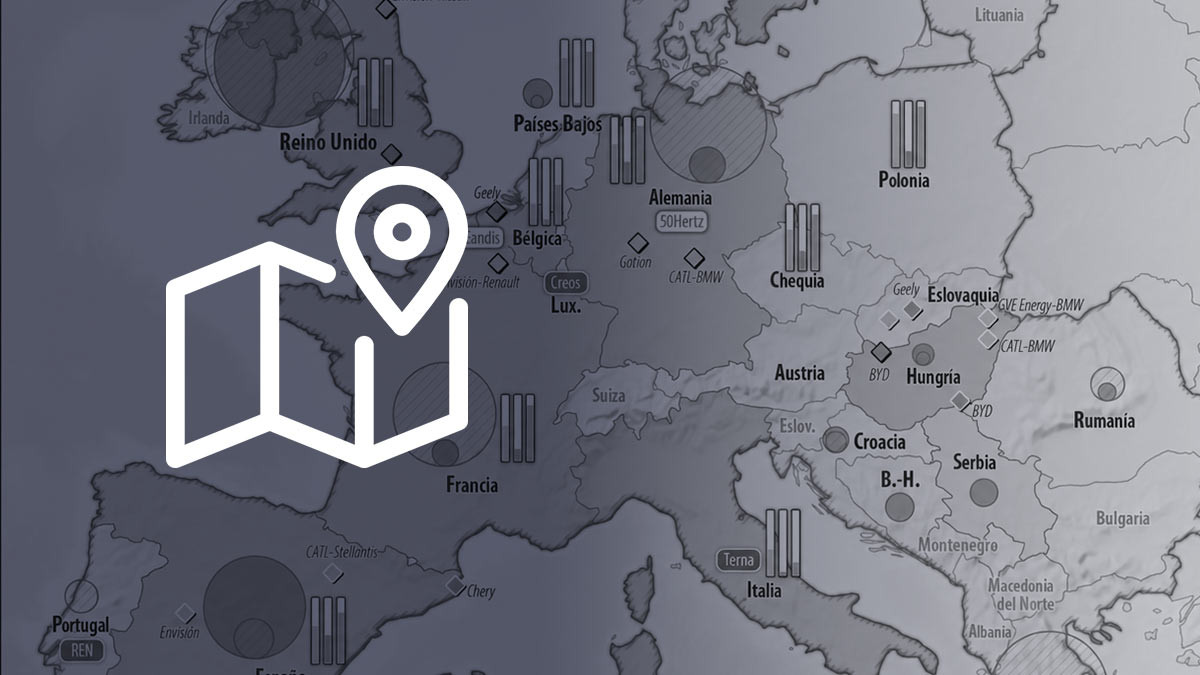
Hover over the map to zoom. European distribution of Chinese investments in green technology and energy sectors. Spain is among the main destinations for projects linked to batteries, electric cars, and industrial transition. | Map: Cassini
As the Cassini map reveals, Spain is fast becoming one of Europe’s top destinations for Chinese industrial projects linked to batteries, electric cars, and low-carbon technologies.Chinese companies like CATL, Chery, and Envision are looking to use Spanish territory as a production platform for the European market. Spain’s attractiveness has three facets: 1) relatively competitive labor costs; 2) full access to the single market; and 3) European subsidies and an urgent political need to attract industrial investment.
In the short term, that strategy can generate both employment and manufacturing activity. But based on the accumulated experience of Europe, an urgent question arises: Who will really control the added value of technology?
The myth of Chinese technology transfer
The notion that Chinese foreign direct investment through technology transfers can act as a mechanism for Europe’s industrial rescue is now being strongly challenged by empirical evidence. According to the CER report, those expectations are excessive in two ways: first, in an optimistic view of the strategic intentions of Chinese companies; and second, in pessimism around Europe’s industrial capacities.While many European capitals are hoping that an influx of Chinese manufacturers will assist the revitalization of weakened sectors, the data hint at a much less symmetrical dynamic. Chinese investment in Europe remains relatively limited – at around €10 billion in 2024 – and extremely selective, concentrated mainly in knowledge-intensive and high value-added industries.
Thus the objective has not been to create new and complete industrial chains in Europe; instead, the dominant pattern has been to acquire existing technological capabilities. The report cites research on more than 160,000 companies in 159 countries and identifies a particularly significant fact: around 41% of Chinese foreign investments between 2012 and 2021 were directed to Europe and concentrated precisely in knowledge-intensive sectors.
"Acquired European companies have experienced a drop of roughly 25% in return on assets, plus stagnation in their patenting activity"Given that figure, we can focus on some post-acquisition effects. Acquired European companies have experienced a drop of roughly 25% in return on assets, plus stagnation in their patenting activity. Meanwhile, Chinese parent companies have increased their volume of patents granted, which have tripled in general terms and quadrupled in the case of State-owned companies. The authors of the report contend that this isn’t simply due to market decisions. Rather, it suggests that many Chinese companies willingly accept lower financial returns, because their true strategic goal is to speed the absorption of technology, engineering capabilities, and industrial know-how into their home territory. In other words, the dominant logic isn’t technological diffusion from China to Europe, but precisely the opposite.
The report also warns that this experience should temper European expectations about future Chinese greenfield investments in batteries or electric cars. Historical evidence again indicates that Chinese companies will tend to protect their key technologies, even when producing within Europe.
Nor have the 27 EU Member States been employing all their available tools. China built its automobile industry using mechanisms that Europe barely considers today: high tariffs, mandatory joint-ventures, restrictions on foreign ownership, and strong demands around industrial location. Beijing used access to markets as a way to force Western multinationals to transfer technology and productive capacity. Europe, on the other hand, continues to offer one of the world’s most open markets, but without equivalent instruments for industrial negotiation.
European ingenuity
Consequently, the problem for the European continent is that it continues to confront the challenge of China with insufficient tools. Brussels has multiplied trade investigations and sectoral tariffs, especially against Chinese electric vehicles – that much is true. But those measures remain slow, fragmented, and limited compared with systemic distortion from the entire Chinese economy."The country can attract investment and factories, but if it fails to develop its own technological capacity, it could be reduced to peripheral functionality"Moreover, Germany is still partially curbing a more aggressive European industrial policy, for fear of trade retaliation and in hopes of preserving access to the Chinese market. Paradoxically, France and certain sectors of the European Commission have begun to make a clearer case for Buy European policies, local content requirements, and mechanisms of strategic protection.
The risk for Spain is especially evident. The country can attract investment and factories, but if it fails to develop its own technological capacity and a coordinated industrial policy at the European level, it could be reduced to peripheral functionality within value chains controlled from Asia.
Deindustrialization and irrelevance
The great European illusion was to think it could simultaneously combine absolute trade openness, external energy dependence, and strategic autonomy. That balancing act is now over. The crisis in Germany demonstrates that even Europe’s leading industrial power can quickly lose ground to a competitor backed by continental scale, massive subsidies, and strategic planning.Spain still has room to take advantage of some aspects of the industrial reconfiguration now underway. But there’s a fundamental difference between reindustrialization and becoming an assembly platform dependent on foreign technology.
German complacency in the face of China Shock 2.0 is no longer just a German problem. It is redefining the industrial equilibrium of the whole of Europe, and in this case, Spain is not on the periphery. The country is moving directly into the center of Europe’s geo-economic chessboard, with all the risks and opportunities that such a move entails.
Ahora en portada
1 de octubre de 2026
Noticias relacionadas
Hace 19 semanas
The geopolitical balance sheet: financial decision-makers in the new international order
Hace 22 semanas
Spain weighs the German plan for EU deregulation: offer relief to SMEs, or protect their social model
Hace 21 semanas
Bruno Maçães, writer: "The generation in power in Europe is still living in 1989"
Lo más leído