Domingo, 18 de octubre de 2026




LÓPEZ PLANA'S EUROPEAN COMPASS
What can Alberto Núñez Feijóo learn from Giorgia Meloni?
Marc López Plana, editor and director of 'Agenda Pública', analyzes how Giorgia Meloni has achieved what Alberto Núñez Feijóo aspires to: uniting the right without fractures, holding the center while containing radicalism, and exercising strong leadership. "Meloni has turned pragmatism into her best strategy for power," writes López Plana.

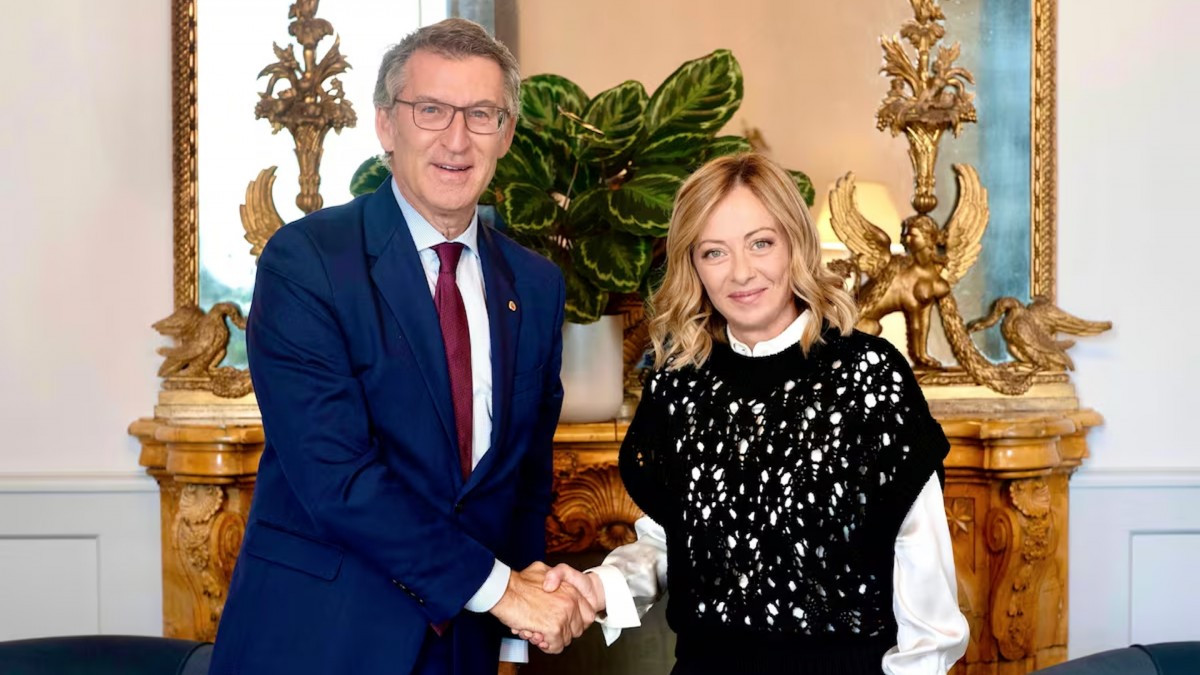
Marc López Plana analyzes Giorgia Meloni’s formula and Alberto Núñez Feijóo’s leadership.Italian's Government
Three years ago, Giorgia Meloni assumed the presidency of Italy’s Council of Ministers, becoming the first woman ever to hold that post and the first European leader with post-fascist roots to govern a major economy. At that time, many feared that her rise would instigate clashes with Brussels and destabilize the Italian political system. However, after three years in office, Meloni has quietly consolidated power. Her Fratelli d’Italia remains the main political force; her coalition partners appear to be under control, with no glaring fractures; and markets continue to finance the country at reasonable rates.
France offers an example of a volatile center and strong radical leadership. Emmanuel Macron has had to sway between center and right with the agility of a tightrope walker. When Marine Le Pen was threatening victory, he hardened his agenda on security and immigration to attract conservative voters. When Le Pen lost strength, he returned to moderate, technocratic Europeanism. France shows that the political center is not a stable plateau but rather a balance temporarily struck amid forceful extremes, where stronger populism means fewer chances at moderation. Strange things are happening in France – just read Ne rien céder by Bruno Retailleau, leader of Les Républicains, who paints radical Islam as an accelerant for social and political instability.
Germany, meanwhile, offers an example of institutional restraint. Since the crisis of the FDP and the weakening of the Social Democrats, the CDU has dominated the political center without close competitors. Meanwhile, the AfD has established itself as the second-strongest national force – and the first in some eastern Länder – with solid leadership at the local level and an increasingly broad social base. Although historical memory and Germany’s role in Europe have restricted a radical turn, the continued rise of the hard right has brought unprecedented tensions to the federal system. Pressure from a young and conservative electorate could push the CDU toward fiercer competition on its right flank, upsetting the balance that has fostered political stability since German reunification. The question of whether to forge a pact with the AfD is now being very intensely debated within the CDU.
In short, the European right is no longer abstractly debating between moderation and radicalization: today it’s a matter of calibrating strategies in response to the political environment, one’s competitors, and positioning on the left. The Italian experience can be seen as a benchmark: Meloni has shown that strong and pragmatic leadership can redefine the capacity of the right and reshape the political map. For conservative parties in other countries, the question is one of how to replicate that balance without losing legitimacy – or losing control of the political space.
In that context, Manfred Weber, president of the European People’s Party, must meet the challenge of keeping an increasingly diverse political 'family' cohesive. He must balance, on the one hand, those sectors wanting tactical reconciliation with the radical right and, on the other, the need to preserve democratic credibility and the EPP’s central role in Europe’s institutions. In order to compete in areas like security, migration, or identity without assuming the extreme right’s anti-liberal logic, Weber has pursued a strategy of 'flexible containment'. But the line between container and contained has become increasingly blurred. It is here that Feijóo can play a key role and serve as a determining factor for Europe’s center-right, thanks to the PP’s weight in the EPP group within the European Parliament.
"Meloni has shown that it’s possible to occupy the center-right and the radical right simultaneously, without isolating her nation or sparking an institutional crisis"According to Bill Emmott, Meloni’s success relies on an unusual mix: a brand of identity nationalism compatible with European pragmatism and technical governance. Meloni has centralized her power without giving in to extreme clientelism, maintaining respect for institutions while normalizing a political project once deemed radical. She has shown that it’s possible to occupy the center-right and the radical right simultaneously, without isolating her nation or sparking an institutional crisis. This balance of ideology and pragmatism makes Italy a lab for analysis of today’s European right: Meloni has managed to harmonize leadership, technical management, and national identity; other countries facing even more complex situations might learn from her experience.
Center-right across Europe
In Western Europe, conservative parties operate within a 'variable geometry' defined by three conditioning factors: the existence of a viable political center, the relative strength of leadership of radical factions, and the degree of moderation on the left. The combination of these factors determines whether the right-wing will be radicalized, hold the center, or be trapped in an intermediate void.France offers an example of a volatile center and strong radical leadership. Emmanuel Macron has had to sway between center and right with the agility of a tightrope walker. When Marine Le Pen was threatening victory, he hardened his agenda on security and immigration to attract conservative voters. When Le Pen lost strength, he returned to moderate, technocratic Europeanism. France shows that the political center is not a stable plateau but rather a balance temporarily struck amid forceful extremes, where stronger populism means fewer chances at moderation. Strange things are happening in France – just read Ne rien céder by Bruno Retailleau, leader of Les Républicains, who paints radical Islam as an accelerant for social and political instability.
Germany, meanwhile, offers an example of institutional restraint. Since the crisis of the FDP and the weakening of the Social Democrats, the CDU has dominated the political center without close competitors. Meanwhile, the AfD has established itself as the second-strongest national force – and the first in some eastern Länder – with solid leadership at the local level and an increasingly broad social base. Although historical memory and Germany’s role in Europe have restricted a radical turn, the continued rise of the hard right has brought unprecedented tensions to the federal system. Pressure from a young and conservative electorate could push the CDU toward fiercer competition on its right flank, upsetting the balance that has fostered political stability since German reunification. The question of whether to forge a pact with the AfD is now being very intensely debated within the CDU.
"Vox party lacks the strength of leadership to represent a stable alternative, and Pedro Sánchez has been losing his power to seduce moderates"Spain offers an intermediate scenario. While the Vox party lacks the strength of leadership to represent a stable alternative, Pedro Sánchez has been losing his power to seduce moderates, although he still retains a portion of the left. Feijóo is trying to sustain his commitment to moderation despite a pressurized and polarized political space. On the Spanish right, the leadership factor is decisive. A few months ago, Francesco Giubilei (one of Meloni’s ideologues) opined to me that "the Partido Popular and Vox should consider the Italian model of right-wing unity" – but I can’t agree. Vox has allied itself with Orbán in Hungary, and that’s a red line not to be crossed. Feijóo needs to resolve his dilemma quickly: he can either be perceived as the next president of the government or as the popular leader who, through polarizing opposition, has favored the rise of Vox while giving wings to Díaz Ayuso. Sánchez is not the only divisive figure in Spain.
What's the next move?
Thus it can be said that spaces on the European right are being defined by structural conditions. Italy shows us that with skillful leadership, it is possible to absorb both centrist and radical voters, to consolidate power, and to maintain international credibility. France illustrates how the center can pull back when confronted with a populist threat, then recompose itself. Conditioned by its history, Germany shows resistance by the center in the face of radical pressure. Spain demonstrates the tensions of a consolidated ‘centerless’ system.In short, the European right is no longer abstractly debating between moderation and radicalization: today it’s a matter of calibrating strategies in response to the political environment, one’s competitors, and positioning on the left. The Italian experience can be seen as a benchmark: Meloni has shown that strong and pragmatic leadership can redefine the capacity of the right and reshape the political map. For conservative parties in other countries, the question is one of how to replicate that balance without losing legitimacy – or losing control of the political space.
In that context, Manfred Weber, president of the European People’s Party, must meet the challenge of keeping an increasingly diverse political 'family' cohesive. He must balance, on the one hand, those sectors wanting tactical reconciliation with the radical right and, on the other, the need to preserve democratic credibility and the EPP’s central role in Europe’s institutions. In order to compete in areas like security, migration, or identity without assuming the extreme right’s anti-liberal logic, Weber has pursued a strategy of 'flexible containment'. But the line between container and contained has become increasingly blurred. It is here that Feijóo can play a key role and serve as a determining factor for Europe’s center-right, thanks to the PP’s weight in the EPP group within the European Parliament.
Ahora en portada
17 de octubre de 2026
16 de octubre de 2026
Noticias relacionadas
Hace 50 semanas
¿Qué puede aprender Alberto Núñez Feijóo de Giorgia Meloni?
Hace 55 semanas
The three dilemmas facing France's moderate right wing
Lo más leído