Viernes, 16 de octubre de 2026




LÓPEZ PLANA'S EUROPEAN COMPASS
Spain facing Xi Jinping’s objective: Europe’s break with the United States
"When I arrived in Brussels, I realised that we don't know enough about China," warned Jamil Anderlini, POLITICO Europe's regional director, at the La Toja Forum. Spain, often seen as 'China-friendly', hardly debates strategic ports or Huawei. Strategy or ignorance? Our editor and director, Marc López Plana, concludes in his European Compass column that if Spain fails to approach "its relationship with Beijing in an informed, conscious and strategic way, particular interests will prevail over those of the State."

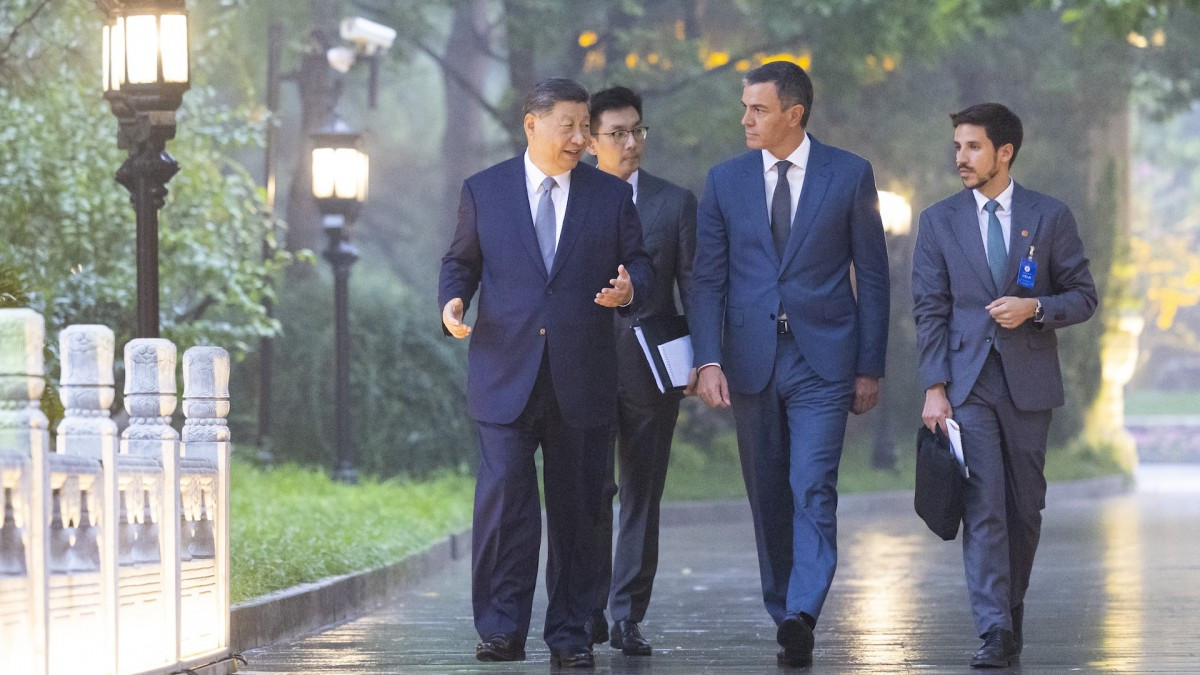
Pedro Sánchez walks alongside Xi Jinping during his previous visit to Beijing, in September 2024.Huang Jingwen / Xinhua News / ContactoPhoto
Last weekend at the La Toja Forum, a senior official of the European Commission told me that inside the EU, Spain is regarded as 'China friendly'. Debate had been anticipated on the transatlantic alliance and relations with the U.S. under Trump, and yet China was invoked in nearly every discussion. At one of the first sessions, Rajoy called China a dictatorship, while Zedillo warned against 'Chinaphobia'. Cognizant of what Carlos López Blanco referred to as "the elephant in the room," I reconsidered my approach to a roundtable I was set to moderate on Europe’s political future.
I think back to something else Jamil Anderlini said: "Xi Jinping’s ultimate goal is the rupture of Europe with the United States."
The 5G and 6G networks are not a luxury, but the very nervous system of our economies. If these are infiltrated, then everything else from banking to defense is left vulnerable.
Spain finds itself in a delicate position. Betting heavily on Huawei might cool cooperation with NATO and the United States, which have already vetoed the company. Betting against Huawei means assuming economic costs and losing opportunities in China, which represents the second-largest market on the planet.
The result is a half-hearted policy: diversification of suppliers, security audits, a little Huawei here, a little Ericsson there. But tensions persist.
Huawei serves as a symbol of the quietest battle currently raging: the question of who controls the invisible conduits on which our digital lives depend. Spain and Europe can pick the comfortable option of saving money today and paying tomorrow, or else the difficult one: investing in technological sovereignty and reducing dependencies.
In the new geopolitics, security is no longer measured only in tanks and planes but in antennas, chips, and fiber-optic cables – and in who has the power to turn them off.
This vacuum can easily become a strategic risk. Chinese investments in key sectors –ports, energy, technology – can lead to new dependencies that go relatively unnoticed until it’s too late. Moreover, thanks to the lack of a national discourse and a clear agenda, Spain has been losing influence in the definition of Europe’s overall policy toward China.
The challenge is twofold: to come to know China better, and to bring that knowledge to the centre of public debate. To do so, Spain needs to invest in specialized research, to promote relevant work by think-tanks and the media, to open spaces for political discussion, and to connect the concerns of companies with a national strategy.
Only through such an approach will Spain be able to transform itself from 'China friendly' (out of ignorance) to a country that manages its relations with Beijing in an informed, conscious, and strategic way. Failure to do so may result in the victory of private interests over those of the State.
Europe’s ignorance of China
Among the participants at my roundtable was Jamil Anderlini, regional director of POLITICO Europe, who relocated to Brussels after having spent 22 years in China. He raised what became the core topic of this week’s Compass: "When I arrived in Brussels four years ago, I realized that not enough is known in Europe about China.""Spain is 'China friendly' might derive from the weakness of our public debate, which has left us incapable of assessing Spain’s true relationship with China"That led me to wonder whether the notion that Spain is 'China friendly' might derive from the weakness of our public debate, which has left us incapable of assessing Spain’s true relationship with China and its possible effects.
The case of COSCO and the lack of debate in Spain
Who has ever wondered why the 51% acquisition of Noatum Ports (operator of container terminals in Valencia and Bilbao) by COSCO Shipping was never properly debated in Spain? COSCO is a Chinese enterprise belonging to the State-owned Assets Supervision and Administration Commission, the official organism that directly manages China’s large State-owned companies. According to EU rankings, Valencia is now the fourth busiest port in container traffic (after Rotterdam, Antwerp-Bruges, and Hamburg). Might it be that we in Spain don’t consider ports to be geopolitically strategic?Europe faces a "systemic rival"
In recent years, relations between Europe and China have undergone decisive changes. Once a strategic partner and trading ally, Beijing was deemed a "systemic rival" by the European Commission in 2019. This opened an intense debate in Europe’s main capitals on technological dependence, economic security, and the need to redefine the rules of globalization."Once a strategic partner and trading ally, Beijing was deemed a "systemic rival" by the European Commission in 2019"Berlin has been seriously debating its dependence on exports to China, which represent a critical percentage for its automotive industry. In 2022, Chancellor Olaf Scholz travelled to Beijing along with a large business delegation, and that visit piqued controversy over whether Germany was reproducing with China the same sort of dependency it maintained with Russia in the area of energy. Germany was also confronted by fierce political discussion over the entry of Chinese capital into the port of Hamburg. Meanwhile, France has placed China at the centre of its Indo-Pacific strategy as well as its policy for strategic autonomy. Italy took an unprecedented step in 2019 by signing onto China’s Belt and Road Initiative – a decision it reversed in 2023 after strong internal dissent and international pressure.
Public opinion in Spain: China has a better image than the U.S.
Spain, on the other hand, has stayed at the margins of this debate. If one examines the public and political discourse in our country, China seems a distant actor, relevant as a trading partner but hardly present as a strategic threat."According to a Metroscopia poll, 51% have a positive opinion of China compared to 44% negative. Its image is improving and has now surpassed that of the United States"At the beginning of September, the 'Pulso España' survey by Metroscopia was published, and I became even more worried: only 43% of Spaniards now have a positive opinion of the United States (20 points less than ten years ago), while 55% express a negative opinion. On the other hand, 51% of Spaniards have a positive opinion of China, compared to 44% negative. China’s image is improving and has surpassed that of the U.S. We might say that Trump prompted this decline, but we must ask ourselves (as Spaniards and Europeans) whether we should be thinking more about what we want than what we don’t happen to like.
Huawei and national security
Do we really prefer China to the United States? A senior German official from the Foreign Ministry told me a few days ago in Berlin about a red-alert triggered in the U.S. when Spain’s government awarded a contract to Huawei for the digital storage of communications intercepted legally by the National Police and Civil Guard."For Spain and Europe, the question is uncomfortable: what does it mean to depend on Huawei in terms of national security?"Technology is power. On today’s geopolitical chessboard, few companies hold as much power as Huawei. This Chinese firm doesn’t only manufacture phones: it designs the inner structure of the 5G and 6G networks through which circulate our data, transactions, and secrets. For Spain and Europe, the question is uncomfortable: what does it mean to depend on Huawei in terms of national security?
I think back to something else Jamil Anderlini said: "Xi Jinping’s ultimate goal is the rupture of Europe with the United States."
The Spanish and European dilemma
Washington has been warning us for years. China’s 2017 Law on National Intelligence obligates all Chinese companies to cooperate with the State. While there is no conclusive evidence of espionage, no evidence is expected in matters of national security: the mere possibility is worrisome enough.The 5G and 6G networks are not a luxury, but the very nervous system of our economies. If these are infiltrated, then everything else from banking to defense is left vulnerable.
Spain finds itself in a delicate position. Betting heavily on Huawei might cool cooperation with NATO and the United States, which have already vetoed the company. Betting against Huawei means assuming economic costs and losing opportunities in China, which represents the second-largest market on the planet.
The result is a half-hearted policy: diversification of suppliers, security audits, a little Huawei here, a little Ericsson there. But tensions persist.
Technology and sovereignty in the new geopolitics
Yesterday in Germany, Macron said the following: "We’ve been incredibly naïve, entrusting our democratic spaces to social networks controlled by big American businesses or big Chinese companies whose interests do not include the survival or proper functioning of our democracies.""Spain and Europe can choose the easy path —to save today and pay tomorrow— or the hard one: to invest in technological sovereignty and reduce dependencies"The problem certainly runs deep. Europe has only two serious alternatives to Huawei: Ericsson and Nokia, neither of which has the financial or political backing enjoyed by the Chinese firm. Our reliance on Huawei is also a consequence of years of technological disinvestment within Europe. With no champions of its own, the continent is now left to choose between Shenzhen and Silicon Valley.
Huawei serves as a symbol of the quietest battle currently raging: the question of who controls the invisible conduits on which our digital lives depend. Spain and Europe can pick the comfortable option of saving money today and paying tomorrow, or else the difficult one: investing in technological sovereignty and reducing dependencies.
In the new geopolitics, security is no longer measured only in tanks and planes but in antennas, chips, and fiber-optic cables – and in who has the power to turn them off.
Spain and China: strategy or ignorance?
Spain presents itself as 'China friendly', but the root of this apparent position may be less a strategy than the product of uninformed debate. The absence of academic, political, and media discussion around China has fostered a pragmatic attitude toward the Asian giant.This vacuum can easily become a strategic risk. Chinese investments in key sectors –ports, energy, technology – can lead to new dependencies that go relatively unnoticed until it’s too late. Moreover, thanks to the lack of a national discourse and a clear agenda, Spain has been losing influence in the definition of Europe’s overall policy toward China.
The challenge is twofold: to come to know China better, and to bring that knowledge to the centre of public debate. To do so, Spain needs to invest in specialized research, to promote relevant work by think-tanks and the media, to open spaces for political discussion, and to connect the concerns of companies with a national strategy.
Only through such an approach will Spain be able to transform itself from 'China friendly' (out of ignorance) to a country that manages its relations with Beijing in an informed, conscious, and strategic way. Failure to do so may result in the victory of private interests over those of the State.
En alianza con
Ahora en portada
16 de octubre de 2026
16 de octubre de 2026
16 de octubre de 2026
Noticias relacionadas
Hace 53 semanas
España ante el objetivo de Xi Jinping: la ruptura de Europa con Estados Unidos
Lo más leído