Sábado, 3 de octubre de 2026




FRANCE
Marine Le Pen: the beginning and the end of Rassemblement National?
Marine Le Pen's conviction for embezzlement has taken her party, Rassemblement National, by surprise, and it is now paying the price of hyper-personalisation around its leader, warns Giovanni Capoccia, Professor of Comparative Politics at Oxford University.
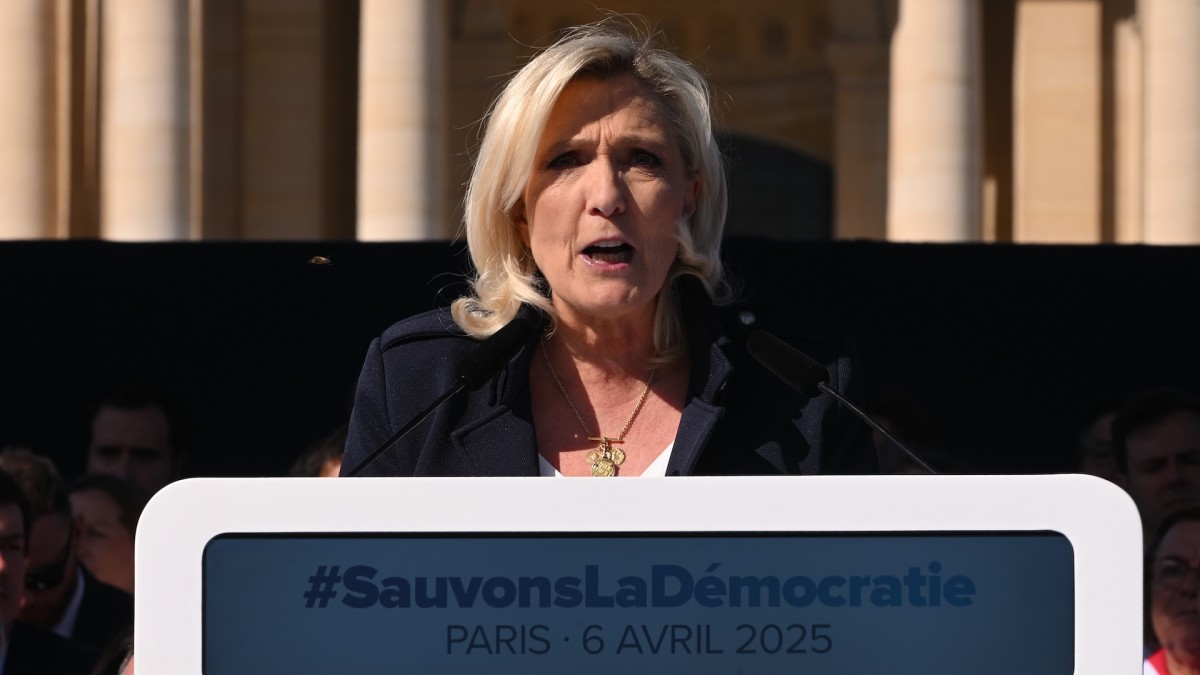
Marine Le Pen speaks during a demonstration in her support after her conviction above a banner reading 'Let's save democracy '. julien mattia / Zuma Press / ContactoPhoto
On March 31, Marine Le Pen was convicted by a Paris court for her role in orchestrating the systematic misuse of European Parliament funds over several years. She was sentenced to four years in prison—two of them suspended— €100,000 fine, and, most importantly, five years of ineligibility for public office, effective immediately.
In the days following the verdict, the fallout has exposed various structural weaknesses within Rassemblement National (RN), a party whose centralized and personalistic leadership under Le Pen appears to have stifled the capability to devise rational strategies.
The failure to devise an appropriate communication strategy was evident from the moment the verdict was read. Le Pen left the courtroom before the judge had finished delivering the sentence, and refused to speak to the press. That evening, during a prime-time interview, she claimed innocence and accused the judiciary of politically motivated persecution designed to block her candidacy in the 2027 presidential election—an attack she framed as an assault on French democracy itself.
At the same time, she attempted to preserve the carefully cultivated image of her party as respectable and law-abiding by accusing the judge in charge of the case of violating the rule of law through an unduly harsh sentence. She argued that she was targeted for her political prominence and her ideological views.
The fallout from the verdict also exposed shortcomings in the RN's organization. Le Pen called for a mass demonstration in Paris on Sunday, April 6—six days after the verdict—to show the RN's strength and popular support. But the chosen venue, Place Vauban near Les Invalides, has a maximum capacity of around 8,000 people—and even that was not filled. For a party polling at around 37%, the inability to mobilize even this modest number is telling. Again, it indicates that the RN was caught off guard and unprepared for a moment that, given the decade-long investigation and the prosecutor's earlier request for immediate ineligibility, should have been anticipated.
Finally, the most damaging revelation may be the party's lack of alternative leadership. Le Pen, like her father before her, views herself as the RN's only viable presidential candidate. Her protégé, Jordan Bardella, 29 years old, president of the party, poses no real challenge: his appeal lies in his youth, media savvy, and unthreatening loyalty—not in his leadership credentials. Rumours that he will replace Le Pen as presidential candidate are, at this point, premature.
However, the scenario in which the RN may need a new candidate is not far-fetched. The Paris Court of Appeal, responding to Le Pen's protests about the "death of democracy," has scheduled her appeal for summer 2026—well before the April 2027 election. This gives her time to campaign if the conviction is overturned or modified.
But that is far from guaranteed. Should the court uphold the original ruling, including her ineligibility, the party will be back to square one—only this time, just a few months from the start of the presidential campaign. Options such as last-minute legal reforms to remove immediate ineligibility would have an even narrower window to materialize.
Of course, it is far too early to write off RN, which remains France's largest party and whose support has grown steadily in recent years. The national and international situation is too fluid for any prediction beyond the very short term.
Still, the hyper-personalization of leadership within the RN may ultimately be its Achilles' heel. As some commentators have put it, the party increasingly resembles "Le Pen's PME" (Le Pen's small or mid-sized business), where everything revolves around a single figure. And if that figure falls, the entire party could emerge severely damaged.
In the days following the verdict, the fallout has exposed various structural weaknesses within Rassemblement National (RN), a party whose centralized and personalistic leadership under Le Pen appears to have stifled the capability to devise rational strategies.
"The 'Le Pen affair' has underscored three core deficits in the RN: communication, organization, and leadership"The Le Pen affair has underscored three core deficits in the RN: communication, organization, and leadership. All seem to stem from a fundamental miscalculation: Le Pen's apparent conviction —reported in the press before the trial— that she would not be found guilty, and certainly not declared ineligible, due to her political stature and electoral support. This belief seems to have led her to dismiss contingency planning, a decision that can be severely detrimental for the RN but that no one within the party leadership appears to have challenged.
The failure to devise an appropriate communication strategy was evident from the moment the verdict was read. Le Pen left the courtroom before the judge had finished delivering the sentence, and refused to speak to the press. That evening, during a prime-time interview, she claimed innocence and accused the judiciary of politically motivated persecution designed to block her candidacy in the 2027 presidential election—an attack she framed as an assault on French democracy itself.
At the same time, she attempted to preserve the carefully cultivated image of her party as respectable and law-abiding by accusing the judge in charge of the case of violating the rule of law through an unduly harsh sentence. She argued that she was targeted for her political prominence and her ideological views.
"The belief that she would not be found guilty seems to have led Le Pen to dismiss contingency planning, a decision that can be severely detrimental for the RN"Yet, this communication strategy appears rather improvised. Leaving aside the fact that the conviction was handed down not by a single judge but by a panel of three, and numerous French politicians—at both national and local levels—have previously been declared ineligible for similar offences. The strategy is contradictory and unlikely to be effective. Combining Trump-style populist outrage ("the system used its nuclear option to stop the RN") with legalistic appeals to the rule of law is not only incoherent but also, as early polling suggests, largely ineffective: surveys indicate that the majority of French citizens believe the court acted impartially.
The fallout from the verdict also exposed shortcomings in the RN's organization. Le Pen called for a mass demonstration in Paris on Sunday, April 6—six days after the verdict—to show the RN's strength and popular support. But the chosen venue, Place Vauban near Les Invalides, has a maximum capacity of around 8,000 people—and even that was not filled. For a party polling at around 37%, the inability to mobilize even this modest number is telling. Again, it indicates that the RN was caught off guard and unprepared for a moment that, given the decade-long investigation and the prosecutor's earlier request for immediate ineligibility, should have been anticipated.
Finally, the most damaging revelation may be the party's lack of alternative leadership. Le Pen, like her father before her, views herself as the RN's only viable presidential candidate. Her protégé, Jordan Bardella, 29 years old, president of the party, poses no real challenge: his appeal lies in his youth, media savvy, and unthreatening loyalty—not in his leadership credentials. Rumours that he will replace Le Pen as presidential candidate are, at this point, premature.
"RN is a party so deeply personalized around its leader that her fate determines its own"Le Pen’s refusal to accept that a judicial ruling could block her from the race, and the absence of any credible successor, are two sides of the same coin: a party so deeply personalized around its leader that her fate determines its own.
However, the scenario in which the RN may need a new candidate is not far-fetched. The Paris Court of Appeal, responding to Le Pen's protests about the "death of democracy," has scheduled her appeal for summer 2026—well before the April 2027 election. This gives her time to campaign if the conviction is overturned or modified.
But that is far from guaranteed. Should the court uphold the original ruling, including her ineligibility, the party will be back to square one—only this time, just a few months from the start of the presidential campaign. Options such as last-minute legal reforms to remove immediate ineligibility would have an even narrower window to materialize.
"It is far too early to write off RN, which remains France's largest party and whose support has grown steadily in recent years"Even a verdict that drops the ineligibility but confirms the conviction would be politically damaging. Le Pen has said she would still run in such a case. Nevertheless, her ability to paint herself as the victim of political justice would obviously be even less credible after two convictions by separate judicial panels. In that sense, the early appeal date may prove a double-edged sword—a poisoned chalice rather than a reprieve.
Of course, it is far too early to write off RN, which remains France's largest party and whose support has grown steadily in recent years. The national and international situation is too fluid for any prediction beyond the very short term.
Still, the hyper-personalization of leadership within the RN may ultimately be its Achilles' heel. As some commentators have put it, the party increasingly resembles "Le Pen's PME" (Le Pen's small or mid-sized business), where everything revolves around a single figure. And if that figure falls, the entire party could emerge severely damaged.

Giovanni Capoccia
Profesor de Política Comparada en el Departamento de Política y Relaciones Internacionales de la Universidad de Oxford.
Catedrático de Política Comparada en la Universidad de Oxford. Trabaja sobre democracia, extremismo y retroceso democrático. Está ultimando un número especial de una revista coeditada sobre 'La lucha contra el iliberalismo en las democracias liberales'.
Ahora en portada
3 de octubre de 2026
Lo más leído