Viernes, 16 de octubre de 2026



LÓPEZ PLANA'S EUROPEAN COMPASS
Merz & Sánchez vs Trump: sustaining the Atlantic alliance without acting like idiots
This week, Spain will be an epicenter in the ongoing debate around U.S.–European relations. Marc López Plana, editor and director of 'Agenda Pública', remarks on the hypothesis he plans to advance when he moderates a session at the La Toja Forum with POLITICO Europe director Jamil Anderlini, Andalucía president Juan Manuel Moreno Bonilla, former EC vice-president Margaritis Schinas, and former Biden advisor Amanda Sloat. The topic will be ‘How to preserve the transtlantic alliance in the age of Trump’.

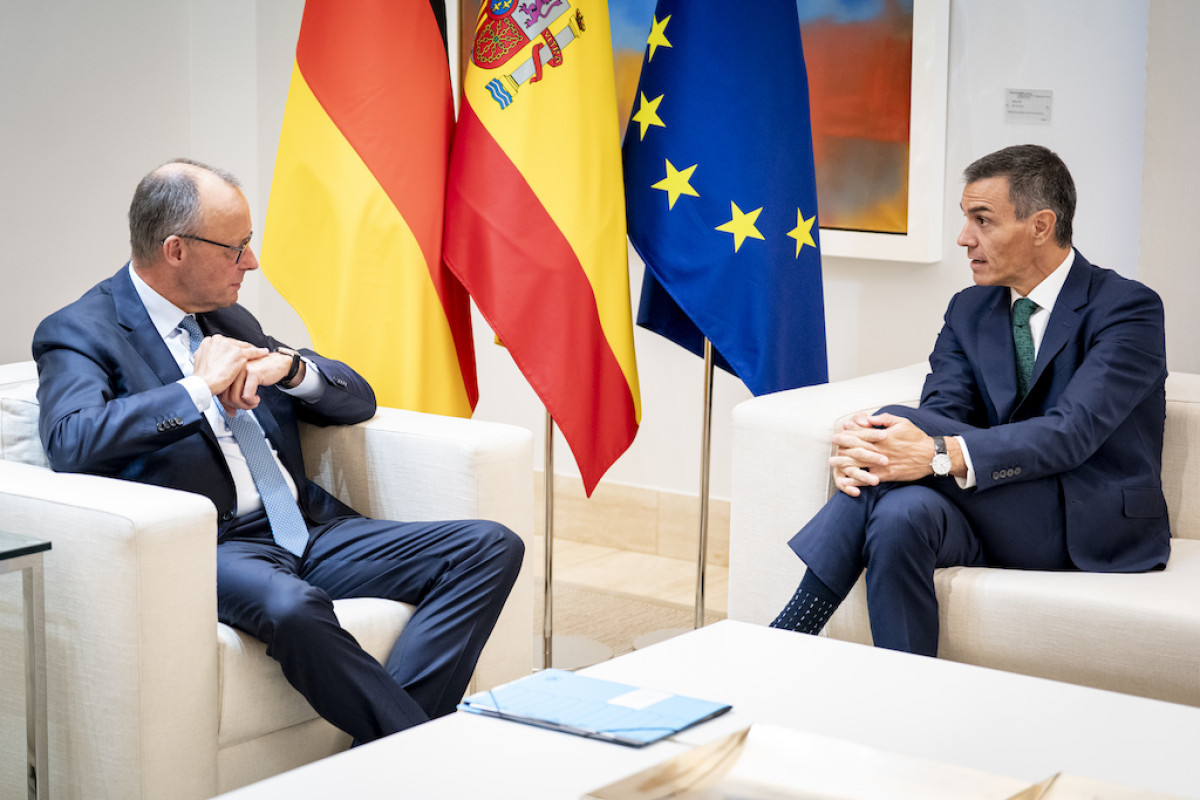
Pedro Sánchez welcomes the Chancellor of the Federal Republic of Germany, Friedrich Merz.A. Pérez Meca / Europa Press / ContactoPhoto
This week, the La Toja Forum will turn a spotlight on relations within today’s transatlantic alliance, so I’d like to take advantage of this weekly column to preview an idea that might be further developed there. In a session integrated by Jamil Anderlini, Juan Manuel Moreno Bonilla, Margaritis Schinas, Amanda Sloat, and moderated by myself, we will consider the EU’s bold strategic approach to current transatlantic developments, where very different roles are being played by the various actors. Ranging beyond its usual rhetoric, the EU has been learning to balance pragmatism with firmness, strengthening its internal cohesion while also managing U.S. relations in intelligent ways.
Trump is clearly seeking to redraw the traditional balance between the U.S. and Europe, pushing the EU into a weakened position both symbolically and strategically. The risk here is more than commercial or military: Trump wants Europe to internalize a logic where all decisions are subject to approval by Washington, with the bloc as a subordinate partner.
Indeed, many worry that the EU has been caving to Trump’s demands, as with the signing of a new U.S. trade agreement, or when European leaders were summoned to the Oval Office for a sit-down with Volodymir Zelensky, just a few days before Trump’s solo meeting with Vladimir Putin. When the trade agreement was signed, our collaborator Thorsten Benner (director of the Global Public Policy Institute in Berlin) disparaged the EU as a "weak player."
The recent meeting in Madrid between Pedro Sánchez and German Chancellor Friedrich Merz reflected this dynamic. While Germany and EC President Ursula von der Leyen have brought a rationalist approach to Washington, seeking to guarantee stability in trade and investment, Spain has been cast as the critic, underlining European principles that cannot be sacrificed and pointing out the limits of transatlantic cooperation. At the same time, within the European Parliament, Spain’s socialists and the S&D group have effectively sustained the current EC administration. As I wrote in the first edition of European Compass, without the disciplined vote of Spain’s socialists, von der Leyen cannot guarantee the continuation of her presidency.
What might appear to be division within the EU or a lack of coordination is in fact a structural feature: the bloc’s ability to convert its pluralism into an instrument for international action. Merz and von der Leyen open up channels and offer certainty, while Sánchez mounts a necessarily critical platform. These two approaches don’t cancel one another but fortify the inner cohesion of the Union, widening the space for diplomatic maneuver.
Far from a "weak player," Europe is taking advantage of its own complexity to gain strategic time and ensure cohesion. This plurality of positions—which might otherwise be read as vulnerability—is here a resource that prevents subordination and allows the Union to present itself not as a single unwavering force but as a multifaceted whole capable of negotiating, resisting, and adapting under pressure.
What might seem at first glance fragmentation or slowness of response becomes a structural advantage: the plurality of positions within the EU facilitate the distribution of strategic roles, balancing pragmatism with critique and bolstering the legitimacy of internal cohesion as well as external action. Every political actor from Sánchez to von der Leyen to Merz operates within this architecture, ensuring that the Union remain active rather than reactive, anticipating and managing Washington’s moves with strategic intelligence.
—
BONUS: This Friday at the La Toja Forum, if the agenda allows, I will inquire of Carlos Cuerpo how he, Foreign Minister José Manuel Albares, and Secretary of State Diego Martínez Belío have managed to strengthen ties with the United States, demonstrating that beyond its most visible leaders, the transatlantic alliance is sustained by complex institutional machinery. Spain remains a pivotal nation, capable of tilting the European consensus on energy, migration, and foreign policy alike. The fact that Spain is currently the fastest-growing economy in the EU reinforces the theory that certain U.S. institutions have no intention of harming this relationship. This conversation will be shared with the readers of Agenda Pública in days to come.
Trump and the reconfiguration of the Atlantic alliance
Donald Trump isn’t only an internal American problem. His unilateral mindset is threatening the international order, prompting widespread reconfigurations. As regards Europe, his intention is to break consensus, divide the Union, and force bilateral negotiations on a state-by-state basis. Tariffs, commercial bullying, and denunciations of EU energy and immigration policy are tactics in a broader strategy meant to deteriorate European autonomy.Trump is clearly seeking to redraw the traditional balance between the U.S. and Europe, pushing the EU into a weakened position both symbolically and strategically. The risk here is more than commercial or military: Trump wants Europe to internalize a logic where all decisions are subject to approval by Washington, with the bloc as a subordinate partner.
"According to the ECFR, Trump’s presidencies have prompted many Europeans to value more highly our model in which collective action serves as a basic guarantor of rights and stability"According to the European Council on Foreign Relations (ECFR), Trump’s presidencies have prompted many Europeans to value more highly our model in which collective action serves as a basic guarantor of rights and stability. A survey by Metroscopia found that only 43% of Spaniards now hold a positive opinion of the U.S. —a drop of 20 points across ten years—while approval of China has risen to 51%.
Indeed, many worry that the EU has been caving to Trump’s demands, as with the signing of a new U.S. trade agreement, or when European leaders were summoned to the Oval Office for a sit-down with Volodymir Zelensky, just a few days before Trump’s solo meeting with Vladimir Putin. When the trade agreement was signed, our collaborator Thorsten Benner (director of the Global Public Policy Institute in Berlin) disparaged the EU as a "weak player."
Has the EU finally learned to distribute its functions?
But what if the EU’s political fragmentation has been less an obstacle than a structural advantage over Trump? Due to the equilibrium between Europe’s People’s Parties and Social Democrats, the political majorities in Brussels are now allowing roles to be distributed in such a way that diverse actors are striking a necessary balance between pragmatism and firmness, constituting a front that has proven more resilient than might be evident.The recent meeting in Madrid between Pedro Sánchez and German Chancellor Friedrich Merz reflected this dynamic. While Germany and EC President Ursula von der Leyen have brought a rationalist approach to Washington, seeking to guarantee stability in trade and investment, Spain has been cast as the critic, underlining European principles that cannot be sacrificed and pointing out the limits of transatlantic cooperation. At the same time, within the European Parliament, Spain’s socialists and the S&D group have effectively sustained the current EC administration. As I wrote in the first edition of European Compass, without the disciplined vote of Spain’s socialists, von der Leyen cannot guarantee the continuation of her presidency.
"Von der Leyen and Merz offer certainty and open channels, while Sánchez provides the legitimacy of a critical stance toward the White House. The sum does not subtract"A senior official at the German Foreign Ministry has confirmed to me that von der Leyen is in constant contact with Merz, coordinating the strategy vis-à-vis Washington and reinforcing Germany’s role as the voice of pragmatism in negotiation. At the other extreme is a counterweight: Sánchez gives voice to social and political perspectives that need to feel themselves represented, reminding us that Europe’s power also derives from its own internal political diversity. If the European Union fails to respond effectively, its very legitimacy could be at stake.
What might appear to be division within the EU or a lack of coordination is in fact a structural feature: the bloc’s ability to convert its pluralism into an instrument for international action. Merz and von der Leyen open up channels and offer certainty, while Sánchez mounts a necessarily critical platform. These two approaches don’t cancel one another but fortify the inner cohesion of the Union, widening the space for diplomatic maneuver.
Far from a "weak player," Europe is taking advantage of its own complexity to gain strategic time and ensure cohesion. This plurality of positions—which might otherwise be read as vulnerability—is here a resource that prevents subordination and allows the Union to present itself not as a single unwavering force but as a multifaceted whole capable of negotiating, resisting, and adapting under pressure.
Gaining strategic time
The U.S. mid-term elections slated for 2026 represent an element of uncertainty that might soon condition Trump’s position. Traditionally, these congressional elections tend to erode a sitting president’s power, forcing new balances to be sought on the domestic front and limiting the space for international extension. In the coming months, this dynamic may affect Trump’s ability to exert unilateral pressure on Europe."The greater the electoral pressure on the president, the more room Europe gains to shape its role strategy between pragmatism and criticism, avoiding subordination"This timetable happens to be playing to the EU’s favor. Knowing that the White House may soon see its authority and capacity for negotiation challenged, the bloc has been able to buy strategic time. In other words, transatlantic negotiations take place not in a vacuum but in a framework, and should Trump’s power decline in the wake of next year’s mid-terms, relations might once again be compelled to rebalance. The greater the electoral pressure on Trump, the more space Europe will have in which to articulate its dual strategy of conciliation and critique, avoiding subordination to Washington while projecting the image of a coalition capable of resistance, even in the face of hostile U.S. leadership.
The trade agreement as example
The recent trade agreement perfectly illustrates how the EU’s domestic political majorities can serve as a strategic instrument vis-à-vis Washington. Spain’s socialist representatives remain silent until their group adopts a unified position, and not merely as a sign of party discipline (which is in truth rather lax when compared to other national parliaments). Rather, this reflects how negotiations in Europe are not limited to bilateral relations between governments but are conditioned by the cohesion of internal blocs, and by the permanent inter-relationship of Europe’s governments and parliamentary groups."Group discipline and the ability of Europe’s majorities (Social Democrats and People’s Parties) to coordinate their positions enables the projection of a united front"Group discipline and the ability of Europe’s majorities (Social Democrats and People’s Parties) to coordinate their positions enables the projection of a united front. In practice, this means that external negotiations with Washington cannot ignore the requirement of European consensus; even a trade deal must be validated by internal majorities, strengthening the EU’s negotiating position and limiting Trump’s ability to impose unilateral conditions.
What might seem at first glance fragmentation or slowness of response becomes a structural advantage: the plurality of positions within the EU facilitate the distribution of strategic roles, balancing pragmatism with critique and bolstering the legitimacy of internal cohesion as well as external action. Every political actor from Sánchez to von der Leyen to Merz operates within this architecture, ensuring that the Union remain active rather than reactive, anticipating and managing Washington’s moves with strategic intelligence.
A stronger European Union?
Trumpism has forced the EU to stop reacting and start anticipating. The European coalition works: some actors negotiate with the U.S. while others articulate boundaries, and together they ensure that Europe will be stronger and more cohesive during future twists and turns in the transatlantic relationship.—
BONUS: This Friday at the La Toja Forum, if the agenda allows, I will inquire of Carlos Cuerpo how he, Foreign Minister José Manuel Albares, and Secretary of State Diego Martínez Belío have managed to strengthen ties with the United States, demonstrating that beyond its most visible leaders, the transatlantic alliance is sustained by complex institutional machinery. Spain remains a pivotal nation, capable of tilting the European consensus on energy, migration, and foreign policy alike. The fact that Spain is currently the fastest-growing economy in the EU reinforces the theory that certain U.S. institutions have no intention of harming this relationship. This conversation will be shared with the readers of Agenda Pública in days to come.
En alianza con
Etiquetas
La brújula europea de López Plana, Firmas Top, Agenda Pública in English, democracia, Unión Europea, Donald Trump, Friedrich Merz, Pedro Sánchez, Estados Unidos, Foro La Toja, España, Alemania, Política Exterior, Ursula von der Leyen, Comisión Europea, Elecciones EE. UU., Parlamento Europeo Ahora en portada
16 de octubre de 2026
16 de octubre de 2026
16 de octubre de 2026
Noticias relacionadas
Hace 54 semanas
Sánchez y Merz frente a Trump: cómo mantener el vínculo atlántico sin ser idiotas
Lo más leído