Viernes, 16 de octubre de 2026




LÓPEZ PLANA'S EUROPEAN COMPASS
The southern strategy that Spain (and Europe) cannot ignore
Spain is having "a hard time reading its own strategic map," claims Marc López Plana. In this edition of European Compass, the director and editor of 'Agenda Pública' underlines the economic and political importance of the Mediterranean region for Spain. Data indicate that relations with this region are even more relevant than those with Latin America; López maintains that Spain should draw inspiration from the integration of Eastern Europe to build new confluences with Morocco, Algeria, and Tunisia.

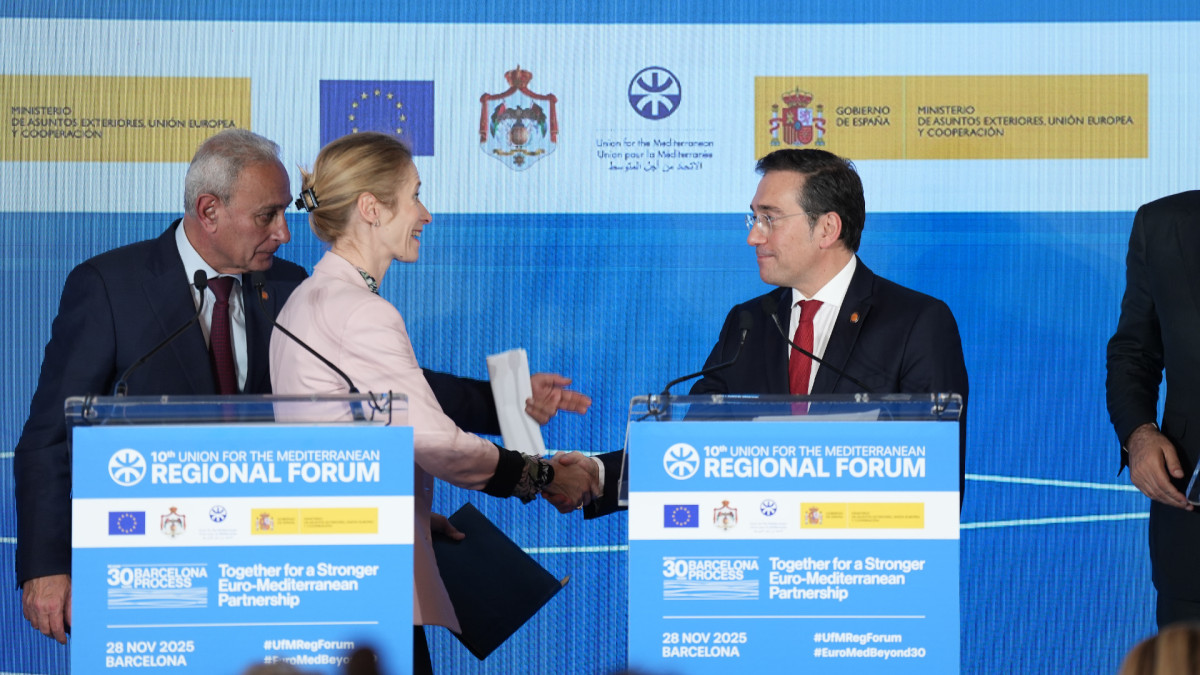
Left to right: Nasser Kamel, Secretary General of the Union for the Mediterranean; Kaja Kallas, High Representative of the EU for Foreign Affairs and Security Policy; José Manuel Albares, Spain’s Minister of Foreign AffairsDavid Zorrakino / Europa Press / ContactoPhoto
The current debate in Spain on the assimilation of migrants revolves around the premise that Latin Americans 'integrate better' than immigrants from North Africa. But that diagnosis ignores an essential reality: the economic and geopolitical structures linking Spain with Morocco, Algeria, and the overall Maghreb are deeper, denser, and more relevant than those maintained with much of Latin America. Spanish politics is having a hard time reading its own strategic map, thanks in part to pressure on the central parties from extreme factions.
This pact could lay the foundations for something Europe has proven unable to achieve for decades: a Euro-Mediterranean economic area, with common rules, regulated labor mobility, and mechanisms for convergence comparable to those that transformed Eastern Europe after 2004. Moreover, the pact will have real consequences for the way Europeans – and Spaniards in particular – understand migratory integration.
Between 2004 and 2019, the per capita GDP (in purchasing power parity) of the admitted countries nearly doubled, from around $18,300 to over $34,700. Recent studies have estimated that the real per capita income is now more than 25% above what it would have been without EU membership. Poland, which in the 1990s was synonymous with brain-drain and low wages, has scaled up to around 80% of the European average – compared to 50% when it joined – and its average annual growth since 2005 tops 3.7%. Meanwhile, in Slovakia and Lithuania, progress (while uneven) has been even more accelerated.
And who can say whether Poland, Hungary, or the Baltic nations wouldn’t have been attacked by Putin, were they not EU Member States?
Morocco has established itself as one of Spain’s main trading partners outside the EU, surpassing major Latin American economies; and Europe remains dependent on Algerian gas supplies, even amid the transition to renewable energy sources. Spain’s Mediterranean ports of Algeciras, Valencia, and Barcelona all connect and support Europe’s southern flanks as well as networks that are vital to regional trade and supply. And this economic interaction is reflected in society: the Maghreb diaspora has been establishing itself in Spain for over three decades, with second and third generations now fully schooled and integrated into the labor market, woven into an increasingly consolidated social and economic fabric.
At root is a structural concern: Europe has yet to articulate a Mediterranean economic framework that can reduce uncertainty and foster convergence, as it successfully did with Eastern Europe.
The preliminary framework rests on three pillars:
1) Progressive access to the internal market, approaching regulatory convergence in goods, services, industrial standards, agriculture, energy, and digitalization.
2) Regulated labor mobility. Europe needs workers, as confirmed by its aging populations. Instead of managing mobility in irregular ways, or through ad hoc instruments, the pact proposes bilateral mechanisms for circular mobility, joint vocational training, and the mutual recognition of qualifications.
3) Mediterranean convergence funds. If Europe has learned anything from the East, it’s that convergence is not feasible without structural investment that involves logistical infrastructures, interconnected energy, digitalization, education, and institutional strengthening. This would not be a replication of EU cohesion funds but a novel instrument, adapted to the region.
Should the Maghreb participate in a European economic area – even one that’s relatively associative in nature – the resulting dynamics would resemble those seen in the East. The benefits of economic convergence would include significant reductions in poverty and youth unemployment, sustained increases in bilateral trade, growth in foreign direct investment, the regularization of labor mobility, and the eventual normalization of migratory waves, which would be structurally integrated into the economies of both origin and destination. Debates around integration would shift from a focus on identity to structural concerns.
First is the re-Islamization of a segment of Muslim youth in France, which can’t be read only in French terms; this phenomenon prefigured dynamics now taking place (or that might be reproduced) in other European countries. Second is China’s growing attractiveness for North Africa’s regimes, which find its political-economic model to be particularly seductive (rapid growth, broad popular social advancement, strong and autocratic leadership). Third is a decisive geo-economic factor: the port of Tanger Med, reconfiguring geopolitics in the Strait of Gibraltar and altering regional logistics.
For the first time in many decades, the Pact for the Mediterranean offers a chance to see Europe’s southern neighborhood not as a problem but as a geo-economic asset. Europe needs to grow, despite difficult demographic trends and stagnating productivity. Meaningful connection with the South – long considered an altruistic gesture – has now become a strategic necessity.
What might happen if Morocco, Algeria, or Tunisia were to join a Mediterranean Economic Area associated with the EU? Most likely, a scenario would emerge of greater investment, mutual growth, orderly mobility, institutional stability, and a narrative of integration not obsessed with cultural differences but focused on shared opportunities.
Given its geography, history, and self-interest, Spain stands to gain the most from such a paradigm shift – and maybe it has the most to lose, if it fails to take the lead.
"Spanish politics is having a hard time reading its own strategic map, thanks in part to pressure on the central parties from extreme factions"This dominant but insufficient narrative needs clarification, to situate the debate on firmer ground: assessments of relations should consider not just cultural affinities but also economic interdependence, structural convergence, security, and regional governance. This is where a European project with transformative potential comes into play – the Pact for the Mediterranean, guided by the commissioner for the Mediterranean and actively promoted by influential director-general Stefano Sannino, who served as secretary general of the EU’s Foreign Service under Josep Borrell.
This pact could lay the foundations for something Europe has proven unable to achieve for decades: a Euro-Mediterranean economic area, with common rules, regulated labor mobility, and mechanisms for convergence comparable to those that transformed Eastern Europe after 2004. Moreover, the pact will have real consequences for the way Europeans – and Spaniards in particular – understand migratory integration.
Looking East when contemplating the South
In 2004, ten countries in Central and Eastern Europe joined the EU in its biggest phase of enlargement to date. At the time, many analysts doubted that economies such as Poland, Slovakia, or the Baltic countries could close the gap with Western Europe. Twenty years later, the figures speak for themselves.Between 2004 and 2019, the per capita GDP (in purchasing power parity) of the admitted countries nearly doubled, from around $18,300 to over $34,700. Recent studies have estimated that the real per capita income is now more than 25% above what it would have been without EU membership. Poland, which in the 1990s was synonymous with brain-drain and low wages, has scaled up to around 80% of the European average – compared to 50% when it joined – and its average annual growth since 2005 tops 3.7%. Meanwhile, in Slovakia and Lithuania, progress (while uneven) has been even more accelerated.
"Poland, which in the 1990s was synonymous with brain-drain and low wages, has scaled up to around 80% of the European average"The driving force behind this transformation wasn’t cultural homogeneity or a supposed predisposition to succeed: it was access to Europe’s internal markets, regulatory harmonization, structural funds, and institutional clarity. To put it bluntly, economic convergence occurs faster within a credible, stable, and financed program for deep integration.
And who can say whether Poland, Hungary, or the Baltic nations wouldn’t have been attacked by Putin, were they not EU Member States?
The Mediterranean: forgotten frontier of European growth
If Eastern Europe has proven successful thanks to economic integration, then the Mediterranean could represent the next frontier of growth. For decades, Morocco, Algeria, and Tunisia have maintained a degree of interaction with Europe that belies the simplistic vision of a 'problematic neighborhood'.Morocco has established itself as one of Spain’s main trading partners outside the EU, surpassing major Latin American economies; and Europe remains dependent on Algerian gas supplies, even amid the transition to renewable energy sources. Spain’s Mediterranean ports of Algeciras, Valencia, and Barcelona all connect and support Europe’s southern flanks as well as networks that are vital to regional trade and supply. And this economic interaction is reflected in society: the Maghreb diaspora has been establishing itself in Spain for over three decades, with second and third generations now fully schooled and integrated into the labor market, woven into an increasingly consolidated social and economic fabric.
"Morocco has established itself as one of Spain’s main trading partners outside the EU, surpassing major Latin American economies"And yet, the narrative still dominant in Spain – and in parts of Europe – would view this relationship only through the prism of security: borders, immigration control, and radicalization. Migration from the Maghreb is seen as alien, disruptive, culturally distant. What are often described as 'integration problems' tend to amount to poverty, housing discrimination, school segregation, and job insecurity.
At root is a structural concern: Europe has yet to articulate a Mediterranean economic framework that can reduce uncertainty and foster convergence, as it successfully did with Eastern Europe.
The Pact for the Mediterranean: outline for an economic architecture
Brussels is implementing the Pact for the Mediterranean in order to establish deeper, better organized, and less reactive relations between the EU and its Maghreb neighbors. Inspired by models like the European Economic Area, this pact would build and improve on current trade agreements.The preliminary framework rests on three pillars:
1) Progressive access to the internal market, approaching regulatory convergence in goods, services, industrial standards, agriculture, energy, and digitalization.
2) Regulated labor mobility. Europe needs workers, as confirmed by its aging populations. Instead of managing mobility in irregular ways, or through ad hoc instruments, the pact proposes bilateral mechanisms for circular mobility, joint vocational training, and the mutual recognition of qualifications.
3) Mediterranean convergence funds. If Europe has learned anything from the East, it’s that convergence is not feasible without structural investment that involves logistical infrastructures, interconnected energy, digitalization, education, and institutional strengthening. This would not be a replication of EU cohesion funds but a novel instrument, adapted to the region.
The geopolitics of convergence
Why raise this debate now? Because Europe is entering a decisive decade. Potential enlargement into Ukraine, Moldova, and the Western Balkans will revive the neighborhood policy, while risks around the Mediterranean might be relegated to a geopolitical back-burner. For Spain, that would constitute an historic mistake."Integration depends not only on cultural affinities but on shared institutions, predictable horizons, and real opportunities for social advancement"The Maghreb is a natural part of our neighborhood: our first frontier in energy and in social interaction, and our principal trade corridor outside the EU. Above all, it’s a major aspect of the future of migratory integration into Europe. Experience has shown that mobility is better managed (and better perceived) within a common economic framework. Integration depends not only on cultural affinities but on shared institutions, predictable horizons, and real opportunities for social advancement.
Should the Maghreb participate in a European economic area – even one that’s relatively associative in nature – the resulting dynamics would resemble those seen in the East. The benefits of economic convergence would include significant reductions in poverty and youth unemployment, sustained increases in bilateral trade, growth in foreign direct investment, the regularization of labor mobility, and the eventual normalization of migratory waves, which would be structurally integrated into the economies of both origin and destination. Debates around integration would shift from a focus on identity to structural concerns.
And Spain? Confronting an opportunity without naivety
Spain should play a central role in this agenda. The time has come to rise above inertia and seize this opportunity, without being naive. Today we regret the dependence developed by Germany on Russian gas; Spain and the European Commission can’t afford to make similar mistakes. In that context, we need to precisely identify some strategic areas requiring priority attention.First is the re-Islamization of a segment of Muslim youth in France, which can’t be read only in French terms; this phenomenon prefigured dynamics now taking place (or that might be reproduced) in other European countries. Second is China’s growing attractiveness for North Africa’s regimes, which find its political-economic model to be particularly seductive (rapid growth, broad popular social advancement, strong and autocratic leadership). Third is a decisive geo-economic factor: the port of Tanger Med, reconfiguring geopolitics in the Strait of Gibraltar and altering regional logistics.
"The discussion shouldn’t focus on whether "Muslims integrate worse than Colombians" but should instead seek an understanding that no group integrates well into an environment of precariousness"On this playing-field, Spain is the country with the most at stake, economically, diplomatically, and socially. For that reason, the discussion shouldn’t focus on whether "Muslims integrate worse than Colombians" but should instead seek an understanding that no group integrates well into an environment of precariousness, segregation, and no shared prospects. True integration that reduces inequalities and builds cohesion requires stable structures, sustained policies, and an inclusive economic project.
For the first time in many decades, the Pact for the Mediterranean offers a chance to see Europe’s southern neighborhood not as a problem but as a geo-economic asset. Europe needs to grow, despite difficult demographic trends and stagnating productivity. Meaningful connection with the South – long considered an altruistic gesture – has now become a strategic necessity.
What might happen if Morocco, Algeria, or Tunisia were to join a Mediterranean Economic Area associated with the EU? Most likely, a scenario would emerge of greater investment, mutual growth, orderly mobility, institutional stability, and a narrative of integration not obsessed with cultural differences but focused on shared opportunities.
Given its geography, history, and self-interest, Spain stands to gain the most from such a paradigm shift – and maybe it has the most to lose, if it fails to take the lead.
Ahora en portada
16 de octubre de 2026
16 de octubre de 2026
16 de octubre de 2026
Noticias relacionadas
Hace 45 semanas
La estrategia sur que España (y Europa) no pueden ignorar
Hace 45 semanas
La 'tesis Sannino': "La UE debe buscar fórmulas de integración para los países del sur del Mediterráneo"
Lo más leído