Jueves, 15 de octubre de 2026




SOCIALDEMOCRATS
Brussels will feel the aftershocks of a Spanish election political earthquake
For Dave Keating, the departure of Pedro Sánchez, the last European leader to firmly defend the centre-left, could lead to the collapse of the European Union's historic centrist grand coalition and pave the way, for the first time, for a governing majority that includes the far right. The Brussels-based writer and journalist warns that the Spanish prime minister's downfall could trigger a crisis in the EU capital unlike anything seen this century.
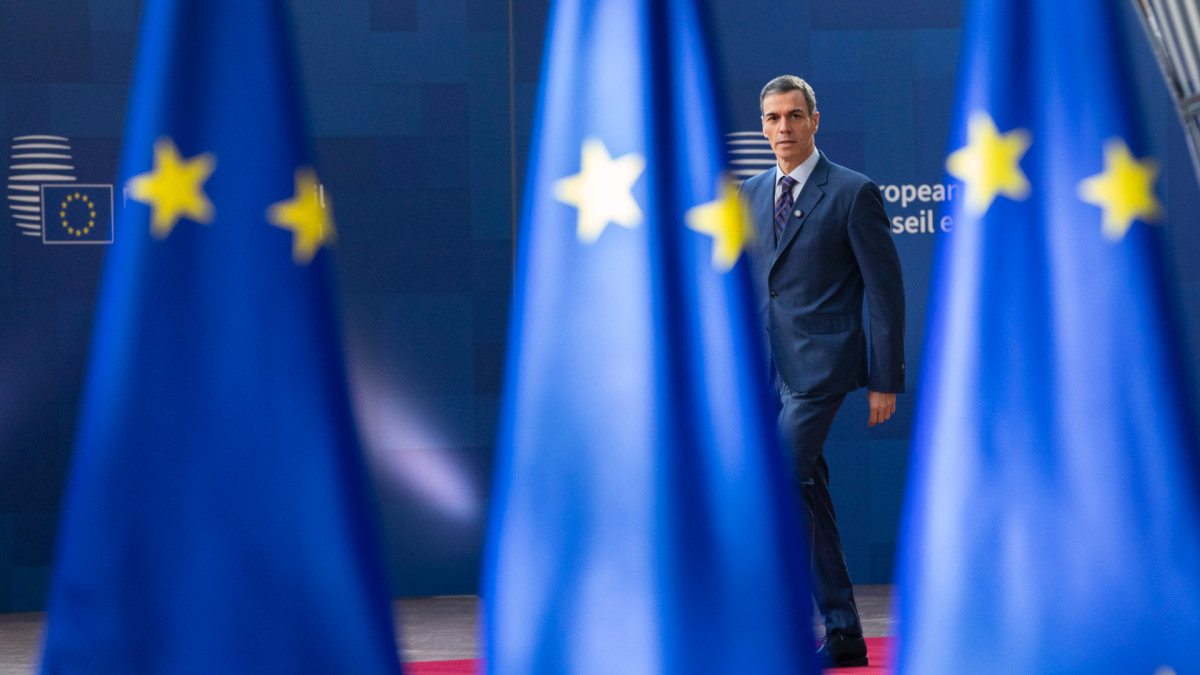
Pedro Sánchez arriving at a European Council meeting.Nicolas Landemard / Zuma Press / Europa Press
The centre-right European People's Party (EPP), the European political group that includes Spain's Partido Popular, has governed the European Union for two decades. The EPP has come first in every European Parliament election since 1999, and every European Commission president since 2004 has been from the group. It has also been the largest party in the European Council throughout this time. But even as the centre-left Party of European Socialists (PES) has shrunk to minimal representation at EU level, it has maintained a "grand coalition" with the EPP which has given it a share of executive power. Now, a loss for Pedro Sánchez in Spain's election could cause that long-standing arrangement to collapse.
Sánchez hasn't won all his battles. In fact, he's lost many of them – unsurprising given the minority position he occupies. He has also rarely been backed up by the PES's other two members, the right-leaning Mette Frederiksen from Denmark, who has kept the PES at arm's length, and the largely unknown Robert Abela from Malta. Sweden's centre-left leader Magdalena Andersson is currently trying to unseat centre-right Prime Minister Ulf Kristersson by forming a coalition government after securing an extremely narrow victory for the left-wing coalition in last month's election.
There has long been a German-style "grand coalition" in the Parliament, one which has mirrored the current one in Germany: the EPP governs as the majority party in the coalition, with the support of the centre-left. More recently, the liberal ALDE/Renew Europe group of Emmanuel Macron and Rob Jetten has also been part of this long-standing centrist governing coalition.
S&D MEPs have grown increasingly furious as von der Leyen's EPP has formed ad hoc alliances with the far right. The 2024 EU election gave the Parliament a right-wing majority, but the EPP promised not to use it. Though they could have governed with the hard-right European Conservatives and Reformists (ECR) of Giorgia Meloni along with the groups even further to the right, Patriots for Europe (PfE) of Marine Le Pen and Europe of Sovereign Nations (ESN) of Alice Weidel, they promised not to. But over the past two years, the EPP has increasingly formed ad hoc partnerships with the far right on specific legislation – often migration-related.
S&D leader Iratxe García has reportedly wanted to pull out of the coalition with the EPP and become the EU opposition for some time. But she has been held back by her ally Sánchez, who does not want his group to be responsible for collapsing the EU's government. Sánchez's support for Council positions has also made it easier for S&D MEPs to hold their noses and vote for the conservative positions coming out of the Council, believing that he has helped moderate the Council's positions.
If the centre-left does pull out of von der Leyen's governing coalition, it will at minimum mean that von der Leyen no longer has a centrist majority to pass her proposals in the EU's legislature. She may then need to turn permanently to the far right to pass her legislation – particularly as she tries to push through her "simplification" deregulation packages rolling back EU laws that were passed during her previous term. This would give the European Parliament, for the first time in history, a right-wing governing majority – even if it remained only unofficial.
In short, a Sánchez loss could trigger a period of political chaos in Brussels not seen since the resignation of the Santer Commission in 1999 – coming at the most dangerous geopolitical moment the EU has ever faced.
"A loss for Pedro Sánchez in Spain's election could cause that long-standing arrangement to collapse"Even when it had brief stints in power in the EU's largest countries, the PES (of which Sánchez's Socialist Party is a member) was not in control. The tenures of François Hollande in France and Olaf Scholz in Germany will barely be remembered by history. At European level they were political pygmies, disregarded in Brussels compared to their predecessors.
Council math
Pedro Sánchez has been the one exception to this trend. As the PES continued to decline, his "lone wolf" position in the European Council emboldened him into becoming a fierce and uncompromising voice for the left in an EU dominated by the right. It was a marked departure from the conciliatory attitude of the PP's Mariano Rajoy, who occupied the Spanish seat before him. But Rajoy was among friends, and Sánchez has not been. He is currently one of only three EU leaders from the PES in the 27-seat European Council, compared to 12 for the EPP. With leaders from other right-wing groups, the right wing has a majority in the Council. Four leaders are liberals, and another four are independents (who mostly lean right).Sánchez hasn't won all his battles. In fact, he's lost many of them – unsurprising given the minority position he occupies. He has also rarely been backed up by the PES's other two members, the right-leaning Mette Frederiksen from Denmark, who has kept the PES at arm's length, and the largely unknown Robert Abela from Malta. Sweden's centre-left leader Magdalena Andersson is currently trying to unseat centre-right Prime Minister Ulf Kristersson by forming a coalition government after securing an extremely narrow victory for the left-wing coalition in last month's election.
"Sánchez hasn't won all his battles. In fact, he's lost many of them – unsurprising given the minority position he occupies"Although Andersson's seat could offset the loss of Sánchez's seat, it would mean the PES is left with only three leaders from small countries – leaders whose commitment to the European centre-left is under doubt. It would effectively, for the first time in EU history, leave the centre-left locked out of power at EU level.
Parliament coalition
The impacts of a Sánchez defeat wouldn't only be felt in the Council. They would also be felt in the directly elected European Parliament.There has long been a German-style "grand coalition" in the Parliament, one which has mirrored the current one in Germany: the EPP governs as the majority party in the coalition, with the support of the centre-left. More recently, the liberal ALDE/Renew Europe group of Emmanuel Macron and Rob Jetten has also been part of this long-standing centrist governing coalition.
"It would effectively, for the first time in EU history, leave the centre-left locked out of power at EU level"Brussels media have reported that there have been internal discussions within the Socialists & Democrats (S&D), the PES's parliamentary group, that if Sánchez loses, they should ditch the pretence that they are in a "governing coalition" with the EPP and instead define themselves as the EU government's opposition. Why now? Two reasons. They have long since ceased to wield any real power as part of this arrangement, and the loss of Sánchez would make that impossible to ignore. But more importantly, one of the reasons they haven't done it yet is that Sánchez has been holding them back from pulling the trigger.
S&D MEPs have grown increasingly furious as von der Leyen's EPP has formed ad hoc alliances with the far right. The 2024 EU election gave the Parliament a right-wing majority, but the EPP promised not to use it. Though they could have governed with the hard-right European Conservatives and Reformists (ECR) of Giorgia Meloni along with the groups even further to the right, Patriots for Europe (PfE) of Marine Le Pen and Europe of Sovereign Nations (ESN) of Alice Weidel, they promised not to. But over the past two years, the EPP has increasingly formed ad hoc partnerships with the far right on specific legislation – often migration-related.
S&D leader Iratxe García has reportedly wanted to pull out of the coalition with the EPP and become the EU opposition for some time. But she has been held back by her ally Sánchez, who does not want his group to be responsible for collapsing the EU's government. Sánchez's support for Council positions has also made it easier for S&D MEPs to hold their noses and vote for the conservative positions coming out of the Council, believing that he has helped moderate the Council's positions.
EU coalitions mirroring national ones
Unlike in the last Spanish election, the PP this time is openly talking about a coalition with the far-right Vox party. Such an arrangement would mirror what is happening in national governments across Europe, such as in Sweden where a coalition between the centre-right and far right just narrowly lost the election last month. There are currently coalition governments bringing together the centre-right and far right in Italy, Finland, Czechia and Slovakia – and previously in Austria and the Netherlands. At EU level, the EPP is simply following the lead of its national parties.If the centre-left does pull out of von der Leyen's governing coalition, it will at minimum mean that von der Leyen no longer has a centrist majority to pass her proposals in the EU's legislature. She may then need to turn permanently to the far right to pass her legislation – particularly as she tries to push through her "simplification" deregulation packages rolling back EU laws that were passed during her previous term. This would give the European Parliament, for the first time in history, a right-wing governing majority – even if it remained only unofficial.
"The PP this time is openly talking about a coalition with the far-right Vox party. Such an arrangement would mirror what is happening in national governments across Europe"But this isn't the extent of the risk facing the EU's president. S&D sources have told Brussels media that they may even pursue a motion of censure against von der Leyen – for which they themselves would need to partner with the far left and far right in order to overcome support for the president from centre-right and liberal MEPs. Under EU law, a successful motion of censure would force the entire 27-member College of Commissioners to resign, sparking a months-long process of national capitals having to nominate commissioners in addition to national leaders finding a new president to nominate for approval by Parliament.
In short, a Sánchez loss could trigger a period of political chaos in Brussels not seen since the resignation of the Santer Commission in 1999 – coming at the most dangerous geopolitical moment the EU has ever faced.
Dave Keating
Periodista en Bruselas
Es un periodista estadounidense-europeo afincado en Bruselas que cubre la Unión Europea y las vicisitudes del proyecto europeo en sentido amplio. Es autor de la obra 'The Owned Continent'.
Ahora en portada
15 de octubre de 2026
15 de octubre de 2026
15 de octubre de 2026
Noticias relacionadas
Hace 4 semanas
When the state no longer knows: how should Europe respond to the power of AI companies?
Hace 11 semanas
Alastair Campbell: "Political debate has become incredibly superficial"
Hace 16 semanas
Europe Facing the Great Transition
Lo más leído