Sábado, 17 de octubre de 2026




PEACE PROPOSAL FOR UKRAINE
From a "Coalition of the willing" to a "Coalition of the acting"
Egor Kuroptev, a Russian analyst and director of the EK Strategic Communications Center, argues that the "peace plan" leaked in the United States is a document designed by Moscow to force Ukraine’s surrender. Kuroptev notes that Europe —and particularly Spain— despite facing the greatest threat since the Cold War, remains unprepared for the hybrid war that Russia is already waging on its territory.
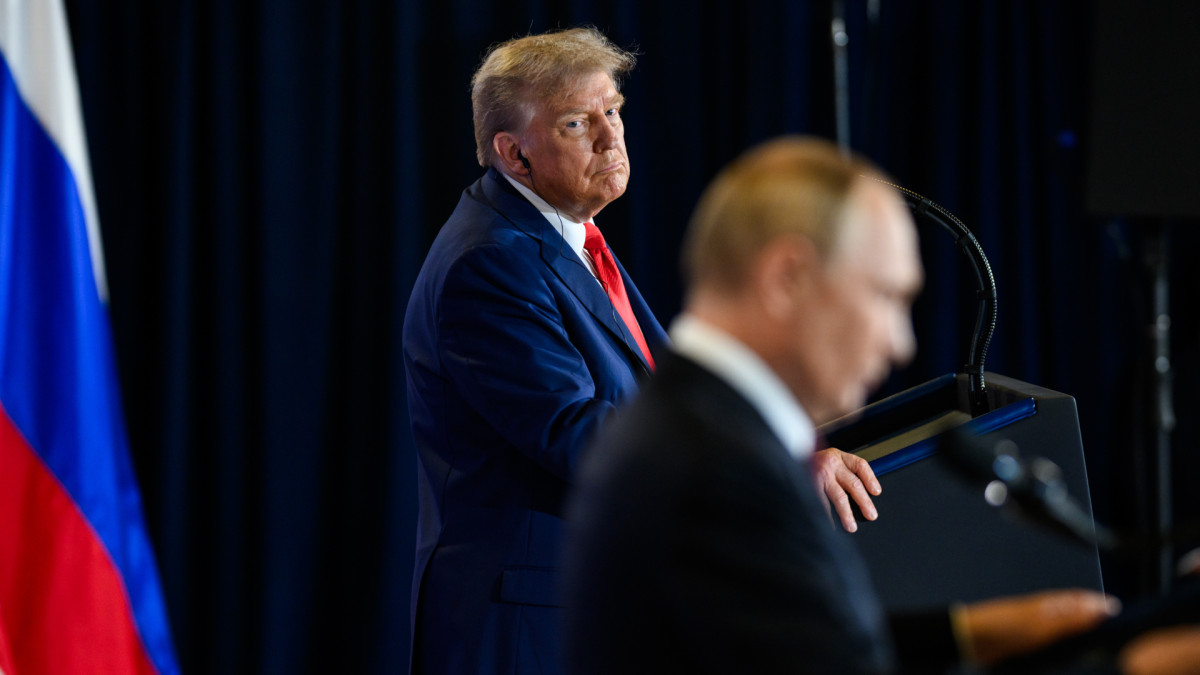
Donald Trump alongside Russian President Vladimir Putin during their latest meeting in Alaska (U.S.).The White House / Daniel Torok
The 28-point so-called peace plan between Russia and Ukraine — initially presented in public discourse as an "American plan" — is in fact a blueprint for Ukraine’s capitulation. For four years, at the cost of tens of thousands of lives, Ukraine has defended not only its own land from Kremlin aggression, but has also safeguarded Europe, buying valuable time for European countries to strengthen their defenses in the face of Russia’s China-backed escalation strategy.
It is highly likely that the so-called "Trump peace plan" was written in Russia and injected into the information space to later become framed as an "American plan." This suspicion is supported by statements from U.S. lawmakers, who said at a press conference on 22 November that Secretary Rubio told them directly in a phone call that the 28 points were "not an American plan" but rather "the Russians’ wish list":
"He (Secretary Rubio) made it very clear to us that we are the recipients of a proposal that was delivered to one of our representatives," said Senator Mike Rounds. "It is not our recommendation. It is not our peace plan. It is a proposal that was received, and as an intermediary, we have made arrangements to share it — and we did not release it.
Rubio later attempted to walk this back, saying it was only a template drafted by U.S. representatives after talks with both Moscow and Kyiv. Yet nothing in the original list resembled compromise — it was effectively a capitulation plan, actively promoted by Kremlin negotiator Kirill Dmitriev, possibly with the involvement of U.S. representative Witcoff, who reportedly passed it to the U.S. President — who appeared to endorse it, perhaps without even reading it.
"Zelensky is preparing the Ukrainian people for capitulation," "Zelensky spreads zrada (public pessimism and panic) for the first time in his daily address," "Capitulation or death by starvation," "the collapse of Kyiv’s policy", "The 28 Trump points that will crush Zelensky" — this is how Russian propagandist media describe the so-called "U.S. peace plan" of 28 steps.
Only a day later, after a wave of criticism from European leaders and President Zelensky’s statement that Ukraine would be forced to "either lose a key ally, or lose dignity, freedom, and justice by trusting someone who has already attacked twice", President Trump clarified that the "peace plan" was not final, while Secretary Rubio rushed to present it as merely a general document offered as a starting point for negotiations.
On Saturday, 22 November, the world watched first with shock as Washington appeared to exert pressure on Ukraine — forcing Zelensky’s statement — and then with disbelief as journalists and U.S. senators began a public dispute on Twitter/X, citing Secretary Rubio’s claim that the plan was a Russian wishlist, while the State Department and Rubio himself tried to refute that interpretation in real time, seemingly to prevent the White House from appearing as a political hub that spreads Russian demands.
But while the unpredictability and transactional approach of the new U.S. administration may not be surprising, what now comes to the forefront is Europe’s complete lack of preparedness to operate under conditions that were foreseeable. The imminent threat does not face the United States — it faces Europe, particularly EU states near Russia’s borders.
A strike in the Suwałki Gap or the Baltic states would require minimal effort from Russia — but if NATO does not respond immediately, the consequences would be devastating. Beyond the fate of the Baltic nations themselves — lives, sovereignty, stability — the entire modern security architecture and the credibility of NATO itself would be at risk.
So is Europe ready to move beyond observing Twitter/X debates among U.S. officials and journalists — and assume responsibility for its own security? To shift from a "coalition of the willing" to a "coalition of action" — a "coalition of defenders" and "coalition of responsibility" rooted in values and professionalism? Monitoring and analysis of the Kremlin’s hybrid war in Europe, a proactive strategy of countermeasures, a transition from rhetoric to real protective action — not in five years, but immediately, the strengthening of defense capabilities, external and internal containment of the Kremlin. If these steps are not taken now — tomorrow may be too late. If Europe — and perhaps Canada, Japan and other value-based democracies — do not form a unified center of independent strategic power today, it will be impossible to explain to their citizens tomorrow why airports are closed, or worse — why they face direct aggression from Putin. The explanation that a superpower across the ocean is temporarily unpredictable will not be sufficient.
Poland, Lithuania, Latvia, and Estonia understand Russia best — because they are directly exposed to its threat. Less so in Germany, where the legacy of WWII still distorts the perception of the present: while in reality the Kremlin today resembles a fascist regime — killing tens of thousands of Ukrainians and Russians, holding neighboring nations hostage, and maintaining
a constant threat of invasion in Europe. Many European countries continue to host events discussing possible post-war settlements — still entertaining the notion that cooperation with Putin’s regime might eventually be possible.
Meanwhile, Russia has restructured not only its economy but even its education system for long-term war — children in certain schools are taught to operate drones, and war veterans visit classrooms to instruct students on "Nazism in Kyiv and Europe." Do European governments know about the thousands of Kremlin disinformation accounts on Telegram, TikTok, Instagram, Facebook and other platforms — in every major European language — designed to sow chaos and undermine democratic values? Some do — but this is only the tip of the iceberg. There are virtually no counter-propaganda campaigns, even though the Kremlin is openly waging a hybrid war against the democratic world.
In a time of rising threats from authoritarian regimes, there will be no possibility of simply waiting out the storm. Survival will depend on unity and leadership — rooted in values and professionalism — which Europe must now provide. From a coalition of the willing to a coalition of the acting.
It is highly likely that the so-called "Trump peace plan" was written in Russia and injected into the information space to later become framed as an "American plan." This suspicion is supported by statements from U.S. lawmakers, who said at a press conference on 22 November that Secretary Rubio told them directly in a phone call that the 28 points were "not an American plan" but rather "the Russians’ wish list":
"He (Secretary Rubio) made it very clear to us that we are the recipients of a proposal that was delivered to one of our representatives," said Senator Mike Rounds. "It is not our recommendation. It is not our peace plan. It is a proposal that was received, and as an intermediary, we have made arrangements to share it — and we did not release it.
"It is highly likely that the so-called «Trump peace plan» was written in Russia and injected into the information space so that it could later be presented as an «American plan»""He (Secretary Rubio) made it very clear to us that we are the recipients of a proposal that was delivered to one of our representatives," said Senator Mike Rounds. "It is not our recommendation. It is not our peace plan. It is a proposal that was received, and as an intermediary, we have made arrangements to share it — and we did not release it. It was leaked." Independent Senator Angus King said Rubio told them the plan "was not the administration’s plan" but a "wish list of the Russians."
Rubio later attempted to walk this back, saying it was only a template drafted by U.S. representatives after talks with both Moscow and Kyiv. Yet nothing in the original list resembled compromise — it was effectively a capitulation plan, actively promoted by Kremlin negotiator Kirill Dmitriev, possibly with the involvement of U.S. representative Witcoff, who reportedly passed it to the U.S. President — who appeared to endorse it, perhaps without even reading it.
"Zelensky is preparing the Ukrainian people for capitulation," "Zelensky spreads zrada (public pessimism and panic) for the first time in his daily address," "Capitulation or death by starvation," "the collapse of Kyiv’s policy", "The 28 Trump points that will crush Zelensky" — this is how Russian propagandist media describe the so-called "U.S. peace plan" of 28 steps.
Only a day later, after a wave of criticism from European leaders and President Zelensky’s statement that Ukraine would be forced to "either lose a key ally, or lose dignity, freedom, and justice by trusting someone who has already attacked twice", President Trump clarified that the "peace plan" was not final, while Secretary Rubio rushed to present it as merely a general document offered as a starting point for negotiations.
On Saturday, 22 November, the world watched first with shock as Washington appeared to exert pressure on Ukraine — forcing Zelensky’s statement — and then with disbelief as journalists and U.S. senators began a public dispute on Twitter/X, citing Secretary Rubio’s claim that the plan was a Russian wishlist, while the State Department and Rubio himself tried to refute that interpretation in real time, seemingly to prevent the White House from appearing as a political hub that spreads Russian demands.
Europe Amid U.S. Unpredictability
These events once again highlight the unpredictability of U.S. policy — visible since early 2025 — during the most dangerous geopolitical moment in decades: while Russia and its allies wage war in Ukraine, and the entire Russian state apparatus — its economy, propaganda, social structures, and institutions — has been recalibrated for years of warfare, clearly extending beyond Ukraine.But while the unpredictability and transactional approach of the new U.S. administration may not be surprising, what now comes to the forefront is Europe’s complete lack of preparedness to operate under conditions that were foreseeable. The imminent threat does not face the United States — it faces Europe, particularly EU states near Russia’s borders.
"Russian Telegram channels are now publishing messages claiming that Europe is preparing to attack Russia, fabricating a pretext for future aggression against European states"Russia’s April 2025 campaign portraying "Nazi Europe" as a threat to Russia — outlined by the Russian Foreign Intelligence Service as "a common challenge for Moscow and Washington just like in 1945" — was a clear attempt to sow division between the U.S. and Europe. But if disagreements between Western countries can be managed, the Kremlin’s focus on escalation with Europe is non-negotiable. The intensified hybrid operations this autumn in Romania, Poland and other states — drone incursions, fighter jet alerts, and airport closures — are evidence of that. The Kremlin justified its invasion of Ukraine with alleged "Nazism," and it now claims "European Nazism" as the reason for an almost inevitable conflict with Europe, framing Russia’s aggression as "forced self-defense." Pro-Kremlin Telegram channels with millions of followers now publish series of posts detailing how Europe is preparing to attack Russia — clearly manufacturing a pretext for Russia’s own aggression against European states.
The Kremlin’s Hybrid War Has Already Reached European Soil
While Russia is indeed exhausted by war in Ukraine, one should remember: the Baltic states have a combined population of just over 7 million, while Ukraine — fighting for four years —has over 40 million. It is also critical to remember that the Kremlin’s propaganda constantly militarizes its exclave — Kaliningrad — calling it a "besieged fortress", when in reality, the oblast serves as a forward base for threats towards European countries, alongside Belarus whose security services effectively operate as a branch of Russia’s FSB (Federal Security Service).A strike in the Suwałki Gap or the Baltic states would require minimal effort from Russia — but if NATO does not respond immediately, the consequences would be devastating. Beyond the fate of the Baltic nations themselves — lives, sovereignty, stability — the entire modern security architecture and the credibility of NATO itself would be at risk.
So is Europe ready to move beyond observing Twitter/X debates among U.S. officials and journalists — and assume responsibility for its own security? To shift from a "coalition of the willing" to a "coalition of action" — a "coalition of defenders" and "coalition of responsibility" rooted in values and professionalism? Monitoring and analysis of the Kremlin’s hybrid war in Europe, a proactive strategy of countermeasures, a transition from rhetoric to real protective action — not in five years, but immediately, the strengthening of defense capabilities, external and internal containment of the Kremlin. If these steps are not taken now — tomorrow may be too late. If Europe — and perhaps Canada, Japan and other value-based democracies — do not form a unified center of independent strategic power today, it will be impossible to explain to their citizens tomorrow why airports are closed, or worse — why they face direct aggression from Putin. The explanation that a superpower across the ocean is temporarily unpredictable will not be sufficient.
"In Spain, there is practically no real awareness of the Kremlin’s threat. Otherwise, Russian officials and propagandists wouldn’t own villas across all major tourist areas"Does Europe understand Russia’s instruments and strategy? Not really. This understanding varies significantly depending on historical and geographic distance. For instance, in Spain there is virtually no real awareness of the Kremlin’s threat — otherwise Russian officials and propagandists would not have had villas around all tourist centers, and the major retail chain Dia (owned by Russian oligarch Mikhail Fridman) would not be sponsoring public events across Madrid. Our own group of Russian political exiles was effectively denied the promised support by the Spanish MFA in September 2024. At first, the MFA assured us it would assist our highly effective anti-Kremlin political network with legalization in Spain — but then left us in an illegal status, ignoring all letters and calls for more than a year, despite articles about this betrayal appearing in Spain’s major media outlets.
Poland, Lithuania, Latvia, and Estonia understand Russia best — because they are directly exposed to its threat. Less so in Germany, where the legacy of WWII still distorts the perception of the present: while in reality the Kremlin today resembles a fascist regime — killing tens of thousands of Ukrainians and Russians, holding neighboring nations hostage, and maintaining
a constant threat of invasion in Europe. Many European countries continue to host events discussing possible post-war settlements — still entertaining the notion that cooperation with Putin’s regime might eventually be possible.
Meanwhile, Russia has restructured not only its economy but even its education system for long-term war — children in certain schools are taught to operate drones, and war veterans visit classrooms to instruct students on "Nazism in Kyiv and Europe." Do European governments know about the thousands of Kremlin disinformation accounts on Telegram, TikTok, Instagram, Facebook and other platforms — in every major European language — designed to sow chaos and undermine democratic values? Some do — but this is only the tip of the iceberg. There are virtually no counter-propaganda campaigns, even though the Kremlin is openly waging a hybrid war against the democratic world.
In a time of rising threats from authoritarian regimes, there will be no possibility of simply waiting out the storm. Survival will depend on unity and leadership — rooted in values and professionalism — which Europe must now provide. From a coalition of the willing to a coalition of the acting.
.png)
Egor Kuroptev
Director del EK Strategic Communications Center
Egor Kuroptev es un exiliado ruso y defensor de los derechos humanos. Experto en defensa, contrainteligencia y análisis político, desempeña el cargo de director en el EK Strategic Communications Center.
Ahora en portada
17 de octubre de 2026
16 de octubre de 2026
Noticias relacionadas
Hace 46 semanas
Cuando Washington improvisa y Moscú avanza: la nueva era de vulnerabilidad europea
Lo más leído