Domingo, 18 de octubre de 2026




SOCIAL RESEARCH
Landlord bias? 3,200 WhatsApp conversations reveal discrimination in rental access against Chinese minorities
Spanish researchers reveal how origin and cultural affinity shape the chances of accessing housing. Although the discrimination detected against the Chinese population is described as "moderate," the authors warn that it amounts to more than a minor inconvenience: an inequality that accumulates over time and prolongs the housing search for those who experience it.

Chinese person working at a restaurant in MadridUnsplash / Jose A. Gallego Vázquez
The phone vibrates. Two WhatsApp messages reach the same landlord just minutes apart. Same interest, same employment status, same age, different names: "Antonio García" and "Wei Chen." Which one will get to view the apartment? In a study recently published in the academic journal Social Forces, we analyzed responses to 3,200 WhatsApp messages sent to landlords in Madrid to better understand the scale and mechanisms of discrimination in rental access for people of Chinese origin.
In that first message, the landlord can see the potential tenant’s photo, name, and a brief profile status—enough to form an instant judgment about the applicant’s suitability, and a unique opportunity for researchers to examine how discrimination works.
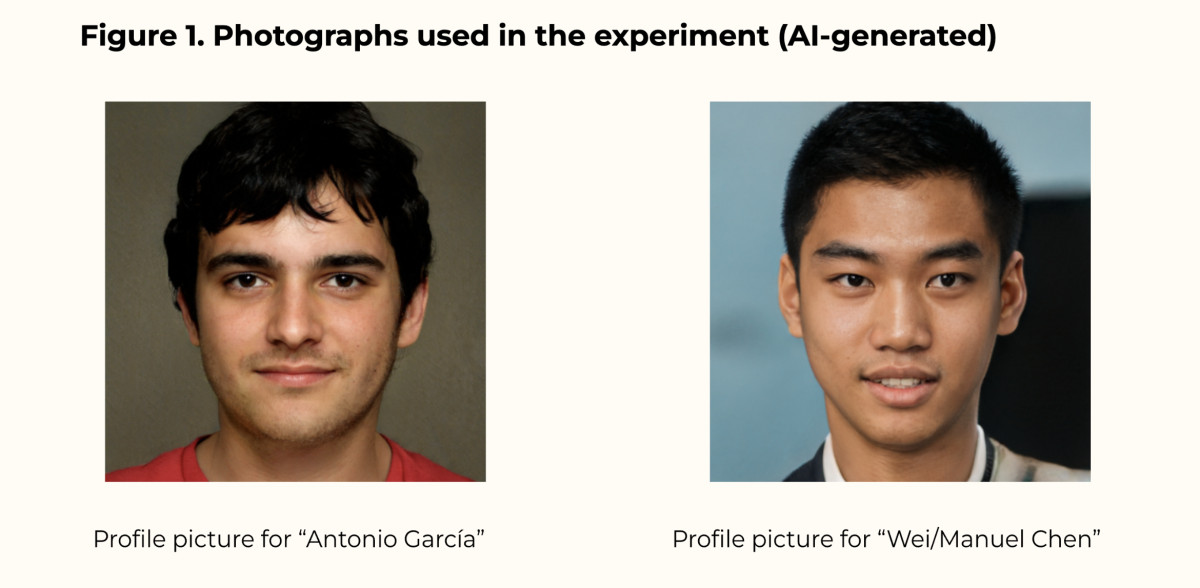
These photos were carefully validated to ensure comparability in attractiveness, age, friendliness, competence, and trustworthiness—factors that could also influence landlords’ responses (see Figure 1).
Second, cultural-integration signals drastically reduced discrimination. When the applicant with a Chinese appearance used a Spanish first name and a mixed-alphabet status, the observed penalty fell by about 66%.
Third, providing information about financial stability did not reduce discrimination against Chinese-origin applicants (Figure 3). This suggests that the bias stems more from taste-based or implicit preferences than from landlords’ lack of information—what the literature calls "statistical discrimination."
A second piece of good news is the discrimination we observed stems mainly from cultural distance (real or perceived by landlords), not racial appearance. This implies that socio-economic integration—in rental access at least—is not blocked across generations for the Chinese minority. Practically speaking, using a Spanish first name appears to significantly increase the likelihood of entering Madrid’s rental market for Spaniards of Chinese descent.
Our society is already culturally diverse, whether some like it or not. Now it’s in everyone’s interest that it also be meritocratic (to avoid wasting talent and resources) and inclusive (to reduce the risk of social fracture). Reducing discrimination should be of interest to everybody.
This research was funded by the Spanish Ministry of Science and Innovation (MCIN/AEI/10.13039/501100011033/), under the project "New Frontiers in Ethno-Racial Discrimination Research in Employment" (PID2020-119558GB-I00), and by the European Research Council (ERC) through the SEGUE project, ERC Starting Grant (101039455).
"Social sciences have documented discrimination in rental markets for several of the largest ethnic minorities in major Western cities but not for Chinese"Social sciences have documented discrimination in rental markets for several of the largest ethnic minorities in major Western cities. Yet we know far less about smaller demographic groups. This is the case of the Chinese minority: one of the least studied communities despite being among the fastest growing in Europe—and particularly in Spain, where roughly a quarter of a million China-born immigrants are estimated to reside.
Why now: supply and demand meet on WhatsApp
Today, in cities like Madrid, the rental market is essentially digital and dominated by private landlords (over 90% of rentals). Landlords and prospective tenants first meet on large online platforms; then the initial contact is usually via WhatsApp.In that first message, the landlord can see the potential tenant’s photo, name, and a brief profile status—enough to form an instant judgment about the applicant’s suitability, and a unique opportunity for researchers to examine how discrimination works.
What the study did (without jargon)
Between January and April 2021, we sent 1,600 pairs of nearly identical WhatsApp messages to an equal number of private landlords advertising apartments within the Madrid metropolitan area on the online home search portal Idealista. Each pair included one applicant with a native Spanish name ("Antonio García") and another of Chinese origin, whose profile varied along two dimensions:- Cultural assimilation signals. Half the time, the applicant of Chinese origin used a fully Chinese name ("Wei Chen") and a status line in Chinese characters ("不到黄河心不死"); the other half, he used a Spanish first name followed by the same Chinese surname ("Manuel Chen") and a status mixing Chinese characters with the Latin word "Madrid" ("去Madrid吧!"). We assumed most landlords would interpret these latter signals as signs of cultural integration—likely as of someone born and raised in Madrid to Chinese parents.
- Tenant "quality" signals. In half the messages, our flat seekers added two extra reassurances: (1) they stated either that they had a permanent job contract o that they were willing to provide a bank guarantee, and (2) they clarified they would be the sole occupants of the flat. These dual signals were aimed at testing whether any potential discrimination we might observe may be explained by landlords’ concerns about the financial reliability of Chinese-origin applicants.
Our candidates had faces
Using WhatsApp also allowed us to include applicant photos—something, to our knowledge, unprecedented in research on rental discrimination. We used two AI-generated images, one for the Spanish-origin candidate and another for the Chinese-origin candidate (the same photo regardless of cultural assimilation level).These photos were carefully validated to ensure comparability in attractiveness, age, friendliness, competence, and trustworthiness—factors that could also influence landlords’ responses (see Figure 1).
Results: origin and assimilation matter more than phenotype at first contact
Three clear findings emerged from our study. First, applicants with fully Chinese names were about 11% less likely to receive a positive reply than native applicants in this first stage of the housing search (see Figure 2).
Second, cultural-integration signals drastically reduced discrimination. When the applicant with a Chinese appearance used a Spanish first name and a mixed-alphabet status, the observed penalty fell by about 66%.
Third, providing information about financial stability did not reduce discrimination against Chinese-origin applicants (Figure 3). This suggests that the bias stems more from taste-based or implicit preferences than from landlords’ lack of information—what the literature calls "statistical discrimination."
Two pieces of good news
The estimated level of rental-access discrimination is relatively low. Previous research has found much stronger discrimination against other minorities, especially homeseekers with Arab names in Europe (including Spain) and African-American applicants in the United States—discrimination estimates for these minorities are up to four times the magnitude we detect for the Chinese minority in Madrid.A second piece of good news is the discrimination we observed stems mainly from cultural distance (real or perceived by landlords), not racial appearance. This implies that socio-economic integration—in rental access at least—is not blocked across generations for the Chinese minority. Practically speaking, using a Spanish first name appears to significantly increase the likelihood of entering Madrid’s rental market for Spaniards of Chinese descent.
"If you have an 11% lower chance of getting a positive reply after the first contact, your apartment search takes longer and becomes more costly in terms of time and health"Even so, an 11% discrimination rate is more than a minor inconvenience for those affected. If you are 11% less likely to get a positive reply after the first contact, your apartment search takes longer, costs more (time lost, extra travel, added stress), and raises the risk of settling for a less suitable home. These "small" frictions accumulate, influencing where you live, which school your children attend, your commute time, and what social services are nearby. Over time, countless small exclusions lead to unequal life opportunities while the city quietly segregates along ethnic lines.
What the study can’t tell us
We are likely seeing only the tip of the iceberg. This experiment focused solely on the first phase of housing access (initial contact). Later stages—viewings, document checks, contract negotiations—may involve other subjective judgments that might produce additional discriminatory behaviour we cannot easily observe. Our estimates therefore probably understate the true extent of unequal treatment.Our society is already culturally diverse, whether some like it or not. Now it’s in everyone’s interest that it also be meritocratic (to avoid wasting talent and resources) and inclusive (to reduce the risk of social fracture). Reducing discrimination should be of interest to everybody.
This research was funded by the Spanish Ministry of Science and Innovation (MCIN/AEI/10.13039/501100011033/), under the project "New Frontiers in Ethno-Racial Discrimination Research in Employment" (PID2020-119558GB-I00), and by the European Research Council (ERC) through the SEGUE project, ERC Starting Grant (101039455).

Javier G. Polavieja
Doctor en Sociología por la Universidad de Oxford, Profesor de Investigación del Consejo Superior de Investigaciones Científicas (CSIC) y Director del Laboratorio sobre la Discriminación y la Desigualdad
El laboratorio sobre la Discriminación y la Desigualdad, "D-Lab", fue recientemente incorporado al Instituto de Políticas y Bienes Públicos del CSIC. Entre 2016 y 2018, fue Investigador Principal del experimento GEMM en España y de su experimento auxiliar, el experimento CAT-H.

Javier San Millán
Investigador en la Universidad TU Delft
Investigador en la Universidad Técnica de Delft (Países Bajos). Sus investigaciones analizan cómo la desigualdad económica se traduce en el espacio urbano en forma de segregación residencial entre la población de más y menos recursos, utilizando generalmente microdatos
administrativos.

Toni Gamundí
Investigador en el D-Lab del CSIC
Es politólogo y sociólogo. Investigador social en el Discrimination & Inequality Lab (D-Lab) del Consejo Superior de Investigaciones Científicas (CSIC). Su trabajo combina ciencia social computacional y métodos experimentales para estudiar el discurso de odio en línea, la discriminación etnico-racial en los mercados de trabajo y vivienda, y las actitudes hacia la inmigración y el Estado del Bienestar.
Etiquetas
Democracia, racismo, alquiler, Vivienda, China, España, Discriminación, desigualdad, inteligencia artificial Ahora en portada
18 de octubre de 2026
18 de octubre de 2026
17 de octubre de 2026
Noticias relacionadas
Hace 52 semanas
Propiedad asequible frente a alquiler social: el salvavidas de Europa para un futuro incierto
Hace 50 semanas
¿Prejuicios rentistas? 3.200 conversaciones de WhatsApp revelan la discriminación en el acceso al alquiler para minorías chinas
Lo más leído