Viernes, 16 de octubre de 2026




EXCLUSIVE STORY
Diary of an MEP in China: What should Europe do about China’s industrial policy?
Following his examination of the main issues facing China’s economy – particularly its problems of industrial 'involution' – MEP Jonás Fernández provides an exclusive analysis focused on what Europe should do in response. This second installment on the Chinese economy argues for a strategy of precision: dialogue around global public goods, selective protection against Chinese 'involution', and a European industrial policy focused on eliminating internal barriers rather than manufacturing European 'champions'.
MEP Jonás Fernández concludes with the second installment of his 'Diaries of an MEP in China'.European Parliament
This second analysis, preceded by an article on the current state of the Chinese economy, is divided into three parts. It begins with a quick overview of the political scenario, aimed at assessing whether China’s institutional framework is favoring the resolution of its economic problems. Next, in view of China’s impact on the global economy, some ideas are presented for a response by the European Union. Finally, some general conclusions are offered.
At the same time, the degree of Party supervision and control over China has been increasing, especially since the removal of presidential term limits, which allowed the prolongation of Xi Jinping’s leadership. I do not propose to detail the problems of economic activity under autocratic political systems, but I will argue that, even in non-democratic models, checks and balances and the relative distribution of power can lessen the disadvantages of power being concentrated into very few hands.
However, the break in rotation with Xi Jinping’s third term reopened uncertainties around the country’s institutional framework, which seems to be strengthening the most authoritarian leanings of that State of pseudo-rights with Chinese characteristics constructed at the end of the 20th century and into the 21st.
In the exclusively economic sphere, in 2020 the Chinese government launched a campaign to redouble its control over the country’s business landscape. The Communist Party dramatically increased its activity within Chinese companies and even multinationals, and various proceedings (judicial or extrajudicial) were initiated against business leaders who had at some point shown discrepancies vis-à-vis the country’s economic policy. Perhaps the best-known case in the West was the 2020 disappearance of Jack Ma, founder of Alibaba, who went missing for three years, suspending the planned IPO of his Ant Group conglomerate. Similar operations were deployed against other tech companies, including Tencent and Didi Global, with the goal of tightening Party control over their activities.
In the same vein, State-owned enterprises (SOEs) regained their prominence in China’s industrial fabric, exerting influence in energy, banking, telecommunications, heavy industry, and other areas. Certain well-known entrepreneurs vanished from the public spotlight, including China Renaissance founder Bao Fan in 2023. Ren Zhiqiang, head of a State-owned real estate company (and a defender of freedom of expression) was sentenced in 2020 to 18 years in prison; Xiao Jianhua disappeared from a Hong Kong hotel in 2017 and didn’t resurface until 2022 in mainland China, at a corruption trial that resulted in a 13-year sentence. The government defended those actions as anti-corruption operations, but distinguishing cases of corruption from strictly political persecutions remains difficult.
With those two purges, Xi consolidated his power at the beginning of his first term. Later, in 2017, emerging possible successor Sun Zhengcai also wound up in prison with a life sentence, again for corruption. One year earlier, a close associate of Hu Jintao named Ling Jihua had also been arrested on identical charges and given a life sentence, unraveling trust in the prior presidential regime.
Similarly, between 2014 and 2016, two members of the Central Military Commission (Xu Caihou and Guo Boxiong) were accused of corruption. Their departure from the military’s highest circle allowed Xi Jinping to expand control over the armed forces. More recently, foreign minister Qin Gang went missing in 2023, with no news of him since; and defense minister Li Shangfu was dismissed in 2024, expelled from the Communist Party and charged with corruption.
This summarized list of political, business, and military indictments and purges, reported in the West, leads one to a presumption that these sorts of actions may be happening at other levels, in both the government and the military.
Likewise, taking advantage of new developments in digital technologies and artificial intelligence, the Communist Party’s growing control isn’t only focused on purging potential rivals or critics in politics, business, or the military – it now extends to mass surveillance of citizens. Internet guardrails, facial identification programs, social credit systems in the digital sphere, AI geared for crime prediction, and new laws for racial and social uniformity indicate an increasingly all-encompassing State.
All of which suggests a reversal in China’s institutionalization of power, which now appears to be absolutely centralized in the president. The State of pseudo-rights with Chinese characteristics created after Mao Zedong’s demise is now fading, ushering in a return of imperial power.
This relatively general political reflection comes in the wake of a debate on the economic plausibility of implementing current planned policies to strengthen consumption, balance the current account, build a more thorough network of social policies, and maintain the industrial commitments of past decades. As I wrote in the preceding article, in order to meet those objectives, the government will need to increase public spending, which won’t be easy if the budgetary priorities of China’s dirigiste industrial policy are to be maintained; it could also lead to problems of involution in other sectors of the economy. Meanwhile, the development of institutional reforms meant to strengthen and expand social security systems (to bring down the rate of savings) doesn’t seem to enjoy ideological or cultural support within the government. Finally, the liberalization of financial flows and the facilitated entry of FDI are notably missing from the current agenda, boosting their apparent difficulty under the regime’s political framework of autocratic reinforcement.
In the economic sphere, the impacts of COVID-19 (2020-2022) and the war that immediately followed compelled a new consensus on trade relations and globalization. The maximalist position of EU institutions in favor of free trade began to soften thanks to supply shortfalls during the most severe months of the pandemic, driving a slowdown in both mobility and social interaction. As activity in Europe recovered, dislocations in trade flows were felt through inflation, and a shortage of basic (especially health-related) products led to reflections on the need to recover some local production of goods that had been outsourced in the name of economic efficiency.
This reorientation of industrial and trade policy was very present in the Draghi report, requested by the Commission at the end of the last legislature. Presented in September of 2024, the report unveiled a new economic policy agenda. Not long afterward, the impacts of U.S. tariff policies forced the EU to move from reflection to concrete decision-making. In addition, the expanding trade deficit with China was reaching stratospheric figures – more than €300 billion in 2025 – with positive effects on the prices of many inputs, but also posing a threat to the continent’s industrial vitality, precisely when European authorities were looking to promote industrial policies that would enhance security of supply after the negative impacts of COVID-19 and the war in Ukraine.
Given all of this, Europe now needs to find its own way and create a space for dialogue with China. Following my earlier description of the challenges facing the Chinese economy, and without attempting to be exhaustive, I can now set forth some recommendations for European economic policy.
In any case, Europe should not adopt a protectionist trade policy in the face of a negative balance in any of the trade headings. Data on the sectoral state of the Chinese economy is certainly difficult to obtain in a country so informationally opaque. Universal threats over trade might be useful, but only to the extent that they allow information to emerge that would surgically delimit the degree of protectionism for European trade policy.
This manner of approaching a revision of our trade relationship with China would also help to align interests within the Union. Currently, there are business sectors in which value chains are fully intertwined, with companies operating both here and there across various stages of production. We’re witnessing the emergence of debates and public positions in some Member States conditioned by their interrelationship with the Chinese economy, leading some governments to pursue aggressive trade policies while others take a lighter approach, depending on local interests and sometimes resulting in ad hoc exceptions. Such a framework for debate can only result in a trade policy that creates more problems than it solves.
For that reason, I believe that the debate in Europe must be reordered in a way that doesn’t accuse China of dumping with every sectoral trade deficit but that focuses discussion on the negative externalities of China’s aggressive industrial policies. As I explained in the previous article, those policies are behind the country’s problems of involution, and it seems that they won’t be efficiently corrected under the new Five-Year Plan. At the same time, we must adopt protection policies that minimize the risks of potential destabilization of the Chinese economy.
On another note, Europe needs to take a position on financial and capital flows vis-à-vis China. Beyond economic considerations, the authoritarian regression of the Chinese regime raises questions about the dependencies derived from direct investment. It would therefore be appropriate to adopt a prudent position that mitigates the risks of strong dependencies on a country whose political institutions operate under a logic very different from that of pluralistic societies, which could compromise the Union’s own room for maneuver in situations of geopolitical stress.
Finally, in this same area, and in view of the degree of entropy introduced by the Trump administration into international trade flows, the EU is correct in pursuing new trade agreements that reduce our dependence on the U.S. economy and open new markets for our companies, fleeing from protectionist a priorism and internalizing the costs of our environmental policies on imports aimed at protecting global public goods like our shared atmosphere while avoiding tariff campaigns that end in shared impoverishment.
As regards the revised industrial policy, Europe can’t look to China’s industrial strategies as an example to follow. Europe would be wise to bear in mind the effects of dirigiste policies now exploding in the Chinese economy under the concept of involution – exactly as transpired on our continent in the 1970s and 1980s.
Along those same lines, it is vital that we improve our digital and telecommunications interconnections and exploit our single market with a common regulatory framework for the deployment of artificial intelligence, avoiding the regulatory fragmentation of other jurisdictions.
That revision of the single market must go hand-in-hand with the Europeanization of a significant proportion of the social insurance frameworks that EU Member States have built through welfare, and this must adapt to greater geographical mobility of labor.
Beyond those horizontal policies, vertical policies will also be appropriate in cases where the security and stability of our societies are at stake. In areas such as defense, the green transition, capabilities in space, and certain others, Europe must accelerate policies aimed at strengthening strategic autonomy. But it must also remain aware that all the lobbies in any sector will seek to define themselves as strategic in order to receive public protection at the expense of the general welfare. We must remain prudent and bear in mind China’s problems of involution.
In addition, industrial policies aimed at creating European champions that require new revisions of competition policies will destroy value for the European economy, increasing the market power of local and sectoral oligopolies. The only way to foster businesses that compete more efficiently in global markets is through the breaking down of national barriers that fragment the market and that reduce the efficient size of companies.
Europe mustn’t further the softening of State aid or artificially favor corporate mergers in national markets. Let us instead strengthen the single market as an exclusive way to facilitate the growth of our companies and improve the profitability of our industrial sector, without the national biases that lead to intra-community relocations due to the greater fiscal capacity of one country or another. Let us not be dazzled by the growth of Chinese companies that under a dirigiste industrial policy will end up paralyzing China’s economy, as happened here in Europe not so long ago.

The European Union must therefore find a space for dialogue and deliberation with the Chinese authorities in areas that affect global public goods. The fight against climate change, the need for shared frameworks for developing technologies linked to artificial intelligence and biotech, where universal ethical standards remain essential, as well as space exploration and the principle of free navigation are a few of the areas where sincere conversations must take place – since at present there’s no dependable interlocutor in the U.S. White House.
In economic matters, China’s presence in global markets offers both opportunities and risks. The entry of an economy with over 1 billion persons into the global market can only be welcomed. Nonetheless, its industrial policies are disrupting international trade outside the logic of the market. Those policies might be a minor drawback in terms of global imbalances, but China’s size is sufficiently relevant that such imbalances can lead to very severe dysfunctions.
As mentioned before, the problem of involution (in the terminology of the Chinese authorities) isn’t anything that we Europeans haven’t already seen. Europe’s industrial restructuring of the 1980s offers a good example of where indiscriminate vertical policies can lead, and the Chinese economy is beginning to suffer the exact same problems.
Moreover, the arrival of the word involution to the Chinese dictionary indicates that the problem is already very present for China’s authorities and businesses. The term is used to differentiate export-oriented sectors with a capacity above local demand from the sale of other goods at below-cost prices; when installed capacity is twice the global demand, with direct impacts on financial and fiscal stability, restructuring can’t be postponed.
However, the reorientation required to address this serious problem is nowhere to be found in the design of China’s latest Five-Year Plan, the 15th in its history, where measures to correct those developments are less than credible, while proposals that could aggravate the source of the crisis are numerous. We must also bear in mind the increasing assertiveness of the Chinese authorities, which doesn’t bode well for improvements in the treatment of pathologies within their economy, which ought to be addressed by a more pluralistic society, with more space for business innovation and a relatively open financial framework.
Faced with all of that, Europe needs to permit ordinary trade, justified by competitive advantages, without imposing universal protectionist measures. On the other hand, we must also identify those goods where Chinese production is suffering involution in order to protect ourselves from future impacts that destabilize international trade flows, beyond the damage this is already causing to the Chinese economy. As regards FDI, Europe must protect its own political autonomy, which could be compromised should its local industrial fabric develop dependencies on Chinese companies subject to extraordinary political influence by the Chinese authorities, outside any market logic.
This is the second part of a comprehensive analysis of the Chinese economy. The first installment is available here.
Political-institutional considerations and their impact on the reorientation of economic policy
Long after the founding of the People’s Republic of China, and after many decades without a clear approach to economic policy, the governing Chinese regime finally managed to stabilize the country and lead it with an iron fist toward markets and economic openness, even while the Communist Party maintained control over institutions, companies, and society. The success of that mission across the past four decades is unquestionable, but diminishing (and sometimes negative) returns are now becoming evident.At the same time, the degree of Party supervision and control over China has been increasing, especially since the removal of presidential term limits, which allowed the prolongation of Xi Jinping’s leadership. I do not propose to detail the problems of economic activity under autocratic political systems, but I will argue that, even in non-democratic models, checks and balances and the relative distribution of power can lessen the disadvantages of power being concentrated into very few hands.
"The Chinese regime finally managed to stabilize the country and lead it with an iron fist toward markets and economic openness, even while the Communist Party maintained control over institutions, companies, and society"Somehow, even in the political sphere, the period inaugurated by Deng Xiaoping made it possible to construct what we might call a State of pseudo-rights with Chinese characteristics, through expansion of the spaces for decision-making (albeit still within the Communist Party) and through greater institutionalization of the exercise of power. Those changes crystallized during the presidencies of Jiang Zemin and Hu Jintao, also imposing leadership-rotation and limiting presidents to two terms.
However, the break in rotation with Xi Jinping’s third term reopened uncertainties around the country’s institutional framework, which seems to be strengthening the most authoritarian leanings of that State of pseudo-rights with Chinese characteristics constructed at the end of the 20th century and into the 21st.
In the exclusively economic sphere, in 2020 the Chinese government launched a campaign to redouble its control over the country’s business landscape. The Communist Party dramatically increased its activity within Chinese companies and even multinationals, and various proceedings (judicial or extrajudicial) were initiated against business leaders who had at some point shown discrepancies vis-à-vis the country’s economic policy. Perhaps the best-known case in the West was the 2020 disappearance of Jack Ma, founder of Alibaba, who went missing for three years, suspending the planned IPO of his Ant Group conglomerate. Similar operations were deployed against other tech companies, including Tencent and Didi Global, with the goal of tightening Party control over their activities.
In the same vein, State-owned enterprises (SOEs) regained their prominence in China’s industrial fabric, exerting influence in energy, banking, telecommunications, heavy industry, and other areas. Certain well-known entrepreneurs vanished from the public spotlight, including China Renaissance founder Bao Fan in 2023. Ren Zhiqiang, head of a State-owned real estate company (and a defender of freedom of expression) was sentenced in 2020 to 18 years in prison; Xiao Jianhua disappeared from a Hong Kong hotel in 2017 and didn’t resurface until 2022 in mainland China, at a corruption trial that resulted in a 13-year sentence. The government defended those actions as anti-corruption operations, but distinguishing cases of corruption from strictly political persecutions remains difficult.
"The Communist Party dramatically increased its activity within Chinese companies and even multinationals, and various proceedings (judicial or extrajudicial) were initiated against business leaders"In the same way, alleged anti-corruption campaigns under Xi Jinping have also shaken the foundations of the Communist Party’s own power. In 2014, Zhou Yongkang – in charge of State security, and one of seven members of China’s top executive body, the Politburo Standing Committee – was charged with corruption and sentenced to life imprisonment. Bo Xilai, who might have once competed against Xi for leadership, was likewise sentenced in 2013 to life in prison, on similar corruption charges.
With those two purges, Xi consolidated his power at the beginning of his first term. Later, in 2017, emerging possible successor Sun Zhengcai also wound up in prison with a life sentence, again for corruption. One year earlier, a close associate of Hu Jintao named Ling Jihua had also been arrested on identical charges and given a life sentence, unraveling trust in the prior presidential regime.
Similarly, between 2014 and 2016, two members of the Central Military Commission (Xu Caihou and Guo Boxiong) were accused of corruption. Their departure from the military’s highest circle allowed Xi Jinping to expand control over the armed forces. More recently, foreign minister Qin Gang went missing in 2023, with no news of him since; and defense minister Li Shangfu was dismissed in 2024, expelled from the Communist Party and charged with corruption.
This summarized list of political, business, and military indictments and purges, reported in the West, leads one to a presumption that these sorts of actions may be happening at other levels, in both the government and the military.
"Foreign Minister Qin Gang went missing in 2023, with no news of him since; and Defense Minister Li Shangfu was dismissed in 2024, expelled from the Communist Party and charged with corruption"From Europe, one can’t verify whether those accusations of corruption are merely an instrumental excuse for targeted elimination or whether those disappearances and sentences (under the inconceivable and exquisite disposition of the Chinese courts) might be justified. Both are probably true, insofar as corruption is the natural result of an environment without freedom of the press or independence of powers. Still, the focus of those cases on competitors or obstacles to Xi Jinping’s expansion of power points in one direction: the mounting autocracy of the regime.
Likewise, taking advantage of new developments in digital technologies and artificial intelligence, the Communist Party’s growing control isn’t only focused on purging potential rivals or critics in politics, business, or the military – it now extends to mass surveillance of citizens. Internet guardrails, facial identification programs, social credit systems in the digital sphere, AI geared for crime prediction, and new laws for racial and social uniformity indicate an increasingly all-encompassing State.
All of which suggests a reversal in China’s institutionalization of power, which now appears to be absolutely centralized in the president. The State of pseudo-rights with Chinese characteristics created after Mao Zedong’s demise is now fading, ushering in a return of imperial power.
This relatively general political reflection comes in the wake of a debate on the economic plausibility of implementing current planned policies to strengthen consumption, balance the current account, build a more thorough network of social policies, and maintain the industrial commitments of past decades. As I wrote in the preceding article, in order to meet those objectives, the government will need to increase public spending, which won’t be easy if the budgetary priorities of China’s dirigiste industrial policy are to be maintained; it could also lead to problems of involution in other sectors of the economy. Meanwhile, the development of institutional reforms meant to strengthen and expand social security systems (to bring down the rate of savings) doesn’t seem to enjoy ideological or cultural support within the government. Finally, the liberalization of financial flows and the facilitated entry of FDI are notably missing from the current agenda, boosting their apparent difficulty under the regime’s political framework of autocratic reinforcement.
"The development of institutional reforms meant to strengthen and expand social security systems doesn’t seem to enjoy ideological or cultural support within the government"In a social and political environment marked by growing authoritarianism, that framework of means and objectives looks even more unlikely. Thus, regardless of other effects of China’s institutional and political drift on which I need not dwell, such a reversal is clearly incompatible with an expansion of freedom and individual responsibility, at least in the economic and business spheres – which the government needs, to fulfill its announced objectives.
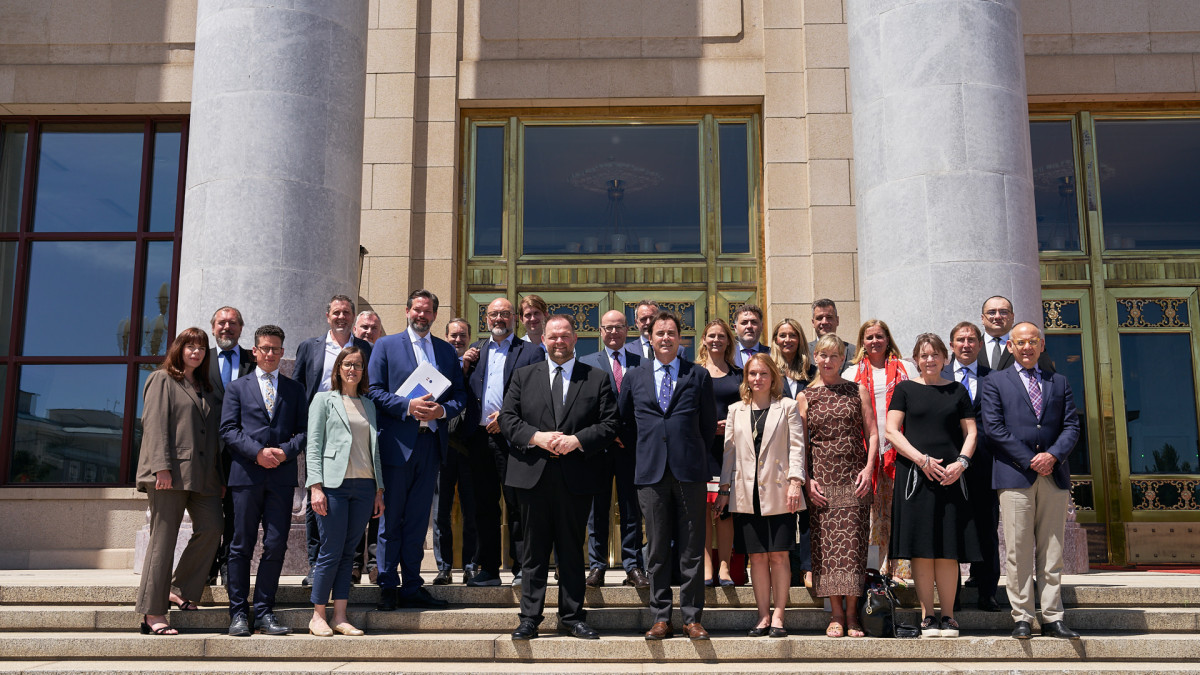
The European Parliament delegation to China last month, with Jonás Fernández. Photo: European Parliament
What must Europe do?
China’s emergence into the global political and economic arena, the withdrawal and unpredictable behavior of the Trump administration in the United States, and Vladimir Putin’s war of aggression in Ukraine are all forcing a reconsideration of the European Union’s role in the world and of its internal policies.In the economic sphere, the impacts of COVID-19 (2020-2022) and the war that immediately followed compelled a new consensus on trade relations and globalization. The maximalist position of EU institutions in favor of free trade began to soften thanks to supply shortfalls during the most severe months of the pandemic, driving a slowdown in both mobility and social interaction. As activity in Europe recovered, dislocations in trade flows were felt through inflation, and a shortage of basic (especially health-related) products led to reflections on the need to recover some local production of goods that had been outsourced in the name of economic efficiency.
"As activity in Europe recovered, dislocations in trade flows were felt through inflation and a shortage of basic products"In the same vein, the start of the war in Ukraine and corresponding sanctions on Russia revealed the dependence of Europe’s economy on third countries – in this case Ukraine, paralyzed by the war, as well as Russia, paralyzed by sanctions. Meanwhile, the particularly strong environmental policies contained in the 2019-2024 mandate raised security standards on imports that failed to internalize the environmental costs that EU regulations began to impose on companies and households. Europe in this way sought to nuance its defense of free trade, announcing new industrial policies to reduce excessive dependencies and help ensure that the green transition was equipped with safeguards to mitigate the risks of localization.
This reorientation of industrial and trade policy was very present in the Draghi report, requested by the Commission at the end of the last legislature. Presented in September of 2024, the report unveiled a new economic policy agenda. Not long afterward, the impacts of U.S. tariff policies forced the EU to move from reflection to concrete decision-making. In addition, the expanding trade deficit with China was reaching stratospheric figures – more than €300 billion in 2025 – with positive effects on the prices of many inputs, but also posing a threat to the continent’s industrial vitality, precisely when European authorities were looking to promote industrial policies that would enhance security of supply after the negative impacts of COVID-19 and the war in Ukraine.
Given all of this, Europe now needs to find its own way and create a space for dialogue with China. Following my earlier description of the challenges facing the Chinese economy, and without attempting to be exhaustive, I can now set forth some recommendations for European economic policy.
"The impacts of U.S. tariff policies forced the EU to move from reflection to concrete decision-making, while the expanding trade deficit with China was reaching stratospheric figures"First, the Chinese authorities are right to differentiate between alleged problems of overcapacity and those caused by the involution of their industrial policy, although they’ve wrongly identified the causes, raising questions about possible future correction. Correct differentiation should make it possible to design a trade policy that fosters the competitive advantages of each jurisdiction while protecting against the harmful effects of Chinese involution. From an extreme free-trade position, it might be argued that any safeguards would reduce consumer welfare by raising prices on imports. But some Chinese exports from sectors where companies are unable to profit from their installed capacity represent a double-edged advantage for the European consumer, as well as a genuine threat to the development of local production, also affecting social and political stability in certain regions.
In any case, Europe should not adopt a protectionist trade policy in the face of a negative balance in any of the trade headings. Data on the sectoral state of the Chinese economy is certainly difficult to obtain in a country so informationally opaque. Universal threats over trade might be useful, but only to the extent that they allow information to emerge that would surgically delimit the degree of protectionism for European trade policy.
This manner of approaching a revision of our trade relationship with China would also help to align interests within the Union. Currently, there are business sectors in which value chains are fully intertwined, with companies operating both here and there across various stages of production. We’re witnessing the emergence of debates and public positions in some Member States conditioned by their interrelationship with the Chinese economy, leading some governments to pursue aggressive trade policies while others take a lighter approach, depending on local interests and sometimes resulting in ad hoc exceptions. Such a framework for debate can only result in a trade policy that creates more problems than it solves.
For that reason, I believe that the debate in Europe must be reordered in a way that doesn’t accuse China of dumping with every sectoral trade deficit but that focuses discussion on the negative externalities of China’s aggressive industrial policies. As I explained in the previous article, those policies are behind the country’s problems of involution, and it seems that they won’t be efficiently corrected under the new Five-Year Plan. At the same time, we must adopt protection policies that minimize the risks of potential destabilization of the Chinese economy.
"I believe that the debate in Europe must be reordered in a way that focuses discussion on the negative externalities of China’s aggressive industrial policies"On the other hand, Europe still enjoys a small but significant surplus in the services account, which represents a clear competitive advantage for European companies. As such, it would seem appropriate to convey to the Chinese authorities our identification of certain concerns around the reorientation of their economic policy – at minimum, the notable drawbacks they’re likely to encounter when pursuing the goals announced in the new Five-Year Plan. This could offer a space for broad cooperation which might allow an opening of markets related to services, feeding back into a process of mutually beneficial trade flows between the jurisdictions.
On another note, Europe needs to take a position on financial and capital flows vis-à-vis China. Beyond economic considerations, the authoritarian regression of the Chinese regime raises questions about the dependencies derived from direct investment. It would therefore be appropriate to adopt a prudent position that mitigates the risks of strong dependencies on a country whose political institutions operate under a logic very different from that of pluralistic societies, which could compromise the Union’s own room for maneuver in situations of geopolitical stress.
Finally, in this same area, and in view of the degree of entropy introduced by the Trump administration into international trade flows, the EU is correct in pursuing new trade agreements that reduce our dependence on the U.S. economy and open new markets for our companies, fleeing from protectionist a priorism and internalizing the costs of our environmental policies on imports aimed at protecting global public goods like our shared atmosphere while avoiding tariff campaigns that end in shared impoverishment.
As regards the revised industrial policy, Europe can’t look to China’s industrial strategies as an example to follow. Europe would be wise to bear in mind the effects of dirigiste policies now exploding in the Chinese economy under the concept of involution – exactly as transpired on our continent in the 1970s and 1980s.
"EU is correct in pursuing new trade agreements that reduce our dependence on the U.S. economy"In this way, Europe should sustain a horizontal approach to industrial policy that addresses the real bottlenecks strangling our economy. The 'shadow tariffs' identified by the IMF within our single market – estimated at 42% in trade in goods, and at 100% in services, and which the ECB has recalibrated to 60% and 110, respectively – are the true obstacle to boosting our growth potential and making a sustainable future viable for European industry. There’s no better growth strategy than to eliminate those internal barriers to intra-EU trade, alongside investments in energy interconnections, to exploit the lower costs of clean energy during the green transition.
Along those same lines, it is vital that we improve our digital and telecommunications interconnections and exploit our single market with a common regulatory framework for the deployment of artificial intelligence, avoiding the regulatory fragmentation of other jurisdictions.
That revision of the single market must go hand-in-hand with the Europeanization of a significant proportion of the social insurance frameworks that EU Member States have built through welfare, and this must adapt to greater geographical mobility of labor.
Beyond those horizontal policies, vertical policies will also be appropriate in cases where the security and stability of our societies are at stake. In areas such as defense, the green transition, capabilities in space, and certain others, Europe must accelerate policies aimed at strengthening strategic autonomy. But it must also remain aware that all the lobbies in any sector will seek to define themselves as strategic in order to receive public protection at the expense of the general welfare. We must remain prudent and bear in mind China’s problems of involution.
"Revision of the single market must go hand-in-hand with the Europeanization of a significant proportion of the social insurance frameworks that Member States have built"On the other hand, any industrial policy will require public resources whose purposes compete with other policies where the effect on growth may be much greater. In that respect, the EU budget is extremely weak for such ventures, and the cost of diverting resources away from cohesion, education, or other priorities will have very negative effects on what are genuinely European public goods. In contrast, it would have little impact on the promotion of industrial policies, which if universal will require the assistance of national budgets, plus a thorough review of the rules governing State aid, which would ultimately undermine the greatest asset of our strategic autonomy: the single market, which we must promote.
In addition, industrial policies aimed at creating European champions that require new revisions of competition policies will destroy value for the European economy, increasing the market power of local and sectoral oligopolies. The only way to foster businesses that compete more efficiently in global markets is through the breaking down of national barriers that fragment the market and that reduce the efficient size of companies.
Europe mustn’t further the softening of State aid or artificially favor corporate mergers in national markets. Let us instead strengthen the single market as an exclusive way to facilitate the growth of our companies and improve the profitability of our industrial sector, without the national biases that lead to intra-community relocations due to the greater fiscal capacity of one country or another. Let us not be dazzled by the growth of Chinese companies that under a dirigiste industrial policy will end up paralyzing China’s economy, as happened here in Europe not so long ago.
The S&D coordinator at the European Parliament’s committee on economic affairs, in Beijing. Photo: European Parliament
Some conclusions
The emergence of China has opened a new global framework of international relations, with political effects as well as economic ones. On top of this major development are the entropy of the U.S. administration, the growing aggressiveness of Russia, instability in the Middle East, crises arising from migratory flows, effects of technological advances on the very nature of human society, and the profound challenges of climate change. The world is in a process of intense transformation, demanding responses from the Union."Let us not be dazzled by the growth of Chinese companies that under a 'dirigiste' industrial policy will end up paralyzing China’s economy"In relation to the questions being prompted by China’s situation in the global sphere – the chief concern of this essay – Europe must bear several things in mind. First of all, the autocratic nature of the Xi administration, which has intensified in recent years. Given the reckless behavior of the United States, China has been bringing a degree of stability that certainly ought to be welcomed. The widening of China’s influence isn’t without conditions and geopolitical risks that range beyond its borders, but to date, the country has played a role of moderation and stabilization in many regards, and that needs to be recognized.
The European Union must therefore find a space for dialogue and deliberation with the Chinese authorities in areas that affect global public goods. The fight against climate change, the need for shared frameworks for developing technologies linked to artificial intelligence and biotech, where universal ethical standards remain essential, as well as space exploration and the principle of free navigation are a few of the areas where sincere conversations must take place – since at present there’s no dependable interlocutor in the U.S. White House.
"The European Union must therefore find a space for dialogue and deliberation with the Chinese authorities in areas that affect global public goods"Likewise, the global multilateral institutions created after the Second World War have to accommodate the presence of China or risk their own dismantling at the hands of another global order that appears to be arising in diametric opposition, where the old rules are replaced by others, whether by force or by forcing drastic changes in ourselves. For the time being, China is insisting on the need for a rules-based world, even if those rules must be adapted; such a revision will leave us with a framework substantially better than the lawless jungle represented by Trump, Netanyahu, and Putin. That said, and returning to China’s autocratic nature, the task won’t be easy, but Europe finds itself with no choice.
In economic matters, China’s presence in global markets offers both opportunities and risks. The entry of an economy with over 1 billion persons into the global market can only be welcomed. Nonetheless, its industrial policies are disrupting international trade outside the logic of the market. Those policies might be a minor drawback in terms of global imbalances, but China’s size is sufficiently relevant that such imbalances can lead to very severe dysfunctions.
As mentioned before, the problem of involution (in the terminology of the Chinese authorities) isn’t anything that we Europeans haven’t already seen. Europe’s industrial restructuring of the 1980s offers a good example of where indiscriminate vertical policies can lead, and the Chinese economy is beginning to suffer the exact same problems.
Moreover, the arrival of the word involution to the Chinese dictionary indicates that the problem is already very present for China’s authorities and businesses. The term is used to differentiate export-oriented sectors with a capacity above local demand from the sale of other goods at below-cost prices; when installed capacity is twice the global demand, with direct impacts on financial and fiscal stability, restructuring can’t be postponed.
However, the reorientation required to address this serious problem is nowhere to be found in the design of China’s latest Five-Year Plan, the 15th in its history, where measures to correct those developments are less than credible, while proposals that could aggravate the source of the crisis are numerous. We must also bear in mind the increasing assertiveness of the Chinese authorities, which doesn’t bode well for improvements in the treatment of pathologies within their economy, which ought to be addressed by a more pluralistic society, with more space for business innovation and a relatively open financial framework.
Faced with all of that, Europe needs to permit ordinary trade, justified by competitive advantages, without imposing universal protectionist measures. On the other hand, we must also identify those goods where Chinese production is suffering involution in order to protect ourselves from future impacts that destabilize international trade flows, beyond the damage this is already causing to the Chinese economy. As regards FDI, Europe must protect its own political autonomy, which could be compromised should its local industrial fabric develop dependencies on Chinese companies subject to extraordinary political influence by the Chinese authorities, outside any market logic.
"We must bear in mind the increasing assertiveness of the Chinese authorities, which doesn’t bode well for improvements in the treatment of pathologies within their economy"Thus we should seek not to replicate China’s industrial policies, despite the spectacular ways in which they’re sometimes presented in public debate. Our own experience and the problems they are already facing in China should serve as an alarm, to avoid further misadventures. Furthermore, if care isn’t taken, Europe’s institutional framework could contribute to worsening those difficulties. Vertical decisions (made in Brussels and financed by national budgets) that relax the regulation of State aid and revise the rules on competition, without prior consolidation of the single market, could end up shattering the single market – our greatest asset in the strategic autonomy we hope to achieve. So let’s remove our national obstacles to market consolidation and surgically decide on which sectors to develop through vertical policies (such as space, security, or the climate transition) and then finance those efforts in solidarity, without having to divert resources from the horizontal policies essential to a successful industrial policy: education, research, innovation, infrastructure, and interconnection.
This is the second part of a comprehensive analysis of the Chinese economy. The first installment is available here.

Jonás Fernández Álvarez
Diputado al Parlamento Europeo en el Grupo de la Alianza Progresista de Socialistas y Demócratas, del que es coordinador en el Comité de Asuntos Económicos y Monetarios
Fue Economista Jefe en Solchaga Recio & Asociados antes de ser elegido eurodiputado en 2014. Ha impartido docencia en la Universidad Carlos III, colabora en medios y cuenta con experiencia en asesoramiento económico al PSOE, así como en programas internacionales de liderazgo.
Ahora en portada
16 de octubre de 2026
16 de octubre de 2026
16 de octubre de 2026
Noticias relacionadas
Hace 17 semanas
Diario de un eurodiputado en China: ¿Qué debe hacer Europa ante la política industrial china?
Hace 17 semanas
Diary of an MEP in China: Is the Chinese economy really doing so well?
Lo más leído