Sábado, 17 de octubre de 2026




FREE TRADE
EU-Mercosur treaty moves forward with Spanish impetus and French resistance
It promises growth, strengthens Europe's global projection and brings two continents closer together. But the EU-Mercosur agreement is still stuck, with France leading the opposition and the agricultural sector on the warpath. Economist Miguel Ortiz explores why this pact remains unsigned and what role Spain can play in breaking the deadlock.
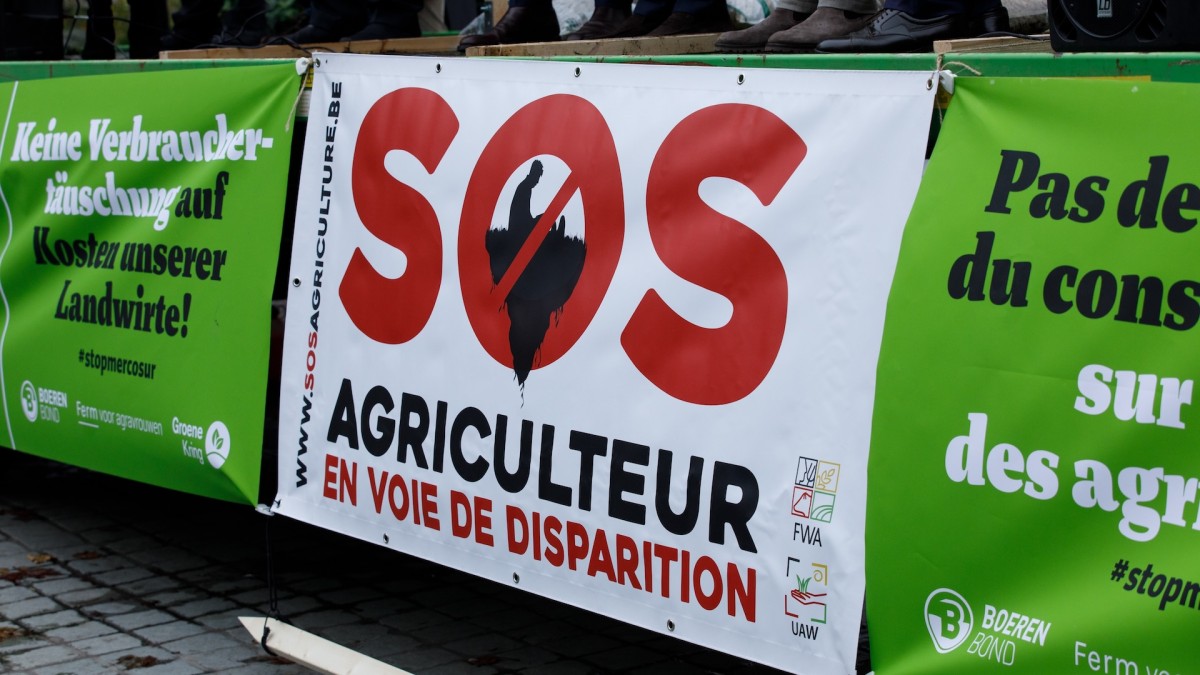
Protests in Brussels ahead of the signing of the free trade agreement between the European Union and Mercosur.Hatim Kaghat / Zuma Press / ContactoPhoto
On 27th November 2024, shortly before former French Prime Minister Michel Barnier was removed from office, the French National Assembly debated and voted by an overwhelming majority to oppose the ratification of the free trade agreement between the European Union and Mercosur (comprising Argentina, Brazil, Paraguay, and Uruguay). This vote came ahead of the agreement's signing on 6th December 2024, which confirmed the culmination of the minimal accord reached in 2019. Its definitive implementation would involve a massive reduction in trade barriers. This would integrate a market of around 700 million people on both sides of the Atlantic.
In the academic world, it is often argued that policies aimed at promoting free trade tend to generate more benefits than drawbacks. These include a greater variety of products, increased competition, improved global factor productivity, and downward price convergence. For example, institutions such as the World Trade Organisation, the OECD, and the World Bank have historically advocated for reducing trade barriers. They view this as a way of integrating emerging economies into international markets.
More recently, the neocon wave of the 1980s triggered an accelerated globalisation. Its reach increased after the fall of the Soviet Union and the incorporation of its former sphere of influence into international markets. As in the days of the old British Empire, this led Western multinationals to compulsively seek cheap labour and favourable tax regimes worldwide. They even went so far as to blackmail governments with threats of relocation if their interests were not satisfied. Some financed paramilitary groups where these interests were not reciprocated, or sponsored coups (as in the recent case of Lafarge).
In relation to this, the recent statements by US Vice President J.D. Vance are not surprising. He explained how negative globalisation had been for his country. He accused American companies of being addicted to cheap wage labour and of not contributing to national development by conducting all their productive activity outside their borders. In a speech not devoid of hypocrisy, he stated that free trade worked as long as investment-receiving countries behaved like poor territories to be exploited. However, it ended up turning against the US once these countries managed to make the necessary technological and qualitative leap. This allowed them to produce quality manufactured goods, considerably damaging American industry.
Furthermore, there is growing scepticism in the West towards everything related to trade liberalisation and free trade. This has been gaining voice and relevance since Donald Trump's first presidency back in 2016. At the time, he railed against the globalisation processes that had been taking place since the early 1990s. It appears that the passage of time has only increased his hostility towards free trade. In Europe, parties such as Rassemblement National or Fidesz have been openly critical of free trade—even between countries within the EU. They consider that it damages the interests of their respective nations. This has put more pressure on community politicians and the leaders of each country when it comes to mobilising in favour of broad and deep trade agreements.
The first thing is to know whether the agreement can have a positive macroeconomic impact. After all, one of the main objectives of any international treaty is to benefit exporters and importers on both sides. Timini and Viani estimated the approximate effect that the entry into force of the agreement would have on most of the nations involved. On average, it was observed that in terms of exports and imports, the Mercosur economies would benefit far more than those of the EU. This can be justified by the previous bilateral dependencies between the two blocs, which are much more pronounced in the case of Latin American countries. On average, welfare also increases on both sides of the Atlantic (understood as the change in total exports relative to total trade). This translates into a greater variety of products thanks to this trade liberalisation. In general terms, this could be understood through the graph immediately below. Moreover, it would also have positive effects in terms of global integration or tariffs. It would connect millions of potential consumers and producers in a volume never seen before.
In the Spanish case, the potential benefits seem to outweigh the losses. Our country has evolved considerably in the past five years, becoming an export powerhouse within the EU. The treaty indirectly makes Spain the natural link between both sides of the Atlantic. This would enormously benefit national producers, who would substantially expand their markets. The expansion would be aided by the enormous cultural, social and linguistic ties that unite us. All of this explains, at least in part, the enormous institutional support that the initiative has enjoyed from the various Spanish executives since its inception.

Of course, an agreement of such magnitude must have safeguards and mechanisms to ensure competition. It needs to prevent market excesses by agents with too much power and enforce common safety and quality standards. It is precisely here that many of the French reservations lie. The French government, pressured by public opinion and especially its agricultural sector, does not view such an ambitious project favourably.
According to the European Commission, the agreement provides sufficient protection for European producers. Specifically, it estimates that it will be beneficial for France mainly in terms of exports. Sectors such as electrical, heavy machinery, rubber exploitation, chemical products or transport, among others, would increase their business volume by billions of euros. This would create numerous jobs and offer French companies an unparalleled commercial and investment platform. In addition, it specifies that the main French designations of origin and protected products will enjoy special safeguards. These include cheeses, wines, beef and pork, etc. On the one hand, these producers will enjoy special channels to export their products. Meanwhile, the EU commits to establishing a series of maximum quotas for the import of Latin American agricultural products. This includes limits on the import of beef, poultry, ethanol or rice, among others. Additionally, an environmental commitment is established to prevent Amazon deforestation for massive soya crops or cattle farming pastures. A dispute resolution mechanism would be implemented if necessary. Regarding sanitary and quality standards, a series of restrictions are established. These prohibit, among other things, the import into the EU of meat from hormone-fed animals and agricultural products treated with pesticides banned in Europe. There would also be strict controls to ensure the traceability of each commodity. This is to protect EU producers against external competitors using fraudulent and illegal mechanisms.
The truth is that we live in a sometimes dystopian world. Multinationals such as BlackRock massively acquire hectares of land and rights to exploit drinking water. They speculate on such basic goods in financial markets. It is logical that small European producers should tremble at the imminence of agreements of such size on an international scale. The way of life of many farmers, livestock breeders or traders may change drastically in the face of its definitive ratification. Against this, they have few weapons, except their voice and capacity for mobilisation in their countries of origin.
"The EU has identified Latin America as a strategic long-term partner that can contribute significantly to the stability of value chains"EU-Mercosur trade is not currently the largest in volume compared to the EU's trade with other blocs. Considerable tariffs still exist on certain products. Nevertheless, the European Union has identified Latin America as a strategic partner for the long term. This partnership could contribute significantly to the stability of value chains in an increasingly fragmented world with growing tensions. The term "value chains", which may seem relatively abstract and vague, is crucial to understanding why the concept of strategic autonomy has gained such importance in the economic debate at the community level. During these six years, the global economic and geopolitical situation has deteriorated as a result of COVID-19. The progressive increase in prices of raw materials and intermediate goods has considerably weakened the competitiveness of European industry. This has intensified the debate on how to protect, nurture and enhance the development of the community's productive framework. The goal is to once again become an international reference and be prepared for the technological cycle change in a multipolar order, where China has much to say and to gain.
In the academic world, it is often argued that policies aimed at promoting free trade tend to generate more benefits than drawbacks. These include a greater variety of products, increased competition, improved global factor productivity, and downward price convergence. For example, institutions such as the World Trade Organisation, the OECD, and the World Bank have historically advocated for reducing trade barriers. They view this as a way of integrating emerging economies into international markets.
"The realm of ideas is typically far from accurately representing the complexity of phenomena. Free trade, per se, means nothing"However, the realm of ideas is typically far from accurately representing the complexity of real-world phenomena. Free trade, per se, means nothing. Historically, many processes of trade liberalisation have been imposed from the top down. It began with 19th-century British liberalism. Its imperialist rhetoric promoted low-tariff policies to ensure the massive export of manufactured goods. At the same time, it secured a constant supply of raw materials and cheap labour from British colonies.
More recently, the neocon wave of the 1980s triggered an accelerated globalisation. Its reach increased after the fall of the Soviet Union and the incorporation of its former sphere of influence into international markets. As in the days of the old British Empire, this led Western multinationals to compulsively seek cheap labour and favourable tax regimes worldwide. They even went so far as to blackmail governments with threats of relocation if their interests were not satisfied. Some financed paramilitary groups where these interests were not reciprocated, or sponsored coups (as in the recent case of Lafarge).
In relation to this, the recent statements by US Vice President J.D. Vance are not surprising. He explained how negative globalisation had been for his country. He accused American companies of being addicted to cheap wage labour and of not contributing to national development by conducting all their productive activity outside their borders. In a speech not devoid of hypocrisy, he stated that free trade worked as long as investment-receiving countries behaved like poor territories to be exploited. However, it ended up turning against the US once these countries managed to make the necessary technological and qualitative leap. This allowed them to produce quality manufactured goods, considerably damaging American industry.
Furthermore, there is growing scepticism in the West towards everything related to trade liberalisation and free trade. This has been gaining voice and relevance since Donald Trump's first presidency back in 2016. At the time, he railed against the globalisation processes that had been taking place since the early 1990s. It appears that the passage of time has only increased his hostility towards free trade. In Europe, parties such as Rassemblement National or Fidesz have been openly critical of free trade—even between countries within the EU. They consider that it damages the interests of their respective nations. This has put more pressure on community politicians and the leaders of each country when it comes to mobilising in favour of broad and deep trade agreements.
"The imminence of a treaty of such dimensions as that of the EU with Mercosur has mobilised European governments of different persuasions against its implementation"It is not surprising, therefore, that the imminence of a treaty of such dimensions as that of the EU with Mercosur has mobilised European governments of different persuasions against its definitive implementation. Many of them have political forces opposed to this agreement in their parliaments. They are also perfectly aware of the suspicions it generates among public opinion. Among them all, the French executive seems to have established itself as the representative of all those European countries that are wary of this agreement. Among other things, it considers that this seriously damages the interests of French and European producers. This position is also shared by Poland, Austria, the Netherlands, and some European regions such as Belgian Wallonia. It is worth asking; therefore, whether the reasons put forward by the French country to oppose it are consistent and realistic.
The first thing is to know whether the agreement can have a positive macroeconomic impact. After all, one of the main objectives of any international treaty is to benefit exporters and importers on both sides. Timini and Viani estimated the approximate effect that the entry into force of the agreement would have on most of the nations involved. On average, it was observed that in terms of exports and imports, the Mercosur economies would benefit far more than those of the EU. This can be justified by the previous bilateral dependencies between the two blocs, which are much more pronounced in the case of Latin American countries. On average, welfare also increases on both sides of the Atlantic (understood as the change in total exports relative to total trade). This translates into a greater variety of products thanks to this trade liberalisation. In general terms, this could be understood through the graph immediately below. Moreover, it would also have positive effects in terms of global integration or tariffs. It would connect millions of potential consumers and producers in a volume never seen before.
In the Spanish case, the potential benefits seem to outweigh the losses. Our country has evolved considerably in the past five years, becoming an export powerhouse within the EU. The treaty indirectly makes Spain the natural link between both sides of the Atlantic. This would enormously benefit national producers, who would substantially expand their markets. The expansion would be aided by the enormous cultural, social and linguistic ties that unite us. All of this explains, at least in part, the enormous institutional support that the initiative has enjoyed from the various Spanish executives since its inception.
Of course, an agreement of such magnitude must have safeguards and mechanisms to ensure competition. It needs to prevent market excesses by agents with too much power and enforce common safety and quality standards. It is precisely here that many of the French reservations lie. The French government, pressured by public opinion and especially its agricultural sector, does not view such an ambitious project favourably.
According to the European Commission, the agreement provides sufficient protection for European producers. Specifically, it estimates that it will be beneficial for France mainly in terms of exports. Sectors such as electrical, heavy machinery, rubber exploitation, chemical products or transport, among others, would increase their business volume by billions of euros. This would create numerous jobs and offer French companies an unparalleled commercial and investment platform. In addition, it specifies that the main French designations of origin and protected products will enjoy special safeguards. These include cheeses, wines, beef and pork, etc. On the one hand, these producers will enjoy special channels to export their products. Meanwhile, the EU commits to establishing a series of maximum quotas for the import of Latin American agricultural products. This includes limits on the import of beef, poultry, ethanol or rice, among others. Additionally, an environmental commitment is established to prevent Amazon deforestation for massive soya crops or cattle farming pastures. A dispute resolution mechanism would be implemented if necessary. Regarding sanitary and quality standards, a series of restrictions are established. These prohibit, among other things, the import into the EU of meat from hormone-fed animals and agricultural products treated with pesticides banned in Europe. There would also be strict controls to ensure the traceability of each commodity. This is to protect EU producers against external competitors using fraudulent and illegal mechanisms.
"European agricultural producers feel unprotected by this type of treaty, as the safeguard mechanisms usually fail, giving rise to a fundamental inequality that hampers competitiveness"On the other hand, there is enormous unease in France regarding the treaty. The apparent 'guarantees' to which the Union is committed are viewed with great scepticism. Previous trade agreements, such as those signed between the EU and South Africa in 1999 and 2002 within the framework of the Trade, Development and Cooperation Agreements, opened the door to millions of tonnes of citrus and wine products. These seriously damaged the competitive capacity of Spanish and French producers, respectively. They still threaten sectors that are already vulnerable due to the globalisation process of recent decades. European agricultural producers feel unprotected by this type of treaty. The safeguard mechanisms frequently fail, giving rise to a fundamental inequality that hampers the competitiveness of European farmers. Of all of them, the French, historically more combative, have been frontally opposed during recent months. They have organised demonstrations and protests to pressure the French Government against its ratification. Both the left and the extreme right have joined them in defence of their food and agricultural sovereignty. Emmanuel Macron has committed to not signing the agreement. However, the French negative vote alone is not enough. Countries in favour must not reach 65% of the total of the twenty-seven Member States for the agreement to be blocked.
The truth is that we live in a sometimes dystopian world. Multinationals such as BlackRock massively acquire hectares of land and rights to exploit drinking water. They speculate on such basic goods in financial markets. It is logical that small European producers should tremble at the imminence of agreements of such size on an international scale. The way of life of many farmers, livestock breeders or traders may change drastically in the face of its definitive ratification. Against this, they have few weapons, except their voice and capacity for mobilisation in their countries of origin.
"Despite the safeguard mechanisms to which the EU is committed, there is nothing that forces them to comply with them in real terms"Furthermore, despite the safeguard mechanisms to which the EU is committed, there is nothing that forces them to comply with them in real terms. Beyond the fact that the mechanisms of the treaty would—at least nominally—cease to be in force, there are few consequences. That is to say, if tomorrow a Latin American government decided to ignore these regulations, we would have to see if there really are negative consequences in case of non-compliance. It is therefore time-critical that, if the treaty is to come to fruition, conditions are created for small European agricultural and livestock producers to be able to develop their activity without suffering a disadvantage from the outset. Likewise, Latin American industry should not be affected by the massive arrival of European manufactures. Of course, this agreement should not have significant environmental impacts or contribute—even more—to the enormous deforestation and intensive exploitation of the planet's lungs. Our future depends on it.

Miguel Ángel Ortiz-Serrano
Profesor de Historia de la Empresa en CUNEF Universidad.
Es doctor en Historia Económica por la Universidad Carlos III de Madrid y fue profesor de Economía en la Universidad de Sussex (Reino Unido). Ha desarrollado el grueso de su actividad investigadora en Sciences Po Paris, donde se ha especializado en el estudio de los mercados financieros en Francia y Europa a finales del siglo XIX.
Ahora en portada
16 de octubre de 2026
16 de octubre de 2026
16 de octubre de 2026
Noticias relacionadas
Hace 84 semanas
Javi Lopez, Vice President of the European Parliament: the moment of truth is now
Lo más leído