Viernes, 16 de octubre de 2026




NEW CHINESE REGULATION
Spain wants Chinese technology. Beijing just said no
China’s new decree on overseas investment locks in State control over the country’s strategic know-how and calls into question the reindustrialization model promoted by Pedro Sánchez, based on attracting investment accompanied by technology transfer. In this analysis, María Herrero Martínez, an international affairs analyst, examines how the new regulation could alter expectations surrounding Chinese investment in Spain and its fit with Europe’s industrial strategy.
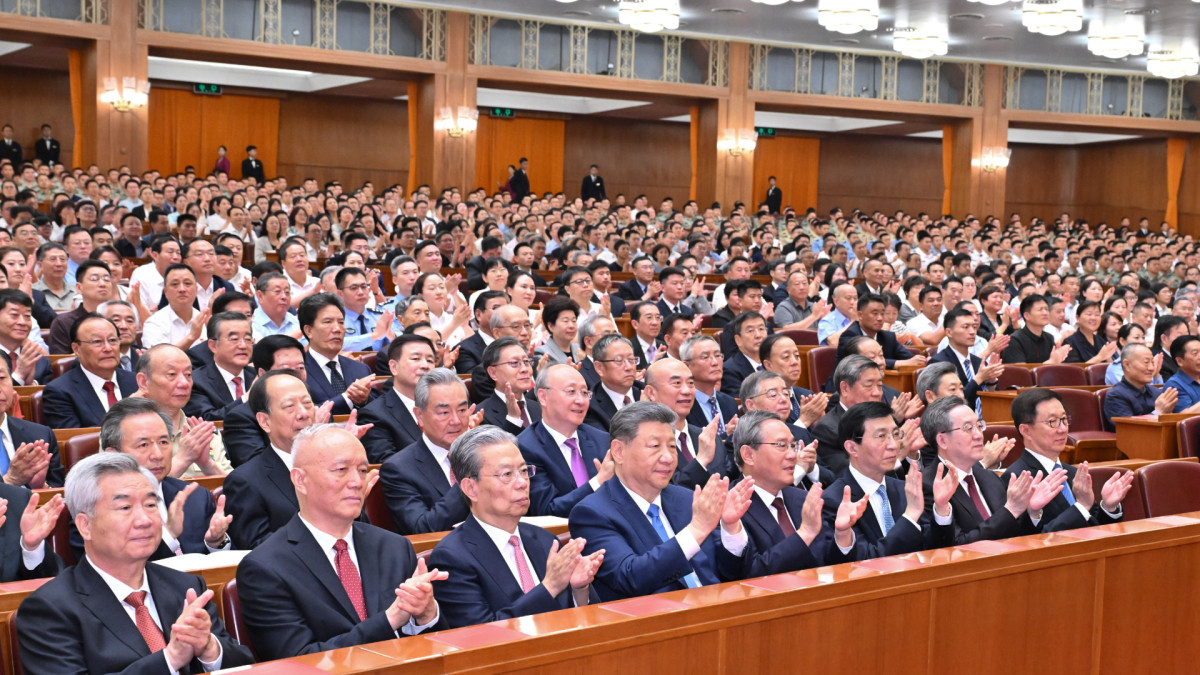
In the front row, some of the most prominent members of the Chinese Communist Party, including President Xi Jinping.Yue Yuewei / Xinhua News / Europa Press
Today — July 1, 2026 — Decree No. 837 of the Chinese State Council enters into force. This 34-article law introduces comprehensive regulation of overseas investment by Chinese companies, organizations, and individuals. Henceforth, such investments will be under continuous supervision, reporting to State authorities, undergoing security reviews, and adapting activities to China’s national objectives — including protection of the country’s image and the open concept of ‘general security’.
At first glance, this measure may appear to focus on domestic affairs, but its true scope is much wider: China is the third-largest foreign investor in the world, so a significant volume of global industry may be directly affected by the conditions that the decree imposes on Chinese investors. And this extension of exhaustive control will be especially relevant in the case of Spain.
Most crucial is not that the decree creates new rules, but that it brings together under a single legal framework what was previously addressed in multiple ways. Thus Chinese companies will no longer be treated as mere commercial actors but as part of an official institutional strategy. This demonstrates how China’s foreign investment is shifting to prioritize quality over volume while protecting the country’s most strategic assets. Decree 837 is the legal instrument that formalizes that change of priority.
The Made in Europe aspect is the IAA’s most controversial requirement — a protectionist reaction to China’s commercial and technological disruption in the market — and the Chinese government has spoken out against it. Specifically, the condition of 70% European participation in the automotive sector seeks to mitigate dumping by China, given that Chinese EVs receive State subsidies that allow them to compete at a significantly lower prices. Chinese investments in this sector currently arriving in Spain are looking to settle inside European borders before the IAA requirement comes into force. However, the operative model behind those investments does not at present add real value to Europe’s manufacturing industry, being based exclusively on final product assembly, while every strategic phase is conducted in China. Decree 837 now legally protects that model by retaining technology and know-how on Chinese soil, even as the IAA and the memoranda signed by Sánchez aim for the attraction of real technology transfer.
At first glance, this measure may appear to focus on domestic affairs, but its true scope is much wider: China is the third-largest foreign investor in the world, so a significant volume of global industry may be directly affected by the conditions that the decree imposes on Chinese investors. And this extension of exhaustive control will be especially relevant in the case of Spain.
"China is the third-largest foreign investor in the world, so a significant volume of global industry may be directly affected"Sánchez’s most recent visit to Beijing explicitly included the promotion of sustainable and high value-added investments, with the goal of generating jobs in Spain and developing local capacities through training and technology transfer. However, Article 13 of the new decree prohibits the organization of cross-border training, the sending of technical personnel abroad, and the provision of remote assistance related to technologies restricted by the State. This includes technologies used in biotech, aerospace guidance systems, the processing of rare earths, the manufacture of lithium batteries for electric vehicles (EVs), and algorithms inherent in Artificial Intelligence.
From informal practice to regulatory strategy
This decree does not introduce radically new policies but formalizes a set of practices that have been unevenly applied until now. A very recent example was the April 27 action by Beijing to block the acquisition of ManusAI by Meta, which signaled that Chinese companies won’t be able to evade State control simply by changing their corporate address. In a move often referred to as Singapore washing, this China-based AI startup had transferred its headquarters to Singapore before attempting the $2 billion sale. Article 13 will now regulate all strategically sensitive technology and know-how of Chinese origin, with the State maintaining controls regardless of the registered address.Most crucial is not that the decree creates new rules, but that it brings together under a single legal framework what was previously addressed in multiple ways. Thus Chinese companies will no longer be treated as mere commercial actors but as part of an official institutional strategy. This demonstrates how China’s foreign investment is shifting to prioritize quality over volume while protecting the country’s most strategic assets. Decree 837 is the legal instrument that formalizes that change of priority.
"The decree officially turns Chinese companies into part of an institutional strategy rather than commercial actors"It could be said that China now wants to impose on its own overseas investors the same logic directed for decades at foreign companies seeking access to its domestic market: no technology transfers, no deal. In the 1980s and 1990s, in a process designed to attract capital as well as knowledge transfer, foreign entities had to enter into joint ventures with local partners to gain access to China.
The relevance for Spain
The past two years have seen a wave of Chinese investment in Spain, with projects including the CATL and Stellantis battery plant in Figueruelas, the Chery and Ebro EV assembly plant in Barcelona, the Envision AESC battery factory in Extremadura, and an announced project by SAIC Motors to construct in Galicia its first EV facility in Europe. All of these were proposed as reindustrialization projects that would bring capital, jobs, and technological knowledge to regions with limited industrial capacity. The Memorandum of Understanding on Exchange and Cooperation in the Field of Economic Development Policy — signed with China’s National Development and Reform Commission during Sánchez’s latest visit to Beijing — aims to fulfill those promises through the promotion of tech-transfer activities. Yolanda Díaz has also met with SAIC Motors and other investors to promote training courses adapted to the profiles required by Asian multinationals."While assembly is carried out in Spain, the technical knowledge that makes assembly possible remains in China"The point is that the model underlying several of these projects runs opposite to the new decree. The Figueruelas plant, for example, requires the arrival of approximately 2,200 Chinese workers to operate the technology for battery manufacture. While assembly is carried out in Spain, the technical knowledge that makes assembly possible remains in China. The conditions of many other announced projects are not yet known in detail, but Article 13 suggests that they will follow a similar model. If Chinese investments are prevented from including transfers of know-how linked to strategic technologies such as EV batteries, then related projects in Spain will be subject to numerous restrictions.
The underlying logic
Decree 837 is structurally incompatible with the European Commission’s proposed Industrial Acceleration Act, known by its English acronym as the IAA, which seeks to increase the weight of manufacturing in the EU’s Gross Domestic Product through four channels: streamlining permits for industrial projects; imposing emissions limits in public procurement plus sectoral requirements for European participation; conditioning foreign investment in strategic sectors; and designating zones for industrial acceleration.The Made in Europe aspect is the IAA’s most controversial requirement — a protectionist reaction to China’s commercial and technological disruption in the market — and the Chinese government has spoken out against it. Specifically, the condition of 70% European participation in the automotive sector seeks to mitigate dumping by China, given that Chinese EVs receive State subsidies that allow them to compete at a significantly lower prices. Chinese investments in this sector currently arriving in Spain are looking to settle inside European borders before the IAA requirement comes into force. However, the operative model behind those investments does not at present add real value to Europe’s manufacturing industry, being based exclusively on final product assembly, while every strategic phase is conducted in China. Decree 837 now legally protects that model by retaining technology and know-how on Chinese soil, even as the IAA and the memoranda signed by Sánchez aim for the attraction of real technology transfer.

María Herrero Martínez
Analista especializada en las relaciones entre la UE y China
Es analista independiente de asuntos internacionales, especializada en las relaciones entre la Unión Europea y China. También trabaja como investigadora a tiempo parcial en la Spanish Youth Atlantic Treaty Association, donde contribuye a debates sobre políticas de seguridad transatlántica y defensa. Anteriormente, María fue investigadora en prácticas en el Instituto Español de Estudios Estratégicos (CESEDEN), donde elaboró análisis estratégicos sobre la política exterior y de seguridad de China para altos responsables de defensa.
Etiquetas
Agenda Pública in English, Aranceles, China, España, Unión Europea, comercio internacional Ahora en portada
16 de octubre de 2026
16 de octubre de 2026
16 de octubre de 2026
Noticias relacionadas
Hace 17 semanas
Diary of an MEP in China: What should Europe do about China’s industrial policy?
Hace 17 semanas
Diary of an MEP in China: Is the Chinese economy really doing so well?
Hace 24 semanas
How Madrid is trying to use renewables to redesign Europe’s industrial map
Lo más leído