Viernes, 16 de octubre de 2026




IN DEPTH
Anti-scale regulations: China and Europe's rivalry over AI
The differences between the US and Europe often lead us to think about a rapprochement with China. However, in terms of artificial intelligence, this seems a long way off. Researchers Unai Gómez-Hernández and David García García explain that, despite the fact that years ago "the foundations for cooperation between the European Union and China" in AI were laid, the many differences in the way the two sides approach the subject and their political nature mean that the rivalry "has gone from being a bilateral disagreement to a dispute over forums and coalitions."
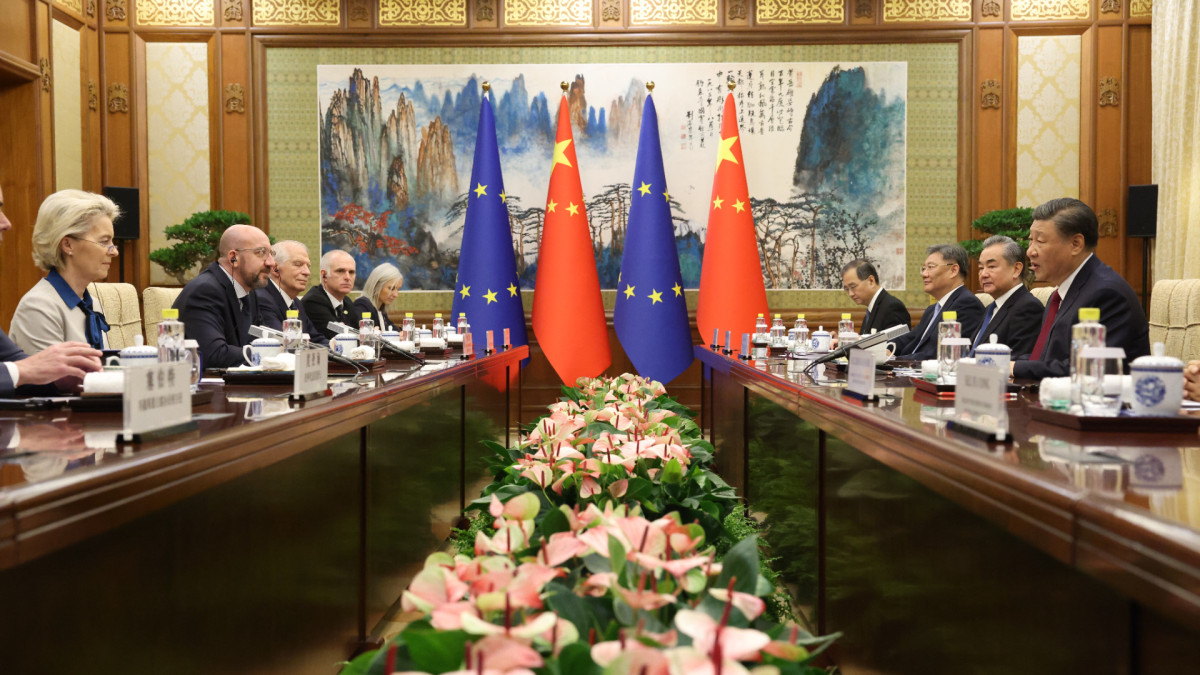
Image of the summit between the European Union and China held in Beijing in 2023.European Union (European Council)
Despite the potential for cooperation on paper, structural differences in governance, market organization, and geopolitical alignment are pushing the EU and China toward systemic rivalry in AI. This gap is magnified by the EU’s competitive disadvantage in frontier AI industries and by the wider US-China technology confrontation, which forces Brussels to position itself within a bloc logic. Donald Trump’s international policies also exacerbate this situation. In University of Columbia professor Anu Bradford’s terms, this is a rivalry between digital empires. China’s AI push reflects an empire of scale, built through state mobilisation and infrastructural diffusion; Europe’s influence has rested on an empire of rules, able to project its internal standards outward through the Brussels Effect.
Indeed, this cooperative approach between the EU and China in AI is also echoed if one factors in the societal focus their respective AI strategies take. The European one underscores the benefits of AI technology for healthcare, environmental sustainability, or education, while, on the Chinese side, there is a focus on people’s well-being, governance, and global cooperation according to their AI Plus Initiative (AI+). Indeed, the EU’s focus on a "human-centric" AI and China’s "people-centred" approach seem to be compatible and mutually beneficial. AI regulation that prioritises citizens makes them the beneficiaries of these strategies.
The first of the two High Level Dialogues on Digital Cooperation between Beijing and Brussels also reinforced the possibilities of cooperation on AI matters. Held in 2020 against the backdrop of the Covid-19 Pandemic, it demonstrated an interest of cooperation of both sides on AI. At the time, China committed to creating a "favourable market competition environment, enhance the protection of property and intellectual property rights". While the fulfilment of these commitments can be questioned years later, the pledge itself was commendable. However, the narrative changed in 2023 with the second High-Level Digital Dialogue. After the release of ChatGPT in late 2022, rather than maintaining the previous positive tone, it addressed the foreseeable differences in AI governance. For instance, the EU "stressed the importance of an ethical use of this technology in full respect of universal human rights", directly referencing the handling of human rights in China and the possibilities of worsening of this situation thanks to the newly developed technology. In fact, the apparently compatible approaches to this technology adopted by Brussels and Beijing appear to be overshadowed by some key differences that are not usually mentioned publicly in the spirit of cooperation.
Second, divergence concerns the externalisation of AI through foreign policy. China can also export AI systems and AI-enabled governance infrastructures to like-minded governments, allowing it to strengthen its position as an alternative provider of global digital goods. In practice, AI is now being exported as part of the Belt and Road Initiative (BRI) through smart city stacks, public security tools, and standards diplomacy, extending Chinese preferences on data governance and state capacity beyond its borders. Brussels may view the BRI as more than just a "policy initiative" and as part of a broader Chinese foreign policy strategy to spread an AI-linked governance model that conflicts with the EU’s human-rights-based risk approach.
At the moment, it is uncertain if President von der Leyen will be able to achieve her goal of rendering EU economically competitive once again before the end of her mandate in 2029. Meanwhile, China’s clout on AI business keeps growing and some European business leaders have already voiced out that their companies would need substantial funds from the EU in order to remain competitive with other international actors, such as China’s SOEs. Indeed, the EU’s economic future seems to be at odds with China’s under the current development trajectory of its AI companies.
Finally, systemic rivalry is increasingly playing out in multilateral governance arenas. As UN processes such as the Global Digital Compact and the Chinese-sponsored UNGA resolution on AI capacity-building expand, and as the Council of Europe AI Convention and the EU AI Act project European rule-setting power outward, EU-China competition shifts from bilateral disagreement to contestation over venues and coalitions. The rivalry, therefore, is not only about models and markets but also about whose regulatory template becomes globally normalised, what can be seen as the Brussels Effect battlefield in AI: whether Europe can still convert internal law into external standards faster than China can convert scale into external infrastructure.
From formal "green shoots" to real differences
Earlier this year, the Artificial Intelligence Summit took place in Paris. The summit, which concluded with a statement on how to develop artificial intelligence (AI) in an inclusive and sustainable way, seemed to provide both the European Union (EU) and China the bases for cooperation on the matter. Brussels and Beijing were amongst its signatories, which accounted for a healthy representation of both the West, the Global South, and other global players such as China or India. The brief text focused on how AI should be used for making the planet more sustainable, reduce breaches amongst people, and stated that market concentration should be avoided on this field, revealing room for cooperation between the key players.Indeed, this cooperative approach between the EU and China in AI is also echoed if one factors in the societal focus their respective AI strategies take. The European one underscores the benefits of AI technology for healthcare, environmental sustainability, or education, while, on the Chinese side, there is a focus on people’s well-being, governance, and global cooperation according to their AI Plus Initiative (AI+). Indeed, the EU’s focus on a "human-centric" AI and China’s "people-centred" approach seem to be compatible and mutually beneficial. AI regulation that prioritises citizens makes them the beneficiaries of these strategies.
"After the release of ChatGPT in late 2022, rather than maintaining the previous positive tone, the second High-Level Digital Dialogue addressed the foreseeable differences in AI governance"At the same time, the overlap in rhetoric should not conceal a deeper strategic asymmetry. China’s AI+ also functions as a major intensification of state-led AI mobilisation. The result is that cooperation language now coexists with a domestic strategy explicitly designed to generate scale advantages and geopolitical resilience, which inevitably alters the EU-China balance in AI.
The first of the two High Level Dialogues on Digital Cooperation between Beijing and Brussels also reinforced the possibilities of cooperation on AI matters. Held in 2020 against the backdrop of the Covid-19 Pandemic, it demonstrated an interest of cooperation of both sides on AI. At the time, China committed to creating a "favourable market competition environment, enhance the protection of property and intellectual property rights". While the fulfilment of these commitments can be questioned years later, the pledge itself was commendable. However, the narrative changed in 2023 with the second High-Level Digital Dialogue. After the release of ChatGPT in late 2022, rather than maintaining the previous positive tone, it addressed the foreseeable differences in AI governance. For instance, the EU "stressed the importance of an ethical use of this technology in full respect of universal human rights", directly referencing the handling of human rights in China and the possibilities of worsening of this situation thanks to the newly developed technology. In fact, the apparently compatible approaches to this technology adopted by Brussels and Beijing appear to be overshadowed by some key differences that are not usually mentioned publicly in the spirit of cooperation.
Three divergences that underscore the systemic rivalry between the EU and China
The first of these divergences concerns the control that AI implies. This technology must be regarded as a booster of processes: be them linked to productivity, analysis, health prognosis or generative writing. Another process it can boost is that of societal control: surveillance, predictive policing, and behavior-shaping can be expanded at unprecedented scale. A society that is already tightly monitored, such as China's, is very different from a society like Europe's. In the Old Continent, citizens can live under relative anonymity, and their personal data is carefully protected by the General Data Protection Regulation (GDPR). Indeed, the level of zeal when it comes to data protection is so great that other neighbouring countries such as the UK have gathered inspiration from the EU’s GDPR in order to create their own regulation (the Brussels Effect at work). China’s Personal Information Protection Law is quite different from the European regulation. For example, data transfers must be conducted on the basis of security assessments carried out by the Chinese government. This resembles the logic behind Hong Kong’s National Security Law passed in 2020, which gives the Standing Committee of the National People’s Congress the power to interpret the law and decide what constitutes a national security risk. AI amplifies the Chinese government's power to control its citizens, which, according to the EU's position, could potentially imply a breach of universal human rights in China. Even if this situation already existed, the incursion of AI into the global landscape exacerbates it."Such discipline suggests a strong synchronization between corporate communication and Party priorities, unthinkable in Europe or the United States"An additional, less visible layer of this first divergence concerns how state strategy structures corporate voice in China’s AI sector. China’s frontier-AI firms have maintained an unusually low public profile in 2025, and their leadership has largely avoided autonomous geopolitical messaging. DeepSeek, despite its symbolic role in China’s model breakthrough narrative, has remained publicly quiet, with one of its first major appearances in nearly a year coming from a senior researcher who warned at the World Internet Conference in Wuzhen, that AI could displace most jobs within 10–20 years and urged technology companies to act as guardians against social disruption. In diplomatic terms, this alignment can be leveraged by Beijing as a credibility signal and as a negotiation advantage vis-à-vis a more plural and often internally contested European ecosystem.
Second, divergence concerns the externalisation of AI through foreign policy. China can also export AI systems and AI-enabled governance infrastructures to like-minded governments, allowing it to strengthen its position as an alternative provider of global digital goods. In practice, AI is now being exported as part of the Belt and Road Initiative (BRI) through smart city stacks, public security tools, and standards diplomacy, extending Chinese preferences on data governance and state capacity beyond its borders. Brussels may view the BRI as more than just a "policy initiative" and as part of a broader Chinese foreign policy strategy to spread an AI-linked governance model that conflicts with the EU’s human-rights-based risk approach.
"The EU’s economic future seems to be at odds with China’s under the current development trajectory of its AI companies"The third divergence is related to China's superior competitiveness in the market. While Chinese AI firms have achieved frontier performance and global visibility (DeepSeek being the most emblematic case), the EU’s AI alternatives are yet to gain global spotlight. The lack of competitiveness of European businesses in high-tech areas such as AI has been laid bare as seen in the Draghi report and the Commission has tried to reverse this situation by releasing its competitiveness compass. Part of this roadmap is the Commission’s Digital Omnibus launched on 19 November 2025 that proposes to delay key "high-risk" AI Act obligations to December 2027 and to introduce flexibility in GDPR/e-privacy and data access rules to facilitate AI training and reduce compliance costs. Supporters frame this as a realist adjustment to remain competitive; critics see it as a rollback of Europe’s rights-centric identity. Either way, it signals that the EU is moving closer to US-style sequencing (innovate first, regulate later), showing that Europe’s regulatory identity is now being reshaped by competitiveness pressure in the shadow of U.S.–China rivalry. Here the EU’s imperial advantage is at stake. If Europe delays or dilutes its high-salience rules to catch up with US or China technological milestones, it may weaken the very Brussels Effect that makes its regulatory model travel.
At the moment, it is uncertain if President von der Leyen will be able to achieve her goal of rendering EU economically competitive once again before the end of her mandate in 2029. Meanwhile, China’s clout on AI business keeps growing and some European business leaders have already voiced out that their companies would need substantial funds from the EU in order to remain competitive with other international actors, such as China’s SOEs. Indeed, the EU’s economic future seems to be at odds with China’s under the current development trajectory of its AI companies.
Finally, systemic rivalry is increasingly playing out in multilateral governance arenas. As UN processes such as the Global Digital Compact and the Chinese-sponsored UNGA resolution on AI capacity-building expand, and as the Council of Europe AI Convention and the EU AI Act project European rule-setting power outward, EU-China competition shifts from bilateral disagreement to contestation over venues and coalitions. The rivalry, therefore, is not only about models and markets but also about whose regulatory template becomes globally normalised, what can be seen as the Brussels Effect battlefield in AI: whether Europe can still convert internal law into external standards faster than China can convert scale into external infrastructure.
Enter Trump’s America: towards a new digital iron curtain?
These three divergences are highlighted considering the current geopolitical situation of the US as a former hegemon that is losing power. Indeed, some have even pointed out to a new emerging Cold Tech War considering the relations between the US and China. As competition crystallises into technology blocs, it becomes harder for Europe to sustain a distinct voice on how AI should be governed. Beijing’s flurry of global initiatives signal a wish of partially remodelling the liberal international order to its own view by establishing pre-eminence in its direct sphere of influence and substantial control over more distant regions. This power struggle is replicated at the AI policy level. That is why earlier this year some US states banned DeepSeek in their territories while Trump’s government issued a report considering Chinese AI a national security risk. This perception of threat might have been prompted by the news of DeepSeek providing biased answers when faced with key questions linked to China’s government, its leaders, or national events like the Tiananmen Square protests. For Brussels, these moves do not just confirm US-China rivalry; they also raise the cost of hedging and complicate any attempt to engage China on AI governance while keeping a credible critical distance."What is at stake for Europe is less the choice of camp than the ability to keep shaping the rules within whichever camp it ends up in"Considering this rough landscape, the EU’s position becomes even more problematic. What is at stake for Europe is less the choice of camp than the ability to keep shaping the rules within whichever camp it ends up in. Using China as leverage could be an effective way for President von der Leyen to achieve her strategic autonomy and competitiveness goals. However, it is difficult to imagine a future in which the EU and its members would prefer to ally with China than with the US. A recent example is the Dutch government's late September 2025 takeover of the Chinese-owned chipmaking company Nexperia, a move widely read as part of Europe’s securitisation of critical technologies under simultaneous US and China-related pressures. If this logic were to be replicated in the long term and a new digital iron curtain were to fall on AI-linked technologies, it is all but certain that Europe would remain on the American side.

Unai Gómez-Hernández
Doctorando en relaciones UE-China - Universidad de Edimburgo y KU Leuven

David García García
Doctorando en Derecho y Ciencia Política en la Universitat de Barcelona
Es becario predoctoral FPI en el proyecto Agenda Dynamics on Social Media (ADSOM) y doctorando en Derecho y Ciencia Política en la Universitat de Barcelona. Investiga el impacto político del cambio tecnológico, el comportamiento en redes y la regulación de la inteligencia artificial.
Ahora en portada
16 de octubre de 2026
16 de octubre de 2026
16 de octubre de 2026
Noticias relacionadas
Hace 37 semanas
Las normas contra la escala: la rivalidad de China y Europa por la IA
Hace 44 semanas
¿Nos roba la IA nuestros empleos?
Hace 53 semanas
España ante el objetivo de Xi Jinping: la ruptura de Europa con Estados Unidos
Lo más leído