Sábado, 17 de octubre de 2026




LOPEZ PLANA'S EUROPEAN COMPASS
María Corina Machado’s diplomatic error in Madrid
In this week’s column, Marc López Plana, director and editor of 'Agenda Pública', admonishes Venezuelan opposition leader María Corina Machado for her "mistaken rejection of a meeting with President Sánchez during her visit to Madrid." Lamentably, Machado instead "used her cause like a projectile weapon within Spain’s domestic politics." López Plana also considers how Machado’s choice may have weakened her own prospects, especially from a European perspective.
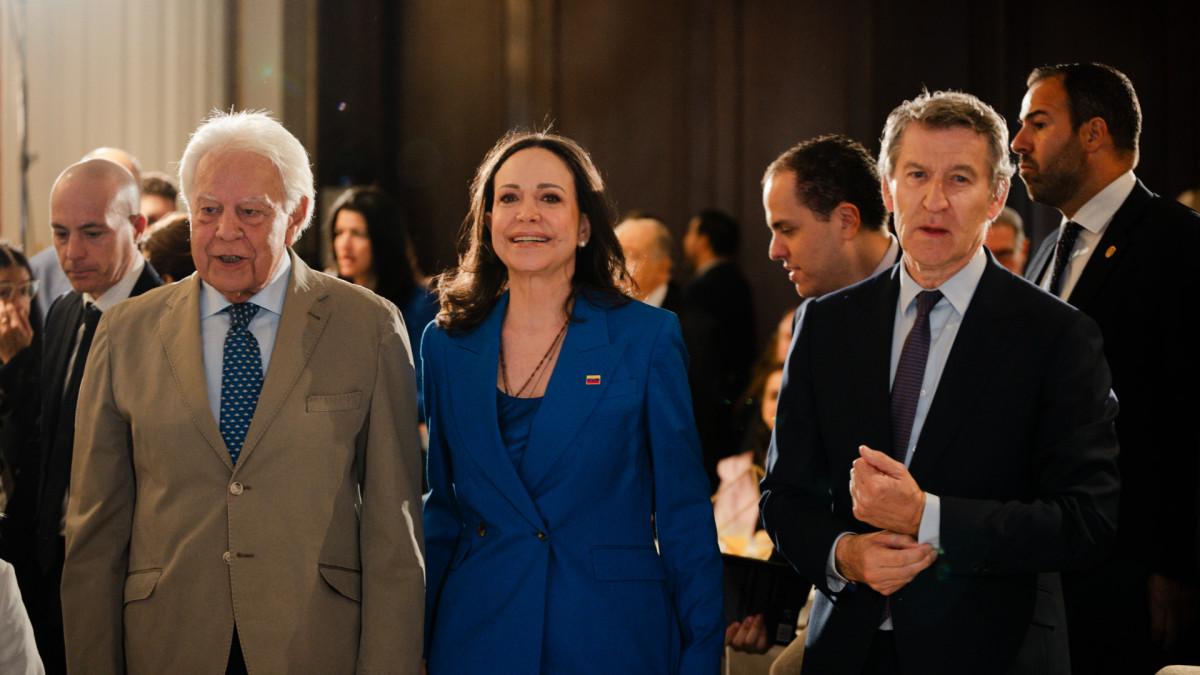
Venezuelan opposition leader María Corina Machado, former President of the Government, Felipe González (l), and PP president Alberto Núñez Feijóo (r).Mateo Lanzuela / Europa Press
In the diplomatic arena, it's often the case that what isn't visible ends up having the most political weight – much more than what appears on the news. This week, television crews have followed María Corina Machado all around Madrid, and certainly the optics have been electric. Cheering crowds turned out in Puerta del Sol to watch the challenger from Caracas deliver fiery rhetoric alongside leaders from the Popular Party (PP) and Vox, giving the strong impression of a "president in waiting". However, behind Moncloa's heavy doors and the curtains at Zarzuela Palace – where the cameras don't reach – the atmosphere was much more somber.
It's worth putting María Corina Machado's strategy into perspective. In a way, everything started out well when she met with King Felipe VI in Chile, at the inauguration of President Kast. That point of entry through the Head of State was an ideal starting point, especially given that these are very complex times in Spanish politics. Above all, the King is regarded as a neutral figure capable of recognizing the Venezuelan opposition's tireless work in favor of democracy. But that promising beginning hasn't developed much, and this week, Machado's strategy was greatly damaged by her mistake of refusing a meeting with Spain's President of the Government during her visit.
Nonetheless, by limiting her official engagements in Madrid to ideological allies from the right and radical right – the latter having been increasingly critical of the King of Spain – María Corina Machado has de facto "partisanized" the Venezuelan cause. In Spain, the Presidency is an institution, not just a person, and to ignore Pedro Sánchez is to ignore millions of citizens.
The ideological differences are well-known. Pedro Sánchez and former president José Luis Rodríguez Zapatero don't sail with the same compass as Machado and Edmundo González. But if she doesn't have the pragmatic resolve to sit at a table with a social democrat in Madrid, then many will logically wonder how she intends to manage the delicate, often dirty task of negotiating with the remnants of the Chavista apparatus in Caracas.
Meanwhile, Spain, hand in hand with its president, is among the countries most actively opposing Trump, and Machado, given her particular relationship with the U.S. president, might have made good use of a meeting with Pedro Sánchez. Indeed, ironically, Pedro Sánchez could be her most effective insurance policy. He needs the EU to stand firm against Washington's erratic moves, so he wants the Union to demonstrate the moral and political stature required to challenge unilateral moves by the White House.
A statesperson should understand that political interlocutors aren't selected on the basis of ideological purity; they are chosen based on their power to help their own people. Pedro Sánchez possesses such power. He has the vote in Brussels and the ear of European leaders, and he remains key to bringing Machado closer to the Zarzuela.
If Machado's goal was to energize her base, then she met that goal. But if her goal was to build the international framework needed for a stable, recognized, and democratically sanctioned transition in Venezuela, she has failed in that endeavor. Very likely, the door to Moncloa was already ajar, or at minimum it could have been opened with the proper diplomatic finesse. By passing by that door, Machado missed more than a meeting: she missed an opportunity to win over a majority in Spain and to demonstrate that she's ready to lead a nation.
"I propose a process of reunion and forgiveness based on justice, without any kind of resentment". That headline from an interview I conducted with Machado could also serve as the headline following her election victory, because people like myself would vote for her, even if we disagreed on many points. Also, for historical reasons, we Spaniards regard such a statement as very important. Only through the unification of internal and external support can a free and democratic Venezuela be built.
It's worth putting María Corina Machado's strategy into perspective. In a way, everything started out well when she met with King Felipe VI in Chile, at the inauguration of President Kast. That point of entry through the Head of State was an ideal starting point, especially given that these are very complex times in Spanish politics. Above all, the King is regarded as a neutral figure capable of recognizing the Venezuelan opposition's tireless work in favor of democracy. But that promising beginning hasn't developed much, and this week, Machado's strategy was greatly damaged by her mistake of refusing a meeting with Spain's President of the Government during her visit.
"The opposition figure may have exchanged her strongest institutional shield for a few fleeting moments of partisan applause"This isn't just a case of missing out on a useful photo-opportunity (and possibly a necessary one). For Machado – who claims leadership on both national unity and the restoration of democracy – the decision to bypass Pedro Sánchez was a strategic blunder. In the complicated triangulation between Madrid, Brussels, and Trump's Washington, the opposition figure may have exchanged her strongest institutional shield for a few fleeting moments of partisan applause.
Everyone's president?
One fundamental requirement for any leader wanting to replace a dictator is to undergo the transition from resistance leader to statesperson – to be both a legitimate representative of popular sovereignty and the leader of a viable political project. The first part fits well with Machado's main argument to the international community: she represents not a faction but an entire nation, the "real" Venezuela.Nonetheless, by limiting her official engagements in Madrid to ideological allies from the right and radical right – the latter having been increasingly critical of the King of Spain – María Corina Machado has de facto "partisanized" the Venezuelan cause. In Spain, the Presidency is an institution, not just a person, and to ignore Pedro Sánchez is to ignore millions of citizens.
The ideological differences are well-known. Pedro Sánchez and former president José Luis Rodríguez Zapatero don't sail with the same compass as Machado and Edmundo González. But if she doesn't have the pragmatic resolve to sit at a table with a social democrat in Madrid, then many will logically wonder how she intends to manage the delicate, often dirty task of negotiating with the remnants of the Chavista apparatus in Caracas.
"Pedro Sánchez is the president of a country in the act of regularizing – that is, dignifying – the lives of between 150,000 and 200,000 Venezuelans"And by the way, whether one likes it or not, Pedro Sánchez is the president of a country in the act of regularizing – that is, dignifying – the lives of between 150,000 and 200,000 Venezuelans. Spain hosts the largest Venezuelan population by far in the EU, as was recently recognized by Leopoldo López, another opponent with an ideological perspective very different from that of Sánchez. Because if Caracas is one political center for Venezuela's opposition, Madrid is another.
The European Union enters the equation
We must also consider Brussels. Spain isn't just a peripheral player in Latin American affairs. Beyond the historical ties, it should be recalled that the President of the Government occupies one of the 27 seats on the European Council. For Machado, the calculation should have been simple: Spain is among Europe's guardians of legitimacy."By distancing herself from Spain's president, Machado has silenced her own voice at the table where real decisions are made"While the European Parliament can pass symbolic resolutions in her favor, it is the Council – where Sánchez has a vote, plus the ability to maneuver with his counterparts in Berlin and Paris – that decides on the renewal of sanctions, the formal recognition of election results, and the deployment of diplomatic missions. By distancing herself from Spain's president, Machado has silenced her own voice at the table where real decisions are made. We shouldn't forget that the EU put Latin American politics on the table from the moment Spain joined the bloc 40 years ago. It wasn't France or Italy that made that policy possible.
Trump's shadow and the European shield
On the other side of the Atlantic, uncertainties persist that María Corina and her team have been analyzing for some time. There's a palpable fear in many European capitals that Trump's decisions will lead to a disorganized or purely extractive policy toward Caracas, ignoring the democratic aspirations of the Venezuelan people. Consequently, we must ask ourselves: can Machado's team entirely rule out the possibility that Trump could withdraw his support for democratic elections?Meanwhile, Spain, hand in hand with its president, is among the countries most actively opposing Trump, and Machado, given her particular relationship with the U.S. president, might have made good use of a meeting with Pedro Sánchez. Indeed, ironically, Pedro Sánchez could be her most effective insurance policy. He needs the EU to stand firm against Washington's erratic moves, so he wants the Union to demonstrate the moral and political stature required to challenge unilateral moves by the White House.
An inaccurate reading of Spanish national politics
The Venezuelan leader has also been mistaken if we look exclusively at the Spanish agenda. Within the rigid hierarchy of Spanish protocol, everything emanates from the Executive. By avoiding a meeting with Sánchez during her visit, Machado has closed the doors of the Zarzuela. With that decision, she chose the fleeting warmth of a political rally over the hard currency of institutional recognition, when she could have had both."Perhaps with an eye to the polls, Machado's advisors probably believed that exclusive reliance on Vox and the PP would be taken as a sign of strength"Another point of concern is Spain's national optics. Perhaps with an eye to the polls, Machado's advisors probably believed that exclusive reliance on Vox and the PP would be taken as a sign of strength. But when Machado appears alone on the balconies of the regional government, led by the PP, she risks alienating the center-left sectors of both the Spanish electorate and the Venezuelan community. In other words, her approach has allowed and even encouraged her cause to be used like a projectile weapon in Spain's domestic politics. Such tactics rarely pay long-term diplomatic dividends.
Let's talk about audacity. Let's talk about diplomacy
María Corina Machado is undoubtedly a figure of immense political and personal bravery. Her ability to mobilize a broken nation is unmatched. Even so, her visit to Madrid suggests a worrying gap between her capacity as an opposition leader and the diplomatic skill required of a future president.A statesperson should understand that political interlocutors aren't selected on the basis of ideological purity; they are chosen based on their power to help their own people. Pedro Sánchez possesses such power. He has the vote in Brussels and the ear of European leaders, and he remains key to bringing Machado closer to the Zarzuela.
If Machado's goal was to energize her base, then she met that goal. But if her goal was to build the international framework needed for a stable, recognized, and democratically sanctioned transition in Venezuela, she has failed in that endeavor. Very likely, the door to Moncloa was already ajar, or at minimum it could have been opened with the proper diplomatic finesse. By passing by that door, Machado missed more than a meeting: she missed an opportunity to win over a majority in Spain and to demonstrate that she's ready to lead a nation.
"I propose a process of reunion and forgiveness based on justice, without any kind of resentment". That headline from an interview I conducted with Machado could also serve as the headline following her election victory, because people like myself would vote for her, even if we disagreed on many points. Also, for historical reasons, we Spaniards regard such a statement as very important. Only through the unification of internal and external support can a free and democratic Venezuela be built.
Ahora en portada
17 de octubre de 2026
16 de octubre de 2026
Noticias relacionadas
Hace 92 semanas
María Corina Machado: "Senator Rubio has long warned about Maduro's threat to the Americas"
Hace 25 semanas
Why Sánchez is departing from Brussels’ script on immigration
Hace 30 semanas
Oliver Stuenkel: "Europe remains a crucial partner for many democracies in the Global South"
Lo más leído