


María Corina Machado: "Senator Rubio has long warned about Maduro's threat to the Americas"
Venezuelan opposition leader María Corina Machado talks to Agenda Pública in a crucial week for her country. She says she is ready to govern and asserts that the Maduro regime has lost all its strength. "The future of democracy in Latin America is being decided in Venezuela today," she says.
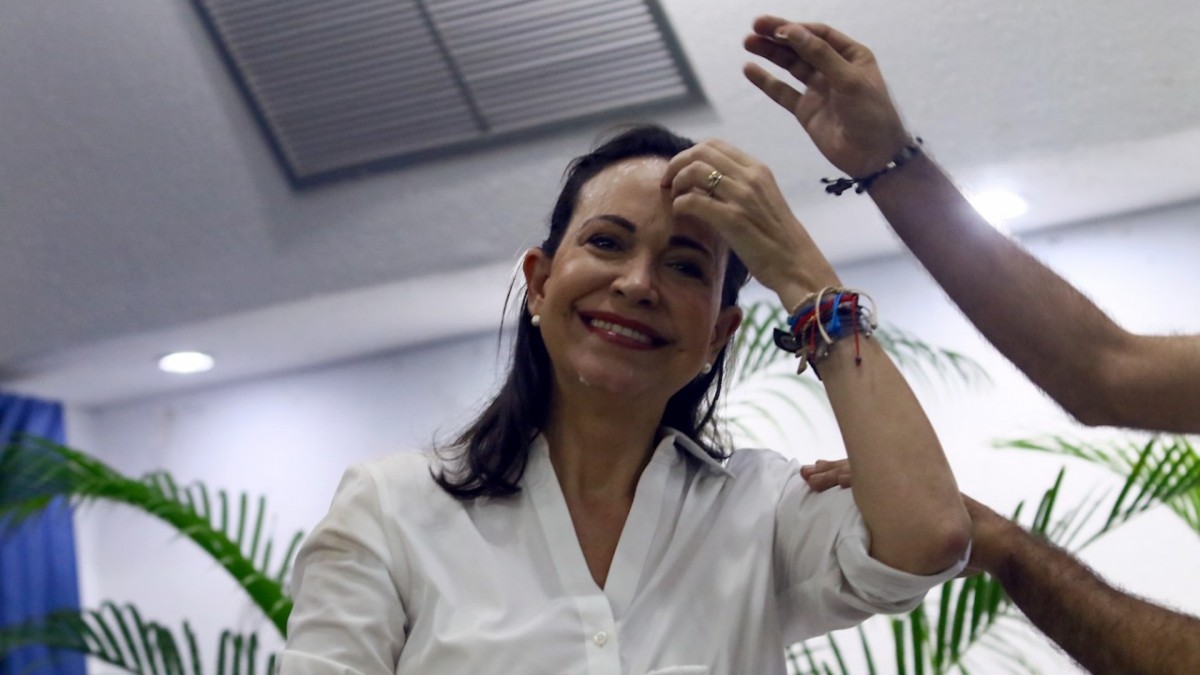
María Corina Machado speaks in an exclusive interview for Agenda Pública. The leader of the opposition to chavismo talks to our director, Marc López Plana, a few days before the announced return of Edmundo González to Venezuela this coming Friday. And a few weeks after they both received the Sakharov Prize from the European Parliament: "These are decisive days for our history", she points out. The publication of this interview shows how important Spanish public opinion is for Latin America, and how in Spain Latin American politics is already an explanatory factor of domestic politics.
For María Corina Machado, who is convinced of the imminent start of a new stage in Venezuela, "the great challenge is to build a society where there is a new relationship between citizens and between citizens and the state". She accepts the need to initiate a negotiation process with the current regime "above all for a transition" that "implies offering incentives and guarantees". "We are not going to engage in a process of persecution or revenge’, she warns, "I am very clear about the responsibility that corresponds to me to reunite a whole country".
She is also confident about the support she will have from the new Trump administration: "Senator Marco Rubio has been perhaps the most vocal person for years about the threat that the Maduro regime poses to the Americas", which in her opinion has turned Venezuela into "the hub of organised crime in the Americas". "We have to work at all levels at the same time. This is worse than a country coming out of a war. We have a multidimensional crisis: "a financial crisis, an economic crisis, a humanitarian crisis, a crisis of services, a security crisis and a crisis of sovereignty", she concludes.
What can happen this Friday, 10th of January, in Venezuela?
First, thank you very much, Marc. I am delighted that we can talk about the significance not only for Venezuela, but also for Ibero-America, of what is happening right now in our country. I am not exaggerating when I tell you that the future of democracy in our region is being decided today in Venezuela. The Venezuelan conflict has escalated to a level that transcends our borders. Venezuela has become the focus of a transnational criminal political dynamic that has been destabilising democracies in the region. It has served as a gateway to the Americas for regimes whose purpose is to weaken liberal democracies in the West, such as Russia, Iran, Syria at the time, or criminal groups such as Hezbollah or Hamas. These groups have complex alliances with the Chávez and now Maduro regimes.
"The future of democracy in our region is being decided today in Venezuela"Moreover, they have intentionally provoked the biggest migration crisis in the world, bigger than Ukraine, bigger than Syria. Imagine if a third of Spaniards had been forced to leave their country. Imagine what this means. It is heartbreaking not only in human, family, social, cultural and productivity terms, but also for the development of criminal activities such as drug trafficking, smuggling of minerals and even human beings, which find sanctuary in Venezuelan territory. Venezuela has become the hub of organised crime in the Americas.
But, to answer your question about the 10th of January: never before has the regime been in such a weak position as it is today. And for objective and verifiable reasons. First of all, they have lost any possibility of social control, they are alone. The country hates them. Secondly, they have lost all legitimacy. We beat them 70-30. If it had been an election with minimum competitive conditions, we would have ended up 90-10. And everybody knows that. Thirdly, they have been losing crucial international support —not only from Brazil, which blocked their entry to the BRICS— but also with the new administration in the United States. Finally, for me, it is relevant to insist that, in terms of public opinion, these people already have zero impact, in other words, nobody believes them.
"Venezuela has become the hub of organised crime in the Americas"The only thing they have left, is their repressive capacity. Every day it is more and more diminished, because the structures of the Police, the Armed Forces and the judicial system are experiencing the same desperation as the rest of society. And within the regime there are serious fractures. So, 10 January is a great opportunity, it is a constitutional milestone, but it is a litmus test for Maduro, not for us. And, of course, for those international actors who will have to make a choice: whether to associate with a toxic and criminal regime or whether to side with the Venezuelan people.
What are you willing to offer to those who are generating these fractures in the regime, and would you be willing to agree with them on a democratic solution for Venezuela?
Obviously, any negotiation process, especially for a transition, implies offering incentives and guarantees. Clearly, the magnitude of these depends on the moment, on the relative forces and obviously on each of the actors, according to their track record and what they are contributing to favouring this transition. There is no prior planning, but rather this must take place during the transition. And, obviously, it is based on one principle: respect for popular sovereignty as expressed on the 28th of July election. That is not negotiable.
"Any agreement in a transition has to be assimilated and supported by society"Secondly, we are not going to start a process of persecution or revenge. Personally, I am extremely clear about my responsibility to reunite a whole country that is already united. I don't think there is another society in the world like the Venezuelan society, where there are no religious, racial, regional, social or political differences. In other words, tell me in what other society in the world, 90% of the people want the same thing. The aim is not to generate resentment, but to seek a process of reunion and forgiveness based on justice.
Of course, incentives will have to be offered. For this to happen, it is essential that there be leadership from the democratic forces that has the credibility of the country because any agreement on a transition has to be assimilated and supported by society.
.jpg)
María Corina Machado and Marc López Plana, director of Agenda Pública, during the call. Foto: Agenda Pública
What do you expect from the countries in your region? What do you expect from Latin America, which is going through difficult times of its own, as support for the democratic process in Venezuela?
Latin America is much more than governments. I expect a lot from the people of Latin America. And we are seeing it. It has been impressive how the mobilisations of Venezuelans abroad have brought together millions of people who are not Venezuelan, but who understand that the future of democracy in Latin America is being decided in Venezuela today. There has also been great solidarity due to the huge presence of Venezuelans in these countries, which has created an enormous sensitivity and awareness of the human drama that is life in Venezuela today.
"We have from Gabriel Boric, in Chile, to Javier Milei, in Argentina, saying the same thing: that the will of the people must be respected"We have also seen enormous solidarity from the parliaments. And this is really interesting because we have seen a coalition across the ideological spectrum. We see it in the parliaments and we see it in the governments. We hear Gabriel Boric in Chile and Javier Milei in Argentina saying the same thing: that the will of the people, power, popular sovereignty, human rights and the rule of law must be respected in our country. So, when we see that this takes on a higher level than ideological debate, it is a very powerful cause that has been bringing together more and more people.
We expect Latin America to defend its own interests, because what is happening in Venezuela affects them directly. We will see what those neighbours who were once close to the Maduro regime will do, but who have started to distance themselves. We have seen the case of Lula refusing the incorporation of Venezuela under Maduro's government into the BRICS. Now comes the moment of truth. Many of these, seeking to maintain a position of a certain prudence, although they did not recognise Edmundo and his victory in the first instance, chose to ask for the official records to be handed over to them. ‘Let's see the minutes,’ they said. And the government didn't hand them over. We did. The time has come to understand that the people of Venezuela voted for democracy. That the evidence is there and that the time has come to be consistent with their own practices in their respective countries.
"History will be implacable with those who take one position or the other"Venezuela has become an issue of domestic politics in most Latin American countries. There is no middle ground here, that is, you cannot be in the middle between corruption and justice. You cannot be between a regime that is in a terminal phase like Maduro's, which violates human rights and has committed crimes against humanity, and the Venezuelan society. History will be implacable with those who take one position or the other.
In the United States, ten days after the 10th of January, a new Administration, led for the second time by Donald Trump, takes office. What do you expect from a leader who is, to say the least, erratic and whose Secretary of State will be Marco Rubio? Is Trump's position on Venezuela compatible with his hesitant position on Russia's invasion of Ukraine?
I am confident that in the case of Venezuela, there will be a very firm position that is consistent with what has been the position not only of President Trump, but also of the collaborators that he has already designated or nominated. Moreover, there is an issue in the case of Venezuela and the United States: the United States has classified information that involves all the pieces or the main pieces of the Venezuelan regime in matters of national security. And that is why, despite having lived through such a particular, polarised electoral process, Venezuela has always remained a bipartisan issue in Congress. I have great friends who are Democratic and Republican senators, Republican and Democratic congressmen. Notice that the initiatives that have come out of Congress have been bipartisan, which is very difficult in these times, it's a unique case. Look at the policies of President Biden, recognising Edmundo as the president-elect and proposing and accompanying initiatives in the framework of the United Nations, in the framework of the OAS, in the framework of different multinational bodies. Or the frontal and total denunciation of the criminal nature of the regime and respect for the decision of the Venezuelan people on 28th of July.
On the part of this new administration, the signals are also unmistakable. Senator Marco Rubio has been perhaps the most vocal for years about the threat posed by the Maduro regime to the Americas. Cristóbal Landó, the Undersecretary of State, is one of the people who knows the region best. He even lived in Venezuela, as his father was a diplomat and ambassador to Mexico. He has a firm and clear position, even after 28th of July. Michael Walsh, National Security Council, is a friend of the cause and a personal friend. He has maintained the strongest positions on the need to advance the transition to democracy in Venezuela in order to be able to resolve the fundamental issues that affect the United States. These issues include migration, drug trafficking, and the destabilisation being generated, even within the United States, by the criminal gangs sponsored by Maduro and his regime. I could go on to Richard Grinnell and Mauricio Claver-Carone himself. These are all people who are well aware of the threats to Latin America and from Latin America to the national security of the United States.
I have no doubt that the Maduro regime, if it persists and reaches that date, will find itself in far more adverse conditions than it has already to facilitate a negotiation for its exit, but the exit will happen. I have no doubt.
How do you interpret the fact that the European Parliament, with a certain division, has pronounced itself in favour of recognising Edmundo González as president-elect of Venezuela, while the countries that form part of the European Union have not?
The position of the European Parliament has been so firm and so clear over the years that we feel more than grateful, Marc. These are the things you never forget. Every so often, these international bodies are not aware of the impact of certain decisions on a diplomatic or rhetorical level. But the decisions of the European Parliament have given us Venezuelans monumental moral support. The feeling that this is a global cause and that it is understood, and that they feel our pain.
"The decisions of the European Parliament have given us Venezuelans monumental moral support"In the week of the Sakharov Prize I had meetings with all the political groups, with everybody. When you see the degree of support —even from some MEPs from countries that are very far away— how they feel that the success of the Venezuelan people in the face of tyranny contributes to world democracy and sets a new standard for citizen organisation, I was moved by that. And I think that is where we see the global vision that prevails in people who have a democratic conscience beyond the dynamics of a particular government.
The massive vote of the European Parliament a few months ago in favour of the International Criminal Court's pronouncement was very important, because this sends a clear message, I insist, along the entire ideological axis. There is a debt owed to the governments that have recognised Edmundo, and particularly to those governments that tend to make Latin America's channels of communication with Europe.
No one doubts what happened. Everyone knows what happened. And in the end, that will bring consequences. History will be implacable with those who do good, those who do evil and those who do nothing. Because the latter end up siding with evil.
How do you assess the fact that Edmundo González is living in Madrid, and how do you assess the process that brought Edmundo González to Madrid and the actions of the Spanish government itself?
I have been very clear about the process of Edmundo's departure from Venezuela. There was a very dark operation in which the regime and international actors were involved. Rodríguez Zapatero himself has acknowledged that he was involved. One day all the details of something that was, in my opinion, absolutely improper will be known. Brutal pressure was put on the president-elect, while he was in a diplomatic post so that he felt deeply threatened and came to feel that his options were either the Helicoid [Venezuela's national security service headquarters] or exile. In addition, a process of terror was carried out on another embassy, in this case that of Argentina, under the protection of Brazil, where they are comrades in arms. What happened is truly improper, and there was interference from external actors. Venezuelan society understood the decision of our elected president, who has also done an excellent job of interacting with international actors and the diaspora. And this operation ended up being reversed by the regime itself.
"I have already said everything I have to say about Mr. Zapatero: he has acted in an absolutely improper and non-transparent way in the management of his relations with the regime"I have already said all I have to say about Mr Zapatero: he has acted in an absolutely improper and non-transparent manner in his handling of relations with the regime and, in particular, with those Venezuelans who are being persecuted or imprisoned. But I prefer not to get involved in issues that have to do with internal politics and his role within Spain.
Regarding Zapatero, I would like to say that, for Spain, as Prime Minister he put an end to ETA. In reality, and in my opinion, the democratic process does not end completely until, at a certain point, the terrorist group ETA laid down its arms and abandoned its activity.
Let's move on to the last question, which is to look to the future with hope. What would be your first five government measures for the first 100 days in Venezuela?
Before the election, I worked eighteen hours a day. After the election, twenty hours a day. In the first hundred days it will be at least twenty-three hours a day. I have enormous confidence in the process of rebuilding Venezuela. First, I feel that there is great cohesion in society and there is great maturity. We, of course, expect quick results, as there is a country that is suffering a lot. Venezuelan children go to public school two days a week. Mothers cook with firewood, there is no petrol or diesel. There have to be results in the short term. But we all know that what is happening is much deeper than this. So when I ask you to look at what is happening in Venezuela, let's not stay on the surface, let's not understand this as a political or electoral process.
"The great challenge is the construction of a society where there is a new relationship between citizens and between citizens and the state"We have built a real social and cultural movement, which has anthropological implications. One thing will be to get Maduro out, which he will get out, I have no doubt. The great challenge is to build a society where there is a new relationship between citizens and between citizens and the state. And that requires a new institutional design, very solid institutions, with republican, democratic, ethical and liberal principles. We must also create incentives so that these institutions are at the service of citizens so that we can have a society that can fly and take off. A Venezuela where we can open up markets, where massive investments can come and, of course, that means recovering the rule of law. Venezuela is in 142nd place out of 142 countries measured in rule of law, according to the World Justice Project. It is the last country on the planet in terms of the general rule of law.
So how are you going to be able to build confidence and bring Venezuelans back?
We have to work on all levels at the same time. This is worse than a country coming out of a war. We have a multidimensional crisis: a financial crisis, an economic crisis, a humanitarian crisis, a services' crisis, a security crisis, a sovereignty crisis.
"We have the teams ready to govern. This is worse than a country coming out of a war"We have the teams ready to govern. We have a project called Venezuela Tierra de Gracia, which we have been working on for years. It contemplates the actions of the first days of the emergency, but at the same time a structural process of transformation of the country. Starting from scratch because not a single institution is still standing here, which gives us an opportunity that few societies have in history. It is about starting from scratch an institutional design that works and that guarantees that all Venezuelans will be equal before the law; that stimulates honest, productive and rewarding work; that allows all Venezuelans to have the opportunity to emerge, even if they are born in the most remote village, in the humblest family, and to live with dignity.
It is exciting. There is accumulated creative energy, not only here. I live talking to Venezuelans abroad, they all have that umbilical cord, that doesn't happen with all the diaspores. And look, I intend to bring them all back, one by one, one by one. Even those that you have incorporated and received with so much affection in Spain. I'm sorry, but we want them back here.
Thank you very much for your time and reflections.
We will bring you, and I will receive you here, I will give you a nice interview in Miraflores. But I ask you to be very attentive these days, they are decisive for our history.