Miércoles, 30 de septiembre de 2026




LÓPEZ PLANA'S EUROPEAN COMPASS
Spain’s European success, and the rest is solvable
Even as Germany flirts with stagnation, Spain has established itself as the unexpected engine of the European Union. But that macroeconomic success conceals a dangerous point of friction: the inability of Spain’s political system to manage growth. Marc López Plana, editor and director of 'Agenda Pública', warns in this week’s 'Brújula Europea' that the lack of structural consensus between the PSOE and PP on housing, immigration, regional financing, and infrastructure is not only a problem of management, but a fertile breeding ground for populism.

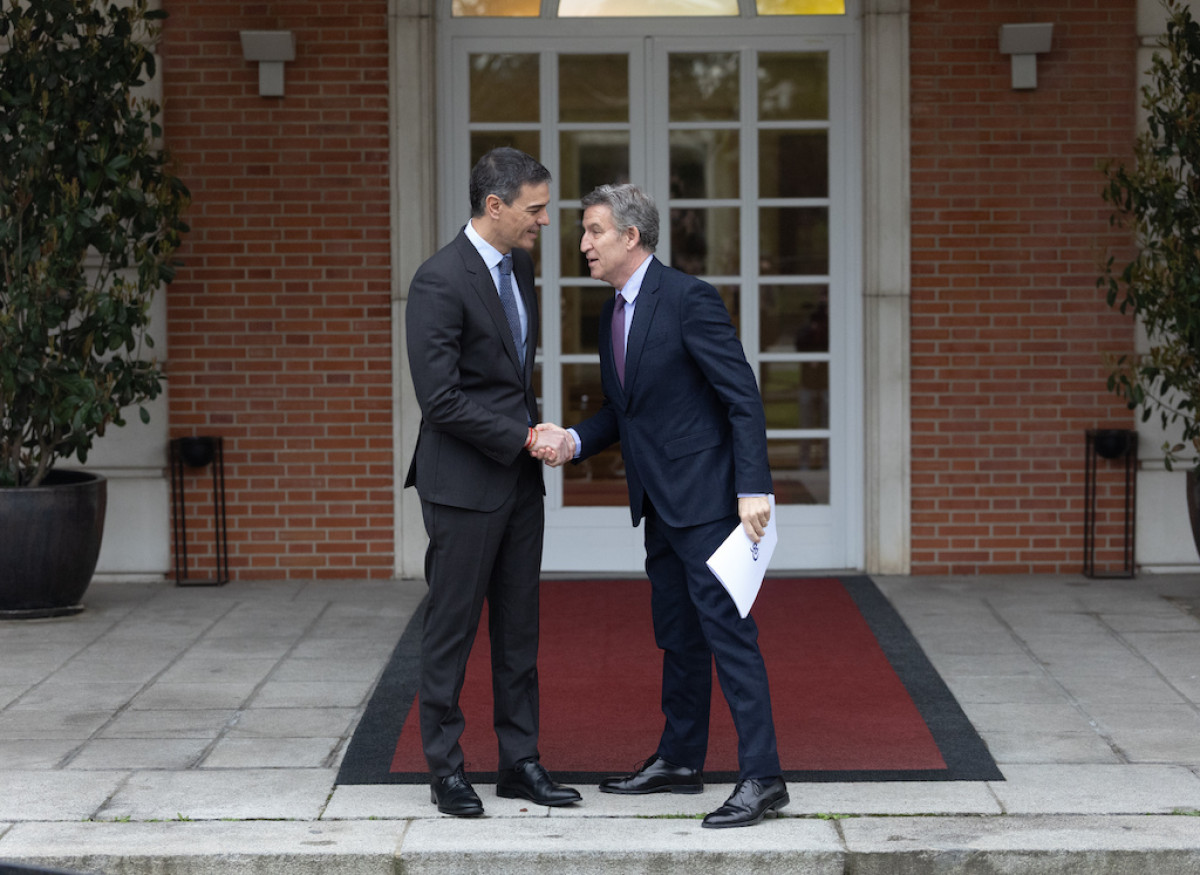
President of the Government Pedro Sánchez (l) receives Alberto Núñez Feijóo (r), president of the Popular Party, at Moncloa Palace.Eduardo Parra / Europa Press / ContactoPhoto
Recent episodes of dysfunction in essential services, from the accident at Adamuz to recurring problems with Rodalies de Catalunya, have been deftly shaped into a narrative of national crisis. Such interpretations contribute more to political disorientation than to a clear understanding of the present moment in Spain, now celebrating its fortieth year as part of the European Union. It is our responsibility as a society to correctly diagnose our current condition and to send the proper message to Europe, the political landscape in which we are fully immersed.
Spain is passing through one of those paradoxical situations that politics rarely manages well. Its economy is growing above the EU average, creating jobs and attracting immigration and capital; unexpectedly, Spain is now among Europe’s strongest engines in a context of continental stagnation. Nonetheless, that success has been generating social and political tensions that threaten to overwhelm the system. The real risk isn’t economic, but political, and it has a name: the inability of the PSOE and PP to reach structural agreements at a time when Spain needs them more than ever.
Spain isn’t in a state of crisis, but a state of tension. Its economy is growing at 2 to 3% while Germany’s is stagnant. Employment is on the rise, even when accounting for statistical effects. Immigration is supporting both the labor market and the pension system. Tourism is breaking records, and Spain is now the second European nation in terms of job creation linked to foreign investment.
But that aggregated success coexists with persistent microeconomic malaise: wages that grow less quickly than the cost of living, housing inaccessible in dynamic areas, local public services pushed to the limit, and a widespread perception that "the country is doing well, but I’m not."
This mismatch between macroeconomic indicators and everyday experience is politically toxic. It feeds tales of decadence in a country that’s not in decline, but where transformations are outpacing institutions designed for a different economic cycle. Spain isn’t stumbling from a lack of growth but from excessive institutional friction.
This pattern isn’t exclusive to Spain. In his book Abundance, Ezra Klein describes a paradox common to many advanced democracies that reach historic levels of wealth, knowledge, and productive capacity, but that lose the political ability to build, coordinate, and execute. The trouble isn’t a lack of money or technical consensus – what’s missing is an institutional system capable of transforming potential abundance into visible results. The gridlock isn’t economic but political and procedural.
The result is corrosive to the prospect of political centrality, which best represents the majority interests of society. When a system fails to deliver basic goods – affordable housing, functional services, regulatory predictability – even in contexts of growth, citizens stop trusting in the competence of those who govern (or aspire to govern). On that difficult terrain, simplifying narratives thrive, as do those who propose to break with a system viewed as incapable of action.
The experience of Germany in the Merkel era offers a very relevant warning. For years, Germany combined growth, fiscal surpluses, and political stability with strong resistance to investment in infrastructure, housing, digitalization, or administrative capacity. The result was a once-prosperous country, materially depleted: trains that don’t arrive, bridges in poor condition, stressed public services, territories that feel abandoned. That silent deterioration – the result of excessive restraint – served as the breeding ground for the rise of the AfD. It wasn’t scarcity that fueled the radical right but the sense that a wealthy state had ceased to work for huge segments of the population.
Spain is running a similar yet distinct risk – not one of prolonged austerity, but of growth without agreements that permit investment, planning, and execution over the medium and long term. Germany shows that even the strongest democracies can erode when the political system refuses to build. Far from generating gains in macroeconomic terms, the cost of such resistance directly affects the ballot box.
Here’s where the deadlock between the PSOE and PP becomes structurally irresponsible. Both parties continue to behave as if the problem were one of alternation, and not of governability in the medium term. The PSOE is presently managing under a logic of resistance and fragmented coalitions; the PP is preparing for the handover with a discourse of normalization, (wrongly) assuming that the change in ruling party will rectify the situation, even if accomplished with the support of Vox. Neither party seems willing to admit that certain decisions must be made together, precisely so they won’t be converted into political ammunition.
Regional financing is the most obvious example. The system is exhausted, misaligned with the authentic weight of public services, trapped in a logic of bilaterality and exceptions. Reforming this will require broad majorities, political and territorial – both impossible without an agreement between the two major parties.
Housing is another minefield. Wherever demand is highest, supply is lacking. Solving this will involve regulatory changes, sustained public investment, collaboration with the private sector, and (above all) time. Considerable time. No government can assume the political cost of measures whose benefits arrive too slowly or too late. Without a basic consensus, housing policy will persist as a succession of patchwork fixes, while social frustration grows. And as the European experience teaches us, frustration rarely translates into moderation.
All this makes for a particularly delicate scenario. If the PP comes to government without prior agreements, it will face an impossible dilemma: either moderate its actions to avoid structural conflicts (frustrating part of its electorate) or else try to impose reforms without broad consensus (leading to social and institutional deadlock). In both cases, the unraveling will be rapid. Should the PSOE remain in government, the attitudes of the PP might be discounted.
And here enters Vox – not as an essential partner in government, but as a strategic opponent. Vox outside the Executive, freed of the responsibilities of management, can capitalize on every friction, every resignation, charaterizing every compromise by the PP as a betrayal. Recent European history shows that the radical right grows less when it actually governs than when heckling from the sidelines, pointing out contradictions and promising ideological coherence. Governing wears a party down; complaint mobilizes it.
Narratives of decadence, nostalgia, and distrust of institutions – all increasingly present in Spain’s public debate – are better suited to a faction that wants to simplify complexities. When economic success doesn’t translate into perceived well-being, politics becomes an exercise in selective memory: an idealized past versus a confusing present. This framework doesn’t favor the governing parties, or those who negotiate; it favors those who promise to restore a bygone order, real or imagined.
The great irony is that Vox doesn’t need Spain to operate badly in order to grow. It’s enough that the economy is performing better than the institutions can absorb, or than politics can explain. ‘Dying of success’ is a perfect scenario for populism: uneven prosperity, frustrated expectations, and political elites who seem to wrestle more with one another than with reality.
Spain isn’t condemned to gridlock or extremism. But current inertia is pushing in that direction, and when the parties that are able to reach agreement choose not to do so, then others who can’t or don’t want to will take their place.
Spain’s economic success is real. Converting it into political stability will require shared responsibility, which is rather less abundant, as well as the ability to build, which is relatively concrete and measurable. Construction is required of housing, infrastructure, fiscal consensus, stable migration policy, and predictable regulatory frameworks. As Ezra Klein suggests, the political frontier of advanced democracies is no longer how much they grow, but what they’re able to do with what they have. If Spain fails to regain its capacity for action – institutional, political, administrative – the next cycle won’t resemble an orderly correction, and conversations will turn toward ‘missed opportunities’, which in politics are rarely recovered without great cost.
Spain is passing through one of those paradoxical situations that politics rarely manages well. Its economy is growing above the EU average, creating jobs and attracting immigration and capital; unexpectedly, Spain is now among Europe’s strongest engines in a context of continental stagnation. Nonetheless, that success has been generating social and political tensions that threaten to overwhelm the system. The real risk isn’t economic, but political, and it has a name: the inability of the PSOE and PP to reach structural agreements at a time when Spain needs them more than ever.
"If the PSOE and PP fail to agree on the basic rules for managing success, then the next government will inherit a difficult (if not ungovernable) set of problems"That thesis causes discomfort for both major parties, but it must be articulated clearly: if the PSOE and PP fail to agree on the basic rules for managing success – regional financing, housing, immigration, productivity, sustainability of the Welfare State – then the next government will inherit a difficult (if not ungovernable) set of problems. And as already appears to be the case, the main beneficiary in such a scenario could be Vox.
Spain isn’t in a state of crisis, but a state of tension. Its economy is growing at 2 to 3% while Germany’s is stagnant. Employment is on the rise, even when accounting for statistical effects. Immigration is supporting both the labor market and the pension system. Tourism is breaking records, and Spain is now the second European nation in terms of job creation linked to foreign investment.
But that aggregated success coexists with persistent microeconomic malaise: wages that grow less quickly than the cost of living, housing inaccessible in dynamic areas, local public services pushed to the limit, and a widespread perception that "the country is doing well, but I’m not."
This mismatch between macroeconomic indicators and everyday experience is politically toxic. It feeds tales of decadence in a country that’s not in decline, but where transformations are outpacing institutions designed for a different economic cycle. Spain isn’t stumbling from a lack of growth but from excessive institutional friction.
This pattern isn’t exclusive to Spain. In his book Abundance, Ezra Klein describes a paradox common to many advanced democracies that reach historic levels of wealth, knowledge, and productive capacity, but that lose the political ability to build, coordinate, and execute. The trouble isn’t a lack of money or technical consensus – what’s missing is an institutional system capable of transforming potential abundance into visible results. The gridlock isn’t economic but political and procedural.
"What’s missing is an institutional system capable of transforming potential abundance into visible results"Spain offers an especially illustrative case of what might be called ‘blocked abundance’. The country is growing, collecting revenues, attracting people and capital; but it isn’t constructing sufficient housing or expanding infrastructures at the necessary pace, and it isn’t adapting its public services to the new demographics and economic scale. Every decision gets bogged down in dueling vetoes, perverse incentives, and a political culture that penalizes accord. As Klein warns, when democracies stop producing material solutions, politics will move from ‘what can we do?’ to ‘who can we blame?’.
The result is corrosive to the prospect of political centrality, which best represents the majority interests of society. When a system fails to deliver basic goods – affordable housing, functional services, regulatory predictability – even in contexts of growth, citizens stop trusting in the competence of those who govern (or aspire to govern). On that difficult terrain, simplifying narratives thrive, as do those who propose to break with a system viewed as incapable of action.
The experience of Germany in the Merkel era offers a very relevant warning. For years, Germany combined growth, fiscal surpluses, and political stability with strong resistance to investment in infrastructure, housing, digitalization, or administrative capacity. The result was a once-prosperous country, materially depleted: trains that don’t arrive, bridges in poor condition, stressed public services, territories that feel abandoned. That silent deterioration – the result of excessive restraint – served as the breeding ground for the rise of the AfD. It wasn’t scarcity that fueled the radical right but the sense that a wealthy state had ceased to work for huge segments of the population.
Spain is running a similar yet distinct risk – not one of prolonged austerity, but of growth without agreements that permit investment, planning, and execution over the medium and long term. Germany shows that even the strongest democracies can erode when the political system refuses to build. Far from generating gains in macroeconomic terms, the cost of such resistance directly affects the ballot box.
Here’s where the deadlock between the PSOE and PP becomes structurally irresponsible. Both parties continue to behave as if the problem were one of alternation, and not of governability in the medium term. The PSOE is presently managing under a logic of resistance and fragmented coalitions; the PP is preparing for the handover with a discourse of normalization, (wrongly) assuming that the change in ruling party will rectify the situation, even if accomplished with the support of Vox. Neither party seems willing to admit that certain decisions must be made together, precisely so they won’t be converted into political ammunition.
Regional financing is the most obvious example. The system is exhausted, misaligned with the authentic weight of public services, trapped in a logic of bilaterality and exceptions. Reforming this will require broad majorities, political and territorial – both impossible without an agreement between the two major parties.
Housing is another minefield. Wherever demand is highest, supply is lacking. Solving this will involve regulatory changes, sustained public investment, collaboration with the private sector, and (above all) time. Considerable time. No government can assume the political cost of measures whose benefits arrive too slowly or too late. Without a basic consensus, housing policy will persist as a succession of patchwork fixes, while social frustration grows. And as the European experience teaches us, frustration rarely translates into moderation.
"Recent European history shows that the radical right grows less when it actually governs than when heckling from the sidelines, pointing out contradictions and promising ideological coherence"Immigration – paradoxically – is one area where technical consensus already exists. Employers and unions agree on its structural importance, which data confirms. But the political consensus is cracking, thanks to the PP’s fear of electoral costs. Contemporary Spain is a place of growth and inclusion: net migration has been very high for five years, and across the past decade, the foreign-born population has become central to the country’s demographics as well as its labor market. Immigration has been decisive in sustaining employment, tax collection, and the pension system. But growth plus inclusion isn’t an automatic process: it requires the ability to adapt. For that dynamism to translate into shared well-being, Spain needs to update its frameworks for housing, infrastructure, public services, and governance, and it needs to do so in conditions of political stability, and with the capacity to execute. Without such an update, integration will cease to be regarded as a success and will instead be felt as friction.
All this makes for a particularly delicate scenario. If the PP comes to government without prior agreements, it will face an impossible dilemma: either moderate its actions to avoid structural conflicts (frustrating part of its electorate) or else try to impose reforms without broad consensus (leading to social and institutional deadlock). In both cases, the unraveling will be rapid. Should the PSOE remain in government, the attitudes of the PP might be discounted.
And here enters Vox – not as an essential partner in government, but as a strategic opponent. Vox outside the Executive, freed of the responsibilities of management, can capitalize on every friction, every resignation, charaterizing every compromise by the PP as a betrayal. Recent European history shows that the radical right grows less when it actually governs than when heckling from the sidelines, pointing out contradictions and promising ideological coherence. Governing wears a party down; complaint mobilizes it.
Narratives of decadence, nostalgia, and distrust of institutions – all increasingly present in Spain’s public debate – are better suited to a faction that wants to simplify complexities. When economic success doesn’t translate into perceived well-being, politics becomes an exercise in selective memory: an idealized past versus a confusing present. This framework doesn’t favor the governing parties, or those who negotiate; it favors those who promise to restore a bygone order, real or imagined.
The great irony is that Vox doesn’t need Spain to operate badly in order to grow. It’s enough that the economy is performing better than the institutions can absorb, or than politics can explain. ‘Dying of success’ is a perfect scenario for populism: uneven prosperity, frustrated expectations, and political elites who seem to wrestle more with one another than with reality.
"Spain’s economic success is real. Converting that into political stability will require shared responsibility, which is rather less abundant"For these reasons, the time for agreement is not tomorrow, or after the next elections – the time to act is now. Not out of altruism, but out of self-interest. The PSOE and Spain must prevent structural reform from being associated with a single bloc, bound to be reversed as soon as the government changes. The PP needs to come to power within somewhat clear terrain, so Spain can continue its current successes. Both parties need to preserve the political center before it is hollowed out entirely.
Spain isn’t condemned to gridlock or extremism. But current inertia is pushing in that direction, and when the parties that are able to reach agreement choose not to do so, then others who can’t or don’t want to will take their place.
Spain’s economic success is real. Converting it into political stability will require shared responsibility, which is rather less abundant, as well as the ability to build, which is relatively concrete and measurable. Construction is required of housing, infrastructure, fiscal consensus, stable migration policy, and predictable regulatory frameworks. As Ezra Klein suggests, the political frontier of advanced democracies is no longer how much they grow, but what they’re able to do with what they have. If Spain fails to regain its capacity for action – institutional, political, administrative – the next cycle won’t resemble an orderly correction, and conversations will turn toward ‘missed opportunities’, which in politics are rarely recovered without great cost.
Ahora en portada
30 de septiembre de 2026
30 de septiembre de 2026
30 de septiembre de 2026
Noticias relacionadas
Hace 34 semanas
El éxito europeo de España y por qué lo demás tiene solución
Hace 48 semanas
¿Qué puede aprender Alberto Núñez Feijóo de Giorgia Meloni?
Hace 35 semanas
El crecimiento español supera al europeo, pero no se traduce aún en bienestar duradero
Lo más leído