Viernes, 16 de octubre de 2026




LÓPEZ PLANA'S EUROPEAN COMPASS
Commotion in Caracas, pressure in Brussels: why Spain must now act to safeguard Europe’s defense
For decades, Europe has delegated responsibility for its own security while confusing an absence of war with peace. Today, that convenient arrangement has become a strategic vulnerability. As Marc López Plana – editor and director of 'Agenda Pública' – points out, Spain suffers from "an incomplete strategic culture." The defense of multilateralism must be more than a declaration; Spain should promote the creation of a European army capable of sustaining the legal order that it claims to uphold.

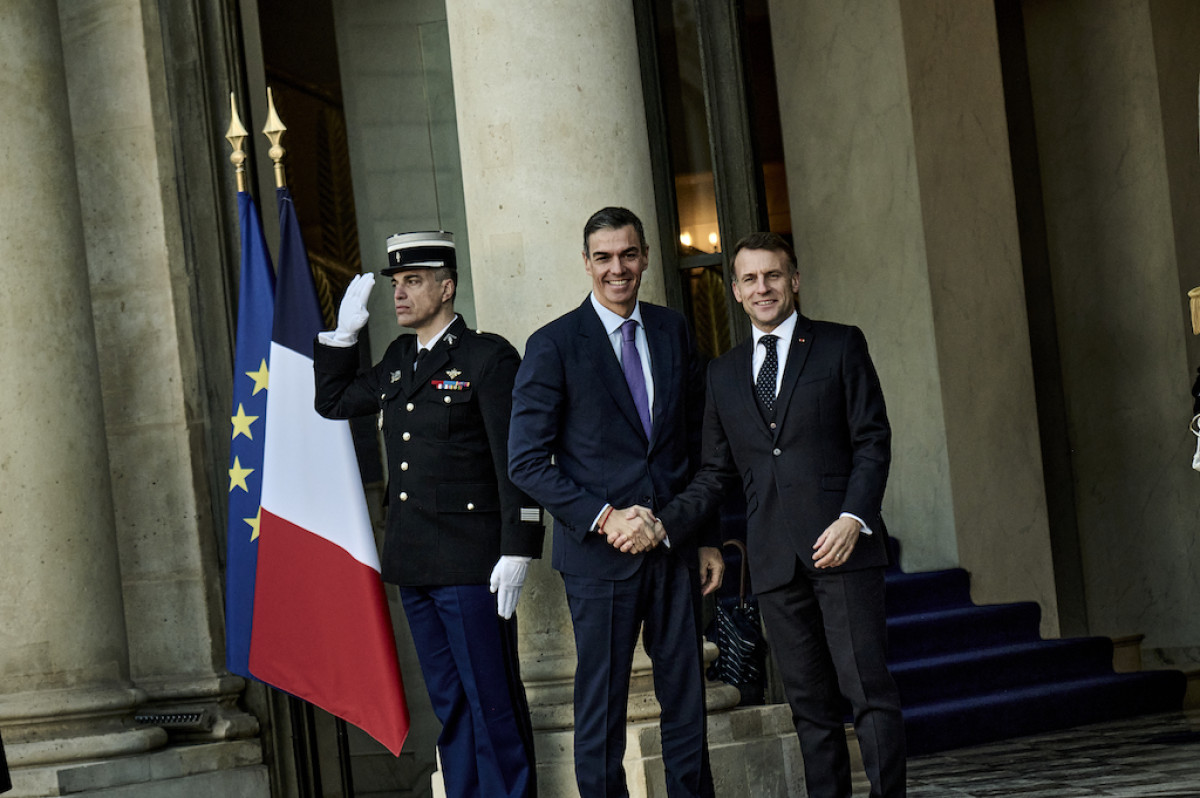
Summit of the coalition of the willing at Elysée PalaceAntonin Burat / Zuma Press / ContactoPhoto
For more than seven decades, Europe has mistaken the absence of war on the continent for lasting peace. That misapprehension has proven comfortable, profitable, and politically useful, and it was made possible thanks to an historical anomaly: the near-total outsourcing of its security to the United States. Today, as that anomaly begins to dissolve, the European Union finds itself faced with an uncomfortable truth – without its own military capabilities, there can be no serious discussion of peace.
The war in Ukraine didn’t create this problem, but it dispelled long-standing illusions. Far from a marginal footnote, that conflict has revealed a structural truth: Europe is not a full strategic actor but a sophisticated economic space shielded by an alien umbrella. For as long as that umbrella persisted, comforting illusions could be maintained; once it began to show weakness, the fragility of the EU was exposed.
The EU has been extraordinarily effective in transforming economic interdependence into internal stability; at the same time, it’s been far less able to translate its economic weight into external coercive power. That asymmetry – economic powerhouse, military lightweight – was acceptable for decades. In our current context, it has become a systemic risk.
To speak of ‘peace’ and compliance with international law in this context without talking about power is an exercise in a certain self-deception. Peace is not a declaration of principles but a relationship among forces.The fetishism of diplomacy
Europe reacted with sanctions, financial aid, and indirect military support, all of which was necessary. Yet none of this obscured the central fact: without the U.S., Ukraine would have fallen. And without Ukraine as a geopolitical buffer, the EU’s eastern border would today pose a very immediate military challenge. Indeed, the EU’s prevailing lukewarm response to actions by the United States owes much to the indispensable role that the U.S. continues to play in the Ukraine-Russia conflict.A European army, or a comforting fiction?
The idea of a European army provokes automatic defensive reflexes. National sovereignty, duplication of NATO, and a lack of political will are all invoked. And while these are genuine obstacles, none of them invalidate necessity.
La pregunta no es si Europa quiere un ejército común. Es si puede permitirse no tenerlo.
Today, the experience of governance of the euro can offer an inspirational model when contemplating a single European army. Just as the Eurozone combines a strong central authority (the European Central Bank) with coordination and oversight from the Member States, a European military could be articulated around a common General Staff that makes strategic decisions, while national forces maintain a degree of operational autonomy. Such a design would allow for coherent, interoperative, and rapid defense in the face of shared crises, avoiding duplication of effort and dispersion of resources, meanwhile preserving the relative sovereignty of each country. The lesson is clear: mandatory coordination, shared rules, and effective supervision are tools that have proven effective in the economic arena and that could be decisive for Europe’s security and global relevance in an increasingly multipolar world.
Despite its key geostrategic position and its recent increase in defense spending, Spain has not developed a proportional public debate on strategic autonomy, deterrence, and shared sovereignty. The absence of such a conversation is no minor oversight: it is a symptom of an incomplete strategic culture that aspires to normatively influence the world without fully assuming the instruments necessary to do so.
Europe has already agreed to share a common currency to ensure its prosperity. The next logical – and necessary – step is to share its defense, to ensure its peace. Without that advance, peace in Europe will remain what it has been for decades: genuine, but borrowed.
The war in Ukraine didn’t create this problem, but it dispelled long-standing illusions. Far from a marginal footnote, that conflict has revealed a structural truth: Europe is not a full strategic actor but a sophisticated economic space shielded by an alien umbrella. For as long as that umbrella persisted, comforting illusions could be maintained; once it began to show weakness, the fragility of the EU was exposed.
The EU has been extraordinarily effective in transforming economic interdependence into internal stability; at the same time, it’s been far less able to translate its economic weight into external coercive power. That asymmetry – economic powerhouse, military lightweight – was acceptable for decades. In our current context, it has become a systemic risk.
Peace as a subcontract
Since 1945, peace in Europe hasn’t been an autonomous construction but a strategic subcontract. NATO (i.e., the United States) has ensured ultimate deterrence in the face of existential threats. In return, Europe has offered political alignment, open markets, and a normative narrative on multilateralism. The deal worked well so long as Washington was willing to foot the bill without too many questions being asked."Thanks not only to Donald Trump’s return to the White House, but in conjunction with a deeper trend, the U.S. is perceived less and less as a permanent guarantor of the European order"That balance is eroding. Thanks not only to Donald Trump’s return to the White House, but in conjunction with a deeper trend, the U.S. is perceived less and less as a permanent guarantor of the European order and more as a global power with priorities in Asia. As U.S. Secretary of State Marco Rubio recently said of the aggression in Ukraine, "This isn’t our war – it’s a war on another continent." The question is no longer whether the U.S. is able to defend Europe, but whether it wants to do so indefinitely, under conditions that Europe would consider ‘normal’.
To speak of ‘peace’ and compliance with international law in this context without talking about power is an exercise in a certain self-deception. Peace is not a declaration of principles but a relationship among forces.
The fetishism of diplomacy
The European Union defines itself as a normative power. It prefers rules to cannons, treaties to tanks, diplomacy to deterrence. That preference is not illegitimate, but it is incomplete. Diplomacy must be backed by credible power.
"The result of Germany’s policy of 'Wandel durch Handel' has not been moderation of the Kremlin, but its emboldening"The relationship with Russia offers a clear illustration of this point. For years, Europe confused trade with influence and energy-dependence with stability: Germany’s policy of Wandel durch Handel. The result has not been moderation of the Kremlin, but its emboldening. The invasion of Ukraine was not a failure of values but a failure of deterrence.
Europe reacted with sanctions, financial aid, and indirect military support, all of which was necessary. Yet none of this obscured the central fact: without the U.S., Ukraine would have fallen. And without Ukraine as a geopolitical buffer, the EU’s eastern border would today pose a very immediate military challenge. Indeed, the EU’s prevailing lukewarm response to actions by the United States owes much to the indispensable role that the U.S. continues to play in the Ukraine-Russia conflict.
What theory has to say (although Europe would rather ignore it)
The notion that peace can endure without power lacks solid theoretical grounding. From Max Weber and Charles Tilly – who linked the political order to a legitimate monopoly of violence – to realists such as Hans Morgenthau, Kenneth Waltz, or John Mearsheimer, international theory converges on a basic premise: peace is no moral aspiration but the result of a stable relationship among forces. Even the most institutionalist traditions (as represented by Robert Keohane or Hedley Bull) assume that norms and institutions only operate well when backed by credible coercive capacity. In strategic terms, as Thomas Schelling emphasized, peace depends on deterrence – on the ability to impose unacceptable costs on an aggressor. A political community that lacks autonomous control of its military strength does not guarantee its own peace but delegates the responsibility. And delegated peace is conditional, by definition.A European army, or a comforting fiction?
The idea of a European army provokes automatic defensive reflexes. National sovereignty, duplication of NATO, and a lack of political will are all invoked. And while these are genuine obstacles, none of them invalidate necessity."The question is not whether Europe wants a common army – it’s whether Europe can afford not to have one"Today, Europe has 27 armies that spend a lot but amount to little. Industrial and operational fragmentation is a luxury affordable only to those who don’t expect to fight. The war in Ukraine has shown that Europe cannot sustain a protracted conflict without massive recourse to U.S. arsenals.
La pregunta no es si Europa quiere un ejército común. Es si puede permitirse no tenerlo.
The euro as precedent
Europe already crossed the Rubicon of sovereignty once by creating the euro. The single currency was not a technical gesture but the surrender of an attribute essential to the modern State: control over monetary policy. States agreed to discipline themselves, understanding that the cost of not doing so would be greater than the cost of sharing sovereignty."Because Europe was able to mutualize its currency, the argument that it cannot mutualize its security – a precondition for its political survival – becomes increasingly less defensible"The result has been less than perfect, but irreversible, and the euro is now basic to the infrastructure of European power. Given that Europe was able to mutualize its currency – a key element in its prosperity – the argument that it cannot likewise mutualize its security – a precondition for its political survival – becomes increasingly less defensible.
Today, the experience of governance of the euro can offer an inspirational model when contemplating a single European army. Just as the Eurozone combines a strong central authority (the European Central Bank) with coordination and oversight from the Member States, a European military could be articulated around a common General Staff that makes strategic decisions, while national forces maintain a degree of operational autonomy. Such a design would allow for coherent, interoperative, and rapid defense in the face of shared crises, avoiding duplication of effort and dispersion of resources, meanwhile preserving the relative sovereignty of each country. The lesson is clear: mandatory coordination, shared rules, and effective supervision are tools that have proven effective in the economic arena and that could be decisive for Europe’s security and global relevance in an increasingly multipolar world.
The absence of strategic debate in Spain: a worrying anomaly
Paradoxically, Spain is one of the countries that should be driving this debate, but its participation thus far has been timid. As I pointed out in a recent edition of Brújula Europea, the idea persists across broad political and social spectra that war is a distant, almost alien phenomenon. This perception has been fueled by decades of externalization of national security and by the (erroneous) conviction that diplomacy alone is sufficient to preserve peace."If Spain wants its defense of multilateralism to be more than a mere declaration, then it should stand among the chief promoters of a European army that is capable of sustaining, when necessary, the legal order that it claims to uphold"In this context, the President of the Government has been correct in his firm responses to non-compliance with international law, even when coming from so crucial an ally as the U.S., as in the case of Venezuela. That position is not a rhetorical gesture but a coherent defense of the international legal order that Spain claims to seek to preserve. And yet that firmness reveals an inadequacy: the defense of international law without the autonomous capacity to back it up amounts to a principled but strategically weak gambit. If Spain wants its defense of multilateralism to be more than a mere declaration, then it should stand among the chief promoters of a European army that is capable of sustaining, when necessary, the legal order that it claims to uphold.
Despite its key geostrategic position and its recent increase in defense spending, Spain has not developed a proportional public debate on strategic autonomy, deterrence, and shared sovereignty. The absence of such a conversation is no minor oversight: it is a symptom of an incomplete strategic culture that aspires to normatively influence the world without fully assuming the instruments necessary to do so.
"Spain has not developed a proportional public debate on strategic autonomy, and the absence of such a conversation is a symptom of an incomplete strategic culture"Europe must either build the capacities required to sustain its own order, or it will remain a strategic object, vulnerable to external decisions outside its control. The EU without an army will remain an incomplete political community.
Europe has already agreed to share a common currency to ensure its prosperity. The next logical – and necessary – step is to share its defense, to ensure its peace. Without that advance, peace in Europe will remain what it has been for decades: genuine, but borrowed.
Ahora en portada
16 de octubre de 2026
16 de octubre de 2026
16 de octubre de 2026
Lo más leído