Lunes, 19 de octubre de 2026




FIRMAS TOP
Former Trump Adviser Warns Carney: "Rules Alone Won’t Keep Canada Safe"
J. P. Carroll, senior researcher on National Security and Trade at the Rainey Center for Public Policy, interviews Peter J. Brown, former Homeland Security and Counterterrorism Advisor to Donald Trump and a senior fellow at the America First Policy Institute. In their conversation, they cover the main items on the transatlantic political agenda, from Greenland to NATO and the Trump administration itself.
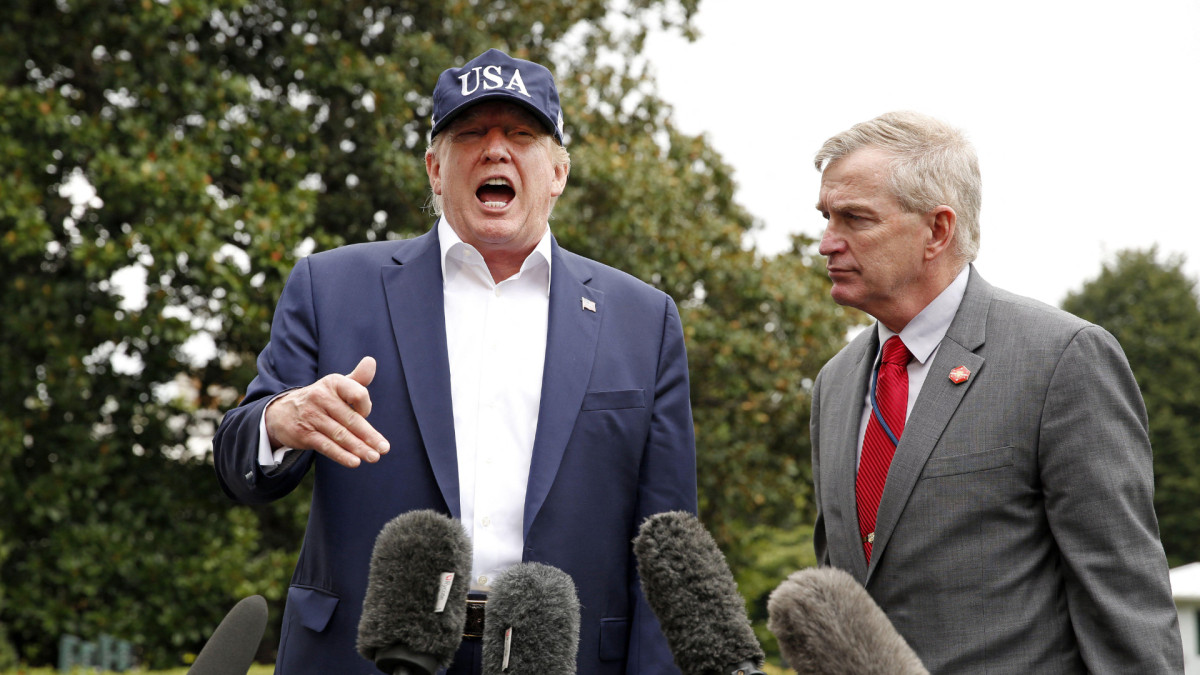
Donald Trump alongside Peter J. Brown, who was then a Homeland Security and Counterterrorism Advisor to the administration.Abaca Press
The following is a brief Q&A edited for length and clarity with America First Policy Institute (AFPI) Senior Fellow for Western Hemisphere Security and Maritime Affairs, Rear Admiral (USCG, Ret.) Peter J. Brown, MS, JD, who shared his thoughts on various current policy matters, including the future of Greenland, the status of NATO, and his thoughts on the first year of President Trump’s second term.
This interview was conducted on January 21, 2026, shortly before Trump announced that he and NATO Secretary-General Mark Rutte had, "formed the framework of a future deal with respect to Greenland." In this conversation, Brown predicted a deal would be reached.
What do you see as the most likely outcome of the U.S. desire to own Greenland?
President Trump is a deal maker. His book from almost 40 years ago now, The Art of the Deal describes, I think, very clearly, his negotiating tactics as making a very big ask – sometimes what seems to be an outrageous ask – and that generates conversation. That conversation then generates negotiation, which has allowed him to achieve goals that otherwise weren't perceived to be achievable.
So, the analogs to the current situation in Greenland – and the perceived strategic value of Greenland – are obvious. Whether full ownership of Greenland is required to achieve [U.S. security needs], I think, remains to be seen.
The other piece of this that I think is interesting and often goes unstated, is Iceland. A lot of people have been talking about critical minerals, and besides the rare earths, there are more mundane minerals that are also critical. And as President [Trump] pointed out in his speech [at Davos on January 21st, 2026], in addition to the mining, the processing is absolutely vital.
Geothermal electricity is abundant and cheap in Iceland. So some combination of an adversarial actor — call it Russia or China — mining critical minerals in Greenland, or in Arctic waters immediately adjacent, and then processing them in Iceland – for sale to Western markets – would essentially hold the West captive, and that's something that President Trump, this administration, and any type of America First foreign policy would be against, understood.
Is the interest in Greenland more of a reflection of the Trump administration prioritizing the Western Hemisphere or does it signal a new phase in Transatlantic relations?
I think it's really a bit of both, and that's a pretty common answer. I think of this in terms of the President's National Security Strategy –President Trump's "Donroe Doctrine," or "Trump Corollary," depending on how you name it, what it did is it added to the Monroe Doctrine of diplomatic and military leadership of the Western Hemisphere by the United States. The "Donroe Doctrine" adds commercial leadership of the hemisphere to the United States, and purports to deny external actors the ability to come in and exert unwanted influence, militarily, diplomatically, or economically.
The desired strategic outcome of a safe and secure Greenland could be achieved through some type of deal with Denmark and Greenland understood.
How do you see the future of NATO — and crucially, the United States’ role in it — as U.S. rhetoric heightens and European troops mobilize in Greenland?
I think NATO has really struggled for a while. NATO has grown in its member count, [but] it hasn't grown proportionally in terms of its physical capabilities, and it becomes much harder to achieve as the number of member states grow and so, and that's a challenge. I think that President Trump certainly sees [this]. I think President Trump sees NATO as weaker than it should be, and the U.S. – even individually – to be potentially stronger and certainly [more able] to demonstrate more resolve internationally to resist foreign aggression, than NATO collectively.
Canadian Prime Minister Mark Carney signaled his belief in a speech at Davos that a U.S.-led international order is something of the past and that middle powers should proclaim their geopolitical and economic independence. What did you make of this coming from a key Five Eyes ally?
I think it's, it's almost amusing that the leader of a country, I think it's somewhere about which 90% of whose population lives within 200 miles of the United States and their primary defense mechanism NORAD is primarily operated by the United States for them, for him [Carney] to say that nations like his ought to proclaim their geopolitical and economic independence when physically they can't be economically or geopolitically independent from the United States, that's a little bit rich. What I'd say is that not so much the US-led international order, but the rules-based international order has been shown to be weakening and that may be a thing of the past.
We are at the 1-year mark of the second term of the Trump administration. How do you see the President’s foreign policy so far and what are you keeping an eye on in the year ahead in line with the Trump administration’s National Security Strategy?
I worked in the first Trump administration (Trump 45), and I will say that this administration, Trump 47, versus all others – including Trump 45, which I thought was excellent – is a massive upgrade, whether it's [with] Secretary of Defense [Pete] Hegseth, Chairman of the Joint Chiefs of Staff, General Dan Caine, whether it's at Homeland Security, [with] Secretary [Kristi] Noem, Attorney General [Pam] Bondi, you know, [or] even in my own prior service, the U.S. Coast Guard, our recently installed Commandant, Admiral [Kevin] Lunday.
The thing that I'm looking at – being a Western Hemisphere guy and a maritime guy – is seeing our national fleet, both [the] Navy and Coast Guard, reach the levels of capacity and capability that are needed to defend the Western Hemisphere, in particular, from the Arctic to the Antarctic. [Also] including, the Caribbean, where we've seen much of the action recently.
So, I think those are two of the two of the key issues: [establishing a robust and sustainable] national fleet and burden sharing in a variety of innovative ways over the course of the coming year.
Thank you.
This interview was conducted on January 21, 2026, shortly before Trump announced that he and NATO Secretary-General Mark Rutte had, "formed the framework of a future deal with respect to Greenland." In this conversation, Brown predicted a deal would be reached.
What do you see as the most likely outcome of the U.S. desire to own Greenland?
President Trump is a deal maker. His book from almost 40 years ago now, The Art of the Deal describes, I think, very clearly, his negotiating tactics as making a very big ask – sometimes what seems to be an outrageous ask – and that generates conversation. That conversation then generates negotiation, which has allowed him to achieve goals that otherwise weren't perceived to be achievable.
"A lot of people have been talking about critical minerals, and besides the rare earths, there are more mundane minerals that are also critical"Just about a century ago, Denmark sold the Virgin Islands to the United States: what we now know is the US Virgin Islands. They did it at a relatively low price, even back then, $25 million, but for a very important reason: and that was the US benefit of it was to deny Germany the ability to use the Virgin Islands as a logistics and outfitting and operational base for U boat submarine warfare in the Caribbean and the US east coast.
So, the analogs to the current situation in Greenland – and the perceived strategic value of Greenland – are obvious. Whether full ownership of Greenland is required to achieve [U.S. security needs], I think, remains to be seen.
The other piece of this that I think is interesting and often goes unstated, is Iceland. A lot of people have been talking about critical minerals, and besides the rare earths, there are more mundane minerals that are also critical. And as President [Trump] pointed out in his speech [at Davos on January 21st, 2026], in addition to the mining, the processing is absolutely vital.
Geothermal electricity is abundant and cheap in Iceland. So some combination of an adversarial actor — call it Russia or China — mining critical minerals in Greenland, or in Arctic waters immediately adjacent, and then processing them in Iceland – for sale to Western markets – would essentially hold the West captive, and that's something that President Trump, this administration, and any type of America First foreign policy would be against, understood.
Is the interest in Greenland more of a reflection of the Trump administration prioritizing the Western Hemisphere or does it signal a new phase in Transatlantic relations?
I think it's really a bit of both, and that's a pretty common answer. I think of this in terms of the President's National Security Strategy –President Trump's "Donroe Doctrine," or "Trump Corollary," depending on how you name it, what it did is it added to the Monroe Doctrine of diplomatic and military leadership of the Western Hemisphere by the United States. The "Donroe Doctrine" adds commercial leadership of the hemisphere to the United States, and purports to deny external actors the ability to come in and exert unwanted influence, militarily, diplomatically, or economically.
"If Denmark and Greenland together can't ensure their own safety, security and stability, then we might step in and help them out again"And then the other part is both transatlantic but also Western Hemisphere in nature. The Roosevelt Corollary to the Monroe Doctrine back in the early 1900s was that when a nation can't maintain and establish a proper and liberal democratic elected government, then the U.S. would have the right and ability to intervene for the protection of itself and its neighbors to ensure that that appropriate governance and security were established in that country, and that led to a number of interventions that the U.S. had in the Caribbean and Latin America. But you could see the President's interest as essentially the Roosevelt Corollary being applied now, not in the Caribbean, but in the Arctic, and saying, "Well, if Denmark and Greenland together can't ensure their own safety, security and stability, then we might step in and help them out again."
The desired strategic outcome of a safe and secure Greenland could be achieved through some type of deal with Denmark and Greenland understood.
How do you see the future of NATO — and crucially, the United States’ role in it — as U.S. rhetoric heightens and European troops mobilize in Greenland?
I think NATO has really struggled for a while. NATO has grown in its member count, [but] it hasn't grown proportionally in terms of its physical capabilities, and it becomes much harder to achieve as the number of member states grow and so, and that's a challenge. I think that President Trump certainly sees [this]. I think President Trump sees NATO as weaker than it should be, and the U.S. – even individually – to be potentially stronger and certainly [more able] to demonstrate more resolve internationally to resist foreign aggression, than NATO collectively.
Canadian Prime Minister Mark Carney signaled his belief in a speech at Davos that a U.S.-led international order is something of the past and that middle powers should proclaim their geopolitical and economic independence. What did you make of this coming from a key Five Eyes ally?
I think it's, it's almost amusing that the leader of a country, I think it's somewhere about which 90% of whose population lives within 200 miles of the United States and their primary defense mechanism NORAD is primarily operated by the United States for them, for him [Carney] to say that nations like his ought to proclaim their geopolitical and economic independence when physically they can't be economically or geopolitically independent from the United States, that's a little bit rich. What I'd say is that not so much the US-led international order, but the rules-based international order has been shown to be weakening and that may be a thing of the past.
"This [Trump] administration would actually welcome smaller powers becoming stronger and more resolute in standing up to the malign actors of the world"In fact, I've said that the rules-based international order is the Maginot Line of the 21st Century, for whether it's Canada or other countries in NATO, to believe and behave as if the rules alone, without the will and capability to enforce the rules by decisive action, will keep them safe, and it won't. The rules are being exploited – aggressively – by malign actors, China being key among them, but Russia being another. So I think that this [Trump] administration would actually welcome smaller powers becoming stronger and more resolute in standing up to the malign actors of the world. I think, I think President [Trump] would welcome that. He has said, you know, we're America First. Other countries can be, you know, Argentina First, or Canada First, and that's absolutely fine, and probably the way it should be understood.
We are at the 1-year mark of the second term of the Trump administration. How do you see the President’s foreign policy so far and what are you keeping an eye on in the year ahead in line with the Trump administration’s National Security Strategy?
I worked in the first Trump administration (Trump 45), and I will say that this administration, Trump 47, versus all others – including Trump 45, which I thought was excellent – is a massive upgrade, whether it's [with] Secretary of Defense [Pete] Hegseth, Chairman of the Joint Chiefs of Staff, General Dan Caine, whether it's at Homeland Security, [with] Secretary [Kristi] Noem, Attorney General [Pam] Bondi, you know, [or] even in my own prior service, the U.S. Coast Guard, our recently installed Commandant, Admiral [Kevin] Lunday.
The thing that I'm looking at – being a Western Hemisphere guy and a maritime guy – is seeing our national fleet, both [the] Navy and Coast Guard, reach the levels of capacity and capability that are needed to defend the Western Hemisphere, in particular, from the Arctic to the Antarctic. [Also] including, the Caribbean, where we've seen much of the action recently.
"President Trump is not only demanding that these nations contribute [more] to their own defense, [but also] ensuring that there's some measure of burden sharing by that nation"I'm looking for the establishment of a robust and sustainable national fleet that will implement this National Security Strategy that the President's put forth. And one of the aspects of the National Security Strategy that probably doesn't get enough attention is this idea of burden sharing and burden shifting. And I think that's one of the things that that NATO and Canada are chafing against, is that President Trump is not only demanding that these nations contribute [more] to their own defense, [but also] ensuring that there's some measure of burden sharing by that nation, and part of it may be territorial concessions to ensure ongoing security for the [Western] Hemisphere and for the West.
So, I think those are two of the two of the key issues: [establishing a robust and sustainable] national fleet and burden sharing in a variety of innovative ways over the course of the coming year.
Thank you.

J. P. Carroll
Analista en Washington D. C. y columinsta de 'Agenda Pública'
MBA Internacional de IE Business School. Máster en Estudios Profesionales (MPS) en Relaciones Públicas y Comunicaciones Corporativas de la Universidad de Georgetown. Es el exdirector adjunto de Medios Hispanos del Comité Nacional Republicano (RNC). J.P. vive en el área de Washington, D. C.
Ahora en portada
19 de octubre de 2026
19 de octubre de 2026
Noticias relacionadas
Hace 38 semanas
El exasesor de Trump que responde a Mark Carney: "Canadá actúa como si las reglas por sí solas fueran a mantenerlos a salvo"
Hace 38 semanas
La doctrina Carney: el liberalismo nacional canadiense como antídoto contra Trump
Hace 38 semanas