Jueves, 1 de octubre de 2026



IN DEEP
The UN at eighty: Between Senescence and the Lucidity of Experience
Between the vitality of its margins and the paralysis of its center, the UN celebrates its 80th General Assembly in New York, caught between a lack of resources, Security Council deadlocks, the pressure of new challenges such as climate change and artificial intelligence, and the urgent need to modernize and decentralize its agencies. This is how Alexis Roig, a researcher at the United Nations University, sums up the current state of the UN, its future, and the possible reforms that could lead to a better-functioning organization.
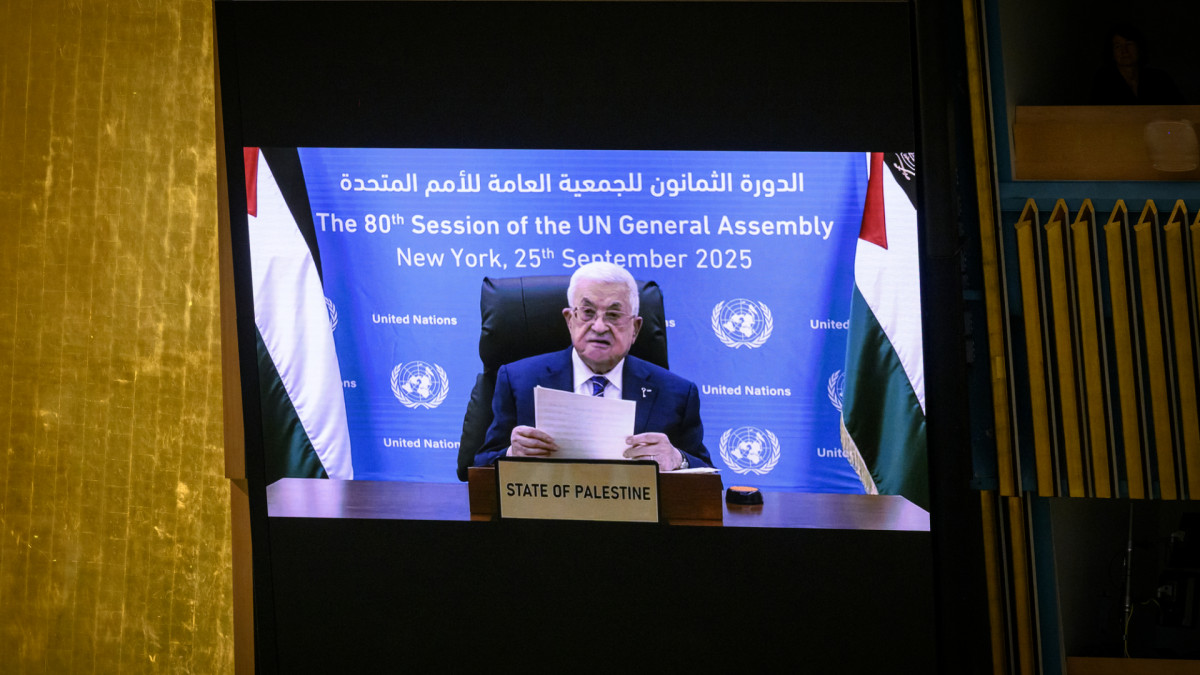
Mahmoud Abbas appears remotely during the 80th session of the UN General Assembly.ONU Photo / Loey Felipe
These days, New York is buzzing like few other times in the year. Traffic jams choke Fifth Avenue, sirens slice through the city, diplomats and delegates rush between meetings that start late and receptions that run past midnight. On the surface, the media report the predictable: inside the Assembly Hall, Ukraine and Russia once again accuse each other of violating the Charter; Israel’s Prime Minister sparks walkouts with his defense of the Gaza operation; Trump reprises his "America First" routine with barbs aimed at global institutions; and, in a turn as historic as it was disconcerting, a former jihadist takes the podium. They are powerful scenes, made for immediate consumption, but they obscure what truly matters.
Between two of these side summits, I shared a cab with a former European minister, 82 years old, now a philanthropist with decades of experience in international organizations. He told me with disarming serenity: "Now I am more useful than ever, more lucid than ever, freer to contribute than in all my years in active politics." His words made me think of the institution also turning eight decades this year. The pressing question is not only whether the UN is exhausted, but whether, like that former minister, it might be entering an age of lucidity, freer, sharper, more useful than ever, or, on the contrary, drifting into institutional senescence.
As was repeated in almost every forum I attended, China and Russia are weaving alternative spheres of influence like the expanded BRICS and the Shanghai Cooperation Organization. The United States privileges functional alliances like AUKUS or the Quad. The European Union, grappling with internal strains, strives to sustain rules-based multilateralism through asymmetric reliance on the G7 and G20. The Global South no longer asks for permission, it acts. The UN may no longer be the only table, but it remains the only universal one. That is its greatest asset.
The solution lies not in heroics but in solvency. Humanitarian aid, for example, cannot survive on chronic deficits and field heroism. Senior officials admit as much. The answer is to anticipate and consolidate: regional management hubs, shared-service platforms for logistics and procurement, digital humanitarian marketplaces with vetted suppliers and traceability, direct cash transfers when local markets function. The goal is to multiply the value of every dollar and strengthen the dignity of those receiving aid.
The financial agenda also moves at the systemic level. As several delegations underlined, for the first time the UN is negotiating an intergovernmental tax convention to address, in a universal forum, base erosion, digital taxation, and extractive royalties, building on but going beyond what the OECD has attempted. Alongside this, the SDG Stimulus, aiming to mobilize $500 billion annually, and the Bridgetown Agenda to recapitalize development banks, point toward a new architecture: reintegrating the UN within global finance. Concrete proposals include a robust secretariat for the tax convention, a technical assistance fund with innovative contributions, the rechanneling of Special Drawing Rights, and automatic disaster clauses in sovereign debt. The day a tax authority in Accra or La Paz wins a case grounded in universal rules negotiated in New York, we will know the game has changed.
The 2022 reform known as the Liechtenstein Initiative increased accountability by requiring the General Assembly to convene after each veto. It raised the political cost of obstruction. But debate is not decision. The Assembly can recommend, not impose.
As was floated in several technical sessions, ideas include systematic hearings on the humanitarian impact of vetoes, prior reports from OCHA or UNICEF before votes, and fast-track exemptions in sanctions regimes for strictly humanitarian operations. More modular peace operations are being explored, with civilian, police, or cyber components deployable in weeks. Also advancing is the framework, opened in 2023, to finance African-led operations case by case with UN funds. Voluntary veto restraint in cases of mass atrocities, championed by France, Mexico, and the ACT group, could be institutionalized with annual public scorecards raising the cost of obstruction. None of these steps requires rewriting founding treaties. All change incentives.
The way forward is redesign: lighter, modular missions. Small, specialized teams, from human rights observers and rapid-protection units to cyber and information experts, regionally interoperable and tightly mandated. Deployments conditioned on host-state consent and realistic risk assessments. The Secretary-General’s New Agenda for Peace adds a crucial piece: investing before crises erupt. Early-warning systems blending hydrological data, food prices, and displacement patterns have already shown effectiveness. The task now is to scale: doubling rapid-response funds with parametric triggers releasing money when indicators flare, building in capacity to analyze disinformation campaigns from the outset, integrating local universities and cities into early detection. Prevention is now as urgent as response.
A staged expansion of the Council could help restore legitimacy: six to eight additional non-permanent seats, with two reserved for Africa, coupled with a mandatory 15-year review clause reopening the debate on permanents and veto. Less epic than a grand reform, but likelier and measurable.
In parallel, the UN 2.0 program and its "Quintet of Change", data, digital, innovation, foresight, and behavioral science, aim to modernize the Secretariat. A Futures Lab has been created, and momentum is building for an Envoy for Future Generations. These are not slogans. They are capacities no other forum possesses.
Housecleaning also means pruning the obsolete. Eight decades have piled up resolutions and mandates that consume resources without adding value. The UN80 package, coordinated by the Secretariat, seeks to review mandates, curb document overproduction, and give flexibility to reallocate resources. Nothing will advance without the Fifth Committee or the Committee for Program and Coordination. Poorly designed cuts could hit fragile pillars like human rights. The way forward is sunset clauses for new resolutions, ex-ante duplication reviews, and public dashboards showing what has been mandated, who must deliver, how much it costs, and what impact it has. In this realm, transparency is reform.
The choice is stark. Let the UN fossilize into a relic, replaced by clubs and powers, or rebuild it as the central nervous system of a fractured world. Stabilize financing, rebalance representation, contain vetoes, reinvent peace operations, govern science and technology, and confront new climate and health challenges with long-range vision.
And something more, learned in that Midtown cab ride. At a certain age, the photo-op matters less than the purpose. That former minister said, with a smile, that now he felt more useful and freer than ever. The UN can prove the same: that age is not irrelevance but accumulated experience in service of what lies ahead. The world still needs a common forum. The question defining the UN’s ninth decade is whether it wants, and can, continue to be it.
"The most interesting developments happen off-camera: that invisible corridor connecting the official and the informal operates as a laboratory of public policy"The most interesting developments happen off-camera. In hallways and elevators turned into improvised forums, in hurried coffees that morph into mini-seminars, in SoHo lofts, university auditoriums, and cultural centers where events multiply. What we call "UNGA week" is in reality a parallel constellation of gatherings where foundations, universities, city networks, and think tanks debate ideas that months later resurface as pacts or resolutions. That invisible corridor connecting the official and the informal operates as a laboratory of public policy.
Between two of these side summits, I shared a cab with a former European minister, 82 years old, now a philanthropist with decades of experience in international organizations. He told me with disarming serenity: "Now I am more useful than ever, more lucid than ever, freer to contribute than in all my years in active politics." His words made me think of the institution also turning eight decades this year. The pressing question is not only whether the UN is exhausted, but whether, like that former minister, it might be entering an age of lucidity, freer, sharper, more useful than ever, or, on the contrary, drifting into institutional senescence.
"The question few dare to confront head-on is whether the United Nations, designed in 1945 to prevent another world can still serve the world’s needs"The question few dare to confront head-on is whether the United Nations, designed in 1945 to prevent another world war and now burdened with tasks ranging from climate to artificial intelligence, humanitarian aid to digital rights, can still serve the world’s needs. The UN has become the default arena for everything the international system fails to manage, yet its structure and resources remain stuck in the past century.
A Triple Trap
The organization faces a triple trap. It is chronically underfunded. Great-power rivalry paralyzes the Security Council. And transnational risks move at a speed its founders could never have imagined. None of this signals the end of multilateralism, but rather its misalignment.As was repeated in almost every forum I attended, China and Russia are weaving alternative spheres of influence like the expanded BRICS and the Shanghai Cooperation Organization. The United States privileges functional alliances like AUKUS or the Quad. The European Union, grappling with internal strains, strives to sustain rules-based multilateralism through asymmetric reliance on the G7 and G20. The Global South no longer asks for permission, it acts. The UN may no longer be the only table, but it remains the only universal one. That is its greatest asset.
"The realistic formula is a UN that serves as a bridge: not arbitrating the impossible, but making rivalries interoperable and shifting capacities to where today’s levers of action lie"Its task today is not just to convene, but to make competing or disconnected systems interoperable. Becoming the architect of bridges across fragmented regimes, from climate to global health, from outer space to digital taxation, may be its most necessary role. In this shifting landscape, as was openly debated in closed-door sessions, Washington wants a cheap and functional UN, Beijing wants one that reflects its weight without judging its internal policies, Europe defends rules and rights, and the Global South is driving the agenda on taxation, climate, health, and data. The realistic formula is a UN that serves as a bridge: not arbitrating the impossible, but making rivalries interoperable and shifting capacities to where today’s levers of action lie.
A Crisis of Financing
As many officials stressed at side events, the first problem is financial. In 2025, contributions to the regular budget fell to their lowest level in seven years. The Secretariat warns of a liquidity crisis delaying salaries, forcing the cancellation of human rights treaty-body sessions, and cutting electoral observation missions. What might look like mere administrative adjustment is, in fact, existential. Without predictable resources, the UN cannot perform even its routine tasks, let alone assume new responsibilities."A system on the verge of insolvency projects no authority even more if it seems like it exists at the mercy of its most powerful members"The deficit is as political as it is fiscal. The United States, historically the largest contributor, has allowed arrears to pile up. China, the second-largest, defers payments until year’s end to signal discontent with parts of the agenda. Many mid-sized powers delay transfers, betting the system will not dare to call them out. Multilateralism is running on empty. Precarity not only erodes capacity, it corrodes legitimacy. A system on the verge of insolvency projects no authority, becoming dependent on ad hoc generosity and vulnerable to suspicion that it exists at the mercy of its most powerful members.
The solution lies not in heroics but in solvency. Humanitarian aid, for example, cannot survive on chronic deficits and field heroism. Senior officials admit as much. The answer is to anticipate and consolidate: regional management hubs, shared-service platforms for logistics and procurement, digital humanitarian marketplaces with vetted suppliers and traceability, direct cash transfers when local markets function. The goal is to multiply the value of every dollar and strengthen the dignity of those receiving aid.
The financial agenda also moves at the systemic level. As several delegations underlined, for the first time the UN is negotiating an intergovernmental tax convention to address, in a universal forum, base erosion, digital taxation, and extractive royalties, building on but going beyond what the OECD has attempted. Alongside this, the SDG Stimulus, aiming to mobilize $500 billion annually, and the Bridgetown Agenda to recapitalize development banks, point toward a new architecture: reintegrating the UN within global finance. Concrete proposals include a robust secretariat for the tax convention, a technical assistance fund with innovative contributions, the rechanneling of Special Drawing Rights, and automatic disaster clauses in sovereign debt. The day a tax authority in Accra or La Paz wins a case grounded in universal rules negotiated in New York, we will know the game has changed.
"The UN needs an automatic budget stabilizer: a real working capital fund, assessed contributions with effective penalties for chronic non-payers"Still, nothing replaces the backbone. The UN needs an automatic budget stabilizer: a real working capital fund, assessed contributions with effective penalties for chronic non-payers, and guaranteed financing for treaty bodies and electoral missions. Without financial security, every reform hangs on contingency.
A Security Council that No Longer Secures
As was evident in countless informal discussions this week, if financing is the silent crisis, the Security Council is the visible one. The body charged with maintaining peace and security has become synonymous with paralysis. Russia vetoes any attempt to censure its invasion of Ukraine. The U.S. vetoes resolutions on Gaza. China blocks action on Myanmar. The result is not just deadlock, it is disillusion.The 2022 reform known as the Liechtenstein Initiative increased accountability by requiring the General Assembly to convene after each veto. It raised the political cost of obstruction. But debate is not decision. The Assembly can recommend, not impose.
"Demand for structural change is growing. The G4 seek permanent seats to reflect economic and demographic realities"Demand for structural change is growing. The G4 (Germany, Japan, India, and Brazil) seek permanent seats to reflect economic and demographic realities. The African Union demands at least two permanent seats with veto, anchored in the Ezulwini Consensus. Latin America and the Caribbean propose more stable tiers of representation. The Uniting for Consensus group suggests another formula: long-term, renewable seats that boost representativeness without creating new untouchables. Nobody expects a sweeping Charter reform soon. But cracks are opening.
As was floated in several technical sessions, ideas include systematic hearings on the humanitarian impact of vetoes, prior reports from OCHA or UNICEF before votes, and fast-track exemptions in sanctions regimes for strictly humanitarian operations. More modular peace operations are being explored, with civilian, police, or cyber components deployable in weeks. Also advancing is the framework, opened in 2023, to finance African-led operations case by case with UN funds. Voluntary veto restraint in cases of mass atrocities, championed by France, Mexico, and the ACT group, could be institutionalized with annual public scorecards raising the cost of obstruction. None of these steps requires rewriting founding treaties. All change incentives.
"The model of large, lightly armed deployments, designed for Cold War cease-fires, fits poorly with urban, asymmetric wars"The ground reality demands such adaptation. The decline of peacekeeping illustrates the malaise. The Mali mission withdrew early under government pressure, leaving a fragile vacuum. In Sudan, blue helmets have failed to protect civilians amid rampant violence. The model of large, lightly armed deployments, designed for Cold War cease-fires, fits poorly with urban, asymmetric wars often waged by governments hostile to oversight. The UN has tried to fine-tune through Action for Peacekeeping Plus, but without political consent or financial muscle, missions stretch until they break.
The way forward is redesign: lighter, modular missions. Small, specialized teams, from human rights observers and rapid-protection units to cyber and information experts, regionally interoperable and tightly mandated. Deployments conditioned on host-state consent and realistic risk assessments. The Secretary-General’s New Agenda for Peace adds a crucial piece: investing before crises erupt. Early-warning systems blending hydrological data, food prices, and displacement patterns have already shown effectiveness. The task now is to scale: doubling rapid-response funds with parametric triggers releasing money when indicators flare, building in capacity to analyze disinformation campaigns from the outset, integrating local universities and cities into early detection. Prevention is now as urgent as response.
A staged expansion of the Council could help restore legitimacy: six to eight additional non-permanent seats, with two reserved for Africa, coupled with a mandatory 15-year review clause reopening the debate on permanents and veto. Less epic than a grand reform, but likelier and measurable.
Innovation and Knowledge to Govern New Domains
Paradoxically, the UN has shown more agility in realms unimagined in 1945. The Pact for the Future launched a Global Digital Compact fostering cooperation on internet governance, data flows, and artificial intelligence. At one of the forums I attended, the proposal was unpacked into operational pieces: a small coordinating office in the Secretariat, a registry of high-impact systems, a global standards exchange, and a capacity-building fund to ensure low-income countries are not left behind. A global incident-notification hub, a kind of worldwide CERT, would give the ecosystem a trusted channel to manage risks. Sovereign data trusts could enable countries to negotiate collective access to strategic datasets. The pragmatic consensus is clear: what is needed is a light architecture. Few pieces, highly useful. Not another bureaucratic behemoth, but a minimal infrastructure of trust to protect citizens and businesses without smothering innovation."Beyond headlines, the UN harbors a quiet capital: its ability to generate and transmit knowledge"Beyond headlines, the UN harbors a quiet capital: its ability to generate and transmit knowledge. The United Nations University bridges science and policy on climate resilience, data governance, and systemic risks. UNITAR trains thousands of officials annually in negotiation, digital governance, and climate diplomacy. The Secretary-General’s Scientific Advisory Board is consolidating as a tool in bioethics, neuroscience, and AI. There is discussion of accompanying major resolutions with long-term impact assessments looking 10 to 20 years ahead, peer-reviewed. This is not a brake on politics but long-range headlights for decision-making. It is science diplomacy in action.
In parallel, the UN 2.0 program and its "Quintet of Change", data, digital, innovation, foresight, and behavioral science, aim to modernize the Secretariat. A Futures Lab has been created, and momentum is building for an Envoy for Future Generations. These are not slogans. They are capacities no other forum possesses.
What Real Reform Requires
Shifting the center of gravity is no whim. The relocation of part of UNFPA’s leadership to Nairobi is emblematic: it brings decision-making closer to where problems burn hottest, attracts diverse talent, and breaks the inertia of thinking multilateralism only in New York or Geneva. Similar moves are being explored in UNICEF and UN Women, as well as in global technology and finance services. But decentralization is not opening offices, it is transferring real budgetary authority, with guarantees of continuity, labor protection, and institutional integrity.Housecleaning also means pruning the obsolete. Eight decades have piled up resolutions and mandates that consume resources without adding value. The UN80 package, coordinated by the Secretariat, seeks to review mandates, curb document overproduction, and give flexibility to reallocate resources. Nothing will advance without the Fifth Committee or the Committee for Program and Coordination. Poorly designed cuts could hit fragile pillars like human rights. The way forward is sunset clauses for new resolutions, ex-ante duplication reviews, and public dashboards showing what has been mandated, who must deliver, how much it costs, and what impact it has. In this realm, transparency is reform.
"It is increasingly evident that legitimacy can no longer rest solely on the States; it is necessary to involve civil society"And legitimacy can no longer rest solely on states. Reforming civil society accreditation to ECOSOC with clear timelines and transparent criteria would send an immediate signal of openness. Public hearings in key processes, digital citizen labs to test policies, mechanisms for networks of universities and cities to engage in technical debates, all are overdue. Cities, as implementers of climate and migration policies, need formal consultative status. Local2030 should become a permanent track during UNGA week.
An Anniversary as a Turning Point
The UN Charter, drafted 80 years ago, opens with a mandate that today sounds both promise and accusation: to save succeeding generations from the scourge of war. It is easy to succumb to cynicism when thinking of crossed vetoes, peacekeeping fatigue, and the theater of speeches. But irrelevance is not destiny. The institution can be reformed if its members choose so.The choice is stark. Let the UN fossilize into a relic, replaced by clubs and powers, or rebuild it as the central nervous system of a fractured world. Stabilize financing, rebalance representation, contain vetoes, reinvent peace operations, govern science and technology, and confront new climate and health challenges with long-range vision.
And something more, learned in that Midtown cab ride. At a certain age, the photo-op matters less than the purpose. That former minister said, with a smile, that now he felt more useful and freer than ever. The UN can prove the same: that age is not irrelevance but accumulated experience in service of what lies ahead. The world still needs a common forum. The question defining the UN’s ninth decade is whether it wants, and can, continue to be it.

Alexis Roig
CEO de SciTech DiploHub e investigador en la Universidad de las Naciones Unidas.
CEO de SciTech DiploHub, la red global que conecta a gobiernos, científicos y organismos internacionales. Con más de quince años de experiencia asesorando a líderes gubernamentales y organismos multilaterales en Europa, Asia y las Américas en diplomacia científica, tecnológica y de ciudades, es investigador de la Universidad de las Naciones Unidas (UNU) y del CIDOB, y profesor en la Universidad Pompeu Fabra (UPF), la University of Shanghai for Science and Technology (USST) y del IBEI.
Ahora en portada
1 de octubre de 2026
Noticias relacionadas
Hace 50 semanas
La ONU y sus ochenta años: entre la senectud y la lucidez de la experiencia
Lo más leído