Sábado, 17 de octubre de 2026




CONVERSATIONS
Director of the Robert Schuman Centre at the European University Institute: "Trump I was an aberration. Trump II was the voice of the American people"
Erik Jones, PhD in International Relations and professor at the European University Institute, talks with 'Agenda Pública' staff writer Jorge de Diego in Florence. The academic, who speaks of a "post-Atlantic Europe," is optimistic about Ukraine's EU accession process, but acknowledges that many challenges remain. For example, in the new European budget, where he believes that "we also have to find a way to cushion the blow for all those rural societies that will be affected."
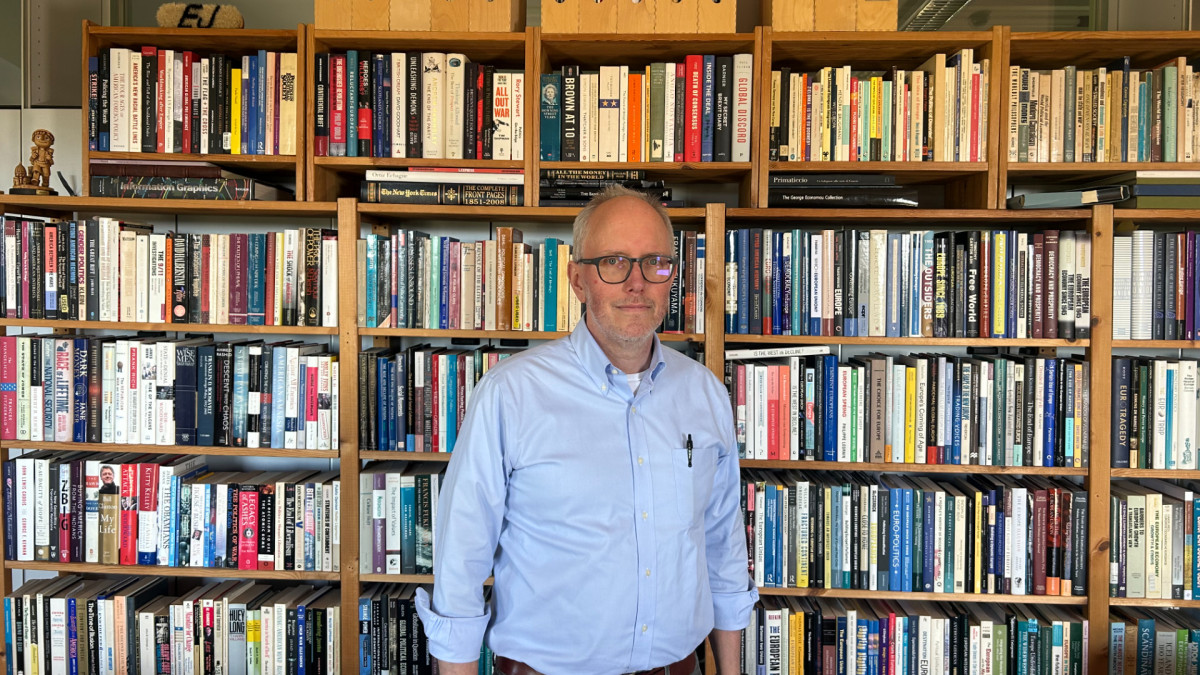
Professor Erik Jones in his office at the European University Institute.Agenda Pública / Jorge de Diego
If knowledge could be transmitted like a virus, spending a few hours in Erik Jones's office would be one of the easiest ways to catch it. The director of the Robert Schuman Centre for Advanced Studies at the European University Institute (EUI) welcomes Agenda Pública in Florence to discuss the complex context in which Europe now finds itself.
With a PhD in International Relations and a distinguished academic career, Professor Jones is not particularly worried about Ukraine's accession to the EU ("it is going to happen"), but he does have doubts about the European budget and the spending that must be devoted to enlargement, a process that includes up to twelve candidate countries. "How is that enlargement going to be written into the budget?", he asks.
In the conversation, held during the EUI's 50th anniversary, for which Agenda Pública was a media partner, there was time to talk at length about the relationship between Europe and the United States. Jones has written about an interesting concept, post-Atlantic Europe, and on this point he insists that "it is not only that Europeans need to realise that the situation has changed. They have to realise it now and act now".
After looking over some of his book covers and several honours —Ukrainian, Indonesian and Slovak among them—, the professor acknowledges that he does not have many books on Spanish politics, although at the end of the interview he stressed his great interest in Spain's international projection.

My first question is about a very current topic: the European Union's Multiannual Financial Framework. There is an important discussion about this issue, and it has also been addressed here today, at the EUI. I wanted to ask you what your expectations are for this MFF, and to what extent the outcome of these negotiations will indicate the future of Europe or the focus of the European institutions.
There are three things that are important to know about the upcoming Multiannual Financial Framework.
The first is that, just like with any MFF, there is a big question about how money is going to be allocated across the different categories of spending in which the European Union is engaged. If we assume that we are going to keep the same level of spending as a share of gross national income, there will be movements from one box to another.
And we know that these movements are going to happen because there is a huge increase in the need for defence spending, industrial policy and infrastructure spending. The EU is also still trying to spend its way through the digital and green transitions. All of this means reshuffling the deck.
But two other issues make it even more problematic.
One is that the EU needs additional own resources in order to repay the loans from Next Generation EU. The Commission has included that in its initial proposal, but it makes the ratio to gross national income go up significantly, by about a quarter of a percentage point, just to service and amortise the Next Generation EU debt.
Member states look at that and say: wait a minute, we have our own budget squeeze and now you are asking us for more money. The answer is: no, we are not asking for more; we need to pay back the money we have already borrowed. But politically, that is not an easy sell.
The third issue is that twelve countries want to join the European Union. How are we going to pay for that? How are they going to be written into this budget? Where will the budget be adjusted or expanded to accommodate the needs of Ukraine and Moldova, or the countries of the Western Balkans?
Are we going to give up on Turkey? Because whatever we do in the budget will send a clear signal to politicians in that country. If there is no financial provision made, then everybody in Turkey will know that Turkey is no longer really in the running. Of course, they already know that, but the symbolic issue is very important.
Speaking of enlargement, I wanted to ask you specifically about Ukraine, because it is a particularly sensitive issue right now. Do you think it could happen soon? How would it integrate with NATO?
The European Union needs to support Ukraine because it cannot allow Ukraine to fall to Russia. And the European Union needs to ensure that Ukraine is rebuilt. It also needs to ensure that Russia does not come back after Ukraine has been rebuilt and destroy everything again.
There is only one way to do all of that: to formalise the relationship between Europe, the European Union and Ukraine in some way. We can call that accession or enlargement, but we do not have to. We can call it whatever we want. The problem is that it is just as expensive.
People tend to think about enlargement as the moment a country becomes a member state, but that is not the right way to think about it. Becoming a member state is the end of the process.
Think about people and firms. Millions of Ukrainians live in the European Union. Ukrainians depend on the European Union and on access to the European Union for their daily survival. Ukrainian firms are redirecting all of their activity towards the European Union. At the same time, EU firms are integrating themselves into value chains in Ukraine, even in the context of this war.
So in an odd sort of way, even if we do not think of Ukraine as an official member state, Ukraine is integrating with Europe right now faster than any country of its size has ever integrated with Europe in the past. Faster even than the United Kingdom integrated with Europe in the 1960s and 1970s.
That kind of enlargement creates huge vulnerabilities. But the vulnerability that would come from Ukraine falling to Russia is even worse. So the question is how we address the vulnerabilities that will be created as Ukraine integrates into the European economy.
The easiest way to address them is to build capacity in the Ukrainian government. How do we build capacity in the Ukrainian government? By putting it through the accession process. The whole merit-based approach to enlargement is about capacity-building: you show merit by showing capacity. That is exactly what the enlargement process is.
Is this enlargement process going to result in Ukraine becoming a member state on 1 January 2027? No. Is it going to result in Ukraine becoming a member state on 1 January 2029? I do not know. But what I can say is that the process is moving much more quickly than we ever thought.
If you think about the period from the headline goals at the Helsinki summit in December 1999 to the decision on who would come in, in December 2002, that was two or three years. Countries that had not even started the accession process, like Slovakia, were admitted in three years. Bulgaria and Romania were told they would be allowed to come in 2007, in four years.
It is interesting, because I expected you to talk about the United States when I asked about Ukraine, and you did not. So let us talk about what you define as "post-Atlantic Europe". Things seem fairly clear, but I have the impression that some EU states act as if, once Trump is gone, everything will go back to the way it was before.
The key thing to remember is that Europeans have lived their entire lives with the United States as not just a reliable partner, but an admirable partner. And that is hard to give up. It is hard to give up inside the United States as well.
I was recently in Washington talking to people, particularly on the Democratic side of the aisle, and they were saying: when we win the midterms, the transatlantic relationship will reset back to the way it was. And I was saying: that is not going to happen. They also said: if we win the presidency in 2028, it will just reset back to the way it was. But it did not reset back to the way it was under Biden, and Biden is very pro-Atlantic.
The United States was basically saying: buy small armoured mobile units that you can move around the country, and if we need to project force, we will provide the strategic lift to carry your agile mobile unit somewhere else, like Afghanistan.
That is no longer credible. Europeans are asking how long it will take to develop strategic lift. The answer is: a long time. And if it is going to take a long time, and you think that the United States may —not will, but may— deprive Europeans of access to American strategic lift, then you have no choice. You have to start now.
To anyone who says Trump is just an aberration, I would say this: Trump I was an aberration. Trump II was the voice of the American people saying that, despite what happened on January 6, despite what happened in the first Trump Administration, and despite everything we know about Trump's relations with women, they still want him to be president. When the American people tell you what they really want, you should believe them.
But the argument is penetrating because they cannot afford to wait. And it is not just about strategic lift. It is also about big data servers and data farms. We need somewhere to house our own data. It is about the infrastructure for financial telecommunications and post-trade activity. We need the capacity to manage our own finances without going through the dollar and without relying on institutions that the United States can look into or block access to.
I think Europeans are reaching that same conclusion very reluctantly and with considerable unease. They are not all doing so at the same pace. But they are getting there.
That does not mean the transatlantic relationship will end. There will always be huge American investments in Europe and huge European investments in the United States. There will always be people who have had great experiences on both sides of the Atlantic and want to repeat them.
But it does mean that the relationship will be very different. And if Europeans disagree about what that "very different" looks like, I am not surprised. Different is different. Everyone has to experience it in their own way before they really understand and accept it.
You have explained what Europe needs in order to face this future without the United States: defence, strategic autonomy and other issues. If you had to choose just one reform for the European Union to navigate the next ten years, what would be the most important one?
If I only got to do one thing, as someone who studies politics, I would rewrite the budget. Because if I rewrote the budget, that would change everything. That is how politics works: on one side, people argue; on the other, money flows. While people are arguing, if you allow me to decide where the money goes, I will do that.
And what would you do specifically?
The interesting thing about making the money flow differently is that there are certain things we absolutely have to do. And it is going to be painful.
One of them is redirecting a lot of funding away from agricultural support. Redirecting funding away from agricultural support does not mean throwing farmers to the wolves. But it does mean reinterpreting the way we engineer support for rural communities, moving it away from agriculture as a business.
Because agriculture is a business. There are very productive agricultural people, and we will have to lean into that. But we also have to find a way to cushion the blow for all those rural societies that will be affected.
Because let us face it: much of the work that you and I do could be done from a rural community. But rural communities are not built to accommodate us. So maybe we should rethink that.
Thank you very much.
With a PhD in International Relations and a distinguished academic career, Professor Jones is not particularly worried about Ukraine's accession to the EU ("it is going to happen"), but he does have doubts about the European budget and the spending that must be devoted to enlargement, a process that includes up to twelve candidate countries. "How is that enlargement going to be written into the budget?", he asks.
In the conversation, held during the EUI's 50th anniversary, for which Agenda Pública was a media partner, there was time to talk at length about the relationship between Europe and the United States. Jones has written about an interesting concept, post-Atlantic Europe, and on this point he insists that "it is not only that Europeans need to realise that the situation has changed. They have to realise it now and act now".
After looking over some of his book covers and several honours —Ukrainian, Indonesian and Slovak among them—, the professor acknowledges that he does not have many books on Spanish politics, although at the end of the interview he stressed his great interest in Spain's international projection.
A part of Jones's library, with several honours and mementos from his academic career. Photo: Agenda Pública / Jorge de Diego
My first question is about a very current topic: the European Union's Multiannual Financial Framework. There is an important discussion about this issue, and it has also been addressed here today, at the EUI. I wanted to ask you what your expectations are for this MFF, and to what extent the outcome of these negotiations will indicate the future of Europe or the focus of the European institutions.
There are three things that are important to know about the upcoming Multiannual Financial Framework.
The first is that, just like with any MFF, there is a big question about how money is going to be allocated across the different categories of spending in which the European Union is engaged. If we assume that we are going to keep the same level of spending as a share of gross national income, there will be movements from one box to another.
And we know that these movements are going to happen because there is a huge increase in the need for defence spending, industrial policy and infrastructure spending. The EU is also still trying to spend its way through the digital and green transitions. All of this means reshuffling the deck.
"Everything we have talked about is becoming increasingly expensive: security, digital, green, infrastructure and industrial policy are all much more important now"That reshuffling is always hard, because people have constituencies —farmers, for example— who receive money from European budgets as they are currently designed, and who will lose money if those budgets are changed looking ahead. So far, this is all fairly normal, except that everything we have talked about is becoming increasingly expensive: security, digital, green, infrastructure and industrial policy are all much more important now.
But two other issues make it even more problematic.
One is that the EU needs additional own resources in order to repay the loans from Next Generation EU. The Commission has included that in its initial proposal, but it makes the ratio to gross national income go up significantly, by about a quarter of a percentage point, just to service and amortise the Next Generation EU debt.
Member states look at that and say: wait a minute, we have our own budget squeeze and now you are asking us for more money. The answer is: no, we are not asking for more; we need to pay back the money we have already borrowed. But politically, that is not an easy sell.
The third issue is that twelve countries want to join the European Union. How are we going to pay for that? How are they going to be written into this budget? Where will the budget be adjusted or expanded to accommodate the needs of Ukraine and Moldova, or the countries of the Western Balkans?
Are we going to give up on Turkey? Because whatever we do in the budget will send a clear signal to politicians in that country. If there is no financial provision made, then everybody in Turkey will know that Turkey is no longer really in the running. Of course, they already know that, but the symbolic issue is very important.
"If no money is allocated to enlargement in this MFF, the credibility of the enlargement process in the eyes of the candidate countries will vanish overnight"If no money is allocated to enlargement in this MFF, the credibility of the enlargement process in the eyes of the candidate countries will vanish overnight. They will see that there is no money to accommodate enlargement, and they will conclude that it is not really being planned.
Speaking of enlargement, I wanted to ask you specifically about Ukraine, because it is a particularly sensitive issue right now. Do you think it could happen soon? How would it integrate with NATO?
The European Union needs to support Ukraine because it cannot allow Ukraine to fall to Russia. And the European Union needs to ensure that Ukraine is rebuilt. It also needs to ensure that Russia does not come back after Ukraine has been rebuilt and destroy everything again.
There is only one way to do all of that: to formalise the relationship between Europe, the European Union and Ukraine in some way. We can call that accession or enlargement, but we do not have to. We can call it whatever we want. The problem is that it is just as expensive.
People tend to think about enlargement as the moment a country becomes a member state, but that is not the right way to think about it. Becoming a member state is the end of the process.
Think about people and firms. Millions of Ukrainians live in the European Union. Ukrainians depend on the European Union and on access to the European Union for their daily survival. Ukrainian firms are redirecting all of their activity towards the European Union. At the same time, EU firms are integrating themselves into value chains in Ukraine, even in the context of this war.
So in an odd sort of way, even if we do not think of Ukraine as an official member state, Ukraine is integrating with Europe right now faster than any country of its size has ever integrated with Europe in the past. Faster even than the United Kingdom integrated with Europe in the 1960s and 1970s.
That kind of enlargement creates huge vulnerabilities. But the vulnerability that would come from Ukraine falling to Russia is even worse. So the question is how we address the vulnerabilities that will be created as Ukraine integrates into the European economy.
The easiest way to address them is to build capacity in the Ukrainian government. How do we build capacity in the Ukrainian government? By putting it through the accession process. The whole merit-based approach to enlargement is about capacity-building: you show merit by showing capacity. That is exactly what the enlargement process is.
Is this enlargement process going to result in Ukraine becoming a member state on 1 January 2027? No. Is it going to result in Ukraine becoming a member state on 1 January 2029? I do not know. But what I can say is that the process is moving much more quickly than we ever thought.
If you think about the period from the headline goals at the Helsinki summit in December 1999 to the decision on who would come in, in December 2002, that was two or three years. Countries that had not even started the accession process, like Slovakia, were admitted in three years. Bulgaria and Romania were told they would be allowed to come in 2007, in four years.
"As the clusters are unlocked, Ukraine will move quickly through them. There will be issues, no doubt. There will be turbulence. But at some point, Ukraine will join"So when you look at that timetable, how long have we been working on the accession process with Ukraine? We have already been doing it for a couple of years. It is going to happen. Negotiations will open this year. The negotiating clusters will start to be unlocked in June, assuming the Hungarian government does what it is supposed to do. And as the clusters are unlocked, Ukraine will move quickly through them. There will be issues, no doubt. There will be turbulence. But at some point, Ukraine will join.
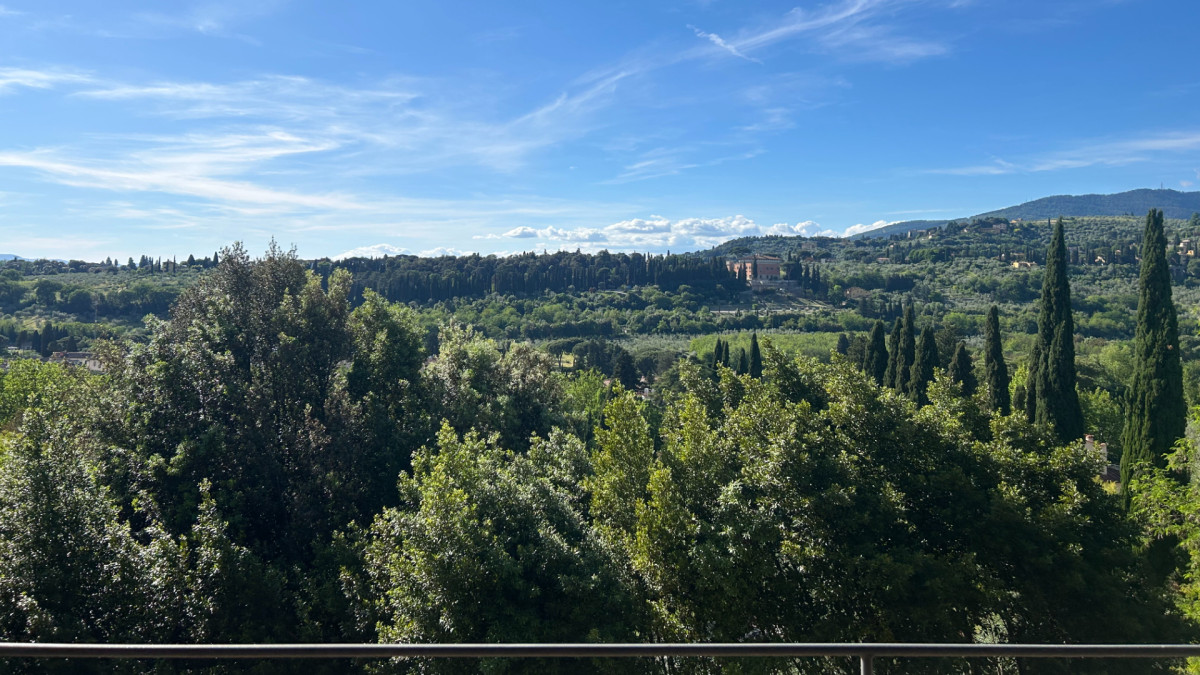
The view from the balcony where the conversation took place, in Fiesole. Photo: Agenda Pública / Jorge de Diego
It is interesting, because I expected you to talk about the United States when I asked about Ukraine, and you did not. So let us talk about what you define as "post-Atlantic Europe". Things seem fairly clear, but I have the impression that some EU states act as if, once Trump is gone, everything will go back to the way it was before.
The key thing to remember is that Europeans have lived their entire lives with the United States as not just a reliable partner, but an admirable partner. And that is hard to give up. It is hard to give up inside the United States as well.
I was recently in Washington talking to people, particularly on the Democratic side of the aisle, and they were saying: when we win the midterms, the transatlantic relationship will reset back to the way it was. And I was saying: that is not going to happen. They also said: if we win the presidency in 2028, it will just reset back to the way it was. But it did not reset back to the way it was under Biden, and Biden is very pro-Atlantic.
"The United States has always said that Europe needs to spend more on its security. But it has also always said that Europeans should not invest in duplicating assets that the United States brings to the table"Here is the key point. Throughout the history of the transatlantic relationship, the United States has always said that Europe needs to spend more on its security. But it has also always said that Europeans should not invest in duplicating assets that the United States brings to the table: large, expensive assets such as satellite intelligence, command, control and communications, strategic lift, or carrier groups.
The United States was basically saying: buy small armoured mobile units that you can move around the country, and if we need to project force, we will provide the strategic lift to carry your agile mobile unit somewhere else, like Afghanistan.
That is no longer credible. Europeans are asking how long it will take to develop strategic lift. The answer is: a long time. And if it is going to take a long time, and you think that the United States may —not will, but may— deprive Europeans of access to American strategic lift, then you have no choice. You have to start now.
To anyone who says Trump is just an aberration, I would say this: Trump I was an aberration. Trump II was the voice of the American people saying that, despite what happened on January 6, despite what happened in the first Trump Administration, and despite everything we know about Trump's relations with women, they still want him to be president. When the American people tell you what they really want, you should believe them.
"It is not only that Europeans need to realise that the situation has changed. They have to realise it now and act on it now"In that context, it is not only that Europeans need to realise that the situation has changed. They have to realise it now and act on it now. And when you say that to Europeans who love the United States and want the United States always to be there, it is very hard for them to accept.
But the argument is penetrating because they cannot afford to wait. And it is not just about strategic lift. It is also about big data servers and data farms. We need somewhere to house our own data. It is about the infrastructure for financial telecommunications and post-trade activity. We need the capacity to manage our own finances without going through the dollar and without relying on institutions that the United States can look into or block access to.
I think Europeans are reaching that same conclusion very reluctantly and with considerable unease. They are not all doing so at the same pace. But they are getting there.
That does not mean the transatlantic relationship will end. There will always be huge American investments in Europe and huge European investments in the United States. There will always be people who have had great experiences on both sides of the Atlantic and want to repeat them.
But it does mean that the relationship will be very different. And if Europeans disagree about what that "very different" looks like, I am not surprised. Different is different. Everyone has to experience it in their own way before they really understand and accept it.
You have explained what Europe needs in order to face this future without the United States: defence, strategic autonomy and other issues. If you had to choose just one reform for the European Union to navigate the next ten years, what would be the most important one?
If I only got to do one thing, as someone who studies politics, I would rewrite the budget. Because if I rewrote the budget, that would change everything. That is how politics works: on one side, people argue; on the other, money flows. While people are arguing, if you allow me to decide where the money goes, I will do that.
And what would you do specifically?
The interesting thing about making the money flow differently is that there are certain things we absolutely have to do. And it is going to be painful.
One of them is redirecting a lot of funding away from agricultural support. Redirecting funding away from agricultural support does not mean throwing farmers to the wolves. But it does mean reinterpreting the way we engineer support for rural communities, moving it away from agriculture as a business.
Because agriculture is a business. There are very productive agricultural people, and we will have to lean into that. But we also have to find a way to cushion the blow for all those rural societies that will be affected.
"When Ukraine joins the European Union, it will bring in an enormous number of highly productive farmers"This is the same issue we are talking about in the context of Ukraine. When Ukraine joins the European Union, it will bring in an enormous number of highly productive farmers. And a lot of other farmers who are less productive will suffer the consequences. We need to help them now to move away from doing things unproductively. That is not to say we should get them out of agriculture. We need to make them more productive in different ways, integrate them into rural communities in different ways, and support those communities.
Because let us face it: much of the work that you and I do could be done from a rural community. But rural communities are not built to accommodate us. So maybe we should rethink that.
Thank you very much.
.png)
Jorge de Diego Hurtado
Redactor en 'Agenda Pública'
Politólogo y analista electoral. Cuenta con experiencia en consultoría en Bruselas y actualmente es redactor en 'Agenda Pública'. También es cofundador de 'El Tablero Político'.
Ahora en portada
16 de octubre de 2026
16 de octubre de 2026
16 de octubre de 2026
Noticias relacionadas
Hace 22 semanas
Director del Robert Schuman Centre del Instituto Universitario Europeo: "Trump I fue una anomalía. Trump II fue la voz del pueblo estadounidense"
Hace 22 semanas
¿Cuál ha sido la principal contribución de España al proyecto europeo? Cinco respuestas desde la política y la academia
Hace 23 semanas
"¿Es este el mundo que había imaginado cuando era más joven? No"
Lo más leído