Sábado, 17 de octubre de 2026




QUALIFIED MAJORITY
European leaders to discuss their reactions to the energy crisis in Cyprus
Europe’s heads of government are set to meet in Cyprus to focus on energy prices, compelled by a sense of urgency on many fronts. Nacho Alarcón, correspondent in Brussels, reports on the energy outlook as well as the debates around EU Article 42.7, Hungary’s veto of credit for Ukraine, and the start of budget negotiations in a European Union that appears to be entering ‘emergency mode’.
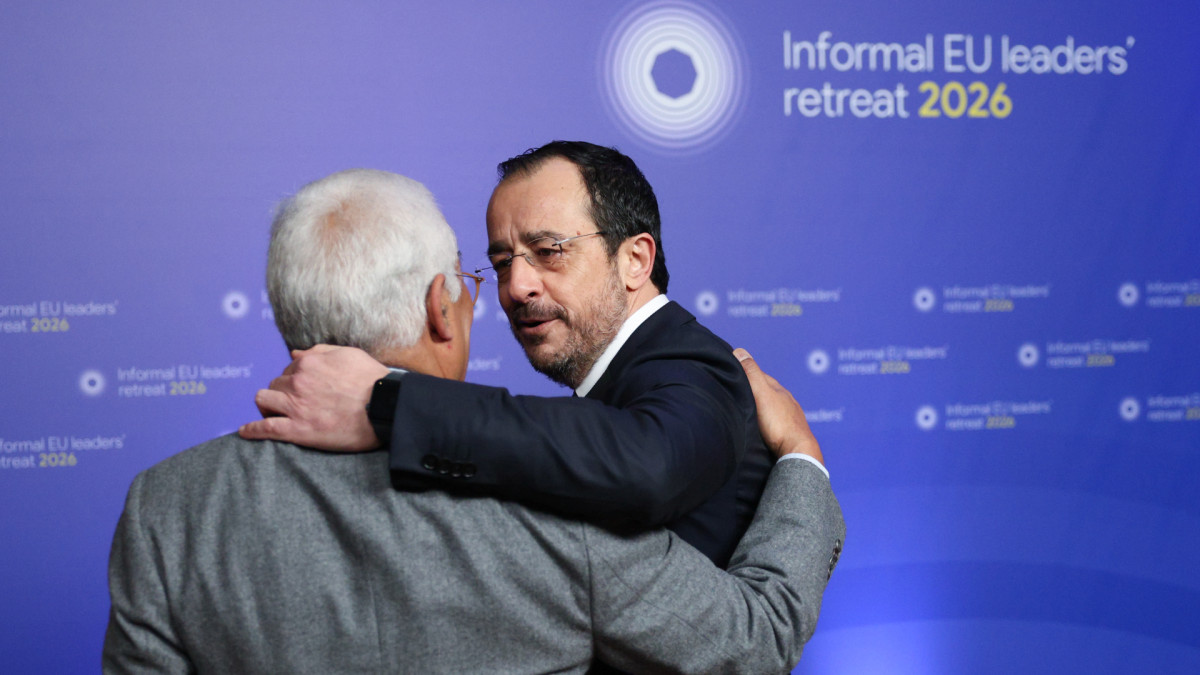
António Costa, President of the European Council (left) embraces Nikos Christodoulides, President of Cyprus.European Union (European Council)
This Thursday and Friday, European leaders will meet in Cyprus for a summit marked by a renewed sense of urgency and crisis. Those feelings are being fed by increased energy prices due to the wars in the Middle East – especially Iran's blockade of the Strait of Hormuz in response to attacks by the U.S. and Israel – but also by other substantive debates that cannot wait for June and the European Council's next formal meeting. As happens every so often, Brussels has activated emergency mode with the aim of making progress on several pressing concerns.
The main point for discussion (energy) will be structured around a communication to be published by the Commission on Wednesday, one day before the leaders convene in Cyprus. Brussels has already sent its main proposals to the capitals in order to gather opinions and make final textual adjustments. The central element is a temporary scheme of State assistance, where the EU executive proposes giving free rein to the national governments to support their most-affected sectors. This is an issue around which consensus tends to prevail. The proposal from Brussels would allow the 27 Member States to cover 50% of extra fuel costs for the fishing and transport sectors, maritime and land-based (short routes only), as well as for agriculture, given the increase in fertilizer prices.
Moreover, in the absence of joint measures, this temporary framework reopens an old debate on the differences in fiscal space available to Member States. Experience gained since 2022 indicates that a relaxation of State assistance often results in a veritable tsunami of subsidies from Germany and France. Some leaders could revive the petition advanced by the Finance Ministers of Spain, Germany, Austria, Italy, and Portugal for a windfall tax on large energy companies that are currently seeing windfall profits thanks to the Middle East crisis.
EU Article 42.7 enshrines in writing that notion of collective defense. Like Austria, Ireland, and Malta, Cyprus is not a NATO member, so in a context of growing instability, there is a certain appetite to clarify this clause and make it more effective. António Costa, President of the European Council, mentioned this in his letter of invitation to EU leaders, and President of Cyprus Nikos Christodoulides plans to prioritize the specification of a clear mechanism on how this article could be invoked.
Finally, António Costa intends to force Europe's leaders to engage in a debate that they have long postponed: the matter of the next Multiannual Financial Framework (MFF) for the years 2028–2034. The roadmap states that the EU needs to reach an agreement in time to prevent next year's presidential elections in France from interfering with negotiations; but delays have been accumulating. The Council expects the Cypriot presidency to present an initial negotiating box with figures and details at the European summit in June, but Costa wants the leaders to begin shaping the political orientation of negotiations.
The main point for discussion (energy) will be structured around a communication to be published by the Commission on Wednesday, one day before the leaders convene in Cyprus. Brussels has already sent its main proposals to the capitals in order to gather opinions and make final textual adjustments. The central element is a temporary scheme of State assistance, where the EU executive proposes giving free rein to the national governments to support their most-affected sectors. This is an issue around which consensus tends to prevail. The proposal from Brussels would allow the 27 Member States to cover 50% of extra fuel costs for the fishing and transport sectors, maritime and land-based (short routes only), as well as for agriculture, given the increase in fertilizer prices.
"The temporary framework mainly benefits industries in countries such as Germany, Italy, and Poland and offers much less margin to Spain and the Nordic countries"A much thornier issue concerns the Commission's proposal to increase from 50% to 70% the subsidizable energy costs for electro-intensive industries under the Clean Industrial Deal State Aid Framework (CISAF). Unlike the 50% already included in the CISAF text, this increase in the eligible percentage need not be allocated to decarbonization, in accordance with Brussels' plans; however, it maintains the existing limit of not injecting aid beyond €50 per MWh. Again, the temporary framework mainly benefits industries in countries such as Germany, Italy, and Poland, meanwhile offering much less margin to Member States that have long opted for a less-polluting energy mix (and, therefore, less exposure to hydrocarbon prices, as in the cases of Spain and the Nordic countries).
Moreover, in the absence of joint measures, this temporary framework reopens an old debate on the differences in fiscal space available to Member States. Experience gained since 2022 indicates that a relaxation of State assistance often results in a veritable tsunami of subsidies from Germany and France. Some leaders could revive the petition advanced by the Finance Ministers of Spain, Germany, Austria, Italy, and Portugal for a windfall tax on large energy companies that are currently seeing windfall profits thanks to the Middle East crisis.
Article 42.7
Notably, the leaders are meeting in a country that has experienced the instability of the Middle East up close. The drone strike in March against a British base at Akrotiri prompted a mobilization of resources from certain Member States, including frigates and Greek F-16s, as well as assets from France, Italy, the Netherlands, and Spain. Beyond that, the incident demonstrated that while the EU already has a clause ostensibly related to collective defense – similar in some ways to NATO's Article 5 – that mechanism is not well oiled.EU Article 42.7 enshrines in writing that notion of collective defense. Like Austria, Ireland, and Malta, Cyprus is not a NATO member, so in a context of growing instability, there is a certain appetite to clarify this clause and make it more effective. António Costa, President of the European Council, mentioned this in his letter of invitation to EU leaders, and President of Cyprus Nikos Christodoulides plans to prioritize the specification of a clear mechanism on how this article could be invoked.
"The 26 attendees will meet with regional leaders to discuss the situation in the Middle East – another point given great importance by the Cypriot government"In addition, and in line with the strategic debate on collective defense of the Union, the 26 attendees (Hungarian Prime Minister Viktor Orbán has decided not to go to Nicosia following his electoral defeat) will meet with regional leaders to discuss the situation in the Middle East – another point given great importance by the Cypriot government. The agenda will probably be affected by the usual last-minute moves from Washington, notably U.S. pressure on the Strait of Hormuz.
Ukrainian and budgetary urgency
On the other hand, European leaders will be speaking with Ukrainian President Volodymir Zelensky, with one issue in mind: releasing the €90 billion loan agreed in December and financed by European bonds, which Orbán has blocked in recent months. Brussels expects that incoming Prime Minister Péter Magyar – set to take office in early May – will overturn Hungary's veto, thus addressing the urgent needs of Kiev in coming weeks.Finally, António Costa intends to force Europe's leaders to engage in a debate that they have long postponed: the matter of the next Multiannual Financial Framework (MFF) for the years 2028–2034. The roadmap states that the EU needs to reach an agreement in time to prevent next year's presidential elections in France from interfering with negotiations; but delays have been accumulating. The Council expects the Cypriot presidency to present an initial negotiating box with figures and details at the European summit in June, but Costa wants the leaders to begin shaping the political orientation of negotiations.
.png)
Nacho Alarcón
Corresponsal en Bruselas y experto en política europea
Corresponsal en Bruselas de 'El Confidencial' y autor de la 'newsletter' de asuntos europeos Nexo Europa. Premio de periodismo europeo Salvador de Mariaga 2024.
Ahora en portada
17 de octubre de 2026
16 de octubre de 2026
Noticias relacionadas
Hace 27 semanas
Ampliar para proteger: ¿Es Ucrania una inversión en seguridad para la UE?
Hace 26 semanas
Impuestos extraordinarios o cuando la "solución" agrava el problema
Hace 26 semanas
Un impuesto extraordinario bien diseñado puede ser justo y eficaz
Lo más leído