Viernes, 16 de octubre de 2026




LÓPEZ PLANA'S EUROPEAN COMPASS
Can the purging of a Chinese general affect employment in Martorell?
Cracks have appeared in the Chinese Communist Party’s internal apparatus, and Xi Jinping seems determined to wipe them out. Marc López Plana, editor and director of 'Agenda Pública', goes beyond the domestic to consider how movements in Beijing could prove decisive in Spain, which is "a key piece" in Xi’s plan "to separate Europe from the United States."
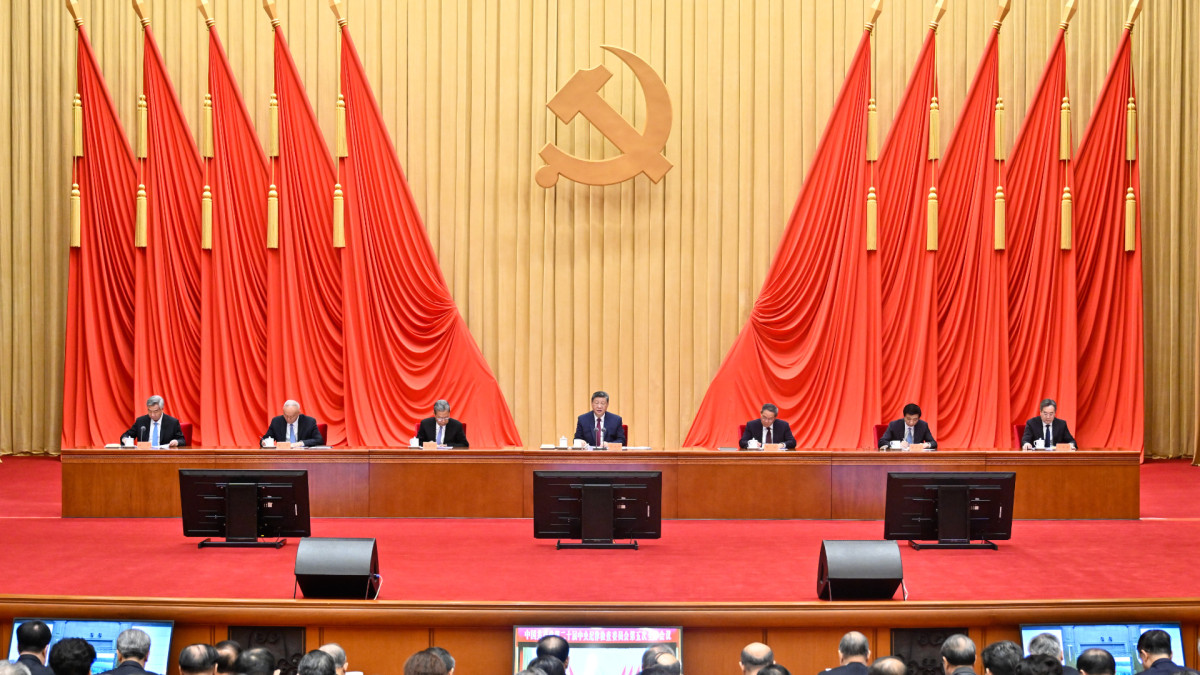
CCP General Secretary and Chinese President Xi Jinping at a Party plenary session.Yue Yuewei / Xinhua News / ContactoPhoto
As 2026 gets underway, the opacity of Chinese politics is once again making an impenetrable ‘black box’ of Beijing. While the algorithms that drive social networks like X amplify rumors of imminent collapse, reality is pointing at an unprecedented purge in the wake of allegations of corruption within China’s army and defense industry.
For Spain, this isn’t just another international news item; it poses a direct challenge to the country’s economic security and position in the West.
Analysts disagree as to the causes: some point to corruption and a lack of operational preparedness; others describe a power struggle between ‘red prince’ generals like Zhang and a younger cohort led by He Weidong. In late 2025, rumors circulated that Zhang had leaked nuclear secrets to the U.S., and that the CIA had infiltrated the PLA, but the evidence remains anecdotal, and both Chinese and Western sources stress that officials are mainly being sanctioned for corruption and disloyalty. China has publicly denounced U.S. intelligence efforts to recruit Chinese officials, and it has warned against foreign infiltration and sabotage following the release of Chinese-language recruitment videos by the CIA.
What might seem a coup on social media is the most aggressive phase of a system devouring its tail to survive, all the while seeking to reach the technological level of the United States.
While other European partners debate the exclusion of Huawei or control over critical infrastructures, Spain has kept to the margins. Should Xi manage to persuade Spain to prioritize its bilateral interests while sustaining its common Atlantic strategy, he will have opened a crack in Western unity, feeding the idea that Europe can operate as an autonomous economic space, distanced from Washington.
The most convincing argument against a coup lies in the architecture of Chinese State control. The deployment of Artificial Intelligence for censorship and mass surveillance has created an environment where any plot requiring secret coordination would be incredibly difficult to pull off. China employs both public opinion monitoring (through data mining and sentiment analysis) and anti-corruption tools that use big data and AI to detect anomalies and to map relationships and potential networks of collusion among officials.
Nonetheless, to altogether dismiss the risk of coup would be to ignore certain worrying undercurrents. Economic pressures may be fostering challenges to legitimacy in the medium term, and youth unemployment has remained persistently high, leading to potential volatility in that segment. Moreover, the demographics are sobering: China’s rapidly aging population is putting fiscal strain on government budgets for health and pensions, which could erode the reputation for performance that has historically insulated the Party from serious challenges.
For Spain, this isn’t just another international news item; it poses a direct challenge to the country’s economic security and position in the West.
Vital machinery working against its own nature
In my recent conversation with Rafael Dezcallar, former Spanish ambassador to China, he explained that the Chinese system is "a unique entity defined by the pragmatism of the Deng Xiaoping era. Mao’s orthodoxy became the efficiency of Deng’s ‘black cat, white cat’." But under Xi Jinping, that pragmatism has mutated. Xi has detected that capitalism breeds individual freedoms and alternative power centers that threaten the monopoly of the Chinese Communist Party (CCP)."The CCP today acts as ‘vital and powerful machinery’ that uses meritocracy and digital control to avoid the fate of the ancient dynasties"The response of the Party has been to recentralize power, and the CCP today acts as ‘vital and powerful machinery’ that uses meritocracy and digital control to avoid the fate of the ancient dynasties. But this machinery is under extreme pressure, as Xi Jinping has overseen one of the most extensive purges of the People’s Liberation Army (PLA) since the Mao era. From mid-2023 through January 2026, the Party-State has removed or investigated more than 20 PLA generals. On January 24, 2026, the Ministry of Defense confirmed that Liu Zhenli, chairman of the Joint Chiefs of Staff, and Zhang Youxia, a longtime ally of Xi and vice chairman of the Central Military Commission (CMC), were under investigation for serious violations of discipline. Observers say the purge has affected top commanders from the navy, ground forces, and Rocket Force, vacating three of seven posts in the CMC and halting promotions.
Analysts disagree as to the causes: some point to corruption and a lack of operational preparedness; others describe a power struggle between ‘red prince’ generals like Zhang and a younger cohort led by He Weidong. In late 2025, rumors circulated that Zhang had leaked nuclear secrets to the U.S., and that the CIA had infiltrated the PLA, but the evidence remains anecdotal, and both Chinese and Western sources stress that officials are mainly being sanctioned for corruption and disloyalty. China has publicly denounced U.S. intelligence efforts to recruit Chinese officials, and it has warned against foreign infiltration and sabotage following the release of Chinese-language recruitment videos by the CIA.
What might seem a coup on social media is the most aggressive phase of a system devouring its tail to survive, all the while seeking to reach the technological level of the United States.
Xi’s objective: use Spain as a wedge in the Atlantic bloc
This is where the situation becomes strategic for Madrid. In a recent column, I explained that "Xi Jinping’s strategic objective is to provoke a rupture between Europe and the United States," and Spain is a key piece in that strategy. Beijing sees Spain as a particularly receptive country, thanks to a public discourse in which China is regarded as a trading partner—but rarely as a subject worthy of strategy debates."Should Xi manage to persuade Spain to prioritize its bilateral interests while sustaining its common Atlantic strategy, he will have opened a crack in Western unity"In politics, Madrid has opted for a pragmatic compromise within the European framework: high-level visits, abstention on tariffs on Chinese electric vehicles (EVs), openness to Huawei in 5G, and a narrative of ‘open strategic autonomy’, supported by public opinion that is mostly favorable to China as a necessary partner.
While other European partners debate the exclusion of Huawei or control over critical infrastructures, Spain has kept to the margins. Should Xi manage to persuade Spain to prioritize its bilateral interests while sustaining its common Atlantic strategy, he will have opened a crack in Western unity, feeding the idea that Europe can operate as an autonomous economic space, distanced from Washington.
Spanish dependency
Spain’s exposure to China in terms of trade and investment remains high. In 2024, Spain exported goods worth $7.69 billion to the Chinese market, most notably in pharmaceuticals, minerals, and pork. Spain is Europe’s leading exporter of pork to China, meanwhile importing $46.6 billion worth of mainly electronics, machinery, and vehicles. China is Spain’s second supplier and fourth trading partner, and this dependence is accentuated in critical chains: more than 80% of certain active ingredients for pharmaceuticals, electronic components (LEDs), and strategic raw materials (magnesium and rare earths) come from China. In terms of investment, Chinese stock in Spain amounts to some €1.186 billion (2022), with greenfield projects announced in 2024 for €4.2 billion in batteries, EVs, hydrogen, and quantum computing, albeit with relevant delays."Today, protecting Spanish interests means keeping an eye on China’s internal politics, which could affect strategic projects in Spain"So Madrid is no mere spectator; our economy is connected to China’s circulatory system by vital channels. With the arrival of brands like Chery in Barcelona and the battery cell projects in Sagunto, Spain aspires to be the European hub for electric motors. However, those companies are extensions of the Chinese State. Today, protecting Spanish interests means keeping an eye on China’s internal politics, which could affect strategic projects in Spain. Chinese management of terminals at Valencia and Algeciras by State-owned COSCO means that Spain’s logistical sovereignty is linked to the stability of the CCP.
Odds of a breakdown
I asked an AI-powered prediction market about the likelihood of a coup d’état in China before the end of 2026. The result was a probability of only 2%, but when the stakes are so momentous, even odds as slim as those merit serious consideration. Although military purges and turbulence among China’s elites have created visible friction, the sophisticated control apparatus of the CCP and a decade of power consolidation by Xi have erected virtually insurmountable barriers against any coordinated internal rebellion.The most convincing argument against a coup lies in the architecture of Chinese State control. The deployment of Artificial Intelligence for censorship and mass surveillance has created an environment where any plot requiring secret coordination would be incredibly difficult to pull off. China employs both public opinion monitoring (through data mining and sentiment analysis) and anti-corruption tools that use big data and AI to detect anomalies and to map relationships and potential networks of collusion among officials.
Nonetheless, to altogether dismiss the risk of coup would be to ignore certain worrying undercurrents. Economic pressures may be fostering challenges to legitimacy in the medium term, and youth unemployment has remained persistently high, leading to potential volatility in that segment. Moreover, the demographics are sobering: China’s rapidly aging population is putting fiscal strain on government budgets for health and pensions, which could erode the reputation for performance that has historically insulated the Party from serious challenges.
Ahora en portada
16 de octubre de 2026
16 de octubre de 2026
16 de octubre de 2026
Noticias relacionadas
Hace 54 semanas
La economista española que más sabe sobre China: "Se lo estamos poniendo en bandeja"
Hace 48 semanas
Rafael Dezcallar: "Es bueno que el rey vaya a China"
Hace 53 semanas
España ante el objetivo de Xi Jinping: la ruptura de Europa con Estados Unidos
Lo más leído