Viernes, 16 de octubre de 2026




LÓPEZ PLANA'S EUROPEAN COMPASS
Europe’s 'historical compromise' under threat: a strategic vulnerability exploited by Trump
Europe is reacting with surprise to Donald Trump’s new National Security Strategy, but perhaps it should examine itself first. As the editor and director of 'Agenda Pública' warns in this week’s European Compass, "Europe’s strategic weakness is not external, but internal – it’s born of the Union’s inability to act as a coherent political unit." This revelation of U.S. interventionist designs doesn’t signal a new era; it merely underlines a weakness that’s been developing for decades.

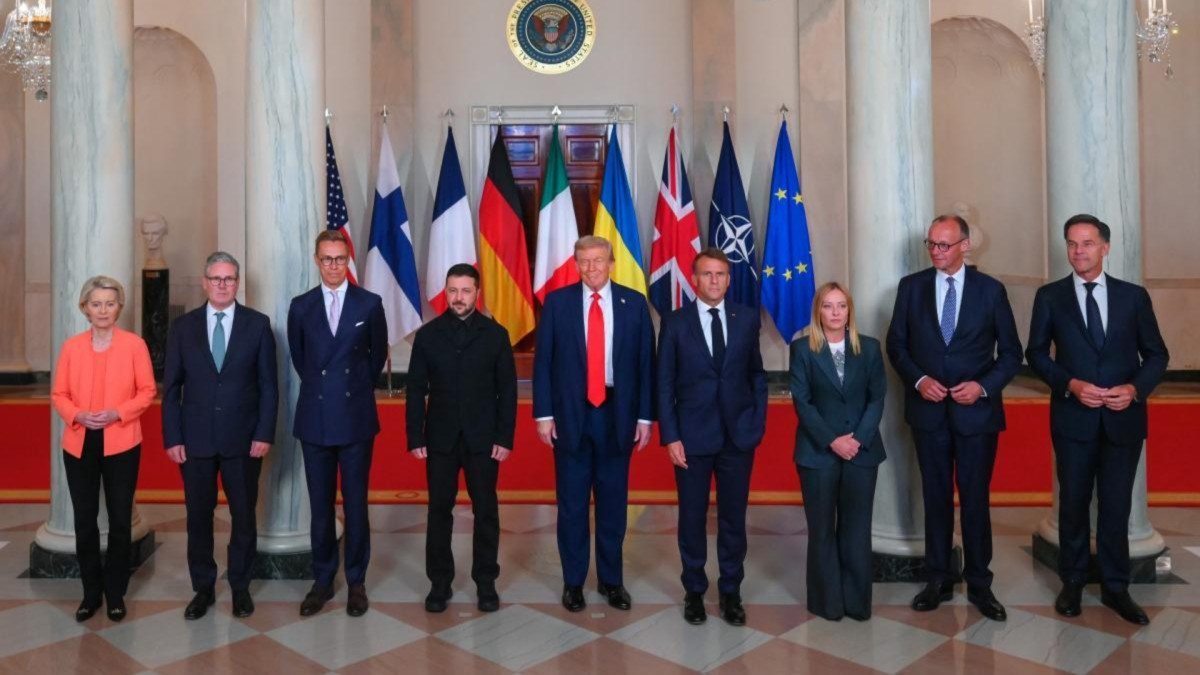
Last August, Donald Trump received some of Europe’s top leaders at the White House.European Commission Audiovisual Service.
The issuance of Donald Trump’s new National Security Strategy has provoked shock and criticism in Europe (and indifference from Spanish politicians). While its broad geopolitical content is surprising enough, something else is especially disturbing: the document is unusually explicit in its assumption that the United States will interfere politically in Europe, should such be deemed necessary "to protect and advance American interests." Public reaction has been swift. On the 'X' social platform – after warnings from Elon Musk that Europe as we know it "is destined to disappear" – many thousands posted the EU flag as an affirmation of identity and symbolic resistance.
The strategy wasn’t limited to the military and diplomatic spheres but included propaganda, covert operations, and the financing of political parties. The logic was simply to ensure that European politics remained aligned with Washington’s strategic interests.
Indeed, if any country has never bothered to hide (whether from its allies or adversaries) its willingness to shape the politics of other nations, it has been the United States. Ever since the post-war era, Washington has acted with the conviction that its own security depends on preventing European deviations from certain strategic U.S. coordinates. Sometimes it has acted through subtle diplomacy, other times through intervention, both overt and covert. If Trump’s new strategy strikes Europe as uncomfortably frank, this is partly because the document spells out what had previously been quietly implied: European politics has never been a matter to be handled by Europe alone.
An early and decisive case of containment policy was the U.S. intervention in Greece at the outset of the Cold War (1946-1949). Following that country’s liberation from Nazi rule, a civil war erupted between the Greek government – initially supported by the United Kingdom, then by the U.S. – and the communist forces (ELAS and EAM/ELAM) backed by neighboring nations. Faced with the prospect of Greece falling under Soviet influence, Truman in 1947 pledged military and economic aid to sustain the government and defeat the insurgents. That intervention made possible the consolidation of a pro-Western government, setting a key precedent for the broader U.S. strategy of containing communism in Europe.
Another very emblematic example took place in Italy in 1948, as depicted in Andrea Segre’s film The Great Ambition. During an election regarded as decisive to Europe’s political balance, both U.S. diplomacy and the CIA actively supported the Christian Democrats to prevent a victory for the Italian Communist Party (PCI). Enrico Berlinguer, leader of the PCI, promoted his 'historic compromise' that sought to stabilize the country while integrating his party into democratic institutions. That was taken as a threat by Washington: any democratic and popular form of communism could upset the delicate equilibrium in Europe. Thereafter, the CIA and U.S. diplomats followed with very close attention the PCI, its leadership, and its strategic decisions.
More recent episodes confirm the persistence of this pattern. During Barack Obama’s presidency, the U.S. National Security Agency intercepted the mobile phone of German Chancellor Angela Merkel, triggering a major diplomatic scandal. This indicated that U.S. pressure and surveillance weren’t reserved for its adversaries alone; even its closest allies might be spied on, to ensure that their decision-making aligned with U.S. interests.
Trump’s NSS reflects a longstanding principle of U.S. foreign policy: national security is not limited to defense against external threats but includes the projection of power and the shaping of political and economic contexts on a global scale. The methods have varied over time, from propaganda, diplomacy, and party financing in the Cold War to today’s digital espionage and economic pressure.
This is why many transitions in Europe cannot be interpreted as purely internal processes. Trump’s NSS merely makes explicit a longstanding logic: intervention, influence, and the projection of power are not exceptions to the rule, but instruments of the State.
Trump’s NSS confirms that interventionism isn’t just a residual Cold War effect but a practice fully in force, legitimized and adapted to the challenges of the 21st century. Understanding this pattern is essential to interpreting contemporary European politics, recognizing that national sovereignty is negotiated on a global chessboard where the U.S. has occupied a permanent seat for decades.
The original historic compromise formulated by Enrico Berlinguer – which was never fully realized – was based on the same political intuition as the tacit agreement between Social Democrats and Christian Democrats that made the European Union possible: the idea that, in contexts of high polarization, democratic stability will require major pacts among opposing ideological traditions.
In Italy, Berlinguer’s project was scuttled by internal resistance, a climate of violence, and Cold War logic. In Western Europe, on the other hand, an understanding was confirmed between the Social and Christian Democrats, permitting construction of a political order based on the welfare state, economic integration, and the institutional anchoring of social conflict. This longstanding, cross-cutting consensus is now being threatened by a policy of rupture embodied by Donald Trump: a logic that distrusts wide-reaching agreements, weakens historical alliances, and erodes the culture of compromise that has sustained and stabilized the European project for decades.
"Shortly after World War II, the United States adopted a strategy of containment, aimed at slowing the advance of the European left"But we’d be fooling ourselves to regard this as the first overt threat of U.S. interference. Shortly after World War II, the United States adopted a strategy of containment, aimed at slowing the advance of the European left. That strategy originated in the so-called 'Long Telegram' by U.S. diplomat George Kennan; it was formally encoded in U.S. National Security Council Report 68, approved in 1950 during the presidency of Harry S. Truman.
The strategy wasn’t limited to the military and diplomatic spheres but included propaganda, covert operations, and the financing of political parties. The logic was simply to ensure that European politics remained aligned with Washington’s strategic interests.
Indeed, if any country has never bothered to hide (whether from its allies or adversaries) its willingness to shape the politics of other nations, it has been the United States. Ever since the post-war era, Washington has acted with the conviction that its own security depends on preventing European deviations from certain strategic U.S. coordinates. Sometimes it has acted through subtle diplomacy, other times through intervention, both overt and covert. If Trump’s new strategy strikes Europe as uncomfortably frank, this is partly because the document spells out what had previously been quietly implied: European politics has never been a matter to be handled by Europe alone.
An early and decisive case of containment policy was the U.S. intervention in Greece at the outset of the Cold War (1946-1949). Following that country’s liberation from Nazi rule, a civil war erupted between the Greek government – initially supported by the United Kingdom, then by the U.S. – and the communist forces (ELAS and EAM/ELAM) backed by neighboring nations. Faced with the prospect of Greece falling under Soviet influence, Truman in 1947 pledged military and economic aid to sustain the government and defeat the insurgents. That intervention made possible the consolidation of a pro-Western government, setting a key precedent for the broader U.S. strategy of containing communism in Europe.
Another very emblematic example took place in Italy in 1948, as depicted in Andrea Segre’s film The Great Ambition. During an election regarded as decisive to Europe’s political balance, both U.S. diplomacy and the CIA actively supported the Christian Democrats to prevent a victory for the Italian Communist Party (PCI). Enrico Berlinguer, leader of the PCI, promoted his 'historic compromise' that sought to stabilize the country while integrating his party into democratic institutions. That was taken as a threat by Washington: any democratic and popular form of communism could upset the delicate equilibrium in Europe. Thereafter, the CIA and U.S. diplomats followed with very close attention the PCI, its leadership, and its strategic decisions.
"The US embassy steered Spain’s elites to ensure that the Transition did not lead to an outcome that ran against Washington’s interests"A relatively subtle but equally telling case occurred in Spain. In his book 'The Transition According to the Spies' (Akal Publishing, 2024), Jorge Urdánoz documents how the U.S. ambassador to Spain was present at all key decisions taken during the Transition, from the architecture of the electoral system to legalization of the Communist Party. According to Urdánoz, the U.S. embassy guided Spain’s elites to ensure that the Transition would not evolve into a scenario unfavorable to Washington’s interests. Although relatively invisible, diplomacy and strategic advice can be very effective tools for intervention.
More recent episodes confirm the persistence of this pattern. During Barack Obama’s presidency, the U.S. National Security Agency intercepted the mobile phone of German Chancellor Angela Merkel, triggering a major diplomatic scandal. This indicated that U.S. pressure and surveillance weren’t reserved for its adversaries alone; even its closest allies might be spied on, to ensure that their decision-making aligned with U.S. interests.
An institutionalized strategy
The U.S. National Security Strategy (NSS) identifies four vital interests: protecting U.S. territory and ‘the American way of life’; promoting prosperity; preserving peace through strength; and (crucially) "advancing American influence in the world." The fourth pillar explicitly legitimizes as a central security component the possibility of political, diplomatic, economic, and technological intervention in other countries.Trump’s NSS reflects a longstanding principle of U.S. foreign policy: national security is not limited to defense against external threats but includes the projection of power and the shaping of political and economic contexts on a global scale. The methods have varied over time, from propaganda, diplomacy, and party financing in the Cold War to today’s digital espionage and economic pressure.
"The United States has combined diplomacy, intelligence, espionage, and others to ensure that external political processes remain in tune with its strategic priorities"This pattern shows that American influence is not occasional but has long been a structural component of the U.S. national security architecture. From Italy to Spain, from Berlin to Washington, the United States has combined diplomacy, intelligence, espionage, economic pressure, and cultural influence to ensure that external political processes remain in tune with its strategic priorities.
This is why many transitions in Europe cannot be interpreted as purely internal processes. Trump’s NSS merely makes explicit a longstanding logic: intervention, influence, and the projection of power are not exceptions to the rule, but instruments of the State.
An inevitable moment
From 1945 to the Trump era, the U.S. has shown remarkable coherence: its national security ranges beyond territorial protection and includes the ability to shape the global political, economic, and cultural order. Intervention can take many forms, but its goal doesn’t change: to ensure that power in other countries follows U.S. strategic logic.Trump’s NSS confirms that interventionism isn’t just a residual Cold War effect but a practice fully in force, legitimized and adapted to the challenges of the 21st century. Understanding this pattern is essential to interpreting contemporary European politics, recognizing that national sovereignty is negotiated on a global chessboard where the U.S. has occupied a permanent seat for decades.
"The U.S. intervenes in Europe because Europe allows it, because Europe needs it, and because Europe has failed to build the instruments required to prevent it"If Europe wants to avoid being surprised by American policy, it should perhaps begin by admitting what has always been obvious: the U.S. intervenes in Europe because Europe allows it, because Europe needs it, and because Europe has failed to build the instruments required to prevent it. Trump’s strategy isn’t an announcement of anything new – it simply throws light on an area previously in shadow. It forces the continent to confront its greatest weakness: not interference by the U.S., but Europe’s own inability to act and strategize in a fully autonomous way. Should the historic compromise between Europe’s Social Democrats and Christian Democrats become more tense and broken, this weakness may be fully exploited.
The original historic compromise formulated by Enrico Berlinguer – which was never fully realized – was based on the same political intuition as the tacit agreement between Social Democrats and Christian Democrats that made the European Union possible: the idea that, in contexts of high polarization, democratic stability will require major pacts among opposing ideological traditions.
In Italy, Berlinguer’s project was scuttled by internal resistance, a climate of violence, and Cold War logic. In Western Europe, on the other hand, an understanding was confirmed between the Social and Christian Democrats, permitting construction of a political order based on the welfare state, economic integration, and the institutional anchoring of social conflict. This longstanding, cross-cutting consensus is now being threatened by a policy of rupture embodied by Donald Trump: a logic that distrusts wide-reaching agreements, weakens historical alliances, and erodes the culture of compromise that has sustained and stabilized the European project for decades.
Ahora en portada
16 de octubre de 2026
16 de octubre de 2026
16 de octubre de 2026
Noticias relacionadas
Hace 43 semanas
Europa sin compromiso histórico: la vulnerabilidad estratégica que Trump aprovecha
Hace 43 semanas
Trump, el poder incómodo: cómo las democracias occidentales aprenden a convivir con él
Hace 45 semanas
La diplomacia clientelista de Trump
Lo más leído