


Romano Prodi: "If Meloni thinks she can be a mediator between Europe and the United States, she is completely mistaken"
He was President of the European Commission and Prime Minister of Italy. Romano Prodi is a key figure in understanding the construction of Europe. In 'Agenda Pública' we talk to him about the current international situation to analyse Pedro Sánchez's trip to Beijing, Giorgia Meloni's visit to Washington and the role of Spain and the EU in these decisive weeks for the world.
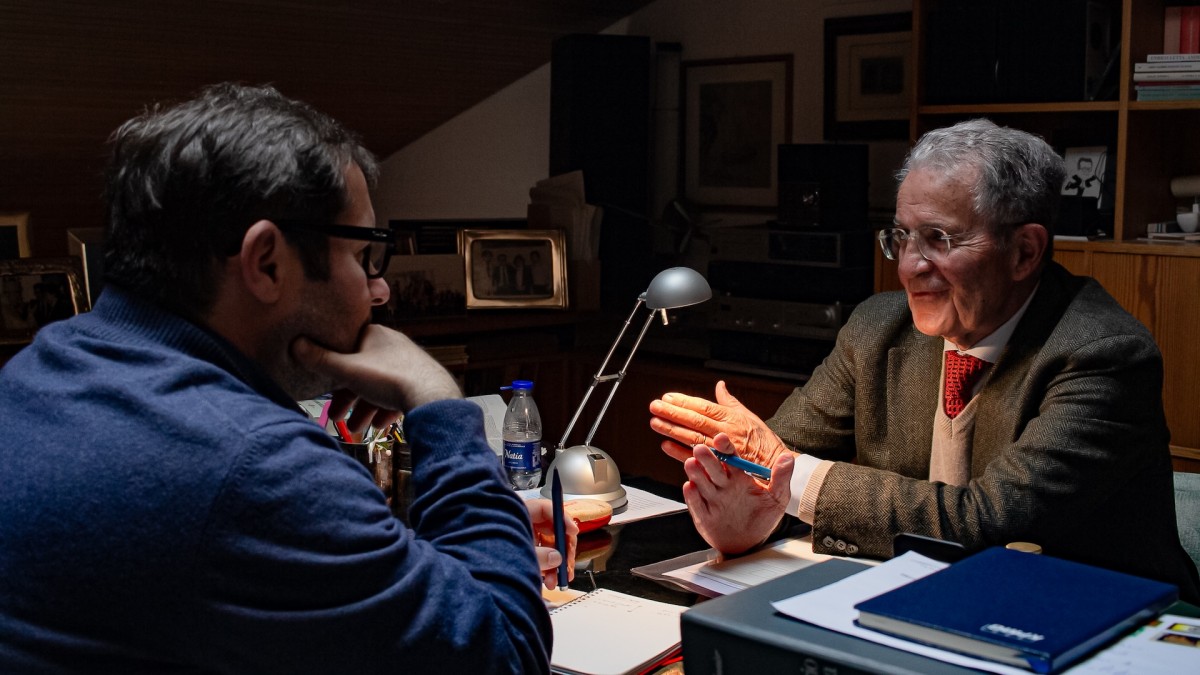
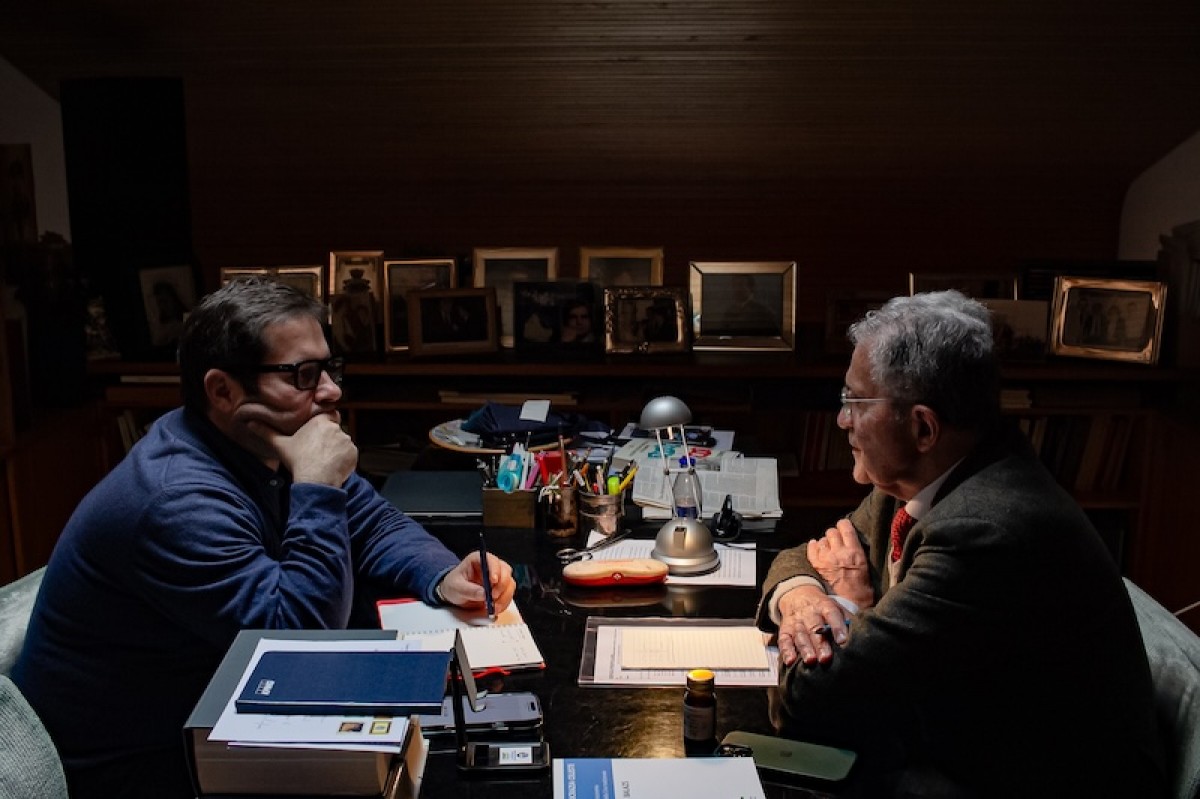
Marc López Plana met with Romano Prodi to discuss the European and Italian geopolitical situation. Photo: Agenda Pública / Marta Simili
Today, you visited a factory in the Emilia-Romagna region that manufactures computer fans and new batteries. They have production here, in India and in China. What have you observed about business strategies in this global context?
Their idea is to transfer all production that will be sold in China back to China. It's about re-autonomising in that country. Studying this and other companies, one realises the madness of Trump. In this factory I visited today, the magnets come from Korea, the connecting piece comes from China because it contains rare earth elements, another piece comes from the United States… Trump doesn't understand the revolution that global value chains represent.
Or perhaps he understands it too well?
He has already made some important adjustments. What he says today is not valid tomorrow. He started with a structure where the idea was "the West against the rest", that is, the United States, Europe, Japan, Korea, Australia, Canada, and Mexico against China, India, etc. Then he launched the message of "the United States against the world", including Europe. The latter is causing problems for the dollar, so he's retreating towards the first scheme.
"Trump wants the great barrier between the US and China to be permanent because the true enemy is always one: China. He gave Europe ninety days, but this is just to blackmail it"He wants the great barrier between the United States and China to be permanent because the true enemy is always one: China. He gave Europe ninety days, but this was just to blackmail it. However, if you behave like this, everything can change in ten days. So far, there has been this initial irrationality corrected by subsequent rationality. He is a reasonable madman who makes meticulous calculations.
Will Trump succeed in making Europe look more towards China?
He wants a Europe that does not cooperate with China, undoubtedly, because he needs to isolate China. Related to this, there is also the widely shared idea that there is an attempt to divide Russia and China. But, regarding the issue at hand, he wants to exclude Europe in its relationship with Russia.
He has set in motion a multiple complications that makes it very difficult to see where it will end. However, although there have been tensions between Russia and the United States, the path towards a truce in Ukraine now seems inevitable to me because Trump has gone too far. He needs a success in economic policy and another in international politics, so he will bet on the discourse of peace.
Does Putin want peace?
Putin plays like cat and mouse. Currently, he also needs peace because the war costs him money and has disrupted many of his economic initiatives. Unless Trump changes and grants massive aid to Ukraine, Putin wins because time is on his side.
Ukraine, without unconditional US support, fails. European aid is not enough. I always remember the incredible example that France, Great Britain and Italy could not even have defeated Gaddafi without US help.
So, Trump needs peace and Putin too, but before achieving it, Putin wants to consolidate his objectives.
And what is Europe going to do now?
In recent times, Europe has had more contact with international politics. I remember that, when the euro was being built, the Chinese president told me: "I hope there will be a euro alongside the dollar because if there is a euro alongside the dollar, there is also room for the yuan". He saw Europe as a referee.
"Since the 2008 financial crisis, Europe has lost its role. Now there is a redistribution of world politics and Europe, being an economic giant, can do well, but it must be united"Since the 2008 financial crisis, Europe has lost its role. Now there is a redistribution of world politics and Europe, being an economic giant, can do well, but it must be united, not only in theory but in everyday action.
This makes me doubtful today because when Europe decides that the next European Council will be in June, I say: "Where is the sense of urgency?". Until now, we have said that we don't know what Trump will do tomorrow, and we decide to hold the next Council in June?
That's why we need the sense of urgency that can only come if unanimity is ended. Because the search for unanimity means paralysis, or at least slowness. It means slowness, compromise, and paralysis.
There is the possibility of leading a group of five countries such as Italy, France, Spain, Germany, and Poland. What do you think about this?
Europe can be built with enhanced cooperation, as was done with the euro. To abolish unanimity in theory, you need unanimity, which is a problem, but you can abolish it in practice. An agreement between the major countries is sufficient.
We know that nine countries are needed to create enhanced cooperation. If you start with France, Germany, Spain, Poland and Italy, finding four more countries is easy, a matter of five minutes.
And why isn't it being done?
It isn't being done because these things require someone's strong initiative, that is, France and Germany.
My only positive thought is that it seems—I say seems because the German government is still acting in a caretaker capacity—that there is an understanding between Macron and Merz. Merz will have the vote in early May, so it's still pending, and therefore he cannot be operational today. But it appears that this understanding exists that will end a cold friendship that has existed for the last few years.
If they take a strong initiative, Poland and Spain will follow them immediately. Italy will have problems not following this alliance. If, on the contrary, there is no firm grip, Italy can continue in its ambiguity of being partly with Trump and partly with Europe.
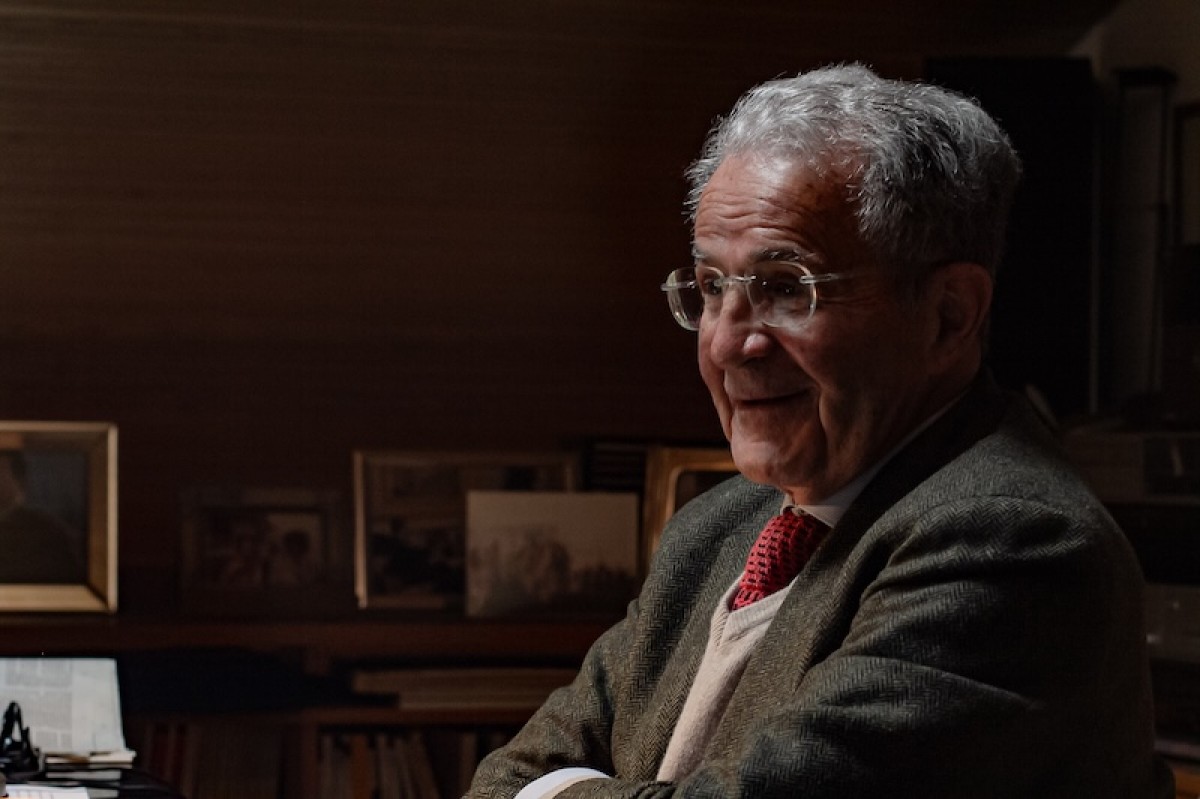
'Instead of a Europe of emotions, now there is a Europe of mediations', laments the former President of the European Commission. Photo: Agenda Pública / Marta Simili
Tomorrow, Italian Prime Minister Giorgia Meloni has a meeting with Trump in Washington D.C. What do you expect from this meeting, and how do you see Italy's position in Europe?
That she goes to Washington is good because it is a time for dialogue, just as I am very pleased that the Spanish president is going to China. Presently, all contacts are important because if we don't have contacts with the two major world powers, we will have fewer options in the near future. So, well done Spain in China, well done Italy in the United States.
Regarding Italy's position, we'll have to see, but if Meloni thinks she can be a mediator between Europe and the United States, she is fundamentally wrong. That role can only be European, and in my experience there is no Europe if there is no Franco-German engine. The two pistons, so to speak.
Italy has always been instrumental in this will. I have never neglected my country's role. The euro was created because Kohl and Chirac wanted it. They accepted Italy and Spain, but there was a forceful push.
"Instead of a Europe of emotions, where we understood that our future was together, now there is a Europe of mediations. That is a drama"The problem is that, instead of a Europe of emotions, where we understood that our future was together, now there is a Europe of mediations. That is a drama. I always remember those days when we were building the euro and one day the German confederation of industry gave a speech against the euro and the German chancellor gave a speech in favour.
As I had an excellent personal relationship with him, I picked up the phone and said: "Helmut, why do you want the euro so much if your supporters don't want it?". And he told me: "I want the euro because my brother died in the war".
Then there were all the economic motivations. But there was also the emotional response that in our future there should be no more wars. If we don't give an equally emotional response that we need a common policy, a common army, a common defence, a common fiscal system that regulates business competition (not a common fiscal system for all), we won't build that emotion. What we have lacked for years is offering young people a goal that they feel as a goal for their future.
Can European societies be convinced of a Europe with a common defence, with a common fiscal system, without a European constituency? Perhaps the time has come to start thinking that we need a European president.
In my personal history I have been responsible for the admission of the euro, for the enlargement, for the culmination of the East with Europe. I thought that the Constitution, which did not yet fully envisage this presidency, was the inevitable step. And the rejection of the Constitution was the beginning of the decline of Europe, the sign that we were walking backwards instead of forwards.
"What we have lacked for years is offering young people a goal that they feel as a goal for their future"I think like you that complete Europe must be political Europe. European elections are important, but they are the sum of national elections. As long as we don't have the challenge between a French socialist, a German Christian Democrat, or a Spanish green, we can hardly have Europe. The Constitution was a great step forward because it strongly united the souls of the different Europes.
But, be careful, your question also touches on the involution of democracy in individual countries, not just the sense of Europe between them. That's the big step backwards we've taken.
This is mainly due to the need for coalitions, sometimes homogeneous, sometimes unequal. There is no major European country with a single party in government. Spain, Italy, Germany, France, none exists.
How to manage this plurality in countries where the radical right plays an important role and, at the same time, build a more united Europe?
When I started to take an interest in politics, Germany had two parties that alternated in government, then three, then four, then five, then six, then seven, then coalitions of two, then three, then homogeneous coalitions, then unequal ones, now it seems to be becoming relatively homogeneous again.
I make a reflection: if you ask people whether they want Europe or not, people answer yes. So I believe that, faced with a great objective, populism can no longer be done. Either there is a strong European project, or we dissolve. We need to create some strong project in which all Europeans are called to give their opinion.
It cannot be the problem of the army at a time like this because it has become divisive, it can be another issue. It can be a great time to start having a foreign policy, but above all an elementary thing: the end of unanimity. When Europe begins to decide, there will be people who feel that the decision is coming, that it changes their lives, then they will mobilise.
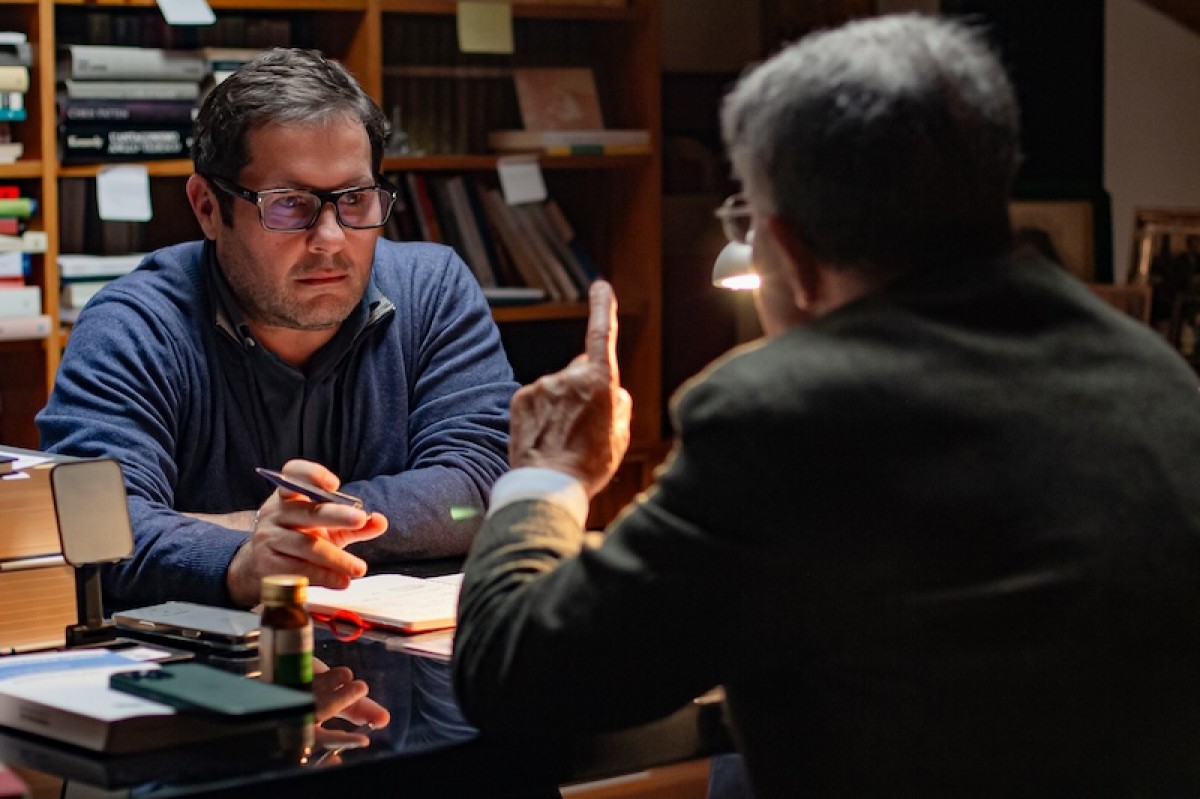
The architect of the introduction of the euro and of the enlargement towards the East analyses the geopolitical challenges posed by Trump's victory. Photo: Agenda Pública / Marta Simili
In my time, the President of the Commission was much stronger than today and the Council was strong, but infinitely less so. We really managed the enlargement from the Commission. Day by day, step by step, in a continuous dialogue with the Council and Parliament, but with an initiative that was an initiative of the European government.
So you're telling me that now, although it seems we have a strong Commission President, this is not the case.
No, it's not. She has fought to have a majority, and to have it she has had to make very complicated compromises. She has been very skilful in building that majority, but it is absolutely fragile and weak.
When they told me that Meloni supports Von der Leyen, I thought: yes, but as a spare wheel.
"When they told me that Meloni supports Von der Leyen, I thought: yes, but as a spare wheel"I repeat, we do not have a strong European government or a strong European electoral system. There has to be a change in both. The question is whether we recover the sense of urgency we had before or not, especially in the face of the fact that the United States and China seem to have all the interest in agreeing over our heads.
Let's talk a bit about Italy. How do you assess what Giorgia Meloni is doing as Prime Minister?
She's not doing anything. The pace of development is below the European average, employment is increasing, but there is no real development, which means that productivity is decreasing.
However, she has a great virtue: she is a glue for her majority and has no opposition. When one has no opposition, one is fine.
That is, my vote of no confidence was 313 against 312 votes. I always had an active opposition. Meloni became very violent with me recently. I was in the kitchen making minestrone, with the television on, and I hear her shouting my name. I ran and saw she was talking about me. She accused me of having power in the Democratic Party when I absolutely do not. She was afraid that I could, as I have done in the past, organise a new coalition. I think that's the only thing she fears, which is absolutely impossible because the opposition is divided.
Does Italy need a new Olive Tree?
It wouldn't be called an olive tree, but a cypress. There is an absolute need. And it's madness that it doesn't exist because I did it in even more complicated times than today. It was very natural that reformists, if they wanted to win, had to unite.
Today, however, radical positions prevail. In the PD, in the Five-Star Movement, the sense of government does not prevail, but the sense of party. I never had a sense of party, I only had a sense of government. And I continue to have only a sense of government.
When you see that the big parties, instead of having a sense of government, have a sense of party, and nobody can turn it into government... there's nothing to be done. Meloni may have a long time ahead of her.
The Christian Democrats played a critical role with the PCI in the time of the first Olive Tree.
The Christian Democracy was built by great leaders, but it was united by the Cold War. At the time of the fall of the wall came the divisions. The different currents had many things, but there was a glue that united them, and it was the need to have an identity in the great division of the world. I used to say that there was a Berlin Wall that divided Italy in two. While in Germany, the wall divided two countries, in Italy the wall divided the interior of the country.
Now Italians are not happy with the Government, they are happy with Meloni in the sense that she retains her strength because she can keep a coalition together. Governments fall when there is an alternative.
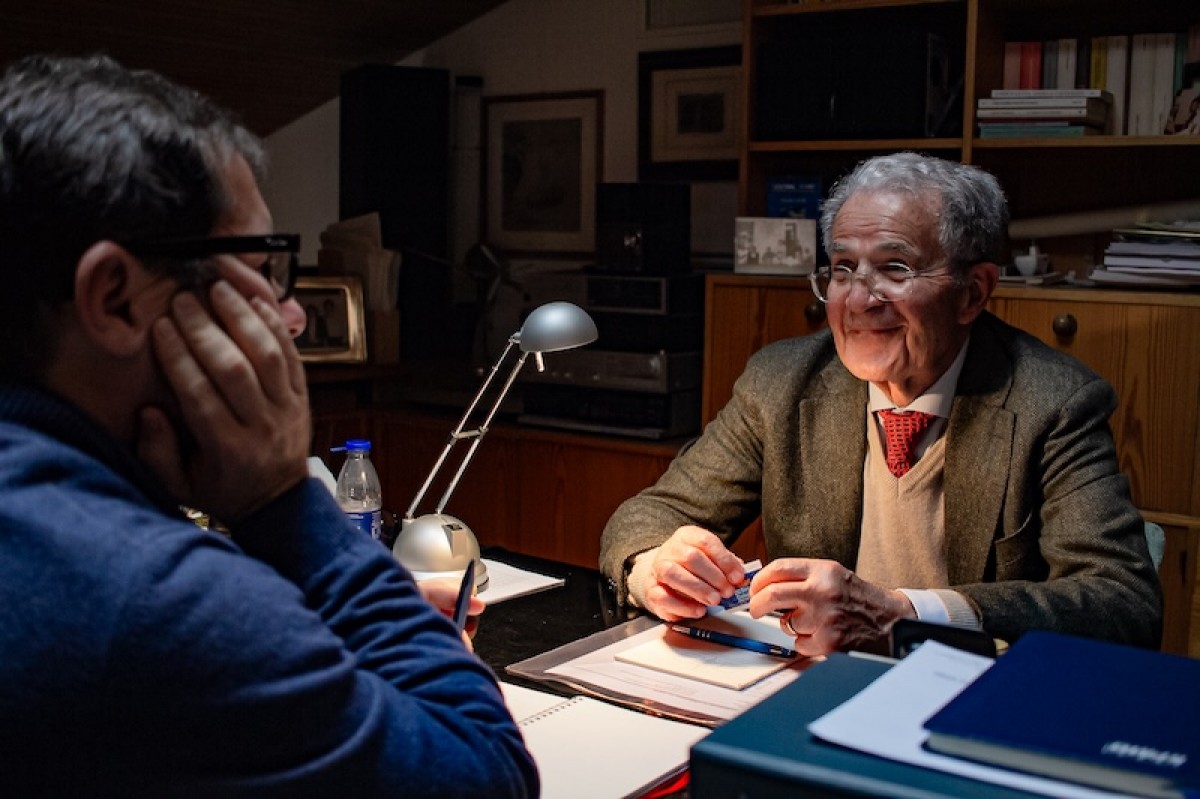
'Madrid has become the capital of Latin America. Spain has recovered its historical mission', says the Italian politician. Photo: Agenda Pública / Marta Simili
Why is the relationship between Italy and Spain so difficult?
It's strange because there is love between the two countries, between the two peoples. I feel a great closeness to the Spanish.
Politically, with Aznar there was no possibility. On the other hand, friendship with the other Spaniards is strong. But I found an establishment in Spain and not in Italy. That's the big difference.
What do you mean by establishment?
Years ago, I went to a couple of breakfasts organised by BBVA and you would meet the business world, there were politicians, etc. You could breathe. Everyone gathered there.
And in Italy there isn't. We are a recent country. We have a production system that is incredible, we are the second industrial country in Europe, much more than France, and we have zero large companies. We have formidable medium-sized companies and then an endless number of unproductive small companies. We have more SMEs than Spain and Germany combined.
Think also of the associativity that Spanish farmers have done for export. Extraordinary, and I have followed it closely. It is much more difficult in Italy.
How do you see Spain?
Spain is recovering a role with Latin America. Madrid has become the capital of Latin America. And thus it has recovered its historical mission.
"In globalisation I feel the Spanish mission. When I say 'capital of Latin America' I'm talking about a gigantic market. Spain is the spontaneous reference"In the Mediterranean we have more complicated political situations, so our task is more difficult. It is, therefore, an instinctive mission, as I feel yours is now.
In globalisation I feel the Spanish mission. When I say "capital of Latin America" I'm talking about a gigantic market. It doesn't mean the political capital, but the spontaneous reference.
In this globalisation we have to find a role. In Italy I see it much more difficult because the Mediterranean, close to us, has been divided among the great powers.
In fact, I am dedicating these years of my life to creating mixed universities of the Mediterranean. The Mediterranean and southern Europe and Italy are saved with a mission, if we recreate a unity of the Mediterranean that existed more under the Ottoman Empire than at present. There were more Italians in Constantinople, Alexandria, Tripoli, or Tunis under the Ottoman Empire than today.
So I say that Europe and the south, Italy in particular, can only find their mission if the new generation is formed differently. Let's make thirty mixed universities. Mixed means equality, shared ownership. So many professors from the north, so many professors from the south, so many students from the north, so many students from the south.
Not theology, nor philosophy, nor political science, but economics to the maximum, then agriculture, medicine. When we have thirty universities and 500,000 students studying together, we will have solved the European and Mediterranean problem.
In Brussels they like the proposal but, in democracies, politicians do not think beyond the end of their mandate.
"In democracies, politicians do not think beyond the end of their mandate"I say it jokingly: the relationship between the Vatican and China goes back a long way. They are the only two structures that have no sense of time, that have a sense of eternal life. But we do have a sense of time.
The future of Europe depends on Africa.
Africa is very close to my heart. I was a UN delegate in the Sahel, in Mali. China invests throughout Africa and maintains economic relations. Russia exploits anti-colonialism with a military command. If they get along, this alliance cannot be won.
I made this proposal in 2002, but I could never bring it to the Commission. The Northern countries were not interested. When I travelled through Tunisia, Morocco, Lebanon or Syria, everyone would tell me: "President, you only look to the east, don't you look to the south?". My answer was: "the train of history is fast, but then we'll come to you".
Instead, now, the north is more afraid of migration and they are more interested in Africa.
You have mentioned the Vatican. What does the Vatican mean for Italy?
There is still a clear identity. But there is also the feeling that the last three Popes have not been Italian. We are moving towards a conclave, the new Pope, in which the cardinals no longer know each other. The big change is that the close identity between ecclesiastical leadership and Italy is now entirely different.
In summary, we have seventeen Italian cardinals who are still the most numerous, but out of a total of 140. The Church is becoming more universal than Italian. It is clear that the relationship between Rome and the Church remains extremely strong.
And what is the role of Christianity in this complex world today?
The only voice in favour of universal peace has been that of the Pope, but I must also say that he has not been successful. Although the moral appeal of Catholicism remains robust and identity too, the differences in political attitude are such that it is difficult to translate it into politics.
"The authority of the Church remains very strong from an ethical perspective, but it does not become a unifying political action. The extreme right now takes over the traditional and conservative aspect of the Catholic world"I consider the authority of the Church very strong from an ethical perspective, although religious attendance is decreasing not only in Spain, but also in Italy, Germany, and the United States. This moral authority is maintained, but it does not become a political action capable of playing a unifying role. And so the extreme right now takes over the traditional and conservative aspect of the Catholic world in an absolutely systematic way.
On the other hand, the authority of the Church is not political. But if you were asking me about its influence on world politics, I say that it is becoming much more difficult already because it is being taken by the right and the left.
When I represented the European Commission, the role of the European Episcopal Conference was much more important than today. That is, be careful that while Catholicism remains, there is not that cultural exchange.
I'll tell you a personal story: I have a strong Catholic background. I became Prime Minister and made my first visit to Bonn. The centre-left met with the leader of the centre-right. We spent the first hour talking about the Roman philosopher theologian Guardini, half German and half Italian, who was our reading as young people.
Now in Europe, in the Catholic world, there is no common reading. This is the problem that the Catholic world must restore, this sense of common religious culture. Not of power, but a moment when we meet and talk about it. Two Catholics with different political orientations, but who did the same readings because there was a cultural unity in the European Catholic world. Now I no longer find it, there is no role for the Episcopal Conference.
When I say that we must also rebuild the spiritual structure of Europe, I am not referring to the strictly religious structure, but also to dialogue about the roots.
'We need the sense of urgency that can only come if unanimity in Europe is ended', declares Prodi. Photo: Agenda Pública / Marta Simili