Martes, 10 de noviembre de 2026


LÓPEZ PLANA'S EUROPEAN COMPASS
The Ceuta crisis Morocco didn't need
The mass arrival of migrants and incursions by Moroccan naval vessels appear to suggest a coordinated operation to put pressure on Spain. But the scale of the crisis and its coincidence with Gianni Infantino's visit point to other possible explanations. In his weekly column, Marc López Plana, editor and director of 'Agenda Pública', argues that "the concentration of power does not guarantee absolute control". Was Ceuta a show of strength or a crisis that spiralled beyond Morocco's control?

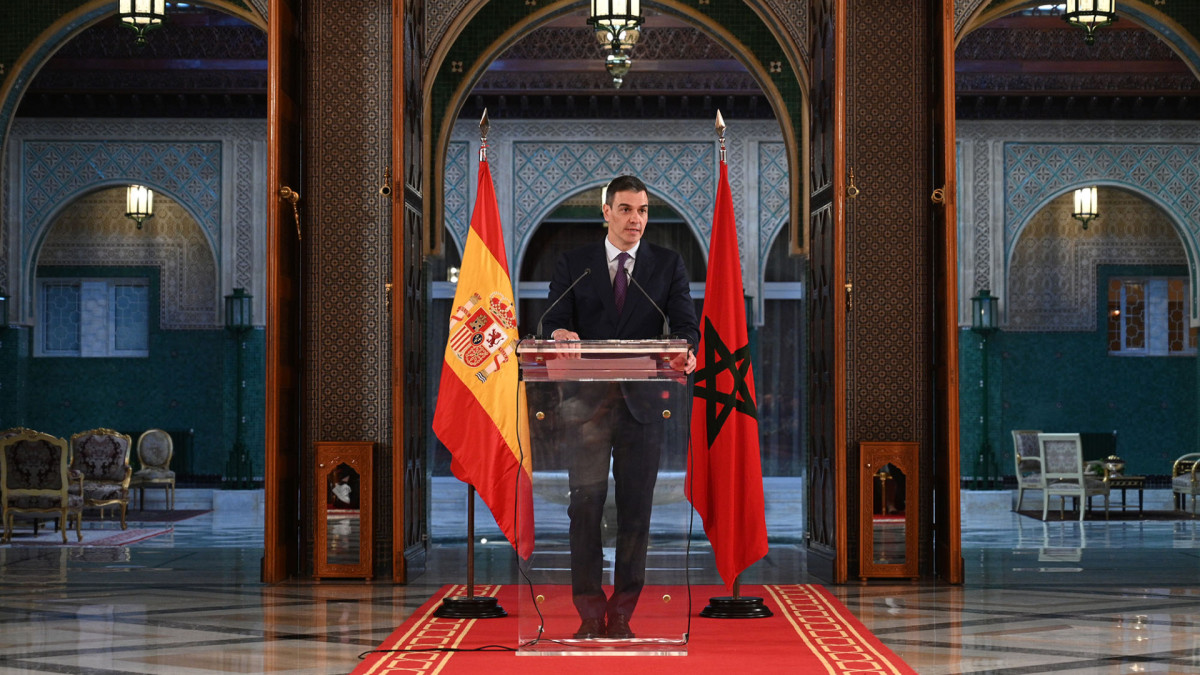
Spanish Prime Minister Pedro Sánchez during a visit to Morocco (2024).Pool Moncloa
The arrival of tens of thousands of people in Ceuta coincided with incursions by Moroccan military vessels into Spanish waters. The timing suggests a hybrid operation: a combination of migration pressure and a show of military force that may have tested Spain's response without provoking an open confrontation.
Yet that interpretation assumes that the Moroccan state acted as a single, coordinated machine, that all its institutions were following the same orders and that the events formed part of a strategy devised at the highest levels of power. Perhaps this reading tells us more about how we interpret Morocco than about how its political system actually works.
Five years later, the scale appears to have been very different. Initial estimates in July 2026 put the number of people entering Ceuta at between 50,000 and 60,000. Subsequent reports have suggested even higher figures, which remain unverified and are subject to differences in methodology. Either way, the crisis would have been several times larger than that of 2021.
The bilateral context had also changed. Spain had altered its position on Western Sahara in 2022 and, since then, Morocco and Spain had rebuilt their relationship. The two countries cooperate on migration and, together with Portugal, are due to co-host the 2030 FIFA World Cup. For Rabat, the tournament is a long-term investment and an opportunity to strengthen its international standing.
What was Morocco hoping to achieve with a crisis on a scale far greater than in 2021? If the aim was to put pressure on Spain, we need to explain why Rabat took such a high risk at a time when it had considerable interests in maintaining cooperation with Madrid.
States may accept reputational costs when they expect a strategic benefit in return. But that explanation requires us to identify the benefit and explain why it justified taking such a risk. The possibility of a deliberate operation cannot be ruled out; it is simply not the only way to interpret what happened.
In the first case, the state uses people's movements as an instrument of pressure. In the second, it risks exposing the limits of its own control. The coincidence with Throne Day made that tension more visible. While Mohammed VI was receiving Infantino and Morocco was attempting to project stability, thousands of citizens were heading towards a border that the state was supposed to control.
The images conveyed more than the frustration of those wishing to leave the country. They could also raise questions about the ability of Moroccan institutions to anticipate and manage a mobilisation on that scale. For a political system that derives much of its authority from preserving order, the scenes could have been particularly damaging.
The concentration of power does not guarantee absolute control. A state can appear extremely powerful from the outside while struggling to manage social dynamics within its own borders.
This makes the question of succession worth examining. A regime's stability also depends on what its elites expect of the future. Mohammed VI's succession does not appear imminent, but preparations for an eventual dynastic transition raise questions about relations between the Palace, the armed forces and the intelligence services.
In this context, one question is often missing from the Spanish debate: who made each decision, and how far did their authority extend?
A warship operates within a chain of command. Its movements can be reconstructed through logs, communications and operational orders. The information currently in the public domain does not establish what instructions the commanders received or who authorised the incursions. Nor does it clarify whether the naval movements were connected to the arrival of migrants or followed a different operational logic.
The concept of hybrid warfare helps us analyse how military and non-military instruments can be combined. But it should not become an automatic explanation for every coincidence. To describe something as a hybrid operation, we need evidence of coordination, an identifiable strategic objective and some form of unified direction. Without those elements, we risk retrospectively constructing a strategy out of events that may have had separate origins.
That does not mean the Spanish government should conceal what happened indefinitely. Democratic accountability requires an explanation of the violations of sovereignty and the measures taken in response. It would also have been important to brief the main opposition party on the situation.
There is, however, a difference between explaining the military response and publicly attributing a strategic intention. Publicly attributing strategic intent requires much stronger evidence.
Neither is sufficient to understand a complex political system. Morocco shares economic interests with Spain, but the two countries also have territorial disputes. Their interdependence on migration coexists with a power structure whose evolution has a direct bearing on Spanish security.
Spain needs to defend its sovereignty and establish responsibility on the basis of verified information. To do that effectively, it must better understand how decisions are made in Morocco. That means understanding the relationships between institutions and the incentives facing those who lead them, without assuming that they all act according to a single will.
Perhaps Rabat intended to put pressure on Spain and misjudged the consequences. It is also possible that some parts of the state apparatus acted with a degree of autonomy we do not yet understand, or that the migration crisis coincided with naval decisions driven by a separate set of considerations.
There is not enough evidence to choose between these explanations. Spain needs to establish who made the decisions and whether the mass movement of people and the naval manoeuvres formed part of the same strategy. Attributing to Morocco a degree of control it may not have exercised could lead to the wrong response; so could dismissing a deliberate operation without investigating it.
The question that remains is whether Ceuta was a demonstration of Morocco's power over Spain or an exposure of the limits of the Moroccan state's control over its own society. That distinction matters before we settle on an interpretation of the crisis.
Yet that interpretation assumes that the Moroccan state acted as a single, coordinated machine, that all its institutions were following the same orders and that the events formed part of a strategy devised at the highest levels of power. Perhaps this reading tells us more about how we interpret Morocco than about how its political system actually works.
A crisis five times larger than in 2021
The comparison with May 2021 is unavoidable. Back then, between 8,000 and 10,000 people crossed into Ceuta amid a diplomatic crisis over Spain's decision to host Brahim Gali, the leader of the Polisario Front. The two countries were engaged in an open dispute, and the sequence of events made it plausible to interpret the migration pressure as a form of coercion.Five years later, the scale appears to have been very different. Initial estimates in July 2026 put the number of people entering Ceuta at between 50,000 and 60,000. Subsequent reports have suggested even higher figures, which remain unverified and are subject to differences in methodology. Either way, the crisis would have been several times larger than that of 2021.
The bilateral context had also changed. Spain had altered its position on Western Sahara in 2022 and, since then, Morocco and Spain had rebuilt their relationship. The two countries cooperate on migration and, together with Portugal, are due to co-host the 2030 FIFA World Cup. For Rabat, the tournament is a long-term investment and an opportunity to strengthen its international standing.
What was Morocco hoping to achieve with a crisis on a scale far greater than in 2021? If the aim was to put pressure on Spain, we need to explain why Rabat took such a high risk at a time when it had considerable interests in maintaining cooperation with Madrid.
The Infantino paradox
One detail deserves particular attention: FIFA president Gianni Infantino was in Morocco for the Throne Day celebrations when the crisis unfolded. His visit coincided with an important moment in the country's sports diplomacy. The 2030 World Cup, which Morocco will co-host with Spain and Portugal, is one of Mohammed VI's major international projects. Morocco hopes to host the final and has made football a tool for raising its international profile and prestige."If the aim was to put pressure on Spain, we need to explain why Rabat took such a high risk at that particular moment"While the monarchy was seeking to project an image of stability before one of its most prominent guests, images of thousands of people trying to reach Ceuta conveyed the opposite. What could Morocco gain from triggering a crisis that damaged that image and complicated relations with a partner it needs to organise the World Cup?
States may accept reputational costs when they expect a strategic benefit in return. But that explanation requires us to identify the benefit and explain why it justified taking such a risk. The possibility of a deliberate operation cannot be ruled out; it is simply not the only way to interpret what happened.
When crowds slip beyond control
Political systems in which authority is heavily concentrated tend to invest resources in monitoring public spaces and preventing mass mobilisations that could overwhelm the security forces. Maintaining order is not simply a policing matter: it also demonstrates that the state retains the ability to exercise its authority."The possibility of a deliberate operation cannot be ruled out; it is simply not the only way to interpret what happened"Seen in that light, the movement of tens of thousands of people towards Ceuta presents a contradiction. It is one thing for a government to temporarily relax border controls to exert pressure on a neighbour. It is quite another to allow an exceptionally large crowd to mobilise in an apparently uncontrolled way, with unpredictable consequences and under the scrutiny of the international media.
In the first case, the state uses people's movements as an instrument of pressure. In the second, it risks exposing the limits of its own control. The coincidence with Throne Day made that tension more visible. While Mohammed VI was receiving Infantino and Morocco was attempting to project stability, thousands of citizens were heading towards a border that the state was supposed to control.
The images conveyed more than the frustration of those wishing to leave the country. They could also raise questions about the ability of Moroccan institutions to anticipate and manage a mobilisation on that scale. For a political system that derives much of its authority from preserving order, the scenes could have been particularly damaging.
"While Mohammed VI was receiving Infantino and Morocco was attempting to project stability, thousands of citizens were heading towards a border that the state was supposed to control"Authoritarian regimes can also organise mass mobilisations when they believe doing so serves their interests. That is why it is important to distinguish between a crowd directed and contained by the state and one whose movements ultimately escape its control. In Ceuta's case, we still do not know who allowed so many people to reach the border, or what capacity there was to stop them. Nor is it clear whether the outcome matched what those making the decisions had intended.
The concentration of power does not guarantee absolute control. A state can appear extremely powerful from the outside while struggling to manage social dynamics within its own borders.
Who is really in charge?
Morocco is not a parliamentary democracy in which fundamental national security decisions rest solely with a government accountable to a legislative majority. The monarchy retains a central role in the structure of the state, particularly in military affairs, diplomacy and intelligence."A state can appear extremely powerful from the outside while struggling to manage social dynamics within its own borders"Nevertheless, concentrated authority does not mean perfect coordination. Security agencies have their own hierarchies, institutional interests and room for manoeuvre. In highly personalised political systems, competition for proximity to the centre of power can influence decisions. These dynamics may become more pronounced if there is uncertainty over the continuity of the leadership.
This makes the question of succession worth examining. A regime's stability also depends on what its elites expect of the future. Mohammed VI's succession does not appear imminent, but preparations for an eventual dynastic transition raise questions about relations between the Palace, the armed forces and the intelligence services.
In this context, one question is often missing from the Spanish debate: who made each decision, and how far did their authority extend?
The frigates are another matter
The naval episode needs to be examined separately. Prime Minister Pedro Sánchez confirmed that Moroccan military vessels had entered Spanish waters. According to published reports, at least one frigate and several patrol boats entered the waters off Ceuta without authorisation, prompting a response from the Spanish Navy.A warship operates within a chain of command. Its movements can be reconstructed through logs, communications and operational orders. The information currently in the public domain does not establish what instructions the commanders received or who authorised the incursions. Nor does it clarify whether the naval movements were connected to the arrival of migrants or followed a different operational logic.
The concept of hybrid warfare helps us analyse how military and non-military instruments can be combined. But it should not become an automatic explanation for every coincidence. To describe something as a hybrid operation, we need evidence of coordination, an identifiable strategic objective and some form of unified direction. Without those elements, we risk retrospectively constructing a strategy out of events that may have had separate origins.
Sánchez's dilemma
Pedro Sánchez defended the handling of the crisis through dialogue with Morocco, while the Spanish Navy acted to protect Spanish waters. This combination of communication and deterrence is intended to convey resolve without closing off a diplomatic solution."To describe something as a hybrid operation, we need evidence of coordination, an identifiable strategic objective and some form of unified direction"A firm response does not require every detail of a confrontation to be made public. If Spain accused Morocco of orchestrating a coordinated attack, political pressure for retaliation would increase. If Rabat believed its prestige was at stake, it might respond in a way that escalated the confrontation.
That does not mean the Spanish government should conceal what happened indefinitely. Democratic accountability requires an explanation of the violations of sovereignty and the measures taken in response. It would also have been important to brief the main opposition party on the situation.
There is, however, a difference between explaining the military response and publicly attributing a strategic intention. Publicly attributing strategic intent requires much stronger evidence.
A doctrine for Spain
For too long, the Spanish debate has swung between two simplistic portrayals. One depicts Morocco as an indispensable partner whose cooperation must be preserved at almost any cost; the other depicts it as an adversary that systematically deploys every instrument at its disposal against Spain.Neither is sufficient to understand a complex political system. Morocco shares economic interests with Spain, but the two countries also have territorial disputes. Their interdependence on migration coexists with a power structure whose evolution has a direct bearing on Spanish security.
Spain needs to defend its sovereignty and establish responsibility on the basis of verified information. To do that effectively, it must better understand how decisions are made in Morocco. That means understanding the relationships between institutions and the incentives facing those who lead them, without assuming that they all act according to a single will.
"Spain needs to defend its sovereignty and establish responsibility on the basis of verified information. To do that effectively, it must better understand how decisions are made in Morocco"There is also a need for closer coordination between intelligence, diplomacy and defence. A migration crisis cannot be treated solely as a border issue; nor can a naval incursion be understood simply as a military incident.
The question we have yet to answer
The problem with the Ceuta crisis is that Spain has yet to offer a convincing public explanation of what happened. The possibility of a coordinated operation against the country remains, but the difference in scale compared with 2021, Infantino's visit and the potential cost of the crisis to Morocco suggest that other explanations should also be considered.Perhaps Rabat intended to put pressure on Spain and misjudged the consequences. It is also possible that some parts of the state apparatus acted with a degree of autonomy we do not yet understand, or that the migration crisis coincided with naval decisions driven by a separate set of considerations.
There is not enough evidence to choose between these explanations. Spain needs to establish who made the decisions and whether the mass movement of people and the naval manoeuvres formed part of the same strategy. Attributing to Morocco a degree of control it may not have exercised could lead to the wrong response; so could dismissing a deliberate operation without investigating it.
The question that remains is whether Ceuta was a demonstration of Morocco's power over Spain or an exposure of the limits of the Moroccan state's control over its own society. That distinction matters before we settle on an interpretation of the crisis.
Ahora en portada
10 de noviembre de 2026
10 de noviembre de 2026
10 de noviembre de 2026
Noticias relacionadas
Hace una semana
From Detroit to Warsaw: Was NATO enlargement driven by US electoral politics?
Hace una semana
Ian Shapiro (Yale): "Sánchez is not a far-left populist. He is a fairly conventional social democrat"
Hace 2 semanas
Javi López and Dave Keating: "Europe’s future will also be decided on 29 November"
Lo más leído