



Kevin Limonier: "Social media is a digital territory, and we need to control it for our national security"
"Geographical knowledge is deeply strategic because understanding how a space is constructed is crucial to exercising power over it." This is the view of Kevin Limonier, founder of Cassini, the company behind what he calls "the private implementation of the French School of Geopolitics." Today in Agenda Pública, we speak with Limonier and his executive team in Spain about their system, which also enables the mapping of "digital platforms and cyberspace," which, he warns, "are now the continuity of geographical space." And he cautions: "The United States holds a topological hegemony over Europe because our data passes through American networks or machines."

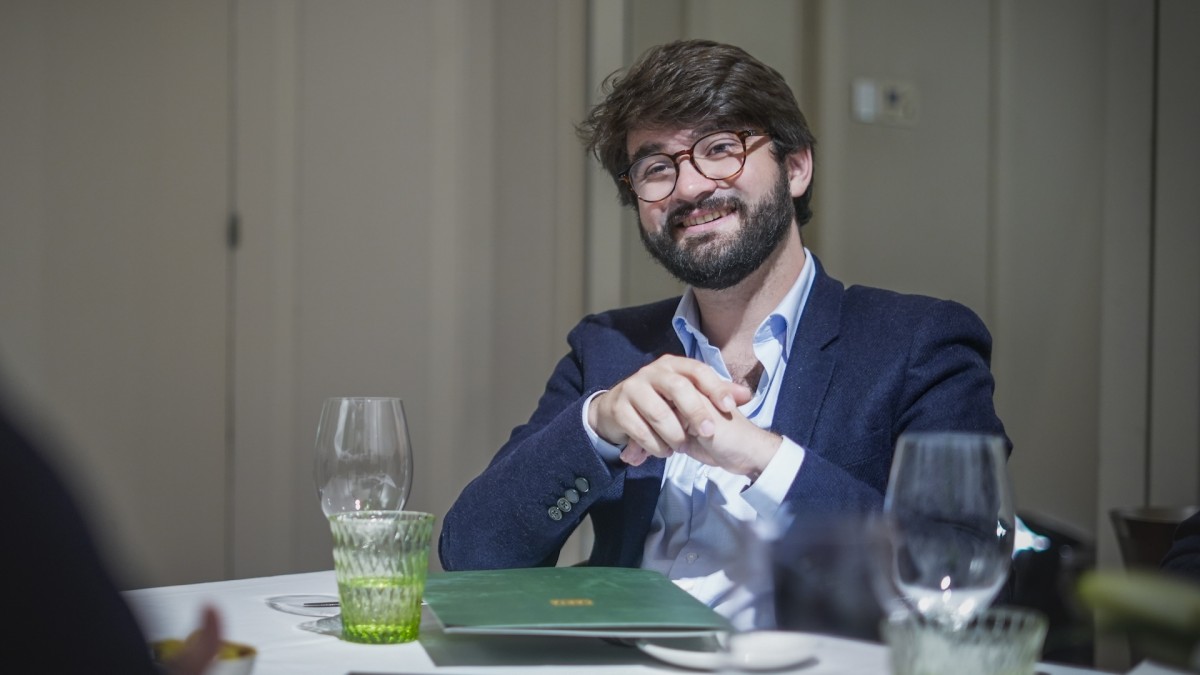
Kevin Limonier is an associate professor at the French Institute of Geopolitics and co-founder of Cassini, which, in partnership with Agenda Pública, shares visual analyses through maps to better understand how power operates. "To understand digital sovereignty, we must consider cyberspace as a succession of layers: physical, routing, software, and social media," he explains. He adds: "Cassini is linked to a laboratory at the French Institute of Geopolitics called Géode, where we produce maps of cyberspace."
"The idea is that hybridity does not exist because everything is territorial. Disinformation is nothing more than another way of disrupting the exercise of power in a foreign territory," he says.
In this conversation with Marc López Plana, editor and director of Agenda Pública, Limonier warns that Europe faces "a paradoxical situation because, in the lower layers of cyberspace—cables and routing protocols—we are at the heart of the network. The real heart of the network is Western Europe and the East Coast of America." However, "in the upper layer, we are in a very weak position" because "we do not have our own platforms" and "we do not control which algorithms are used to shape representations of the world and the information users can access."
"We need to make people understand that social media functions like a digital territory, and we must control it. It is a matter of national security."
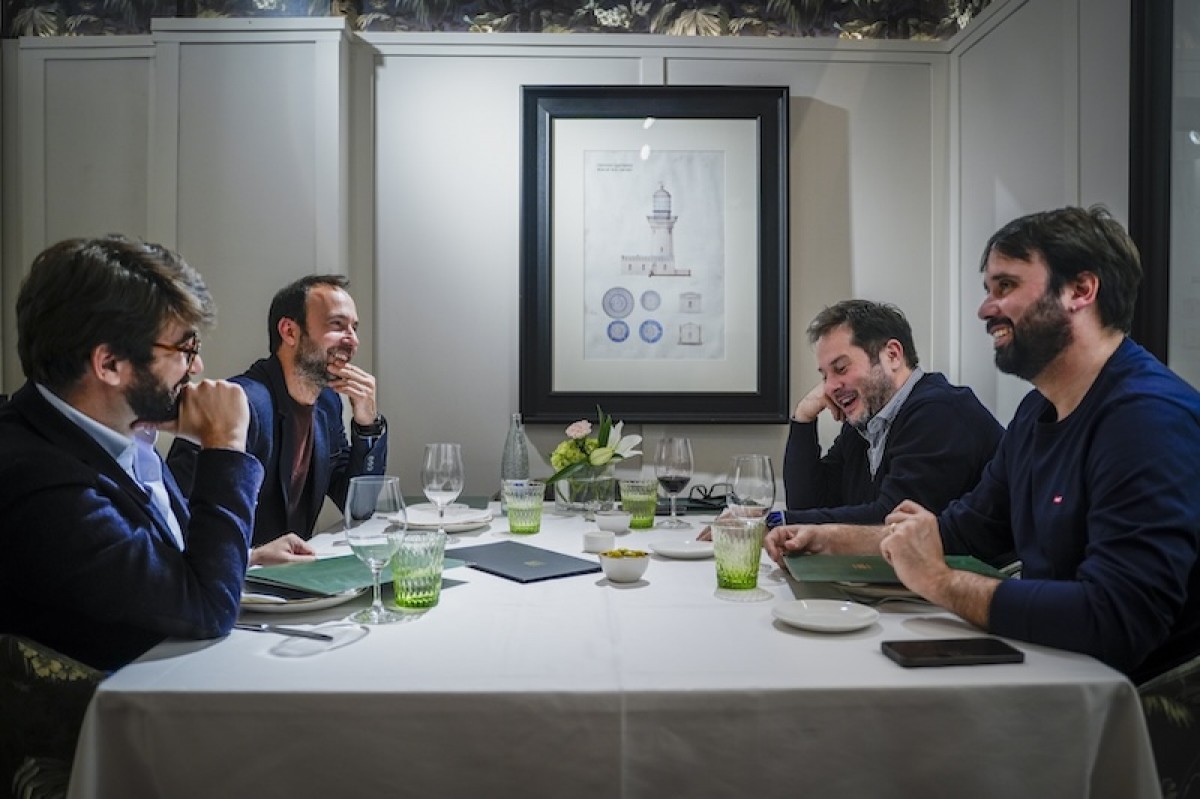
Kevin Limonier spoke with Marc López Plana, director of Agenda Pública along with Darío Salinas Palacios, CEO of Cassini Group Spain, and Albert Borràs Rius, co-director of Cassini Spain. Photo: Agenda Pública / Tsun Ho
Please tell me about the history of Cassini.
Cassini is a company we founded in 2010. At the time, I was a young PhD student alongside my colleague, David Amselem, who is now the CEO of Cassini. Our goal was to create a company capable of deciphering the relationship between politics and space—analysing spatial and geographical contexts to identify strategic levers and the strategies implemented by actors within a given territory.
"The entire world is composed of intricate networks, which can be either physical or non-physical. Our philosophy is to analyse these networks and understand how they interact with geography"As geographers, we consider that the entire world is composed of intricate networks, which can be either physical or non-physical. Our philosophy is to analyse these networks and understand how they interact with geography. Space, of course, can be physical—territory—but it can also be non-physical, which is what we call topology. This applies to fields such as disinformation, cybernetics, and economic intelligence, all of which operate within topological rather than strictly geographical frameworks. By examining these networks, we provide our clients with the tools to understand situations at different geographical scales, from the global to the local level, and across various timeframes, from long-term historical trends to immediate events.
Cassini represents the private-sector application of the French School of Geopolitics, founded in the 1970s by the French geographer Yves Lacoste. Lacoste established this school because he strongly opposed what geography had become in France. In my country, and perhaps in Spain as well, geography has long been closely tied to the colonial project—it was about mapping the empire, conquering new lands, and exploration.
After the fall of the French colonial empire, some geographers turned to Marxism, viewing geography as a tool for analysing class struggle and its spatial implications. Others completely depoliticized their approach, focusing instead on territorial development. Lacoste positioned himself at the centre of this debate. He was the only one to assert that geography is a form of strategic warfare—that geographical knowledge is inherently strategic because understanding how space is structured is crucial to exercising power over it.
For decades, the strategic importance of geography was largely forgotten. Today, however, with the evolving situation in the United States and the threats it poses to our countries, there is a renewed focus on territory, empires, and geopolitics. In this context, we work with governments in France and other Western countries, as well as with companies whose operations are directly threatened by the instability of the modern world. To anticipate future developments, one must grasp the different scales at play and the intricate relationship between time, space, and networks.
Precisely, how do you apply this to the so-called hybrid warfare?
For many years, we have been discussing what is commonly referred to as hybrid warfare. The problem with the concept of hybridity is that it remains vague and poorly defined. We tend to label as 'hybrid' anything that does not fit within the framework of traditional territorial strategies. No one, for instance, would describe an invasion as hybrid—it is purely conventional warfare.
"The reality is that hybridity does not exist. Disinformation is simply another means of disrupting the exercise of power in a foreign territory"The reality is that hybridity does not exist. Disinformation is simply another means of disrupting the exercise of power in a foreign territory. In my view, the very use of such concepts demonstrates our difficulty in connecting the dots and formulating appropriate responses. If we were able to recognize that acts such as sabotage in a munitions factory in the UK, damage to undersea cables, or a disinformation campaign are all components of a broader territorial strategy—one orchestrated by Russia with clear strategic objectives, such as weakening Western support for Ukraine—then we would not need the concept of hybridity at all.
If we understand why an action takes place, who is behind it, and what their objectives are, the notion of hybridity becomes unnecessary—everything becomes clear. The problem is that this concept is blinding us, preventing us from seeing the fundamentally territorial nature of these strategies.
Recently, there have been some terrorist attacks in Germany. Do you think Russia could be behind them?
This could be because Russia's strategy in Europe is centred on destabilization, and any means of achieving that goal are considered valid. We know that the Russians are fully capable of orchestrating false-flag operations in European countries. A clear example of this occurred in France, where Moldovan individuals were responsible for marking Stars of David on the walls of Paris. This act was then amplified by a disinformation network well known in France—the Doppelgänger operation—run by a company with close ties to the Kremlin.
"The Russian strategy is to identify and exploit the vulnerabilities within our democratic systems. In Germany, immigration remains a key fault line"Another example: I believe it was in 2015 or 2016 when Russia Today in Germany fabricated a series of false reports linking migrants to crime. The Russian strategy is to identify and exploit the vulnerabilities within our democratic systems. In Germany, immigration remains a key fault line. In France, there are several, but one of the most significant is the anti-American sentiment within a segment of the ruling class. Another is the identity crisis affecting a large portion of the right and far-right.
In Spain, they could exploit different vulnerabilities—perhaps independence movements. During our research in France, we observed connections between certain Basque activists and Russian assets. In the Spanish-speaking world, particularly in Latin America, Russia has long maintained an editorial line that leans strongly to the left—completely opposite to the editorial stance of RT France. This strongly suggests that their primary concern is not ideological coherence but rather the strategic exploitation of societal divisions.
Based on your knowledge of Russia, what do you think is the real relationship between China and Russia?
I believe there is a strong Russian desire to strengthen economic and political ties with China. Russia is actively seeking to disengage from the West, particularly from Europe, and reorient itself toward China. However, geography remains a significant obstacle. Russia's economic core—central Russia, including Moscow, St. Petersburg, and the Volga region—is far from China but well-connected to Europe. Western investments in Russia far exceed Chinese investments.
"In my area of expertise—cyberspace mapping—when attempting to access a server in Russia, data never routes through China; it always passes through Europe"Returning to the concept of networks, Russia remains deeply integrated with the Western world in terms of interconnectivity. In my area of expertise—cyberspace mapping—when attempting to access a server in Russia, data never routes through China; it always passes through Europe.
In my view, the alliance between China and Russia is circumstantial and profoundly asymmetrical. China is undeniably a geopolitical superpower, while Russia is not. Russia is a regional power with global ambitions, projecting itself as an empire. We often say that Russia has the GDP of Italy, which allocates 10% of that GDP to military spending. With a population of 150 million, it is not even twice the size of France. We need to keep these factors in perspective.
Today there is a theory that if Trump wants to reconcile with Russia, it is to disengage Russia from China. Is this a strategy of power rivalry against China?
Of course, there is an ideological convergence around anti-liberalism and certain reactionary ideologies. Europe, as a democratic and liberal model, is clearly viewed as the enemy. However, at some point, even Chinese communism—whatever it may represent—could also become a target for the new US administration.
What is the true relationship between Putin and Trump?
What we do know is that there is an ideological and circumstantial alignment. Trump wants to disengage from Ukraine to focus on Mexico—his primary obsession—and possibly Iran. To achieve this, he is willing to make significant compromises, even if they are not in the best interest of the United States. His fascination with strongmen is a factor that must be considered.
"Russia is a kleptocracy—a fusion of former KGB operatives, their worldview, and their vision of how power should function"Russia is a kleptocracy—a fusion of former KGB operatives, their worldview, and their vision of how power should function. They see themselves as an aristocracy. After the collapse of the Soviet Union, this aristocracy also evolved into a mafia, as survival in the newly liberalized Russian system required them to secure positions of influence. Thirty years later, they have become a hybrid entity—part Soviet-style intelligence apparatus, part organized crime syndicate.
It is crucial to remember that the United States is a superpower, whereas Russia is not. This distinction matters because we often place them on the same level when, in reality, they are not. Putin projects the illusion of being on equal footing, and the fact that many believe this is, in itself, an informational victory.
My theory is that Putin and his entire system are deeply concerned about Trump's unpredictability. This explains their cautious approach—they are saying very little. Meanwhile, the Russian economy is slowly but inevitably shrinking. They know they cannot sustain this war indefinitely, but they also know that Trump is highly unpredictable.
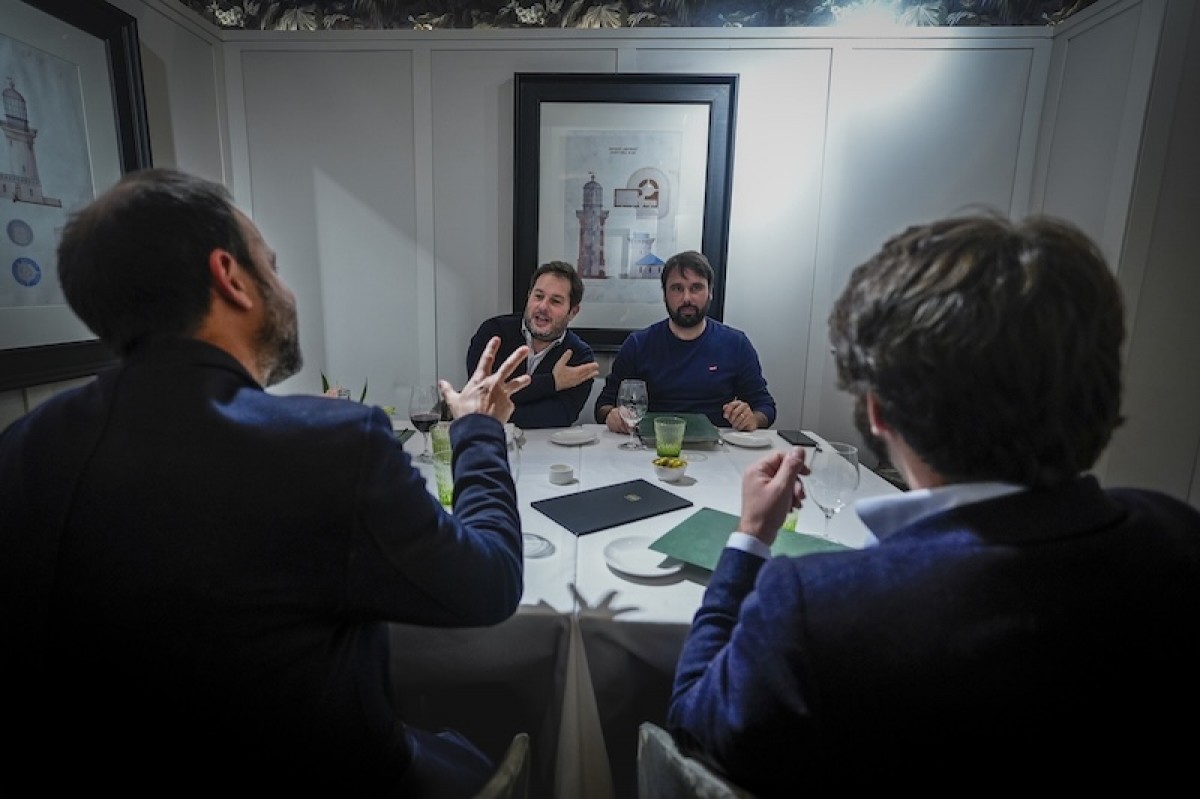
The conversation revolved around two major themes on which Cassini works: Russia and cyberspace. Photo: Agenda Pública / Tsun Ho
What is the real power of Twitter or platforms like Twitter at this moment?
As a geographer, I consider digital platforms and cyberspace to be an extension of geographical space. This is where we now spend a significant portion of our time, where we interact with one another, and—importantly—it is a space that can be mapped.
"Cassini is linked to a research laboratory within the French Institute of Geopolitics called Géode—Géopolitique de la Datasphère"Cassini is linked to a research laboratory within the French Institute of Geopolitics called Géode—Géopolitique de la Datasphère. This lab comprises between forty and fifty researchers who study the geopolitical implications of the digital revolution. As a centre of excellence recognized by the French Ministry of Defence, Géode specializes in mapping cyberspace.
One of our key areas of research is the idea that cyberspace is not only a continuation and projection of physical space but also a reflection of it. By analysing social networks, for example, we can gain valuable insights into political discourse and behaviours. The same applies to territorial strategies—what happens in the digital realm often mirrors, influences, or reveals deeper geopolitical dynamics.
Would it be possible to have a common European defence without having our own Twitter?
I agree. We need to extend some fundamental but essential concepts of political geography to cyberspace. How does sovereignty function in cyberspace? This is a debate we have in France for almost 10 years.
To understand what borders and sovereignty mean in cyberspace—and why Europe needs to develop its own approach—we must recognize that cyberspace consists of multiple, interconnected layers.
The first and most fundamental is the physical layer. This is where cyberspace intersects with geography: it includes cables, telephone networks, data centres, satellites, and all the physical infrastructure necessary for digital connectivity.
Secondly, you have the routing layer. Unlike the physical layer, this is not tangible—it consists of data routing strategies within the network. It functions similarly to an air traffic control tower, directing the flow of information and determining how data travels across cyberspace.
Our data currently belongs to American companies.
Data travels across the world at two-thirds the speed of light because there is a physical limit to data circulation speed. We have an entire research project dedicated to understanding how data flows, identifying strategic bottlenecks, and analysing the critical geopolitical choke points for the European Union.
"To fully grasp digital sovereignty, one must consider that cyberspace is structured in a series of interconnected layers: the physical layer, the routing layer, the software layer, and the social media layer"To fully grasp digital sovereignty, one must consider that cyberspace is structured in a series of interconnected layers: the physical layer, the routing layer, the software layer, and the social media layer.
The first two—the physical layer (cables, data centres, satellites) and the routing layer (the network's data transmission strategies)—are often referred to as the lower layers of cyberspace.
Above them are the upper layers, where the focus shifts to the data that flows through these infrastructures and the information derived from it—data processed and structured to make sense for users. Within the upper layers, we have the software layer, which ensures interoperability between systems, and at the very top, the social media layer, where platforms like Twitter and Bluesky operate. However, for this layer to function, all underlying layers must be operational. If a cable is cut, for example, social media platforms become inaccessible.
This concept is critical in understanding what is happening today in Ukraine, for instance. In occupied territories, Russian forces either cut internet cables or reconfigure routers, preventing the local population from accessing the Western internet. This is a deliberate strategy to control information and isolate communities within the occupied zones. This is a continuation of territorial occupation, but in cyberspace.
China built its own internet network in ninety-four, and they are independent from the whole world…
China's network infrastructure has been designed from the outset to be tightly controlled. The Chinese government understood early on that centralizing its network was crucial. As a result, China's internet is highly centralized, with only a few controlled entry points to the outside world—essentially functioning as cyber borders.
Two other countries have similarly centralized networks: Iran and, to some extent, France. France is a highly centralized state, and its entire network infrastructure was originally built by a single state-owned company, France Télécom.
"The Russian internet developed after the collapse of the Soviet Union, at a time when the government was weak"In Russia, however, the situation is completely different. The Russian internet developed after the collapse of the Soviet Union, at a time when the government was weak. This allowed private and local actors to establish their own networks, which later interconnected. As a result, Russia has one of the most complex internet networks in the world, comparable to Brazil's, due to the vastness of their territories. This complexity makes it particularly difficult for the Russian authorities to exert full control over their internet infrastructure.
In Europe, we face a paradox. At the lower layers of cyberspace—such as cable infrastructure and routing protocols—Europe is at the very heart of the global network. The true center of the internet lies in Western Europe and the East Coast of the United States, with an immense volume of global data traffic passing through these regions. For example, Marseille is emerging as one of the world's three main data exchange hubs.
However, at the upper layers of cyberspace, we are severely lacking. Europe does not have its own dominant digital platforms, meaning we have little control over the algorithms that shape the way information is presented and influence public perception. This is a critical issue because social media functions as a digital territory, and failing to control it has major implications for national security, sovereignty, and strategic influence.
We must start seeing cyberspace through a territorial lens. Understanding and asserting control over the digital domain is just as vital as managing physical borders in today's geopolitical landscape.

The conversation took place at l'Olivé restaurant in Barcelona. Photo: Agenda Pública / Tsun Ho
What level of censorship is Russia applying to its internet?
Since the start of the war in Ukraine in 2022, most Western and opposition media outlets have been blocked in Russia. This censorship is enforced through a system far more sophisticated than the commonly used DNS blocking employed in other parts of the world.
DNS blocking works by preventing access to a website by severing the link between its domain name and its corresponding IP address. Normally, when an illegal website is blocked, authorities simply cut this connection.
"In Russia, they have developed an advanced censorship infrastructure with hardware devices known as TSPU, directly integrated into ISP data centres"However, in Russia, they have developed an advanced censorship infrastructure. They have deployed a system of hardware devices, known as TSPU, directly integrated into ISP (Internet Service Provider) data centres. These machines, which can be remotely controlled, are increasingly capable of blocking VPN traffic as well.
In most of the world, VPNs are essential tools for bypassing digital censorship—for instance, to access restricted websites. But in Russia, authorities are developing new technologies to detect and block VPN traffic, particularly when it relies on encryption methods not authorized by the Russian government.
According to a 2016 law, any encryption system that does not share its decryption key with the FSB (Russia's Federal Security Service) is deemed unauthorized. This means that the Russian authorities are blocking everything they cannot decrypt. To achieve this, they use DPI (Deep Packet Inspection) technology, deployed through TSPU machines across the Russian internet infrastructure. These machines are remotely managed by a central command centre controlled by Rostelecom, Russia's state-run telecommunications watchdog.
Russia is building an extremely sophisticated digital control system. If this system becomes fully effective, it could mark the end of the internet as we know it. The internet, as conceived by its founding architects, was designed to be a decentralized and borderless network. Russian technology could fundamentally alter this vision—effectively creating a borderized internet, where national authorities exert absolute control over digital access and communication.
Do you mean that in the future, the network could be like the borders of a country, like with police or walls?
Absolutely.
We know that Russia is an autocratic country. But at the same time, we have in the United States three or four companies that run the world. What do Facebook, Meta, WhatsApp and Twitter know about us, Europeans?
The United States has long had the capacity to conduct extensive surveillance, and we know this because of the PRISM program revealed by Edward Snowden. PRISM was a massive intelligence-gathering operation enabled by the Patriot Act after 9/11—essentially functioning as a search engine for surveillance. We know that the program, first exposed in 2012, is still operational today. Now, imagine what it has evolved into thirteen years later, with advancements in AI.
"The United States holds topological hegemony over Europe because our data flows through American networks, servers, and infrastructure"This is also a matter of geopolitics. There is a concept known as topological power—the ability to control the strategic nodes of a network. The United States holds topological hegemony over Europe because our data flows through American networks, servers, and infrastructure.
Europe has taken steps to counterbalance this dominance by developing a legal framework, notably through the Digital Services Act (DSA), but we must continue in this direction. I deeply regret that Thierry Breton has been dismissed from the European Commission—not because he is French, but because he is one of the few who truly understands the geopolitical stakes of the information age. He was the only one speaking about informational territory—the idea that information is a fundamental part of our sovereignty.
This is critical: we need legislation, but more importantly, we need the means and the political will to enforce it. Europe must continue building and strengthening its regulatory framework. Of course, we must ensure that these measures do not stifle business development, but ultimately, the real solution lies in Europeans recognizing ourselves as a geopolitical and territorial power. We must acknowledge that the information space is part of our sovereignty, just as much as physical borders are.
We must control how our data circulates. If companies do not comply, we should have the power to block them. Even Elon Musk would not risk losing a market of 400 million people. We need to believe in ourselves and assert our digital sovereignty. Defending our digital borders and our values is absolutely critical for the future of Europe.
In theory, would it be possible to have a European defence without having European intelligence services?
One interesting approach would be to replicate what the Americans did after World War II with the Five Eyes alliance—an intelligence-sharing pact in which participating countries completely share their databases. This model could serve as a foundation for establishing a European intelligence community.
"We won't create a European Secret Service overnight, but the way forward is through data sharing, particularly in the field of signals intelligence"Of course, we won't create a European Secret Service overnight—just as we won't build a European army overnight. I believe in the idea, but it will take many years because we are simply not ready. The same applies to intelligence. However, the way forward, in my view, is through data sharing, particularly in the field of signals intelligence (SIGINT), where the most concrete and actionable data is gathered.
Another critical issue is the lack of a security culture in Brussels. The situation there is deeply concerning. I could recount numerous cases of non-existent or fabricated identities being used to request information from the European Parliament under EU transparency regulations. These individuals—who were clearly part of foreign intelligence operations—successfully obtained sensitive information because no one in Parliament questioned their legitimacy. This is a disgrace and highlights the alarming gaps in security awareness at the heart of the EU.
The fundamental problem is that Brussels is not a state—and it doesn't think like one. Once again, it fails to approach these issues with a territorial mindset.
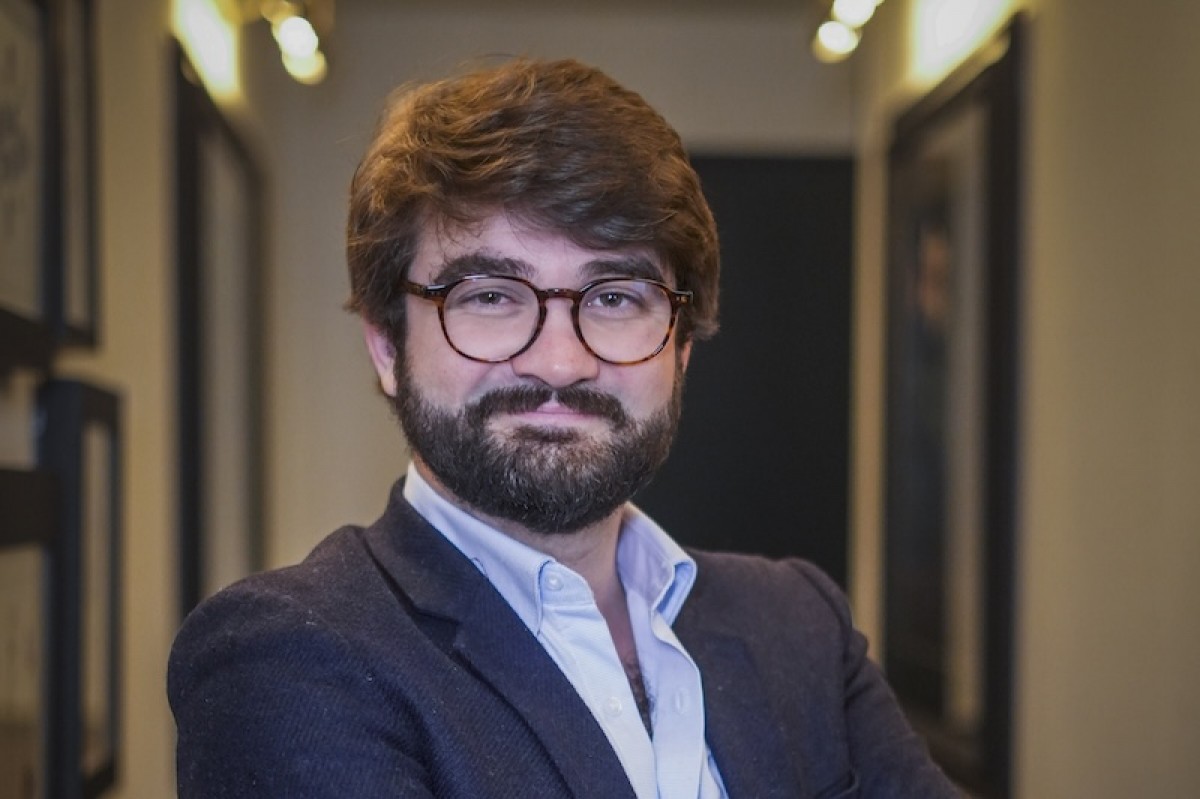
Limonier is one of the leading French and European experts on cyberspace. Photo: Agenda Pública / Tsun Ho