Domingo, 18 de octubre de 2026



ANALYSIS
Merkel is out to defend her legacy, Von der Leyen should be taking notes
Despite the urgency, the European Union remains paralysed and Ursula von der Leyen should understand Angela Merkel's legacy: strong leadership can stabilise institutions in turbulent times, but without transformation, it leaves a very fragile foundation. Agenda Pública brings together experts Ángel Saz-Carranza (EsadeGeo), Judith Arnal (Real Instituto Elcano) and Alberto Alemanno (HEC Paris) to learn from Germany's mistakes and what the European Union must overcome in this new stage.
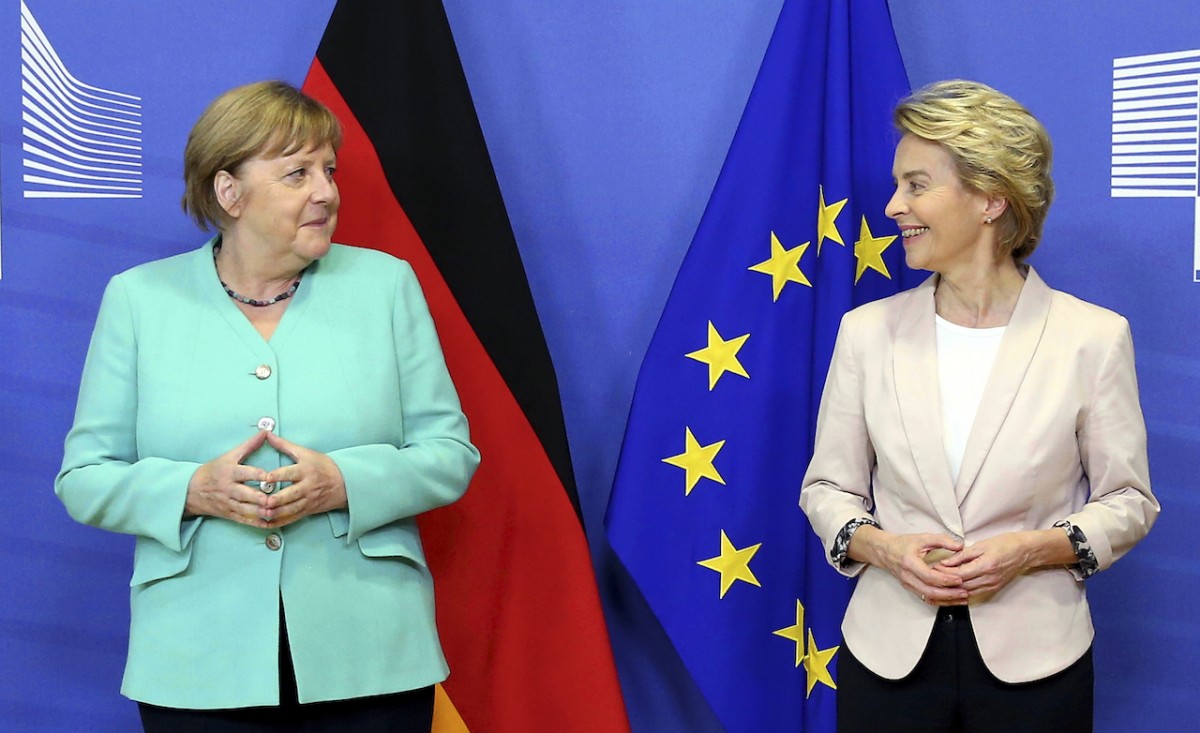
Angela Merkel and Ursula von der Leyen.Pool / Zuma Press / ContactoPhoto
In German, the verb merkeln describes the act of postponing important decisions for as long as possible. This word sums up much of Angela Merkel's sixteen years in office. Her chancellorship is often remembered for its calm and decisive leadership during crises, from the collapse of the eurozone to the refugee crisis. Her measured style earned her the nickname Mutti (mother, in German).
Germany, a crisis that has been brewing for decades
Merkel's pragmatism, once admired as a source of stability, masked the absence of major reforms, leaving Germany unprepared for the tectonic shifts of the second decade of the 21st century. "The current political and economic situation in Germany has been developing for decades," says Judith Arnal, main researcher at CEPS and the Elcano Royal Institute.
During Merkel's term, the country operated with an economic model dependent on manufacturing exports and cheap Russian energy. Germany, Arnal explains, "was the champion of the analogue era, excelling in mechanical engineering, chemical engineering and the manufacturing of internal combustion vehicles." However, this dominance blinded the country's policymakers to the need for reforms while the economy remained strong.
"This industrial dominance was based on a model supported by the State in which politicians, banks, and industrialists worked in close coordination, providing feedback to each other," summarizes the principal researcher at Elcano. While it was effective at the time, Arnal maintains, it created blind spots. "The concentration in the automotive and heavy industries prevented Germany from carrying out the necessary transitions," he notes.
Arnal points out several structural and geopolitical decisions during this period have ended up causing Germany's current vulnerabilities. The researcher cites examples such as the closure of its last nuclear plants in April 2023, which severely limited its energy options. Its dependence on Russian gas, disrupted by the war in Ukraine, and its dependence on China as a key export market, now increasingly unstable, further exposed these flaws. Brexit also eliminated a vital trading partner, removing a pillar of Germany's trade surplus.
This fragile foundation is now shaking in a global economy where "trade is no longer driven solely by economic efficiency, but is shaped by security, employment, and even environmental concerns," explains Angel Saz-Carranza, director of EsadeGeo. For Germany, the change has exposed the risks of a heavily export-oriented economy. "Tariffs and geopolitical tensions, such as Donald Trump's trade policies, have highlighted the fragility of this approach," he adds. Arnal agrees: "Germany must review its production model: massive exports and heavy industrialization are no longer viable."
The "European way of life" in crisis
Much like Germany, the EU faces the consequences of an outdated economic framework, which threatens the "European way of life", in the words of Mario Draghi. However, unlike Merkel, Ursula von der Leyen seems to have been able to anticipate her diagnosis of the changes in the global economy. During the final months of her first term as President of the Commission, Von der Leyen commissioned reports to identify the Union's reform needs from two prominent European leaders, Enrico Letta and Mario Draghi. Its conclusions were clear: Europe must urgently adapt to digital and green transitions by deepening its integration and expanding the single market.
Despite the urgency, Europe remains paralysed. Political polarization and resistance to reform by key member states, particularly France and Germany, present formidable barriers. The EU faces three critical risks: democratic backsliding, slow economic growth and growing anti-immigration sentiment. Many of these challenges date back to Merkel's tenure, during which key reforms were avoided and decisions such as protecting Orbán for economic interests or welcoming millions of Syrian refugees – admirable as it was – fueled the rise of the far right in all of Europe.
The mandate of Von der Leyen II
Von der Leyen enters her second term with much stronger political capital. Of course, she does not command the same presence as Mutti used to, but neither does she inspire the same levels of animosity. During her first mandate, the Commission achieved historic milestones, including "the implementation of much of the Green Deal and the NextGenerationEU recovery plan after the COVID-19 pandemic," recalls Saz-Carranza.
However, it comes with much less political support. The approval in the European Parliament of her new College of Commissioners has been the one with the least support in the history of the EU. In the European Parliament, an uneasy coalition of the main pro-European parties and far-right forces, including a part of Meloni's ERC. After the sloppy manoeuvres of some national delegations, not even her own party, the EPP, voted en bloc in favour of the new Commission.

Alberto Alemanno, professor of EU Law at HEC Paris and the College of Europe, warns that this fragile majority "will weaken the Commission's ability to independently define and direct a clear political agenda, risking being left as a subsidiary of the Council", a body much more sensitive to political changes in Europe. He adds that "the centrist coalition that has governed Europe since its inception may have reached its natural end." This, although positive in terms of democratic representativeness, will end up "increasing political volatility, precisely when decisive government action is most needed," warns Professor Alemanno.
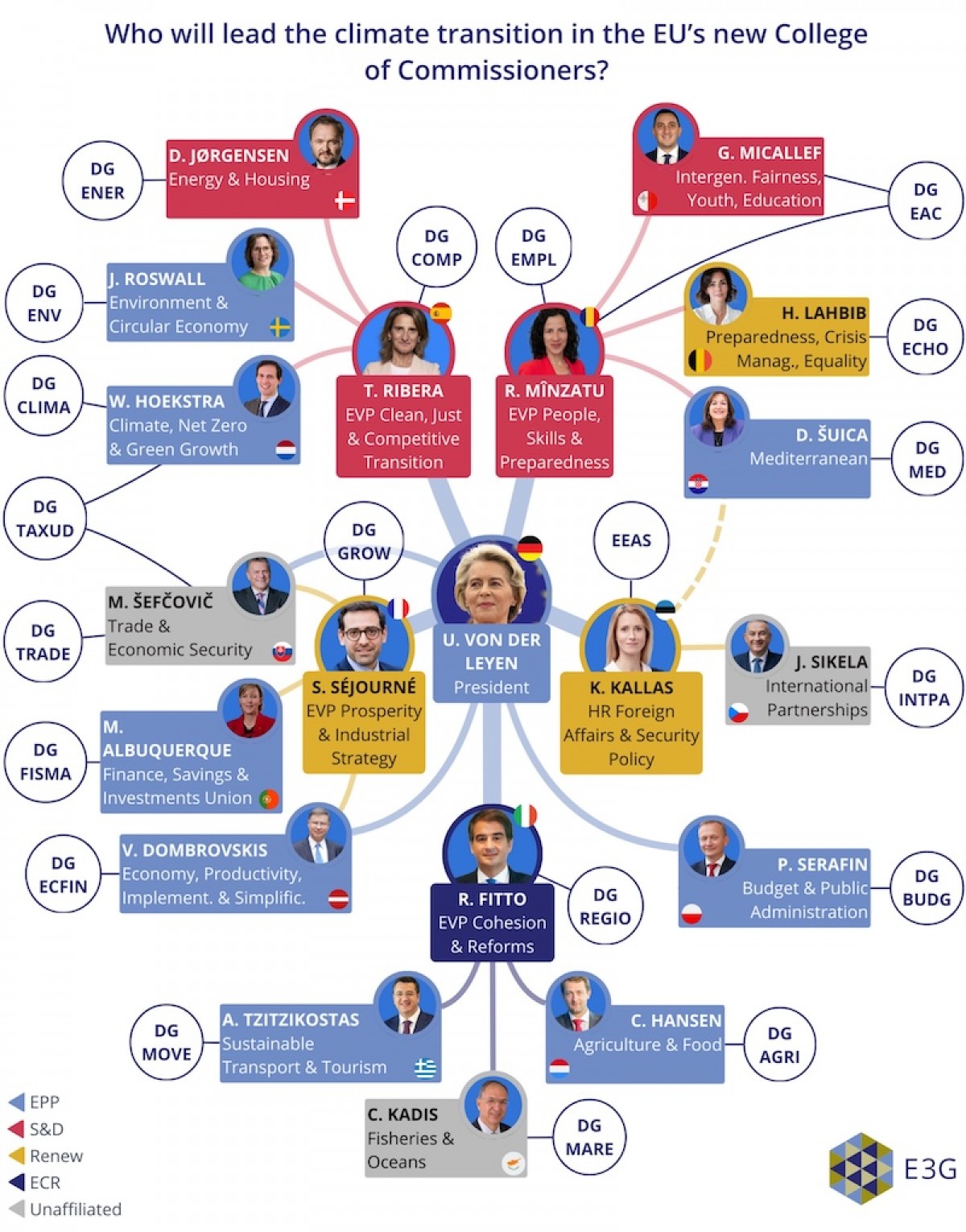
For example, Teresa Ribera, as Vice President for the Clean, Fair and Competitive Transition, must work in coordination with the commissioners of Climate Action, Environment and Circular Economy and Energy. Simultaneously, she will share duties with the Executive Vice President for Prosperity and Industrial Strategy, Stéphane Sejourné. If compromises cannot be found between the parties, the decisions will pass to the presidency.
Structural limitations also lurk. Germany's fiscal conservatism remains a barrier to financial deepening, such as the creation of Eurobonds, a proposal championed by Draghi —as Bernardo De Miguel explained here. "Resistance to Eurobonds transcends ideology in Germany," Arnal explains, noting that even when Chancellor Scholz was Merkel's finance minister, he maintained this stance.
France, the EU's other traditional power, also appears weakened. According to Saz-Carranza, "Barnier's implicit coalition with Le Pen has diminished Macron's influence in European politics." Furthermore, his newborn government faces the threat of imminent collapse before the end of the year if it fails to finally approve the country's new budget.
This leadership vacuum leaves the EU without a clear driver for reform, since countries like Spain and Poland, although ambitious, "remain limited by their peripheral positions, both geographically and in economic matters and divergent interests," explains Saz-Carranza. .
Von der Leyen's second term holds both promise and danger
For Saz-Carranza, the Commission can have some success: "Progress can be made in areas such as the single market and security, but environmental ambitions, including the Green Deal, can be sidelined." Professor Alemanno explains that "the next multiannual financial framework of 2026 is likely to be reduced, which will further limit the EU's ability to meet citizens' expectations." Furthermore, he warns that "the gap between Europeans' expectations and the EU's capabilities could strengthen nationalist and Europhobic forces." The German elections in February will be a good control point to understand the evolution of this trajectory.
Von der Leyen must understand the mandate of her political forbearer: strong leadership can stabilize institutions in turbulent times, but without transformation, it leaves a fragile foundation. As the Commission President faces her second term, the question is whether she will be able to break the cycle; or whether the EU, like Germany under Merkel, will continue to merkeln—and defer its critical reforms to the next generation of leaders. Even in the knowledge that Europe cannot afford a wasted legislature or decade.
Without decisive action, the future of the EU has been clearly described by Mario Draghi: an economically vulnerable and politically fractured continent. Which could pave the way for far-right forces to exploit the growing discontent. Merkel's legacy now represents for Von der Leyen both a warning and a challenge to the future of Europe.
"Merkel's pragmatism, which, in the past, was admired as a source of stability, masked the absence of major reforms, leaving Germany unprepared for the tectonic changes of the second decade of the 21st century"However, almost four years after leaving office, Merkel has broken her silence to defend her political legacy with the publication of her memoirs. Once celebrated as the saviour of Europe during the euro crisis, she is now the figure that many analyse to understand the crises facing Germany and the EU today. The German country faces an obsolete economic model and a rising far right. While the Union faces one of its most decisive stages with an adverse geopolitical panorama and a global economy that is leaving it behind.
Germany, a crisis that has been brewing for decades
Merkel's pragmatism, once admired as a source of stability, masked the absence of major reforms, leaving Germany unprepared for the tectonic shifts of the second decade of the 21st century. "The current political and economic situation in Germany has been developing for decades," says Judith Arnal, main researcher at CEPS and the Elcano Royal Institute.
During Merkel's term, the country operated with an economic model dependent on manufacturing exports and cheap Russian energy. Germany, Arnal explains, "was the champion of the analogue era, excelling in mechanical engineering, chemical engineering and the manufacturing of internal combustion vehicles." However, this dominance blinded the country's policymakers to the need for reforms while the economy remained strong.
"This industrial dominance was based on a model supported by the State in which politicians, banks, and industrialists worked in close coordination, providing feedback to each other," summarizes the principal researcher at Elcano. While it was effective at the time, Arnal maintains, it created blind spots. "The concentration in the automotive and heavy industries prevented Germany from carrying out the necessary transitions," he notes.
Arnal points out several structural and geopolitical decisions during this period have ended up causing Germany's current vulnerabilities. The researcher cites examples such as the closure of its last nuclear plants in April 2023, which severely limited its energy options. Its dependence on Russian gas, disrupted by the war in Ukraine, and its dependence on China as a key export market, now increasingly unstable, further exposed these flaws. Brexit also eliminated a vital trading partner, removing a pillar of Germany's trade surplus.
"Germany must review its production model: massive exports and heavy industrialization are no longer viable"
This fragile foundation is now shaking in a global economy where "trade is no longer driven solely by economic efficiency, but is shaped by security, employment, and even environmental concerns," explains Angel Saz-Carranza, director of EsadeGeo. For Germany, the change has exposed the risks of a heavily export-oriented economy. "Tariffs and geopolitical tensions, such as Donald Trump's trade policies, have highlighted the fragility of this approach," he adds. Arnal agrees: "Germany must review its production model: massive exports and heavy industrialization are no longer viable."
The "European way of life" in crisis
Much like Germany, the EU faces the consequences of an outdated economic framework, which threatens the "European way of life", in the words of Mario Draghi. However, unlike Merkel, Ursula von der Leyen seems to have been able to anticipate her diagnosis of the changes in the global economy. During the final months of her first term as President of the Commission, Von der Leyen commissioned reports to identify the Union's reform needs from two prominent European leaders, Enrico Letta and Mario Draghi. Its conclusions were clear: Europe must urgently adapt to digital and green transitions by deepening its integration and expanding the single market.
Despite the urgency, Europe remains paralysed. Political polarization and resistance to reform by key member states, particularly France and Germany, present formidable barriers. The EU faces three critical risks: democratic backsliding, slow economic growth and growing anti-immigration sentiment. Many of these challenges date back to Merkel's tenure, during which key reforms were avoided and decisions such as protecting Orbán for economic interests or welcoming millions of Syrian refugees – admirable as it was – fueled the rise of the far right in all of Europe.
The mandate of Von der Leyen II
Von der Leyen enters her second term with much stronger political capital. Of course, she does not command the same presence as Mutti used to, but neither does she inspire the same levels of animosity. During her first mandate, the Commission achieved historic milestones, including "the implementation of much of the Green Deal and the NextGenerationEU recovery plan after the COVID-19 pandemic," recalls Saz-Carranza.
However, it comes with much less political support. The approval in the European Parliament of her new College of Commissioners has been the one with the least support in the history of the EU. In the European Parliament, an uneasy coalition of the main pro-European parties and far-right forces, including a part of Meloni's ERC. After the sloppy manoeuvres of some national delegations, not even her own party, the EPP, voted en bloc in favour of the new Commission.
Alberto Alemanno, professor of EU Law at HEC Paris and the College of Europe, warns that this fragile majority "will weaken the Commission's ability to independently define and direct a clear political agenda, risking being left as a subsidiary of the Council", a body much more sensitive to political changes in Europe. He adds that "the centrist coalition that has governed Europe since its inception may have reached its natural end." This, although positive in terms of democratic representativeness, will end up "increasing political volatility, precisely when decisive government action is most needed," warns Professor Alemanno.
"Von der Leyen has designed a Commission in which, through the introduction of internal blockages and undefined powers between the different members, she herself will always be the final decision-maker"Saz-Carranza also shows concern about the internal functioning of the new Commission, which he deems as "presidential." "Von der Leyen has designed a Commission in which, through the introduction of internal blockages and undefined powers between the different members, she herself will always be the final decision-maker," argues the director of EsadeGeo.
For example, Teresa Ribera, as Vice President for the Clean, Fair and Competitive Transition, must work in coordination with the commissioners of Climate Action, Environment and Circular Economy and Energy. Simultaneously, she will share duties with the Executive Vice President for Prosperity and Industrial Strategy, Stéphane Sejourné. If compromises cannot be found between the parties, the decisions will pass to the presidency.
Model of dependencies of the College of Commissioners of the European Union. Foto: E3G
Structural limitations also lurk. Germany's fiscal conservatism remains a barrier to financial deepening, such as the creation of Eurobonds, a proposal championed by Draghi —as Bernardo De Miguel explained here. "Resistance to Eurobonds transcends ideology in Germany," Arnal explains, noting that even when Chancellor Scholz was Merkel's finance minister, he maintained this stance.
France, the EU's other traditional power, also appears weakened. According to Saz-Carranza, "Barnier's implicit coalition with Le Pen has diminished Macron's influence in European politics." Furthermore, his newborn government faces the threat of imminent collapse before the end of the year if it fails to finally approve the country's new budget.
This leadership vacuum leaves the EU without a clear driver for reform, since countries like Spain and Poland, although ambitious, "remain limited by their peripheral positions, both geographically and in economic matters and divergent interests," explains Saz-Carranza. .
Von der Leyen's second term holds both promise and danger
For Saz-Carranza, the Commission can have some success: "Progress can be made in areas such as the single market and security, but environmental ambitions, including the Green Deal, can be sidelined." Professor Alemanno explains that "the next multiannual financial framework of 2026 is likely to be reduced, which will further limit the EU's ability to meet citizens' expectations." Furthermore, he warns that "the gap between Europeans' expectations and the EU's capabilities could strengthen nationalist and Europhobic forces." The German elections in February will be a good control point to understand the evolution of this trajectory.
"The gap between Europeans' expectations and the EU's capabilities could strengthen nationalist and Europhobic forces"
Von der Leyen must understand the mandate of her political forbearer: strong leadership can stabilize institutions in turbulent times, but without transformation, it leaves a fragile foundation. As the Commission President faces her second term, the question is whether she will be able to break the cycle; or whether the EU, like Germany under Merkel, will continue to merkeln—and defer its critical reforms to the next generation of leaders. Even in the knowledge that Europe cannot afford a wasted legislature or decade.
Without decisive action, the future of the EU has been clearly described by Mario Draghi: an economically vulnerable and politically fractured continent. Which could pave the way for far-right forces to exploit the growing discontent. Merkel's legacy now represents for Von der Leyen both a warning and a challenge to the future of Europe.
Etiquetas
Agenda Pública in English, UE, España, Eurozona, Ursula von der Leyen, Merkel, Alemania, Draghi, Innovación, economía Ahora en portada
17 de octubre de 2026
16 de octubre de 2026
Noticias relacionadas
Hace 98 semanas
Von der Leyen (segunda parte): entre la impotencia y la gran transformación
Hace 101 semanas
Madrid y Barcelona (juntas): la solución frente al proteccionismo americano y el colapso alemán
Lo más leído