


Germany combats 'Standortkrise' with a major fiscal expansion
In his weekly column, Marc López Plana, editor and director of 'Agenda Pública', analyzes the profound economic and political transformation Germany is currently undergoing. From the abandonment of austerity to the deployment of unprecedented fiscal expansion, Berlin is trying to respond to an industrial, geopolitical, and social crisis that threatens to reconfigure Europe’s balance of power. The result is a Germany that is more interventionist, more unsettled, and increasingly decisive for the future of the European Union.

A short time later, I met with the Minister of the Economy from the German state of Saarland, who explained to me first-hand the inside story of the great institutional ploy that ended up rescuing the federal budget.
He detailed how a group of top economists – Clemens Fuest, Michael Hüther, Moritz Schularick, and Jens Südekum – managed to convince Friedrich Merz’s CDU and Lars Klingbeil’s SPD that they had to reform the Constitution quickly, for reasons of overwhelming mathematical and geopolitical urgency: the stagnating economy, infrastructure in poor condition after long neglect, and the need for investment in defense. To make matters worse, the freshly elected Bundestag would lack a necessary two-thirds majority without the support of extreme parties (the AfD and Die Linke). Thus, promoted from Saarland’s federal pulpit by Minister-President Anke Rehlinger, a reform of the brake on debt was approved in extremis by the outgoing Parliament, unblocking a fund of €500 billion and shielding by simple majority vote all military expenditure exceeding 1% of GDP.
"Fiscal expansion is now in full swing, and defense spending is rising dramatically"Today, in June of 2026, Germany’s political, industrial, and fiscal map reveals that moment as prologue to a rapid and painful transformation. In light of the most recent macroeconomic data, we can confirm that the paradigm shift is no political mirage: fiscal expansion is now in full swing, and defense spending is rising dramatically.
This awakening of public spending wasn’t a triumph of long-term planning but a lifeline thrown in the midst of a perfect storm. With three of its historic pillars for success having crumbled – cheap Russian energy, the American security umbrella, and privileged access to the Chinese market – Germany is living through a deep structural crisis.
China Shock 2.0
Merz has wrongly diagnosed his country’s ailments, exclusively obsessing over energy prices and Europe’s suffocating bureaucracy. However, as various recent analyses have indicated, the real underlying structural problem is Germany’s loss of external competitiveness vis-à-vis China.
Unlike in the past, the German export model isn’t competing with an emerging economy eager to absorb outside technology but with a major industrial superpower that gobbles up global demand, driven by massive subsidies and an unmatchable scale of production. China now dominates entire strategic sectors such as electric vehicles, threatening to destroy hundreds of thousands of jobs linked to German exports.
X-ray of expenditures
To face this existential threat, Germany’s spending tap has been fully opened. The fiscal data for April provided by Niklas Garnadt, senior European economist for Germany at Goldman Sachs, is a clear testament to that new approach. German federal spending in April reached €45.8 billion – well above forecasts of €42.2 billion, and €8 billion above the amount spent in April 2025.
The breakdown of those figures reveals that injections of capital are happening on multiple simultaneous fronts:
- Main budget: spending reached €38.6 billion in April, some €300 million above expectations. Both social spending and investment exceeded estimates.
- Accelerated rearmament: spending on the extra-budgetary military fund reached €1.2 billion in April, slightly above the expected €1 billion. So far this year, defense spending has risen by 34%, totaling €7 billion.
- Infrastructure and climate fund: disbursement stood at €6.1 billion, comfortably exceeding forecasts.
"German federal spending in April reached €45.8 billion – well above forecasts of €42.2 billion, and €8 billion above the amount spent in April 2025"The impact of this massive disbursement from State coffers is overwhelming. As of April, the accumulated fiscal deficit was at €63.6 billion, or €36.2 billion higher than the same period in the previous year. Data supports the projection of a notable fiscal expansion in 2026, with a boost of around 0.6 percentage points.
The "minister of investment" and the challenge of execution
The shift to a more expansive fiscal policy has a clear political component. Upon taking office last year, Finance Minister Lars Klingbeil promised to be the "minister of investment," and the 2026 budget takes him at his word, allocating around €127 billion (about 2.8% of GDP) to federal investment, compared to last year’s budget of €116 billion. Transport remains the champion, accounting for about a third of all such spending."Since 2020, actual investment has fallen far short of budgeted amounts, due to exasperatingly slow roll-outs"In Germany, however, planning is not synonymous with implementation. Since 2020, actual investment has fallen far short of budgeted amounts, due to exasperatingly slow roll-outs. To combat that bureaucratic bottleneck, the Future of Infrastructure Act being debated in Parliament seeks to speed up planning and the granting of permits.
Germany’s fears and Europe
The fear of deindustrialization has turned Germany defensive in Brussels, more heavily focused on finding internal solutions. One clear example is Agenda 2026, a report from the CDU/CSU proposing profound deregulation of the European Union to strengthen competitiveness and to ease the bureaucratic burden on companies. But that could also lead to a weakening of progress in social rights, equal pay, and environmental protection in the name of competitiveness.Another very current example is discussion in Brussels of the Industrial Accelerator Act. Once Europe’s undisputed industrial locomotive, Germany continues to flounder after the loss of cheap Russian gas. If a chemical giant like BASF or a steel company like ThyssenKrupp notices that energy costs in Spain are consistently 30% to 40% lower than they are in Germany, then this ‘accelerator’ won’t speed the recovery of German industry but rather its relocation to the Mediterranean. On the other hand, Germany could deploy its ‘fiscal bazooka’ to infuse its industries in crisis. The risk is clear: the IAA could end up financing internal offshoring, where factories don’t move to the most efficient place or where energy costs are cheaper, but instead to the country that offers the juiciest package of public money. In Brussels, this has a name: "cannibalization of the single market" under the guise of strategic autonomy.
Discontent: the CDU and SPD represent barely a third of the electorate
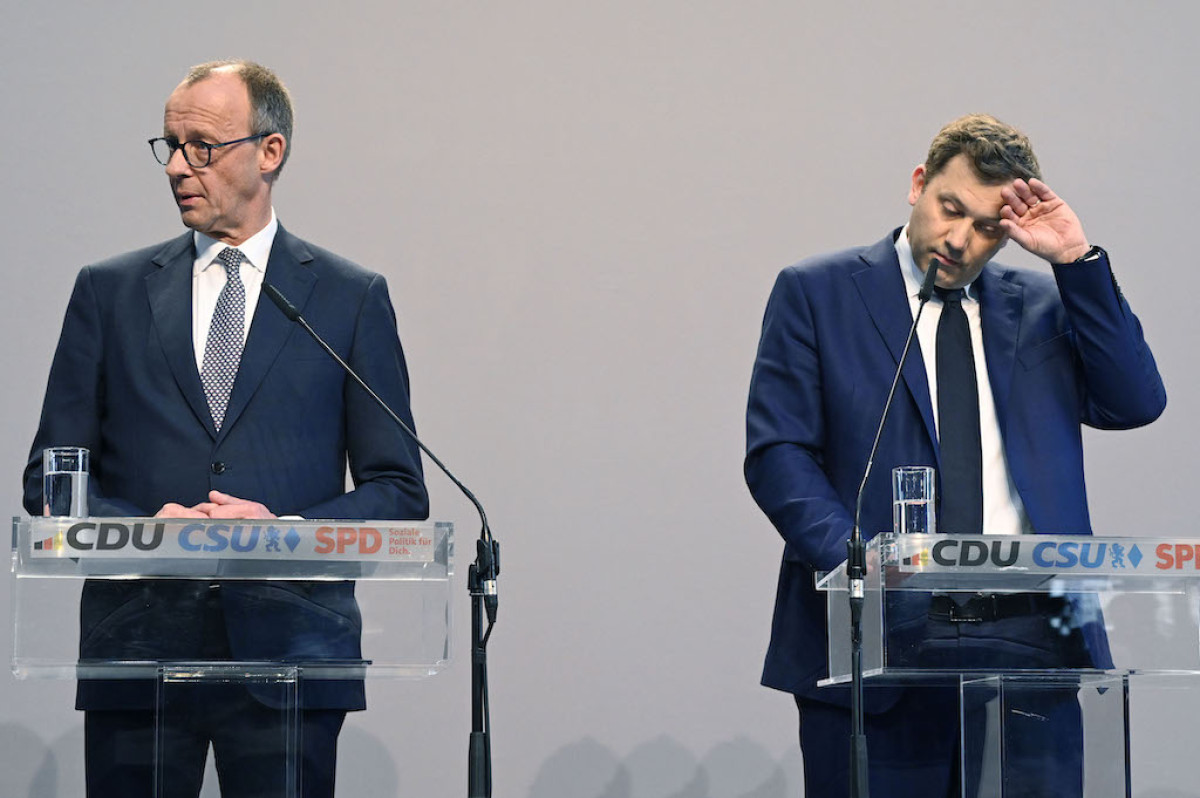
This economic transformation is striking governmental paralysis head-on. As political scientist Frank Decker rightly observes, social democracy has been mired in a deep identity crisis for over 20 years. Trapped once again as a junior partner in a ‘grand coalition’, the SPD is unable to express its ideology alongside the orthodoxy of Friedrich Merz’s CDU. The result is a government seized by mistrust and failing to project a clear horizon to a deeply pessimistic society."With the radical right nearing 30%, any traditional 'cordon sanitaire' will require increasingly contrived and arithmetic pacts – thus eliminating real alternation and naturally feeding back into the AfD’s anti-system discourse"While the tensions in Parliament are extreme, the numbers on the street are extremely problematic. The traditional Sonntagsfrage method of polling paints a bleak picture for the establishment and helps to explain the panic of the political center.
According to the latest data from the polling firm INSA (May 2026), the Alternative for Germany party (AfD) has both consolidated its lead and shot to 29% among intended voters. The wear-and-tear of governing in a context of industrial crisis grinds down the coalition: the CDU falls to 22%, while the SPD scrapes along at 12%. Together, they represent barely a third of the electorate.
With the radical right nearing 30%, any traditional cordon sanitaire will require increasingly contrived and arithmetic pacts – thus eliminating real alternation and naturally feeding back into the AfD’s anti-system discourse.
Rumors of government crisis?
This situation has unleashed a political storm in Berlin. As reported last week by the German Table Media outlet, internal tensions have been pushing relations within the coalition to an almost absolute limit.In the most hard-line sectors of the CDU, an openly radical thought model is starting to circulate: force out the SPD, situate Merz at the head of a minority government, and begin tolerating or seeking specific agreements with the AfD, should governability demand such. That would mean the definitive breakdown of the historic institutional Brandmauer firewall against the radical right.
"With its government fracturing, rumors of extreme alliances that once seemed impossible, and the AfD capitalizing on discontent, Berlin is projecting its instability toward the European Union"Germany is enduring one of the most painful metamorphoses in its modern history. Abandonment of the dogma of austerity and massive injections of public spending confirm that the State has taken the reins to rescue its industry. However, capital alone can’t buy social tranquility at home, or make up for the loss of competitiveness against China.
With its government fracturing, rumors of extreme alliances that once seemed impossible, and the AfD capitalizing on discontent, Berlin is projecting its instability toward the European Union.
BONUS. Some in Spain could interpret all this as an unprecedented opportunity to reindustrialize and attract green capital fleeing from price escalation in Germany; but careful, because we also live under the constant threat that an embrace of economic nationalism in Germany could tear the single market to pieces. We need a European Germany – not a German Europe. The best way to avoid past mistakes is to anchor a unified Germany in a much deeper project of European integration.