Domingo, 18 de octubre de 2026




CONVERSATIONS
Two experts, one verdict: "Europe is on its own"
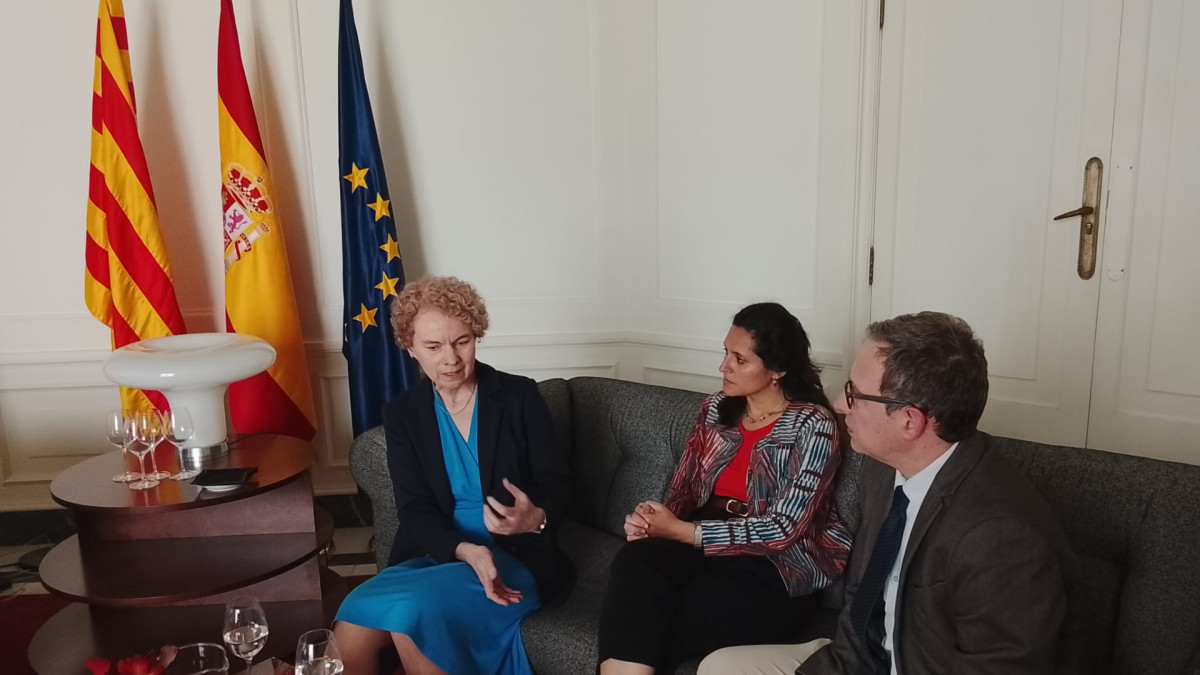
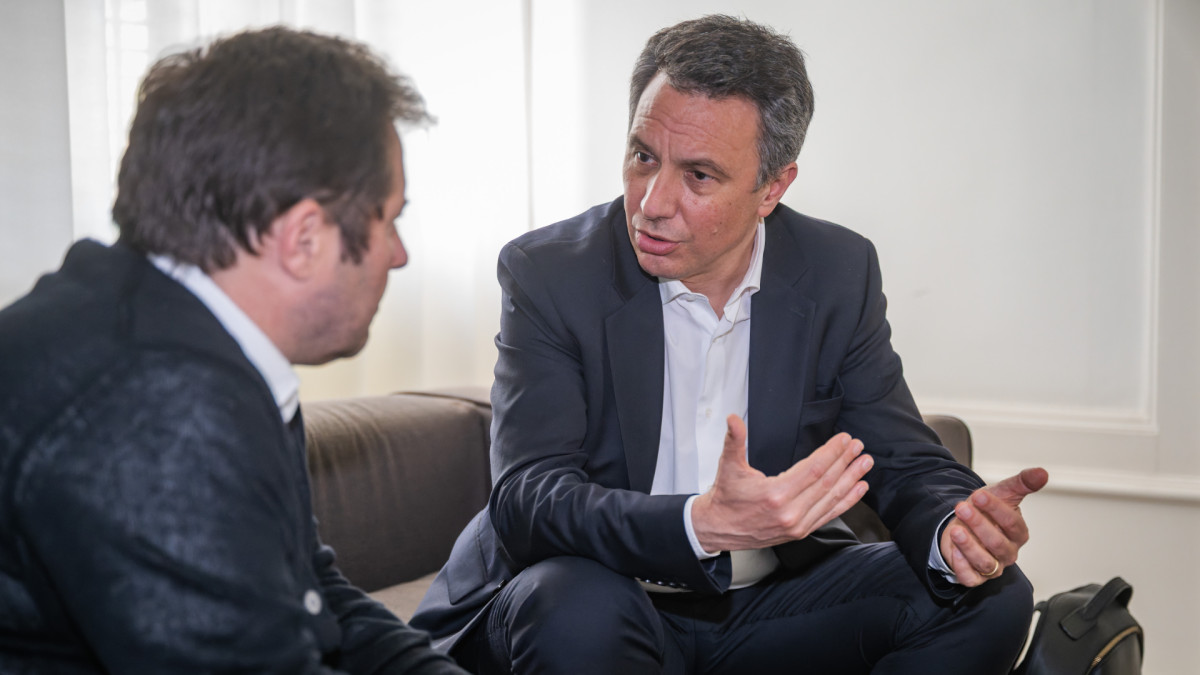
During the latest edition of the international conference War and Peace in the 21st Century, organised by CIDOB, the think tank’s senior researcher and former Member of the European Parliament, Domènec Ruiz Devesa, spoke with the director of the Paris office of the German Marshall Fund of the United States (GMF), Tara Varma, and the director of the International Centre for Defence and Security (ICDS), Kristi Raik. The two engaged in a discussion on European defence and, in particular, on the role of the US in this context.
-1920x1080.jpg)
Raik, Varma and Ruiz chat at the Palau de Pedralbes.Agenda Pública
The centre of the debate on European autonomy, and therefore on its security and defence, lies in one question: how and what does Europe need to broaden its independence from the US? The answer to this question involves highly complex areas, and requires first-hand knowledge of the present state of European security, how the war front in Ukraine is being sustained, and the role of European and national institutions and defence companies.
CIDOB senior researcher Domènec Ruiz Devesa puts the right questions on the table so that Kristi Raik and Tara Varma can map the defence relationship between Europe and the US. Raik is the director of the International Centre for Defence and Security (ICDS), Estonia’s leading foreign-policy think tank. Varma is the director of the Paris office of the German Marshall Fund of the United States, the think tank created to strengthen relations between North America and the European Union. Both were speakers at the twenty-fourth edition of CIDOB’s War and Peace in the 21st Century.
In this conversation, they engage in an exchange of knowledge on what Europe must do if it truly aspires to guarantee its own security with greater independence, what US interests are in this decoupling, and how today’s threats should be addressed.
You are acutely aware of the Russian threat because you have it right in front of you, and because Estonia has suffered it in the past and continues to suffer it through hybrid attacks and the whole range of instruments that Putin's Russia deploys across Europe. In the Baltic states, you feel that threat very closely. Estonia has also been a strong supporter of Ukraine, and you understand very well Ukraine's predicament and its need to keep fighting for its sovereignty and independence. How do you assess Europe's contribution to this effort? How do you assess the United States' contribution at this moment? And what do you think we can expect in the near future in terms of improved support for Ukraine from both the United States and the European Union?
Kristi Raik (K. R.): In Estonia, there is no doubt that supporting Ukraine and making sure that it remains a sovereign nation is a core interest for all of Europe, not just for the security of the frontline countries, but for Europe as a whole.
What Europeans have done to support Ukraine is quite remarkable. Europeans have managed to step up their support after Donald Trump's second presidency began and the US effectively started withdrawing and ending its financial support to Ukraine. It is now completely up to the Europeans, and they have been taking over.
Tara, can we really say that the Americans have withdrawn their assistance? Even if it is no longer a donation, and perhaps the Biden packages felt more generous, the fact remains that they are still selling equipment to Europeans so that it can be sent to Ukraine. Is that still cooperation? Is that something Europeans should still be grateful for?
Tara Varma (T. V.): As Europeans, we had expected the US to pull the plug completely on its support to Ukraine, and that has not happened. It has, however, severely decreased its support. We should be very clear that all the support sent to Ukraine in 2025 was material that had been provisioned by the Biden administration. It was not new material prepared by this administration. People who are now part of the administration tried, under the previous administration, to block the supplemental aid proposed in Congress. So we are seeing a vision of US support to Ukraine that is totally different.
That said, there is still a form of US support, as Kristi has just said, in the role of strategic enabler. Particularly on intelligence, it is very hard for Europeans to replace or substitute for the US, and the same goes for air defence.
At the same time, the very fact that the European Union is now providing not only financial and humanitarian aid, which is a fairly classical European toolbox, but also lethal military aid to Ukraine, is unprecedented. Europeans are by far providing the most support.
There is a transactional element in this transatlantic approach to Ukraine right now, and I do not think it is sustainable. At some point Europeans will have to invest in their own defence industry. We are already seeing a number of European member states setting up joint ventures directly with Ukraine because that is a more pragmatic and flexible way of doing things than simply buying American.
We also discussed during the conference the myth that everyone is turning to the US because all the material is supposedly sitting on the shelves. That is no longer true. The US has severely depleted stocks. Those stocks were already depleted in the middle of the war in Ukraine, two years into the war. And now, with the war in Iran, stocks are even more depleted as the US looks towards strategic competition with China.
Interestingly enough, Donald Trump himself has been the one saying he wants to remain involved. There are many hypotheses as to why. Everyone talks about the Nobel Prize, and I think that is probably true. I also think he wants to be credited with ending the war. He has invested a great deal of personal capital in this vis-à-vis the American public, but also vis-à-vis Vladimir Putin and Xi Jinping.
I would expect him to stay involved for the time being, but with a very different attitude from the previous administration. We have seen President Trump and a number of people in his administration effectively place responsibility for the war on both Ukraine and Russia, without recognising Russia as the aggressor. It was Russia's full-scale invasion of Ukraine that caused the war. Ukraine had no responsibility whatsoever. Europeans have understood that change of perspective, and that means we are now the primary supporters of Ukraine.
That makes sense, because Ukraine's future is in Europe. Ukraine is already in Europe, and by defending itself, Ukraine is effectively defending Europe. So there is one issue, which is the transatlantic relationship and the turmoil it is undergoing, and another, which is how we support Ukraine. Sometimes those overlap, but sometimes they do not, and as Europeans we have to advance on both tracks.
That is a very important point, because this system of buying weapons from the Americans has at least two limits. One, as you mentioned, is the availability of the American industrial base, and with the war in Iran that is becoming more difficult. The other is our ability to develop European systems and eventually replace that scheme. The French now claim they are supplying most of the intelligence to the Ukrainians, but the conventional wisdom is still that Ukraine remains overly dependent on US intelligence. What is your assessment?
T. V.: These things are very hard to assess by nature, because they are secretive. It is true that this is what the French president has said. I think he wanted to show that it is possible to envisage Europeans working together and providing more intelligence support to Ukraine.
France has in fact been providing intelligence support for a long time. Since the beginning of the war, there has been significant intelligence cooperation between France and Ukraine, even if the French military leadership did not particularly want to state that publicly for various reasons. Given the political changes in Europe and the fact that Ukraine needs our support more than ever, it made sense to say it openly now.
Even if France is doing more, the issue is not simply France providing intelligence to Ukraine. There needs to be a much higher level of intelligence cooperation at European level in order to provide this information to Ukraine. The US operates on a scale we are not used to, but we do have the tools to do more ourselves. So this is not about undermining ourselves by default. We could do much more in intelligence cooperation. We already do some of it, especially in cyber, and that cooperation could be expanded well beyond cyber at European level.
Kristi, how realistic is it that within a reasonable timeframe — say five years — Europe can develop its own strategic enablers? From your perspective in Estonia, again from the frontline, how confident are you that Europe can develop these capabilities in time?
K. R.: Of course, we do not know how much time Europe has. At the moment we still have these critical dependencies on the US, and we see that very clearly in Ukraine. Intelligence is probably the most important one. Fortunately, it does not even cost the US anything to continue sharing intelligence with Ukraine. It is entirely a political decision, and so far the US has continued to do it.
For Europe as a whole, this is one of the critical fields where we do not have a very quick way out of dependency. That is why, for Ukraine as well, it is so important to keep the US engaged, especially in a situation where President Trump is pushing the peace process in a direction that runs contrary to Ukrainian interests.
What the US is demanding from Ukraine is very much in line with Russian demands. The US is pushing Ukraine not only to give up the territories Russia has occupied — close to 20% of Ukrainian territory — but even additional territory that Russia has not managed to conquer militarily and now hopes to obtain through diplomacy.
For the Ukrainian side, Russian demands supported by the US are simply impossible to accept. As long as Ukraine is able to continue fighting, it will do so, because otherwise it would mean giving away an important part of its territory and sovereignty. That would not be a path to sustainable peace. Most likely, Russia would then want even more. So the US does not really have a formula for a peace that would be realistic and sustainable. What we are seeing instead is Trump's desire to be able to say that he ended another war, and then leave Ukrainians and Europeans to live with the consequences.
Member states in eastern Europe and the Baltic states have traditionally been very pro-NATO. They believed their security was better served by NATO than by the EU. My impression after one year of Trump is that there is now a broader realisation in Europe that we cannot put all our eggs in one basket, namely NATO. But the moment we build European defence, the Americans could say they are no longer needed. What is your view, Kristi?
K. R.: First of all, I would say that in northern Europe there is a broadly shared view that NATO is still the framework for defence, and that NATO has to be Europeanised. Europeans have to take more responsibility for their own defence. Countries in the Nordic-Baltic region and Poland take that very seriously. Germany is also investing heavily in defence, while still using NATO structures, because that is the most practical and effective way to use the command structures and defence plans.
There is no real European alternative at the moment. There is political rhetoric — even slogans — about a European army, but there is no serious or realistic plan for it. So the approach in northern Europe is pragmatic: use the structures we already have in NATO while Europeans take more responsibility for their own defence. At the same time, we should try to preserve whatever remains of the transatlantic relationship.
That is a separate and very large question, because we can no longer trust or rely on the United States in the way we used to. And yet NATO is still there in its daily work. It is still exercising and still has defence plans.
But to start building entirely new European defence structures in another framework, such as the EU, would take years, and we do not have that time. We would also struggle to find the resources. Resources are limited. In northern Europe, the approach is above all pragmatic: use NATO to the greatest extent possible and deepen regional defence cooperation. That is one way of developing alternative forms of resilience, knowing that the transatlantic relationship has become extremely fragile.
We have the Joint Expeditionary Force led by the UK, the Nordic countries have their own defence cooperation through NORDEFCO, and Nordic-Baltic cooperation is closer than ever before. In a practical sense, this complements NATO. There are exercises, and there is serious thinking about what would happen if Russia decided to test one NATO member. We do not know how Trump would react, but I think we can be quite certain that there would be a regional response, so that no country would be left entirely alone. We have a collective capability that we are prepared to use.
Yes, but for that to work within NATO, you would need a political agreement with the Americans that NATO structures could be used without them, and you would need to change military planning, because the current planning and war-gaming assume that the Americans are part of the effort.
K. R.: We need a step-by-step process of Europeans taking over. Even with only minimal US involvement, one can imagine a future in which Europeans make use of NATO structures. Would the US want to block that completely? It is a theoretical question. What would its interest be in doing so? And would the US really try to leave NATO entirely? That is not so easy either.
I think the greater risk is that the US simply stops engaging. That is the very real risk: that it no longer wants to invest in the future conventional defence of Europe.
 Tara, let me give you the last word. I am sure you have a view on this.
T. V.: To me, it is not an either-or situation. We have invested so much in NATO, and for the time being NATO still deters Putin. We should be clear about that. Yes, there have been major drone incursions in the Baltic states, in Poland, in France near nuclear bases, and in Belgium, as we mentioned earlier. We are seeing incursions over NATO territory, but not a formal attack. I think that still shows that NATO remains a deterrent in Putin's mind.
At the same time, we need to be very clear about what is coming out of Washington, because I think this administration means what it says when it calls on Europeans to do much more. For the time being, the US will certainly keep the nuclear umbrella over Europe, but in conventional terms it expects Europeans to do more. And, frankly, that is a fair request, given the size of the EU market and the strength Europe has. But if Europe does more, it has to do so on its own terms. It cannot simply be a response to the demands of a US administration.
So while we continue investing massively in NATO, Europeanising it as much as possible and investing in positions within command-and-control structures, we also have to duplicate some of our resources. The war in Ukraine showed that this can work. In the first few weeks after Russia's full-scale invasion, the response worked because there was duplication. We received material from NATO and from EU member states, and that redundancy allowed us to provide more to Ukraine than we otherwise could have.
Redundancy can be useful, especially in times of instability. Europe is going to be affected by US foreign-policy decisions for the foreseeable future. We have to plan accordingly, whether in the Middle East or in Europe's broader neighbourhood. We have to plan, and we have to build redundancy.
The Parliament and the Commission can do many things. The Commission, for example, can provide more money, and it has been doing so. But the political will has to come from the European Council and from the heads of state and government.
That would be a major step forward. As we heard earlier today, there is now a 90% overlap between EU membership and NATO membership. It is a little absurd that these two institutions, based in the same city of Brussels, know so little about each other and work together so little. We have NATO's 2022 Strategic Concept and the EU's 2022 Strategic Compass, and developments have already moved on from there. Working more closely together and building a common strategic culture is absolutely essential. So too is Europe building its own capacities within NATO, but also at national and EU level.
Thank you very much.

CIDOB senior researcher Domènec Ruiz Devesa puts the right questions on the table so that Kristi Raik and Tara Varma can map the defence relationship between Europe and the US. Raik is the director of the International Centre for Defence and Security (ICDS), Estonia’s leading foreign-policy think tank. Varma is the director of the Paris office of the German Marshall Fund of the United States, the think tank created to strengthen relations between North America and the European Union. Both were speakers at the twenty-fourth edition of CIDOB’s War and Peace in the 21st Century.
In this conversation, they engage in an exchange of knowledge on what Europe must do if it truly aspires to guarantee its own security with greater independence, what US interests are in this decoupling, and how today’s threats should be addressed.
The three analysts share a conversation focused on the challenges for European security. Photo: Agenda Pública
You are acutely aware of the Russian threat because you have it right in front of you, and because Estonia has suffered it in the past and continues to suffer it through hybrid attacks and the whole range of instruments that Putin's Russia deploys across Europe. In the Baltic states, you feel that threat very closely. Estonia has also been a strong supporter of Ukraine, and you understand very well Ukraine's predicament and its need to keep fighting for its sovereignty and independence. How do you assess Europe's contribution to this effort? How do you assess the United States' contribution at this moment? And what do you think we can expect in the near future in terms of improved support for Ukraine from both the United States and the European Union?
Kristi Raik (K. R.): In Estonia, there is no doubt that supporting Ukraine and making sure that it remains a sovereign nation is a core interest for all of Europe, not just for the security of the frontline countries, but for Europe as a whole.
What Europeans have done to support Ukraine is quite remarkable. Europeans have managed to step up their support after Donald Trump's second presidency began and the US effectively started withdrawing and ending its financial support to Ukraine. It is now completely up to the Europeans, and they have been taking over.
"There are certain capabilities, such as air defence and intelligence, where Europeans are currently not able fully to replace the US contribution"Ukraine still needs certain military equipment from the US, and we have a mechanism for that, the so-called PURL mechanism, under which Europeans buy US equipment and deliver it to Ukraine. But increasingly Europeans are now carrying the responsibility. There are certain capabilities, such as air defence and intelligence, where Europeans are currently not able fully to replace the US contribution. So Ukraine is also making an effort to keep the US politically and diplomatically engaged, while Europe carries the heavy burden of support.
Tara, can we really say that the Americans have withdrawn their assistance? Even if it is no longer a donation, and perhaps the Biden packages felt more generous, the fact remains that they are still selling equipment to Europeans so that it can be sent to Ukraine. Is that still cooperation? Is that something Europeans should still be grateful for?
Tara Varma (T. V.): As Europeans, we had expected the US to pull the plug completely on its support to Ukraine, and that has not happened. It has, however, severely decreased its support. We should be very clear that all the support sent to Ukraine in 2025 was material that had been provisioned by the Biden administration. It was not new material prepared by this administration. People who are now part of the administration tried, under the previous administration, to block the supplemental aid proposed in Congress. So we are seeing a vision of US support to Ukraine that is totally different.
That said, there is still a form of US support, as Kristi has just said, in the role of strategic enabler. Particularly on intelligence, it is very hard for Europeans to replace or substitute for the US, and the same goes for air defence.
At the same time, the very fact that the European Union is now providing not only financial and humanitarian aid, which is a fairly classical European toolbox, but also lethal military aid to Ukraine, is unprecedented. Europeans are by far providing the most support.
There is a transactional element in this transatlantic approach to Ukraine right now, and I do not think it is sustainable. At some point Europeans will have to invest in their own defence industry. We are already seeing a number of European member states setting up joint ventures directly with Ukraine because that is a more pragmatic and flexible way of doing things than simply buying American.
We also discussed during the conference the myth that everyone is turning to the US because all the material is supposedly sitting on the shelves. That is no longer true. The US has severely depleted stocks. Those stocks were already depleted in the middle of the war in Ukraine, two years into the war. And now, with the war in Iran, stocks are even more depleted as the US looks towards strategic competition with China.
"In his administration, I would actually say that he is probably the one most invested in the US remaining involved in support for Ukraine"The US might still pull the plug on support to Ukraine, and we need to be very careful about that. President Trump has wielded that threat more than once. In his administration, I would actually say that he is probably the one most invested in the US remaining involved in support for Ukraine. Others, such as Pete Hegseth and JD Vance, have advised the president to walk away and see no US interest in staying involved.
Interestingly enough, Donald Trump himself has been the one saying he wants to remain involved. There are many hypotheses as to why. Everyone talks about the Nobel Prize, and I think that is probably true. I also think he wants to be credited with ending the war. He has invested a great deal of personal capital in this vis-à-vis the American public, but also vis-à-vis Vladimir Putin and Xi Jinping.
I would expect him to stay involved for the time being, but with a very different attitude from the previous administration. We have seen President Trump and a number of people in his administration effectively place responsibility for the war on both Ukraine and Russia, without recognising Russia as the aggressor. It was Russia's full-scale invasion of Ukraine that caused the war. Ukraine had no responsibility whatsoever. Europeans have understood that change of perspective, and that means we are now the primary supporters of Ukraine.
That makes sense, because Ukraine's future is in Europe. Ukraine is already in Europe, and by defending itself, Ukraine is effectively defending Europe. So there is one issue, which is the transatlantic relationship and the turmoil it is undergoing, and another, which is how we support Ukraine. Sometimes those overlap, but sometimes they do not, and as Europeans we have to advance on both tracks.
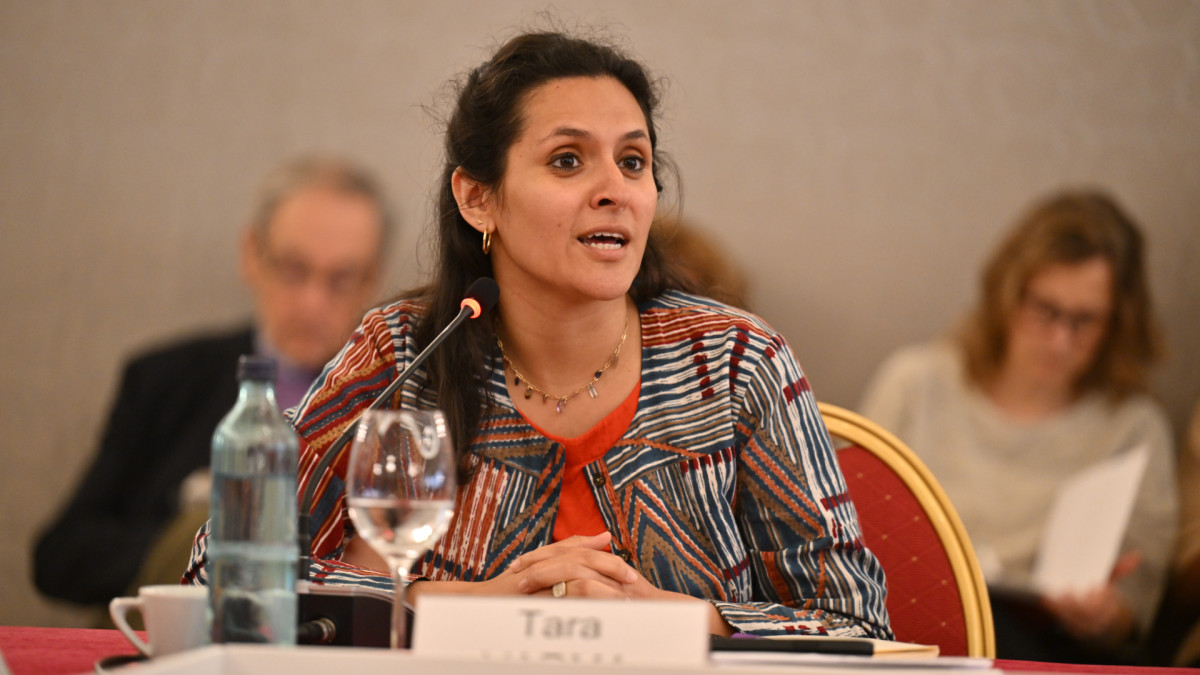
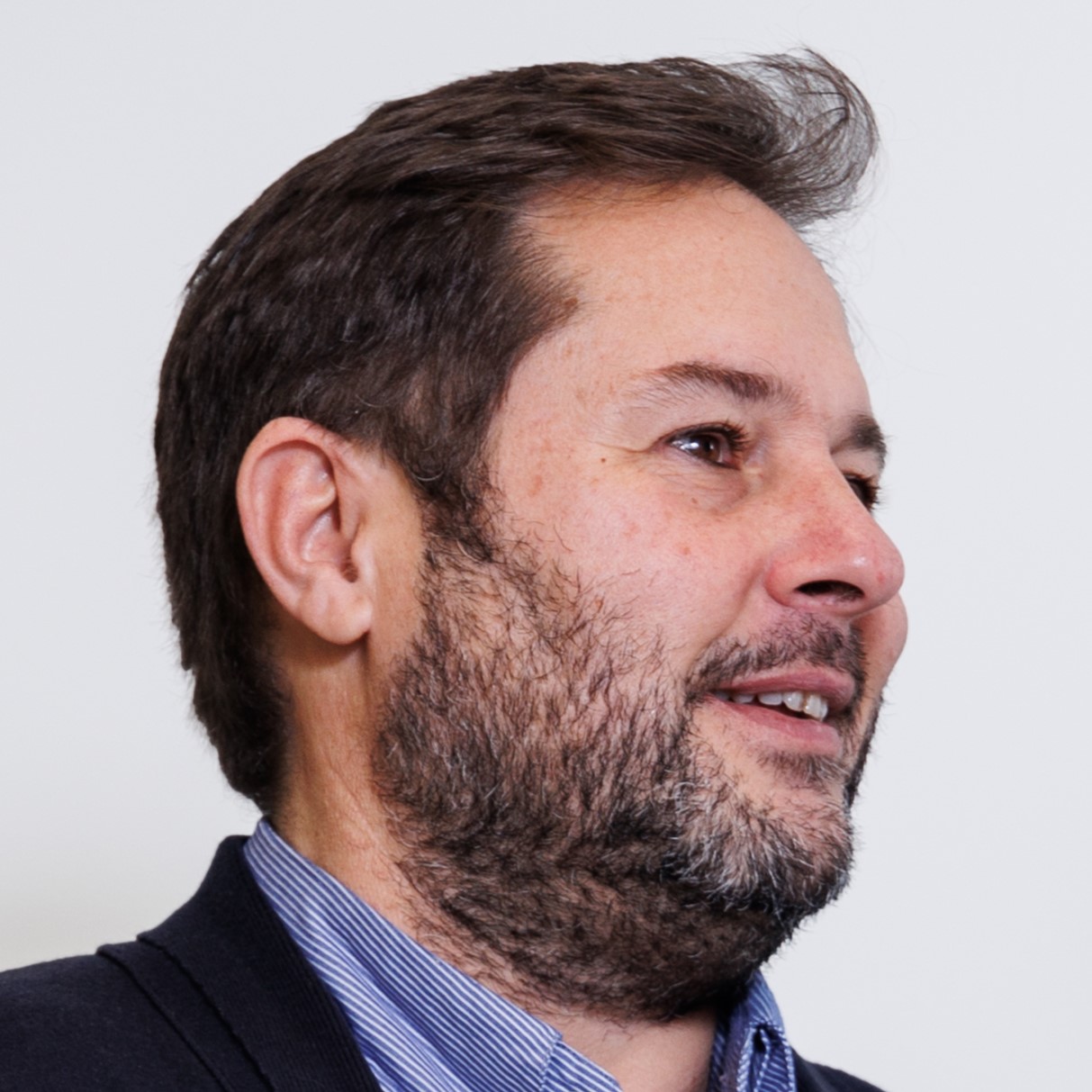
Tara Varma (GMF) during her participation in the 'War and Peace in the 21st Century' conference. Photo: CIDOB
That is a very important point, because this system of buying weapons from the Americans has at least two limits. One, as you mentioned, is the availability of the American industrial base, and with the war in Iran that is becoming more difficult. The other is our ability to develop European systems and eventually replace that scheme. The French now claim they are supplying most of the intelligence to the Ukrainians, but the conventional wisdom is still that Ukraine remains overly dependent on US intelligence. What is your assessment?
T. V.: These things are very hard to assess by nature, because they are secretive. It is true that this is what the French president has said. I think he wanted to show that it is possible to envisage Europeans working together and providing more intelligence support to Ukraine.
France has in fact been providing intelligence support for a long time. Since the beginning of the war, there has been significant intelligence cooperation between France and Ukraine, even if the French military leadership did not particularly want to state that publicly for various reasons. Given the political changes in Europe and the fact that Ukraine needs our support more than ever, it made sense to say it openly now.
"Intelligence-sharing is absolutely critical for Ukraine to remain on the battlefield. It is key"But even if France is providing more intelligence, I think what was really meant is that France comes second after the US. The US is still ahead, and that is crucial. It is also very important that President Trump has not stopped that support, because intelligence-sharing is absolutely critical for Ukraine to remain on the battlefield. It is key. That is precisely what Europeans should ask and demand of the US president: that he continues to provide that intelligence support.
Even if France is doing more, the issue is not simply France providing intelligence to Ukraine. There needs to be a much higher level of intelligence cooperation at European level in order to provide this information to Ukraine. The US operates on a scale we are not used to, but we do have the tools to do more ourselves. So this is not about undermining ourselves by default. We could do much more in intelligence cooperation. We already do some of it, especially in cyber, and that cooperation could be expanded well beyond cyber at European level.
Kristi, how realistic is it that within a reasonable timeframe — say five years — Europe can develop its own strategic enablers? From your perspective in Estonia, again from the frontline, how confident are you that Europe can develop these capabilities in time?
K. R.: Of course, we do not know how much time Europe has. At the moment we still have these critical dependencies on the US, and we see that very clearly in Ukraine. Intelligence is probably the most important one. Fortunately, it does not even cost the US anything to continue sharing intelligence with Ukraine. It is entirely a political decision, and so far the US has continued to do it.
For Europe as a whole, this is one of the critical fields where we do not have a very quick way out of dependency. That is why, for Ukraine as well, it is so important to keep the US engaged, especially in a situation where President Trump is pushing the peace process in a direction that runs contrary to Ukrainian interests.
What the US is demanding from Ukraine is very much in line with Russian demands. The US is pushing Ukraine not only to give up the territories Russia has occupied — close to 20% of Ukrainian territory — but even additional territory that Russia has not managed to conquer militarily and now hopes to obtain through diplomacy.
"Russia has no real interest at this point in reaching peace, because it believes it can still improve the outcome by continuing the war"We have a diplomatic negotiation process under way in which President Trump is probably the only party genuinely in a hurry to achieve peace and serious about doing so. For him, the precise terms may matter less than being seen as the peacemaker and receiving recognition for it. But Russia has no real interest at this point in reaching peace, because it believes it can still improve the outcome by continuing the war.
For the Ukrainian side, Russian demands supported by the US are simply impossible to accept. As long as Ukraine is able to continue fighting, it will do so, because otherwise it would mean giving away an important part of its territory and sovereignty. That would not be a path to sustainable peace. Most likely, Russia would then want even more. So the US does not really have a formula for a peace that would be realistic and sustainable. What we are seeing instead is Trump's desire to be able to say that he ended another war, and then leave Ukrainians and Europeans to live with the consequences.
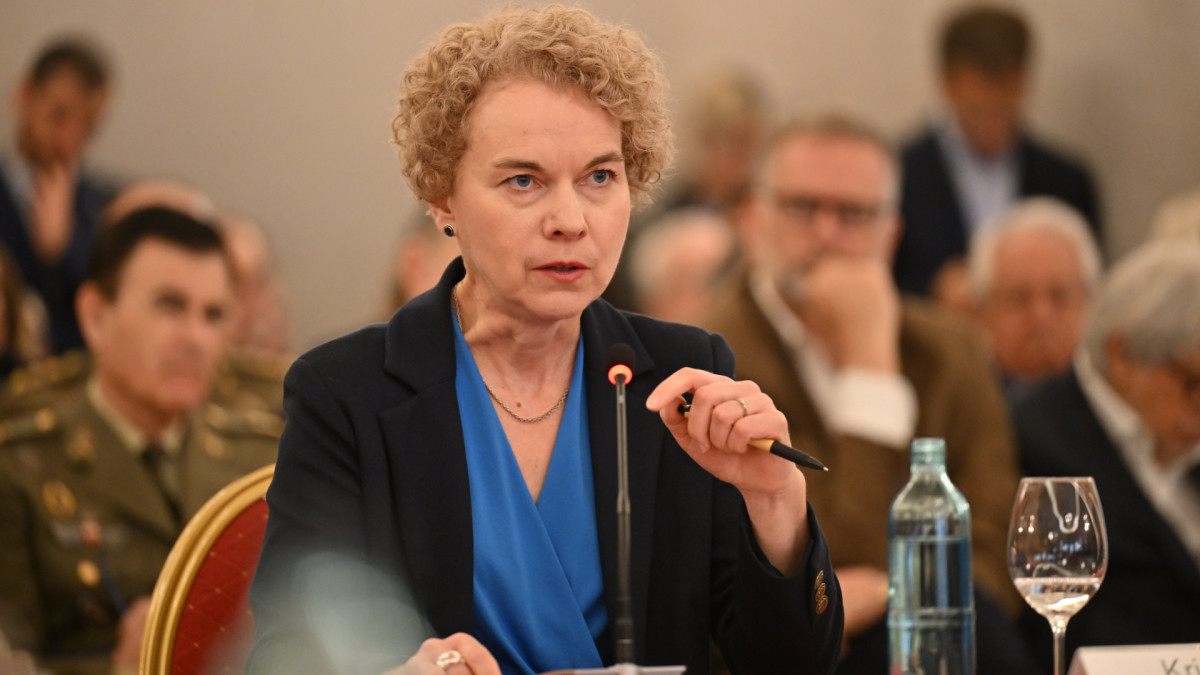
Kristi Raik (ICDS), also during 'War and Peace in the 21st Century'. Photo: CIDOB
Member states in eastern Europe and the Baltic states have traditionally been very pro-NATO. They believed their security was better served by NATO than by the EU. My impression after one year of Trump is that there is now a broader realisation in Europe that we cannot put all our eggs in one basket, namely NATO. But the moment we build European defence, the Americans could say they are no longer needed. What is your view, Kristi?
K. R.: First of all, I would say that in northern Europe there is a broadly shared view that NATO is still the framework for defence, and that NATO has to be Europeanised. Europeans have to take more responsibility for their own defence. Countries in the Nordic-Baltic region and Poland take that very seriously. Germany is also investing heavily in defence, while still using NATO structures, because that is the most practical and effective way to use the command structures and defence plans.
There is no real European alternative at the moment. There is political rhetoric — even slogans — about a European army, but there is no serious or realistic plan for it. So the approach in northern Europe is pragmatic: use the structures we already have in NATO while Europeans take more responsibility for their own defence. At the same time, we should try to preserve whatever remains of the transatlantic relationship.
That is a separate and very large question, because we can no longer trust or rely on the United States in the way we used to. And yet NATO is still there in its daily work. It is still exercising and still has defence plans.
"But to start building entirely new European defence structures in another framework, such as the EU, would take years, and we do not have that time"The best way forward is to increase the European burden step by step, in a spirit of burden-shifting. Whether that will work, we do not really know, because the Trump administration can be very erratic and has behaved in ways contrary to European security interests. The Greenland issue, for example, is not forgotten by Trump and could come back in a dramatic way. So we cannot be sure what all this will mean for NATO in the coming months.
But to start building entirely new European defence structures in another framework, such as the EU, would take years, and we do not have that time. We would also struggle to find the resources. Resources are limited. In northern Europe, the approach is above all pragmatic: use NATO to the greatest extent possible and deepen regional defence cooperation. That is one way of developing alternative forms of resilience, knowing that the transatlantic relationship has become extremely fragile.
We have the Joint Expeditionary Force led by the UK, the Nordic countries have their own defence cooperation through NORDEFCO, and Nordic-Baltic cooperation is closer than ever before. In a practical sense, this complements NATO. There are exercises, and there is serious thinking about what would happen if Russia decided to test one NATO member. We do not know how Trump would react, but I think we can be quite certain that there would be a regional response, so that no country would be left entirely alone. We have a collective capability that we are prepared to use.
Yes, but for that to work within NATO, you would need a political agreement with the Americans that NATO structures could be used without them, and you would need to change military planning, because the current planning and war-gaming assume that the Americans are part of the effort.
K. R.: We need a step-by-step process of Europeans taking over. Even with only minimal US involvement, one can imagine a future in which Europeans make use of NATO structures. Would the US want to block that completely? It is a theoretical question. What would its interest be in doing so? And would the US really try to leave NATO entirely? That is not so easy either.
I think the greater risk is that the US simply stops engaging. That is the very real risk: that it no longer wants to invest in the future conventional defence of Europe.
ARTÍCULOS RELACIONADOS
El presidente ucraniano, Volodímir Zelenski, y la presidenta de la Comisión Europea, Úrsula von der Leyen.Servicio audiovisual de la Comisión Europea

Camille Grand, secretario general de la ASD (derecha) y Marc López Plana, editor y director de 'Agenda Pública' (izquierda).CIDOB
T. V.: To me, it is not an either-or situation. We have invested so much in NATO, and for the time being NATO still deters Putin. We should be clear about that. Yes, there have been major drone incursions in the Baltic states, in Poland, in France near nuclear bases, and in Belgium, as we mentioned earlier. We are seeing incursions over NATO territory, but not a formal attack. I think that still shows that NATO remains a deterrent in Putin's mind.
At the same time, we need to be very clear about what is coming out of Washington, because I think this administration means what it says when it calls on Europeans to do much more. For the time being, the US will certainly keep the nuclear umbrella over Europe, but in conventional terms it expects Europeans to do more. And, frankly, that is a fair request, given the size of the EU market and the strength Europe has. But if Europe does more, it has to do so on its own terms. It cannot simply be a response to the demands of a US administration.
So while we continue investing massively in NATO, Europeanising it as much as possible and investing in positions within command-and-control structures, we also have to duplicate some of our resources. The war in Ukraine showed that this can work. In the first few weeks after Russia's full-scale invasion, the response worked because there was duplication. We received material from NATO and from EU member states, and that redundancy allowed us to provide more to Ukraine than we otherwise could have.
Redundancy can be useful, especially in times of instability. Europe is going to be affected by US foreign-policy decisions for the foreseeable future. We have to plan accordingly, whether in the Middle East or in Europe's broader neighbourhood. We have to plan, and we have to build redundancy.
"The Commission is not the right place to discuss European security and defence. Nor is the European Parliament"Whether that happens at EU level is another question. Many people have turned to the European Commission, but my own view is that the Commission is not the right place to discuss European security and defence. Nor is the European Parliament, which does not have the competence for that. The initiative should come from the European Council. António Costa, as president of the European Council, is ideally placed to work with heads of state and government to build a proposal that respects national prerogatives, but also creates something European that would be accepted by European leaders, by the public and by the outside world as a common political proposition.
The Parliament and the Commission can do many things. The Commission, for example, can provide more money, and it has been doing so. But the political will has to come from the European Council and from the heads of state and government.
That would be a major step forward. As we heard earlier today, there is now a 90% overlap between EU membership and NATO membership. It is a little absurd that these two institutions, based in the same city of Brussels, know so little about each other and work together so little. We have NATO's 2022 Strategic Concept and the EU's 2022 Strategic Compass, and developments have already moved on from there. Working more closely together and building a common strategic culture is absolutely essential. So too is Europe building its own capacities within NATO, but also at national and EU level.
Thank you very much.
En alianza con

Agenda Pública Corp
Análisis de políticas públicas
'Agenda Publica' impulsa alianzas con organizaciones, empresas y sociedad civil para generar contenidos de interés para nuestros lectores. Las piezas se elaboran por nuestro equipo de forma autónoma.
Ahora en portada
18 de octubre de 2026
18 de octubre de 2026
17 de octubre de 2026
Noticias relacionadas
Hace 27 semanas
Ampliar para proteger: ¿Es Ucrania una inversión en seguridad para la UE?
Hace 26 semanas
Camille Grand, secretario general de la patronal de defensa europea: "Es posible construir un gran campeón europeo"
Lo más leído