Viernes, 16 de octubre de 2026




FIRMAS TOP
Former Foreign Minister of Peru: "I am clear about what benefits the vast majority of Peruvians"
With Peru’s elections just a few months away, National Security researcher J. P. Carroll interviews former Peruvian Foreign Minister Javier González-Olaechea Franco. In his view, Nicolás Maduro’s capture amounts to "an irrefutable victory" for "the Venezuelan people, and all the leaders who fought and achieved an irrefutable victory." Regarding the United States he argues that "Washington understands that we are a very important political and economic bastion in South America and in the Pacific."
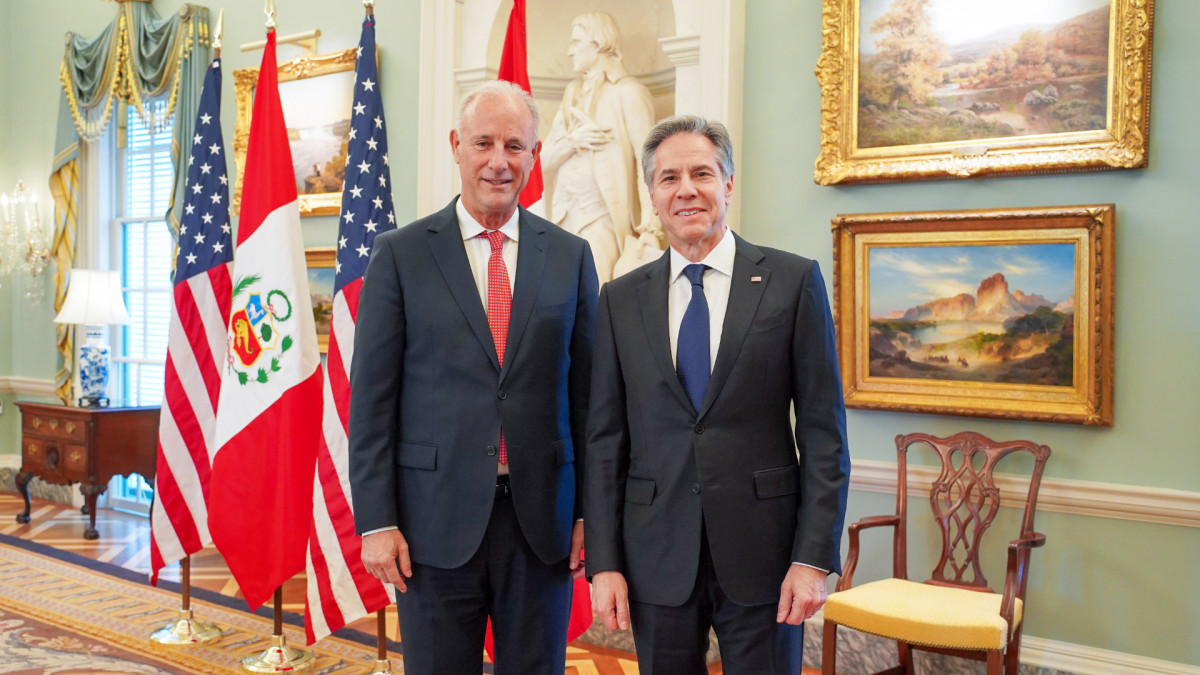
Former Foreign Secretary, Javier González-Olaechea (left), held a meeting with the Secretary of State of the United States of America, Antony Blinken (2024).Cancillería del Perú.
The following is a conversation with the former Minister of Foreign Affairs of Peru, Javier González-Olaechea Franco, Ph.D., who served in that role from 2023 to 2024. Over the course of his career, he has achieved distinction as a diplomat, senior policy advisor, and as a highly accomplished and widely respected academic in the fields of political science and international relations.
While serving as Minister of Foreign Affairs of Peru, he distinguished himself for his knowledge of Venezuela, and caring for the plight of the Venezuelan people. In light of recent developments in Venezuela, I reached out to him to discuss that, as well as other matters, including the role of Spain in Venezuela, U.S.-Peru relations at this time, his hopes for the future of Peruvian foreign policy, and how he sees the year ahead more broadly.
1) First of all, what is your reaction to the removal of Nicolás Maduro from power, now that he is facing trial in the United States?
The same as always. When a person is accused of many crimes, they must face a trial that is fair, truthful, well-documented, and conducted with all the guarantees of due process, including the right to a defense.
2) It is said that when you were Minister of Foreign Affairs – before attending the extraordinary session of the Organization of American States (OAS) following Mr. Maduro’s electoral fraud in 2024 – you already had a Declaration with the 18 votes needed to ensure its approval. Is that true?
The truth must always be known and prevail. Faced with the irrefutable fraud of the Maduro regime, several foreign ministers who had been convened agreed on a text for a Declaration of democratic minimums.
Already seated in Peru’s chair and witnessing the consummation of this brazen act, I felt enormous frustration. As we say in my country, I felt that we had "the rug pulled out from under us" minutes earlier to block our objective, which was fully consistent with the democratic foundations of the OAS.
3) When you were Peru’s Minister of Foreign Affairs, leaders around the world paid attention when you publicly criticized the Maduro regime at the OAS. With Maduro now out of office, do you feel in any way vindicated?
Those who have been vindicated are the truth, the Venezuelan people, and all the leaders who fought and achieved an irrefutable victory.
To think of or feel what has recently happened as a personal vindication would be an affront to all Venezuelans who aspire to freedom and who are still fighting for it. What is objectively true is that Peru was the first country in the world to recognize Mr. [Edmundo] González Urrutia as the president-elect of Venezuela. Over time, other countries followed suit.
4) You know key figures of the Venezuelan democratic opposition and remain in contact with many prominent voices in foreign policy in the region and beyond. Based on what you hear in those conversations, when do you think a transition to democracy in Venezuela might take place?
The truth is that I have dealt with the most visible Venezuelan leaders and do maintain relationships with figures from many parts of the world.
The transition will be complete when a new constitution, produced through clean elections, is in force and when authorities are elected or appointed, as the case may be, in accordance with that new charter.
5) What role – if any – do you think Spain should play in what comes next in Venezuela?
Given the substantial political differences among Spain’s main political actors and the fact that general elections will be held in Spain, I cannot speculate on whether it will play a role or what that role might be. For now, the European Union – of which Spain is a member – does not recognize the current government in Caracas.
6) At this moment, with the European Union (EU) on the verge of reaching its long-awaited agreement with The Southern Common Market (MERCOSUR) – although it still faces some challenges to finalize it – how do you see EU-Latin America relations more broadly, beyond MERCOSUR?
The EU's relations with Latin America are formal and limited because each bloc internally reflects a significant economic and ideological asymmetry.
7) More than 1.5 million Venezuelans live in Peru after fleeing their country in recent years. What do you think recent developments mean for Peru? And do you believe some Venezuelans will choose to return to their country of origin?
We have welcomed them – and I emphasize the word welcomed rather than merely received, because all Venezuelans in Peru enjoy the same rights as Peruvians, except for voting – at an estimated number that coincides with the figure in your question. I am convinced that many will choose to return once the full conditions I have referred to are in place.
8) In Peru’s upcoming presidential elections, what foreign policy priorities would you like the winner to pursue? Do you have a preferred candidate whom you support or advise?
The next government could improve our image abroad, strengthen proactive and effective multilateralism, expand our diplomatic and consular presence in more regions and countries, promote greater and better investment and trade through new free trade agreements, diversify our arms procurement matrix, strengthen support for Peruvians living abroad, better promote our culture and gastronomy, and maintain good relations with those who seek the same with us, above all.
As for the presidential candidates, I have not expressed a preference. I am clear about what benefits the vast majority of Peruvians.
9) How do you currently assess relations between the United States and Peru?
They are improving with Peru, as the United States of America maintains itself as a community of values that will soon be 250 years old. Washington understands that we are a very important political and economic bastion in South America and in the Pacific, and Peruvians value this, as well as our relations with other major geopolitical and geoeconomic actors.
10) Finally, we are barely one month into 2026 and already many things have happened, to say the least. What geopolitical developments are you following closely for the rest of the year?
Recently, good things have happened, and others that I would have preferred not to see occur.
I follow, to the extent possible, the most important developments around the world and consider whether they represent opportunities or challenges for Peru.
It is from this position of active observation that I perceive profound and exponential changes characteristic of the emerging Disruptive Era.
While serving as Minister of Foreign Affairs of Peru, he distinguished himself for his knowledge of Venezuela, and caring for the plight of the Venezuelan people. In light of recent developments in Venezuela, I reached out to him to discuss that, as well as other matters, including the role of Spain in Venezuela, U.S.-Peru relations at this time, his hopes for the future of Peruvian foreign policy, and how he sees the year ahead more broadly.
1) First of all, what is your reaction to the removal of Nicolás Maduro from power, now that he is facing trial in the United States?
The same as always. When a person is accused of many crimes, they must face a trial that is fair, truthful, well-documented, and conducted with all the guarantees of due process, including the right to a defense.
2) It is said that when you were Minister of Foreign Affairs – before attending the extraordinary session of the Organization of American States (OAS) following Mr. Maduro’s electoral fraud in 2024 – you already had a Declaration with the 18 votes needed to ensure its approval. Is that true?
The truth must always be known and prevail. Faced with the irrefutable fraud of the Maduro regime, several foreign ministers who had been convened agreed on a text for a Declaration of democratic minimums.
"Faced with the irrefutable fraud of the Maduro regime, several foreign ministers who had been convened agreed on a text for a Declaration of democratic minimums"Hours before the extraordinary session, we obtained the 18 necessary votes – what is known as consensus – for it to be approved that afternoon. Minutes before the session began, the president of the session asked to meet with all the signatories. We met him in an adjacent room, where he read us a letter from the representative of one of the 18 countries stating that it would withdraw from the consensus unless we removed a substantive clause: independent verification of the votes. It was not even the same representative. Those present were stunned and bewildered, and the discussion was direct and harsh; strong language was used, and there was even a threat. While we were debating, I tried to secure the 18th vote on the floor of the session, but it was impossible. After two hours, I left the meeting, and a few minutes later it ended. The president of the session carried out his threat, acting contrary to the statute governing the sessions.
Already seated in Peru’s chair and witnessing the consummation of this brazen act, I felt enormous frustration. As we say in my country, I felt that we had "the rug pulled out from under us" minutes earlier to block our objective, which was fully consistent with the democratic foundations of the OAS.
3) When you were Peru’s Minister of Foreign Affairs, leaders around the world paid attention when you publicly criticized the Maduro regime at the OAS. With Maduro now out of office, do you feel in any way vindicated?
Those who have been vindicated are the truth, the Venezuelan people, and all the leaders who fought and achieved an irrefutable victory.
To think of or feel what has recently happened as a personal vindication would be an affront to all Venezuelans who aspire to freedom and who are still fighting for it. What is objectively true is that Peru was the first country in the world to recognize Mr. [Edmundo] González Urrutia as the president-elect of Venezuela. Over time, other countries followed suit.
4) You know key figures of the Venezuelan democratic opposition and remain in contact with many prominent voices in foreign policy in the region and beyond. Based on what you hear in those conversations, when do you think a transition to democracy in Venezuela might take place?
The truth is that I have dealt with the most visible Venezuelan leaders and do maintain relationships with figures from many parts of the world.
The transition will be complete when a new constitution, produced through clean elections, is in force and when authorities are elected or appointed, as the case may be, in accordance with that new charter.
5) What role – if any – do you think Spain should play in what comes next in Venezuela?
Given the substantial political differences among Spain’s main political actors and the fact that general elections will be held in Spain, I cannot speculate on whether it will play a role or what that role might be. For now, the European Union – of which Spain is a member – does not recognize the current government in Caracas.
6) At this moment, with the European Union (EU) on the verge of reaching its long-awaited agreement with The Southern Common Market (MERCOSUR) – although it still faces some challenges to finalize it – how do you see EU-Latin America relations more broadly, beyond MERCOSUR?
The EU's relations with Latin America are formal and limited because each bloc internally reflects a significant economic and ideological asymmetry.
"For now, I believe the only thing that can be promoted is the entry of a Latin American country into the Organization for Economic Cooperation and Development (OECD)"Peru will join this important organization in less than two years, representing a significant, assertive, and further leap forward for Peruvians.
7) More than 1.5 million Venezuelans live in Peru after fleeing their country in recent years. What do you think recent developments mean for Peru? And do you believe some Venezuelans will choose to return to their country of origin?
We have welcomed them – and I emphasize the word welcomed rather than merely received, because all Venezuelans in Peru enjoy the same rights as Peruvians, except for voting – at an estimated number that coincides with the figure in your question. I am convinced that many will choose to return once the full conditions I have referred to are in place.
8) In Peru’s upcoming presidential elections, what foreign policy priorities would you like the winner to pursue? Do you have a preferred candidate whom you support or advise?
The next government could improve our image abroad, strengthen proactive and effective multilateralism, expand our diplomatic and consular presence in more regions and countries, promote greater and better investment and trade through new free trade agreements, diversify our arms procurement matrix, strengthen support for Peruvians living abroad, better promote our culture and gastronomy, and maintain good relations with those who seek the same with us, above all.
As for the presidential candidates, I have not expressed a preference. I am clear about what benefits the vast majority of Peruvians.
9) How do you currently assess relations between the United States and Peru?
They are improving with Peru, as the United States of America maintains itself as a community of values that will soon be 250 years old. Washington understands that we are a very important political and economic bastion in South America and in the Pacific, and Peruvians value this, as well as our relations with other major geopolitical and geoeconomic actors.
10) Finally, we are barely one month into 2026 and already many things have happened, to say the least. What geopolitical developments are you following closely for the rest of the year?
Recently, good things have happened, and others that I would have preferred not to see occur.
I follow, to the extent possible, the most important developments around the world and consider whether they represent opportunities or challenges for Peru.
It is from this position of active observation that I perceive profound and exponential changes characteristic of the emerging Disruptive Era.
J. P. Carroll
Analista en Washington D. C. y columinsta de 'Agenda Pública'
MBA Internacional de IE Business School. Máster en Estudios Profesionales (MPS) en Relaciones Públicas y Comunicaciones Corporativas de la Universidad de Georgetown. Es el exdirector adjunto de Medios Hispanos del Comité Nacional Republicano (RNC). J.P. vive en el área de Washington, D. C.
Ahora en portada
16 de octubre de 2026
16 de octubre de 2026
16 de octubre de 2026
Noticias relacionadas
Hace 34 semanas
Excanciller de Perú: "Tengo claro lo que nos conviene a la gran mayoría de los peruanos"
Lo más leído