Viernes, 16 de octubre de 2026




FIRMAS TOP
Former CIA agent explains Trump's logic and warns that Europe "is not united"
From Washington, D.C., security adviser J. P. Carroll speaks with former CIA officer and geostrategy expert Bjorn Beam. An adviser to several NATO partner countries, he argues that the current context is ideal for Europe to "take its security seriously" and reviews some of the most pressing items on the agenda, including Venezuela, the U.S. security strategy, and the conflict in Gaza.
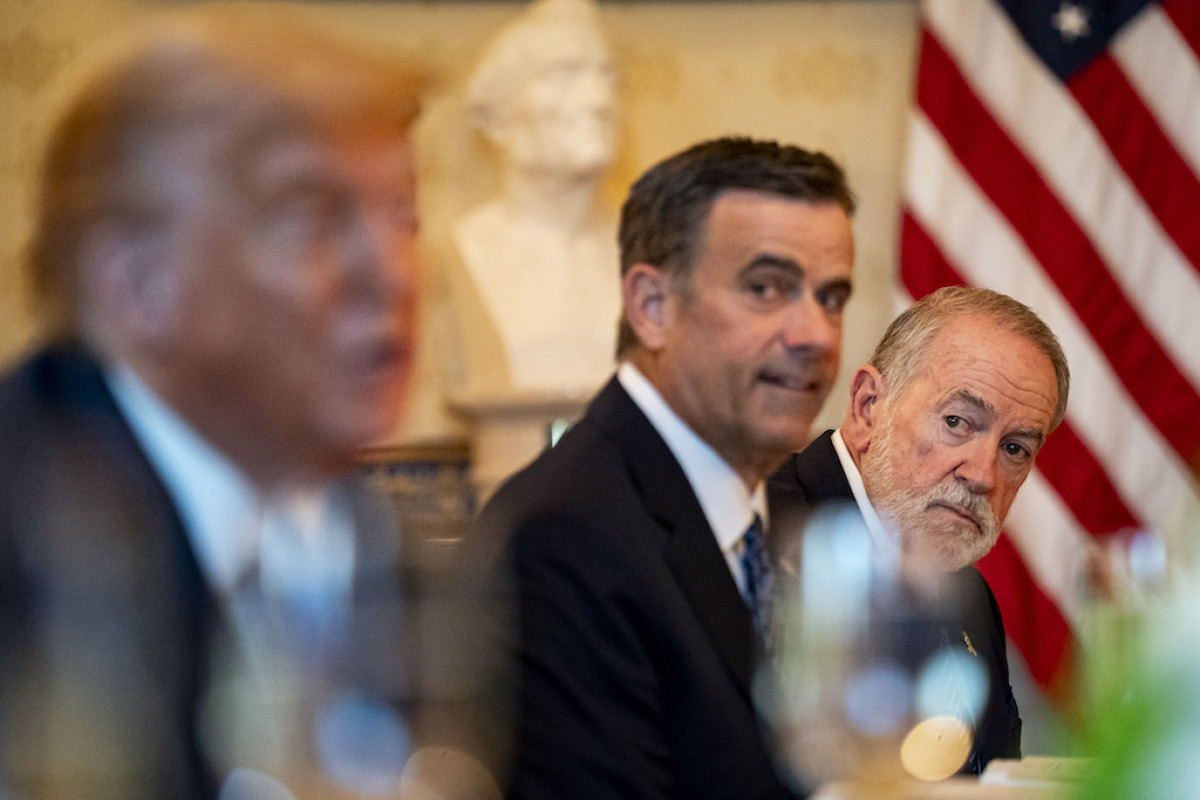
Mike Huckabee, US ambassador to Israel, right, John Ratcliffe, director of the Central Intelligence Agency (CIA), center, during a dinner with US President Donald Trump, left.Al Drago - Pool via CNP / Zuma Press / ContactoPhoto
In the aftermath of the publication of the National Security Strategy by the Trump administration, Agenda Pública decided to catch up with Bjorn Beam, an American Madrid-based geopolitical and technology strategist at Arcano Partners, with over a decade of experience in the U.S. intelligence community, including service as a Central Intelligence Agency (CIA) Officer and member of the Presidential Daily Briefing Staff.
I should note, Beam is a longtime friend of this author. While we don’t agree on everything, he is one of the most knowledgeable geopolitical analysts out there and a fundamentally decent person whose analysis comes from that rare intersection of knowledge, optimism, and goodwill.
Beam has briefed senior government leaders on global threats, emerging technologies, and crisis developments, and led operations addressing some of the world's most complex security challenges. Today, he advises NATO partners, European institutions, and multinational companies on geopolitical risk and the strategic implications of artificial intelligence.
At its core, this shift in U.S. policy as outlined in the National Security Strategy, "is less about maintaining alliances and more about managing exposure, managing risk, and how the United States can position itself in a longer term hold situation based off of the Trump administration's goals and doctrines … This is a key shift from previous documents that have not really laid it out in such a manifesto like manner."
According to Beam, "It is breaking with the traditional doctrine of previous [National Security Strategy] documents, and it is a shift, specifically, when we look at our partnerships here in Europe, [a] shift from a partnership, to more of a variable, to a liability. And [regarding] Latin America [it is] a shift back towards the Monroe Doctrine of creating a buffer zone of U.S. dominance in the region."
With regard to China, Beam highlighted that the document is "using different rhetoric to focus on them [China] as an economic competitor, rather than a direct hostile competitor." This is a marked shift from previous rhetoric on China during President Trump’s first term in office.
Beam went on to say, "we have Chinese [naval] forces doing something very similar to [the United States], [Chinese naval] forces [in the South China Sea], except for hitting drug boats, [they are instead] posturing around the Philippines, around Vietnam, and, of course, around Taiwan."
According to Beam, "We are seeing the militarization globally of commercial routes in ways that we have not seen in this decade or the century."
However, he went on to add that rather than looking at European Union countries, the potential investment interest from some is in Ukraine. "Startups in Ukraine, Israel, and the United States [are seen with great interest], and very few startups in Europe [are garnering such interest]," Beam said.
"When you peel back the layer of [the European Union], you get very fast to the nationalistic will [in individual countries]. Regardless of the rise of the left of right wing politics in Europe – or not – there are always things come back to domestic politics," Beam observed.
"I think we're beginning to see the [U.S.] tariffs [make an impact], and … regardless of a change in U.S. politics or not, we should anticipate a higher cost of trade," Beam told Agenda Pública.
According to Beam, the pressures of U.S. tariffs and the war in Ukraine are both bringing Europe together though. The tougher things get on both fronts, "the more progress they [European Union countries] try to make," he said.
At its core, Beam observed that Spain is protected from global economic headwinds through its membership in the European Union. He also noted that the country remains an attractive destination in its own right for foreign direct investment.
"At the same time, Beijing approaches Europe with a long-term perspective that links trade, technology, and market presence into a coherent national strategy. The interaction between these two outlooks increasingly defines the relationship," per Beam.
"As Chinese growth relies more heavily on exports amid weak domestic demand. European markets absorb capacity in autos, batteries, renewables, and advanced manufacturing, creating ties that extend beyond individual transactions," Beam noted.
"Each starting point carries its own moral logic and prescribes a different solution," according to Beam. "These competing historical realities shape diplomacy, security planning, and public expectations in ways that resist convergence," Beam noted.
"The United States continues to press for shared responsibility in any post-war arrangement, while Europe emphasizes humanitarian support and [adherence to] political principles," Beam said in discussing prospects for peace. "Between those positions sits a gap of governance and security that remains difficult to close. Until actors align on responsibility as well as narrative, the conflict is likely to remain defined by management rather than resolution, shaped by endurance rather than agreement," Beam observed.
If you want to read more of Beam’s analysis, check out his Substack, Beam Intel.
I should note, Beam is a longtime friend of this author. While we don’t agree on everything, he is one of the most knowledgeable geopolitical analysts out there and a fundamentally decent person whose analysis comes from that rare intersection of knowledge, optimism, and goodwill.
Beam has briefed senior government leaders on global threats, emerging technologies, and crisis developments, and led operations addressing some of the world's most complex security challenges. Today, he advises NATO partners, European institutions, and multinational companies on geopolitical risk and the strategic implications of artificial intelligence.
The U.S. National Security Strategy
According to Beam, "The National Security Strategy is really a formalization of priorities as a doctrine. So it's taking what policy makers see and converting it into the vision that they want to execute at a national level, at an economic level, at an intelligence level, [with] the full force of the U.S. government, to position themselves, to understand what risk they need to exploit and how they can more effectively position themselves with partners and against enemies in the world.""The National Security Strategy is really a formalization of priorities as a doctrine. So it's taking what policy makers see and converting it into the vision that they want to execute"Beam went on to say that the document, "is very much in line with what they've [the Trump administration have] been talking about this whole time. He described it as a, "formalization of what they were saying, we are moving more from Alliance politics to power management."
At its core, this shift in U.S. policy as outlined in the National Security Strategy, "is less about maintaining alliances and more about managing exposure, managing risk, and how the United States can position itself in a longer term hold situation based off of the Trump administration's goals and doctrines … This is a key shift from previous documents that have not really laid it out in such a manifesto like manner."
According to Beam, "It is breaking with the traditional doctrine of previous [National Security Strategy] documents, and it is a shift, specifically, when we look at our partnerships here in Europe, [a] shift from a partnership, to more of a variable, to a liability. And [regarding] Latin America [it is] a shift back towards the Monroe Doctrine of creating a buffer zone of U.S. dominance in the region."
With regard to China, Beam highlighted that the document is "using different rhetoric to focus on them [China] as an economic competitor, rather than a direct hostile competitor." This is a marked shift from previous rhetoric on China during President Trump’s first term in office.
"We are seeing the militarization globally of commercial routes"
Conversation with Beam moved on to discuss the standoff between the United States and Venezuela, saying that in Europe, particularly in Spain, "there’s a bit of surprise, confusion and disbelief." He went on to say that if a conflict did escalate between the United States and Venezuela – beyond the ongoing boat strikes – it would result in "raising insurance prices, raising the cost of transit, and raising just the risk of moving through those waters [in the Caribbean] by any type of commercial vessel."Beam went on to say, "we have Chinese [naval] forces doing something very similar to [the United States], [Chinese naval] forces [in the South China Sea], except for hitting drug boats, [they are instead] posturing around the Philippines, around Vietnam, and, of course, around Taiwan."
According to Beam, "We are seeing the militarization globally of commercial routes in ways that we have not seen in this decade or the century."
On Ukraine, the European Union, and European Security
"This is an opportunity for Europe to take its security seriously," Beam told Agenda Pública. He went on to say that he is, "seeing an interesting degree of excitement coming from the venture capital space … [and that] this is a chance to build domestic industries."However, he went on to add that rather than looking at European Union countries, the potential investment interest from some is in Ukraine. "Startups in Ukraine, Israel, and the United States [are seen with great interest], and very few startups in Europe [are garnering such interest]," Beam said.
"When you peel back the layer of [the European Union], you get very fast to the nationalistic will [in individual countries]""Europe is not able or willing to fully manufacture [in the defense space] for a variety of reasons … which I think is concerning," Beam told Agenda Pública. He went on to say, "we're still seeing infighting of a European Union that is not a union. It is not united."
"When you peel back the layer of [the European Union], you get very fast to the nationalistic will [in individual countries]. Regardless of the rise of the left of right wing politics in Europe – or not – there are always things come back to domestic politics," Beam observed.
On the European Economy and The Impact of U.S. Tariffs
Beam summed up Europe’s state of affairs saying, "Europe outsourced its energy security to Russia, its defense spending to the United States, and its manufacturing capabilities to China.""I think we're beginning to see the [U.S.] tariffs [make an impact], and … regardless of a change in U.S. politics or not, we should anticipate a higher cost of trade," Beam told Agenda Pública.
"The tariffs, I think, are backfiring [on] the United States, by pushing Europe closer to China""The tariffs, I think, are backfiring [on] the United States, by pushing Europe closer to China. It's raising questions for European businesses," according to Beam. "Where do they look for investment? Where do they look for building new factories? Where is the marketplace that they think will be more easily reached regardless of the complexities of selling goods in China and the lack of intellectual property [protections] that comes with it?" Beam said.
According to Beam, the pressures of U.S. tariffs and the war in Ukraine are both bringing Europe together though. The tougher things get on both fronts, "the more progress they [European Union countries] try to make," he said.
On Spain
"Spain has been able to really ride out the economic and geopolitical storms of U.S. tariffs for various factors," Beam noted. He went on to say that the country must, "maintain that growth in an AI era" and that it requires "reevaluating business models that consider infrastructure security as a key risk and liability that all companies need to be focusing on."At its core, Beam observed that Spain is protected from global economic headwinds through its membership in the European Union. He also noted that the country remains an attractive destination in its own right for foreign direct investment.
On China
"For many European economies, Chinese engagement offers scale, speed, and capital at a moment when domestic capacity faces rising costs and political limits," Beam told Agenda Pública."At the same time, Beijing approaches Europe with a long-term perspective that links trade, technology, and market presence into a coherent national strategy. The interaction between these two outlooks increasingly defines the relationship," per Beam.
"As Chinese growth relies more heavily on exports amid weak domestic demand. European markets absorb capacity in autos, batteries, renewables, and advanced manufacturing, creating ties that extend beyond individual transactions," Beam noted.
On Gaza
"One of the core obstacles to resolution [of the conflict] lies in the absence of agreement on when the conflict truly began," Beam told Agenda Pública. "For some, it starts with recent attacks. For others, it stretches back decades or generations," Beam observed."Each starting point carries its own moral logic and prescribes a different solution," according to Beam. "These competing historical realities shape diplomacy, security planning, and public expectations in ways that resist convergence," Beam noted.
"The United States continues to press for shared responsibility in any post-war arrangement, while Europe emphasizes humanitarian support and [adherence to] political principles," Beam said in discussing prospects for peace. "Between those positions sits a gap of governance and security that remains difficult to close. Until actors align on responsibility as well as narrative, the conflict is likely to remain defined by management rather than resolution, shaped by endurance rather than agreement," Beam observed.
If you want to read more of Beam’s analysis, check out his Substack, Beam Intel.

J. P. Carroll
Analista en Washington D. C. y columinsta de 'Agenda Pública'
MBA Internacional de IE Business School. Máster en Estudios Profesionales (MPS) en Relaciones Públicas y Comunicaciones Corporativas de la Universidad de Georgetown. Es el exdirector adjunto de Medios Hispanos del Comité Nacional Republicano (RNC). J.P. vive en el área de Washington, D. C.
Ahora en portada
16 de octubre de 2026
16 de octubre de 2026
16 de octubre de 2026
Noticias relacionadas
Hace 41 semanas
Este exagente de la CIA explica la lógica de Trump y advierte que Europa "no está unida"
Lo más leído