Jueves, 22 de octubre de 2026




MUNDO TRUMP
Trump's war without war against Maduro
"All for war, but without war." That's how Antonio Legaz, defense and intelligence analyst at Indra, describes Washington’s strategy toward Venezuela: an "unnamed intervention" that combines maximum pressure, covert operations, and internal attrition. "Trump can honestly say he’s not planning a war," Legaz writes, "because he’s doing everything except what international law formally recognizes as an armed conflict."

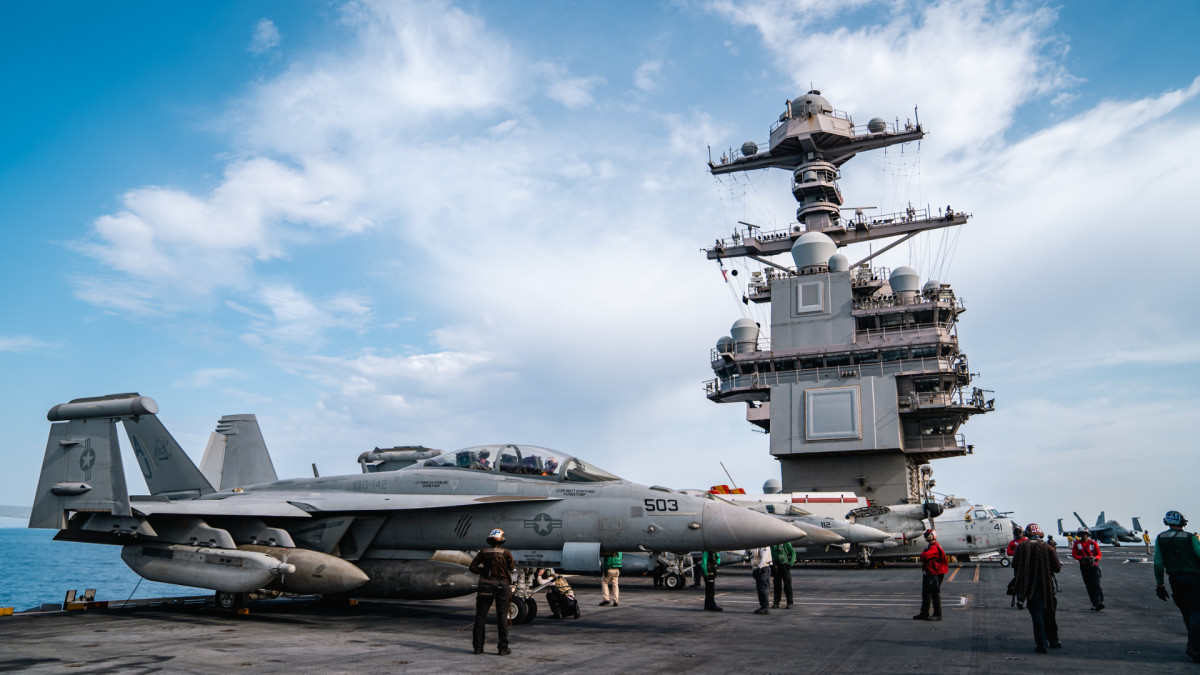
The aircraft carrier USS Gerald R. Ford, deployed in Caribbean waters, in an image from 2023.NATO
On Sunday November 2nd, Donald Trump denied on camera that war was being prepared against Venezuela. Two days later, the carrier USS Gerald R. Ford commenced its deployment to the Caribbean with 5,000 sailors and 75 combat aircraft aboard. This 'contradiction' forms part of a clear strategy of disconnection between what Washington says and what it does, opening the door to a doctrine of unnamed intervention where regimes can be changed without admission and, therefore, without political cost.
The question is no longer whether the U.S. will act against Venezuela; it is already doing so. Since September, the Pentagon has carried out 15 attacks on boats in the Caribbean, leaving at least 64 dead. Meanwhile, B-1 Lancer bombers have violated Venezuelan airspace, and about 10,000 U.S. military personnel are concentrated in the region — the largest mobilization since Panama in 1989. All this has been justified as part of the war on narcotics, but as a former U.S. ambassador to Venezuela has noted, the force is “too large and powerful to just be anti-drug.”
Having learned from past failures, the U.S. military plan is sophisticated. War-games held since 2017 concluded that an Iraq-style invasion would fail, thanks to Maduro’s coordination with allies and a lack of regional support. The current strategy would combine three tactics: surgical airstrikes against military installations; special forces operations to capture or eliminate Maduro; and the seizure of airfields and oil fields. Reluctant to incur American casualties, Trump is prioritizing drones and long-range weapons and has given the CIA authorization for covert operations including sabotage and destabilization.
This psychological warfare is deliberate. Bombers flying near the coast, ostentatious displays of force, leaks of the coordinates of the presidential bunker all serve to demoralize, and to encourage defections. Washington is waiting for what it calls the Aleppo moment: the inexorable collapse of the regime from external pressure and internal betrayal, with the final blow dealt by the Venezuelans themselves.
Latin America’s history is littered with interventions that promised quick fixes but germinated decades of chaos. Maybe that’s why Trump is employing a different logic: maximize pressure, minimize risks, and — above all — maintain plausible deniability. There will be no formal invasion, because no formal recognition is required. Instead there will be anti-narcotics operations, anti-terrorist attacks, and support for democratic forces. Regime change will happen without Washington ever having to name it as a goal.
Maduro understands all this, which is why he gave thanks to the Pope’s call for dialogue in early November, a plea disguised as diplomacy. It’s also why Russia is sending anti-aircraft missiles and China is keeping Venezuela’s credit lines open. Everyone understands that the end is near, but no one knows when it will come, or what form it will take. That uncertainty may be the most powerful weapon that Trump has deployed in the Caribbean.
The final paradox is that if Maduro falls from power without the U.S. firing a single missile at Caracas, then Trump will be right: there will have been no war with Venezuela. Only pressure, limited operations, and internal collapse of the regime. The perfect intervention is one that’s never recognized as such, and that seems to be exactly what we are witnessing.
The question is no longer whether the U.S. will act against Venezuela; it is already doing so. Since September, the Pentagon has carried out 15 attacks on boats in the Caribbean, leaving at least 64 dead. Meanwhile, B-1 Lancer bombers have violated Venezuelan airspace, and about 10,000 U.S. military personnel are concentrated in the region — the largest mobilization since Panama in 1989. All this has been justified as part of the war on narcotics, but as a former U.S. ambassador to Venezuela has noted, the force is “too large and powerful to just be anti-drug.”
All in for war, but with no war
Admittedly, the legal trick is elegant. By designating the so-called Cartel de los Soles (allegedly led by Nicolás Maduro and his generals) as a narco-terrorist organization, Washington is equating Venezuela’s president with jihadists, thereby circumventing prohibitions on the assassination of foreign leaders as well as the need for congressional authorization. In this way, Maduro ceases to be a Head of State and can be targeted by anti-terrorist operations: warfare under the guise of international policing."Trump makes no secret of his fascination with the abundant resources in Venezuela, a country that has the largest oil reserves on the planet"The real motivations go well beyond drug trafficking. Venezuela has the largest oil reserves on the planet, not to mention gold, coltan, and other strategic minerals. Trump hasn’t hidden his fascination for those resources; he pressured oil executives to finance the campaign in May, and in March he threatened 25% tariffs on anyone buying Venezuelan crude. The anti-narcotics rhetoric is for show, obscuring perennial motives: petroleum, minerals, and geopolitical geometry.
Geopolitical incentives for intervention
Arrayed behind Maduro are China, Russia, and Iran. Beijing is Caracas’ main creditor, with $59,000 million in outstanding loans and receiving 90% of oil exports, while Chinese companies control Venezuela’s most important mining concessions. Moscow signed a strategic partnership treaty with Venezuela on October 28th and has deployed Igla anti-aircraft missiles to the country, where Russian ammunition and Iranian drone factories are already located. For the U.S., the overthrow of Maduro would mean more than overturning a government; the move would close off what Washington views as its adversaries’ gateway into Latin America.Having learned from past failures, the U.S. military plan is sophisticated. War-games held since 2017 concluded that an Iraq-style invasion would fail, thanks to Maduro’s coordination with allies and a lack of regional support. The current strategy would combine three tactics: surgical airstrikes against military installations; special forces operations to capture or eliminate Maduro; and the seizure of airfields and oil fields. Reluctant to incur American casualties, Trump is prioritizing drones and long-range weapons and has given the CIA authorization for covert operations including sabotage and destabilization.
"Washington's real gamble is not brute force, but rather to take advantage of the internal divisions of a Chavismo movement that is fragmented into three factions"Nonetheless, Washington’s approach is not one of brute force, but one that takes advantage of the profound internal fractures caused by Chavismo. The regime is divided into three factions: moderates like Jorge and Delcy Rodríguez, who want to negotiate a transition; radicals aligned with Diosdado Cabello, who reject all agreement; and the military under Vladimir Padrino López, whose loyalty depends on access to illicit business. The blockade of drug trafficking routes has eroded that source of income, weakening the glue that has held the military leadership together.
A strategy of attrition
The signs of decay are multiplying. In March, Francisco Convit, a businessman accused of laundering $10 billion for the regime, escaped from Helicoide prison with the help of high-ranking intelligence officers. This was the first (but not the only) major betrayal: persistent rumors point to secret negotiations between Venezuelan generals and Washington, and a pro-Maduro propagandist fled to Colombia in October. The regime conducts constant purges and requires prior authorization even for domestic flights. Panic has replaced cohesion.This psychological warfare is deliberate. Bombers flying near the coast, ostentatious displays of force, leaks of the coordinates of the presidential bunker all serve to demoralize, and to encourage defections. Washington is waiting for what it calls the Aleppo moment: the inexorable collapse of the regime from external pressure and internal betrayal, with the final blow dealt by the Venezuelans themselves.
Latin America’s history is littered with interventions that promised quick fixes but germinated decades of chaos. Maybe that’s why Trump is employing a different logic: maximize pressure, minimize risks, and — above all — maintain plausible deniability. There will be no formal invasion, because no formal recognition is required. Instead there will be anti-narcotics operations, anti-terrorist attacks, and support for democratic forces. Regime change will happen without Washington ever having to name it as a goal.
"Trump can honestly say that he is not planning a war, as he is doing everything except what international law formally recognizes as warfare"Most fascinating about this moment is its calculated ambiguity. Trump can honestly say that he isn’t planning a war, because by his definition, the things he has done don’t qualify as war. Maximum pressure, covert action, surgical bombardments, systematic destabilization — everything except what international law formally recognizes as a military conflict. We have entered an era where interventions are conducted without being named, where regime change is labelled anti-drug enforcement, and where violence by the State is distributed across so many actions that it becomes impossible to pin-point the precise moment when war began.
Maduro understands all this, which is why he gave thanks to the Pope’s call for dialogue in early November, a plea disguised as diplomacy. It’s also why Russia is sending anti-aircraft missiles and China is keeping Venezuela’s credit lines open. Everyone understands that the end is near, but no one knows when it will come, or what form it will take. That uncertainty may be the most powerful weapon that Trump has deployed in the Caribbean.
The final paradox is that if Maduro falls from power without the U.S. firing a single missile at Caracas, then Trump will be right: there will have been no war with Venezuela. Only pressure, limited operations, and internal collapse of the regime. The perfect intervention is one that’s never recognized as such, and that seems to be exactly what we are witnessing.
Etiquetas
Agenda Pública in English, Estados Unidos, Venezuela, Donald Trump, Nicolás Maduro, Guerra, defensa, Otan Ahora en portada
22 de octubre de 2026
22 de octubre de 2026
21 de octubre de 2026