Domingo, 18 de octubre de 2026




LÓPEZ PLANA'S EUROPEAN COMPASS
Europe’s Omnibus Directive and the battle redefining power in Brussels
In this analysis, Marc López Plana, editor and director of 'Agenda Pública', argues that the recent adoption of the Omnibus Directive on administrative simplification – approved with broad support from the radical right, and without Social Democrats – “has become a political test” reflecting “a majority that no longer fits” in the new European legislature. According to López Plana, the EPP "is no longer willing to support the Commission’s agenda," signaling a silent leadership crisis that weakens Ursula von der Leyen.

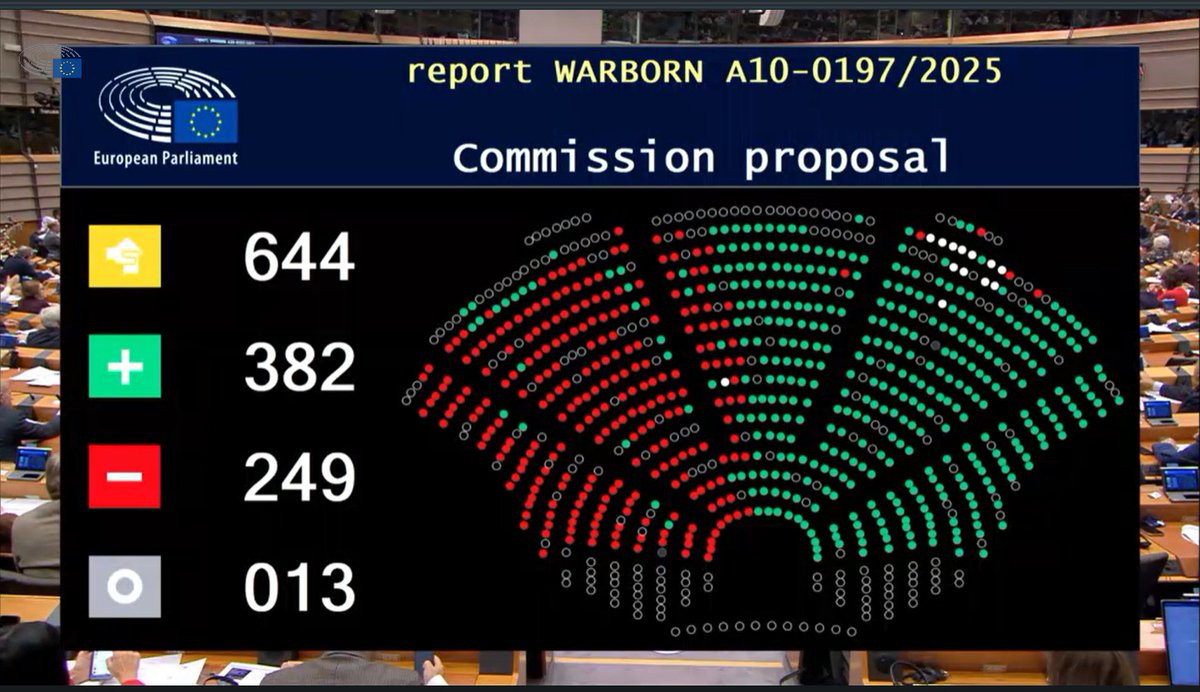
Parliamentary vote result.European Parliament
The European Commission has often boasted that its regulatory machinery is among the most sophisticated in the world. A few years ago, there was even talk of a ‘Brussels Effect’, whereby EU regulations are taken as de facto global standards, shaping policies and practices worldwide. Under this effect, companies desiring access to the European Union’s vast consumer market are compelled to comply with its strict rules; then, in order to save costs, they apply those same rules to their global operations, leading other countries to follow suit. This regulatory influence has derived from the EU’s status as a major economic power as well as its ability to set high regulatory standards.
But in recent weeks, an omnibus proposal to repeal or simplify over 300 pieces of legislation has evolved into the symbolic battleground for a much larger dispute over who sets the rules in the European Union.
The Omnibus Simplification Directive – a set of proposals by the European Commission for regulatory streamlining within the EU – aims to review and simplify numerous European regulations at the same time, in order to reduce administrative burdens for companies and improve the overall coherence of the regulatory framework. These proposals emerged as a political and technical response to a diagnosis of excessive bureaucracy in Europe, with origins in the Draghi Report and in the Commission’s priority of strengthening competitiveness through simplification. But they also represent a powerful tool for rebalancing the burden of regulatory obligations, affecting how that burden will be shared among large, medium, and small companies.
Wolters’ hard-line approach to regulatory cuts proved incompatible with pacts agreed between the EPP and the radical right, prompting her resignation as rapporteur. She was replaced by René Repasi, also from the S&D group but more conciliatory in tone. Officially, this change was a ‘technical adjustment’ – but in Brussels, nothing ‘technical’ is entirely innocent.
In practical terms, every PP vote aligned with Weber reinforces the idea that the Commission president’s leadership is more fragile than it seems. In fact, in a recent edition of European Compass, I mentioned that Feijóo is concerned that "the promises made by von der Leyen to win the presidency of the European Commission are not being fulfilled."
In Brussels, crises don’t always erupt with a bang: sometimes they slip silently between the lines of a technical dossier.
But in recent weeks, an omnibus proposal to repeal or simplify over 300 pieces of legislation has evolved into the symbolic battleground for a much larger dispute over who sets the rules in the European Union.
The Omnibus Simplification Directive – a set of proposals by the European Commission for regulatory streamlining within the EU – aims to review and simplify numerous European regulations at the same time, in order to reduce administrative burdens for companies and improve the overall coherence of the regulatory framework. These proposals emerged as a political and technical response to a diagnosis of excessive bureaucracy in Europe, with origins in the Draghi Report and in the Commission’s priority of strengthening competitiveness through simplification. But they also represent a powerful tool for rebalancing the burden of regulatory obligations, affecting how that burden will be shared among large, medium, and small companies.
"The First Omnibus Package became a political test that has divided Parliament twice. Manfred Weber’s EPP chose to turn it into an internal show of force to pressure Ursula von der Leyen"Specifically, the First Omnibus Package – which contains proposals to simplify the CSRD (Corporate Sustainability Reporting Directive), the CSDDD (Corporate Sustainability Due Diligence Directive), the Taxonomy, and the CBAM (Carbon Border Adjustment Mechanism Regulation) – became a political test that has divided Parliament twice. Manfred Weber’s EPP decided to turn it into an internal show of force, putting pressure on the coalition that supported Ursula von der Leyen’s re-election. This move sought to demonstrate that the People’s Party group is no longer willing to rubber-stamp the Commission’s agenda.
Weber gains speed, von der Leyen falters
The EPP leader’s strategy has been clear: to convert ‘regulatory simplification’ into a political weapon. Each vote has been an opportunity to show that the Commission is no longer in automatic control of the European Parliament. Nonetheless, Alberto Alemanno, the Jean Monnet Professor in European Union Law at HEC Paris, has warned that the banner of ‘simplification’ could serve as an excuse to erode essential regulatory powers in areas including the environment, consumer protection, and food safety. Alemanno argues that Europe needs more – not less – capacity for strategic regulation.The background: does the EU really legislate too much?
Many business groups contend that it does. However, studies by the European Parliament indicate that most of the affected legislative acts are old, marginal, or no longer applicable. The real complexity derives more from the interaction between national, regional, and European levels than from the legislative volume in Brussels. Commenting on this debate, MEP Jonás Fernández asserts that administrative simplification would be useful, but that it should not be confused with deregulation: proposals to reduce bureaucracy cannot be allowed to lower Europe’s regulatory ambition or to merely serve the political purposes of the EPP.Unexpected changes at JURI and a plenary session revealing a majority which no longer fits
The proposals in question were given first consideration by the Committee on Legal Affairs (JURI). Here, Lara Wolters of the Netherlands was appointed rapporteur for the Progressive Alliance of Socialists and Democrats (S&D) group, meeting with EPP rapporteur Jörgen Warborn, who was already in accord with radical right-wing groups.Wolters’ hard-line approach to regulatory cuts proved incompatible with pacts agreed between the EPP and the radical right, prompting her resignation as rapporteur. She was replaced by René Repasi, also from the S&D group but more conciliatory in tone. Officially, this change was a ‘technical adjustment’ – but in Brussels, nothing ‘technical’ is entirely innocent.
"MEP Jonás Fernández has argued that administrative simplification would be useful, but that it should not be confused with deregulation"In the plenary session of 6 November, the Omnibus Directive delivered a sharp x-ray view of Europe’s new legislature. The S&D group was divided, unable to reconcile internal tensions between those who fear that simplification will open the door to deregulation and those ready to accept a portion of the package for pragmatic reasons. And yet the latter faction sided with Renew and the Greens on the central points, forming a bloc of resistance against accelerated simplification. Meanwhile, the EPP used the session to distance itself from the Commission, aligning with radical right-wing groups on key amendments and votes and sending a unanimous message to von der Leyen. The final result confirmed the political fracture: the president no longer governs with the majority that elected her, and the Omnibus Directive has exposed the extent to which her coalition has eroded from within.
The missing element: Dolors Montserrat, Weber, and the reconfiguration of the EPP
One decisive political factor appears to have gone unnoticed outside of Brussels: the growing harmony between Dolors Montserrat and Manfred Weber, which is modifying the influence of Spain’s PP within the EPP. Montserrat – who serves as secretary general of the European People’s Party – has fully supported Weber’s strategy of refocusing the group toward more conservative positions and greater confrontation with von der Leyen. This alignment has also pushed Alberto Núñez Feijóo toward a harder line, relatively distant from von der Leyen’s project.In practical terms, every PP vote aligned with Weber reinforces the idea that the Commission president’s leadership is more fragile than it seems. In fact, in a recent edition of European Compass, I mentioned that Feijóo is concerned that "the promises made by von der Leyen to win the presidency of the European Commission are not being fulfilled."
Could von der Leyen fall?
The Omnibus alone won’t bring down the von der Leyen presidency, but it reveals a structural change: the EPP is swapping its role as institutional force to become an autonomous political actor, willing to distance itself even from the president it promoted. Alemanno’s warnings around the loss of regulatory power and Fernández’s concerns about covert deregulation appear to converge here: if fragmentation continues in the Parliament, and if the EPP membership manages to remain aligned, then von der Leyen is already facing a silent leadership crisis. Weber has been narrowing his majority of support, straining relations with the S&D group, Renew, and the Greens while "preparing" an agreement between the PP and Vox in hopes of bringing down Pedro Sánchez’s government. He knows perfectly well that if the Sánchez government falls, von der Leyen’s presidency will likewise end.In Brussels, crises don’t always erupt with a bang: sometimes they slip silently between the lines of a technical dossier.
Ahora en portada
17 de octubre de 2026
16 de octubre de 2026
Noticias relacionadas
Hace 47 semanas
Europa ante el ómnibus y la batalla que redefine el poder en Bruselas
Lo más leído