Viernes, 23 de octubre de 2026




CONVERSATIONS
Derek Guy on Style, Politics, and Why the King of Spain Dresses Better Than Most
Derek Guy (@dieworkwear) is one of the most respected voices when it comes to fashion. His knowledge of men’s clothing has made him a reference for politicians, businesspeople, and athletes, about whose style he often comments and offers advice online. Among the figures he most admires is King Felipe VI, whom he says has "restrained and consistent taste." In a conversation with 'Agenda Pública' reporter Jorge de Diego, Guy talks about his success on social media, housing, and how to build a wardrobe on minimum wage.
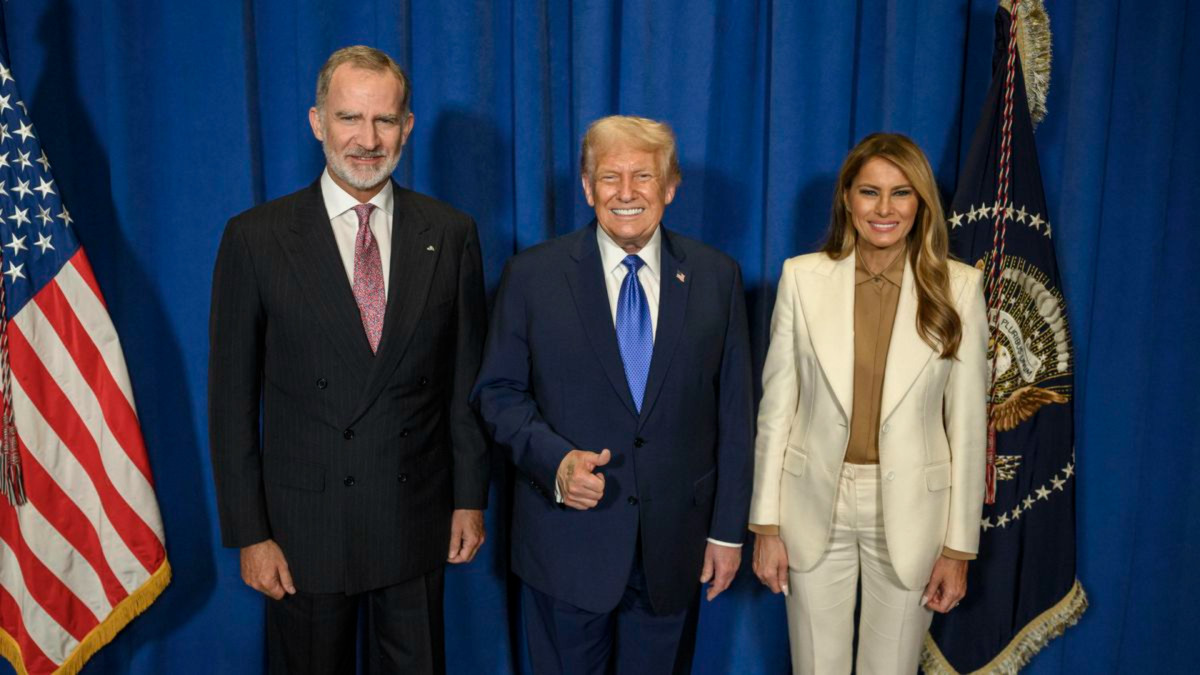
King Felipe VI with Donald and Melania Trump during the last UN Assembly.The White House
Derek Guy has been writing about men’s clothing for the past fifteen years, but it wasn’t until 2020 that his X account (formerly Twitter) began to grow rapidly. Today, Derek (@dieworkwear) has over 1.3 million followers on that platform and—although he says he "has no idea why people follow" him—he has become a prominent reference in that niche.
Guy keeps a clear line between his public profile and his private life: there are no known photos of him online, and he prefers not to say how he earns a living. His distinctive profile picture, which he has kindly allowed us to use, is his most recognizable trademark. He combines this privacy with a surge in reputation, and in recent years he has collaborated with major outlets such as the The New York Times, Financial Times and POLITICO.
His feed mixes advice on (men’s) clothing—often illustrated with public figures, celebrities, or even the King of Spain—with reflections on housing, tariffs, and gun policy. In his own words, he talks about "fashion as part of culture," which at times includes politics in a broad sense, such as workers’ rights or the political history of a garment. What follows is our phone conversation, conducted between Valladolid and the U.S. west coast.

Derek, you are known for having written blogs about men’s style for years, but your fame is mainly due to your Twitter account, which has over 1.3 million followers. In the past, you’ve admitted that you didn’t really know why people follow you. Do you have a clearer idea of your success today?
I’ve been writing about menswear for fifteen years and, up until two or three years ago, I had about 50,000 followers—basically people who were into menswear and who read my blog. That made sense to me.
Sometimes I think that when you talk about very "arcane" topics such as tailoring, there are very few people nowadays who can provide that kind of information, but frankly I can’t explain why so many people are interested in what I write.
In your most recent work, you’ve gone from talking about menswear to addressing political issues—or, rather, trying to connect the two. That’s also led you to write for influential media such as the Financial Times and POLITICO. What motivated that shift?
I use my profile like a personal account, not an authority and not a "fashion advice" feed. Early on I talked more about politics, and as the account grew I leaned toward tailoring because it’s a language many understand. I approach clothing through culture, which sometimes includes politics—workers’ rights or the history of a garment.
I’m an immigrant, the son of refugees; I have my own political interests. A family friend’s son was killed in a mass shooting. I care about public health. Since I don’t plan to monetize my account, I can be completely honest about what I find interesting. I’m not a menswear vending machine.
In recent months you’ve focused on issues like immigration and housing. What makes you think, "I need to talk about this," knowing some people may only want clothing tips?
As I said, I’m an immigrant. Immigration has shaped my life and my family’s journey. At the same time, I spend a large percentage of my monthly income on rent, and that share keeps growing. I talk about all of this because it feels frustrating. I work all the time. I don’t take days off for my birthday or New Year’s holidays because I have to pay rent. And, of course, I wish this country would get housing costs under control.
I don’t know what it’s like for other people. Occasionally I go online and see people hanging out in Paris or Italy on vacation. When I was younger, I had free time to do things—go to record stores and concerts. As you get older, it becomes more worrying because you think: what happens if I get sick? What if I don’t have savings? What if I suffer from dementia and need to hire someone to help me at home and I don’t have the money? This isn’t unique to me; a lot of people go through this. But since I don’t monetize my account, I’m going to speak about immigration, housing, and mass shootings because those things have affected my life.
Do you consider your stance left-wing?
I consider myself progressive; we should expand the welfare state, support intervention in markets when needed, and back robust social services and progressive taxation—the state can play a role in improving people’s lives.
Back to clothing. You’ve often criticized how politicians in the Trump era dress. Politics is one of those fields where the incentives and the means to dress well come together. Why do you think so many politicians still don’t dress well, in your view?
In that respect, politicians are like everyone else. To dress well in tailoring, you have to put in the time, finding a proper tailor, understanding fit, all of that. Most people don’t want to do that. And there aren’t many tailors left in the U.S. So people end up at made-to-measure companies run by businesspeople rather than tailors, or they buy off-the-rack guided by a sales associate who tells them they look great and walks them to the register for the commission—because they also have to pay rent.
Do you think the political climate makes it impossible to have neutral, sincere conversations about clothing?
No. Many people write about clothing in a very neutral way—academics, fashion writers, journalists, bloggers. I’m not selling anything; I’m just someone who loves clothes. I don’t consider myself an authority. I also have a specific point of view: I’m not that interested in creative-director appointments, trend cycles, or what bag to wear this summer. My main interest is how clothing relates to culture. I love reading the history—how gardeners dressed in the early 20th century, fishermen in the 1970s, hikers in the 1990s—and then thinking about how that language is used today. I also love craft: how things are made.
Given that, my view will naturally have a political edge. I’m interested in immigrant stories and in how different cultures—and rebel movements—dress.
When I do an explainer thread—say, about fit—I think it’s useful to show good and bad examples. But I’d never pull a random person’s photo from Instagram and post it to mock a bad suit. That feels immoral. If a body has to be in the clothes, I choose famous people. And among famous people, it’s true I’m more likely to post someone I have less sympathy for than someone I empathize with. If you support deporting immigrants, I don’t feel as bad using your image to illustrate poor fit. That doesn’t change my judgment about the clothes; it just affects who I pick as the example.
Lately you’ve highlighted pro-tariff "America First" influencers who sell merchandise made abroad. Why take on that hypocrisy?
What am I supposed to do? I see someone say "buy American," "boycott China," push tariffs—and then I click the link in their bio and their merch is made in China. I’m not a nationalist. It’s fine to buy Chinese, Portuguese, Mexican, Japanese goods—as long as the workers are paid fairly. You shouldn’t buy products if someone was exploited.
For fifteen years I’ve also told people: here are great American makers—shoes, jeans, T-shirts. If you genuinely want to reshore manufacturing, pay me and I’ll help you find a U.S. factory. That’s a sincere offer. No one has taken me up on it. Meanwhile, some of these influencers make hundreds of thousands of dollars selling merch. If your brand is "buy American," bring some of that business home. Otherwise, it just looks hypocritical.
One of your best-known positions is that "people used to dress better." That nostalgia often appears on the conservative side of politics. How is your view different?
I do think the average person dressed better in the past. But for people who are interested in fashion, today is the best time because you can wear anything from the past plus whatever comes next. In the past, men had to wear suits and women had to wear sundresses. The average person looked "better," but options were limited.
Now you can wear a 1960s suit, or dress like a 1930s railroad worker, a 1970s hiker, punk, disco—whatever. And there’s very little consequence. In the 1920s, if a man wore a different-colored shirt to the office, he could be sent home. Today, unless you work in a very conservative law firm, you won’t lose your job for dressing "off." That broader social openness creates more stylistic freedom.
Even if you don’t care about clothes, you’re better off today: you don’t have to spend on suits or the upkeep they require. You can throw a T-shirt in the washing machine and it costs less. But let’s say you care about tailoring and you live in certain cities—say, New York—. Nowadays, you have access to a lot of choices: Italian and British tailoring, ready-to-wear, made-to-measure, bespoke. Look at big red-carpet events—the creativity is incredible. So yes, the average person once dressed "better," but style is more interesting and open now.
You often argue you don’t need to spend $4,000 on a jacket or a designer belt. But can someone on minimum wage meet reasonable stylistic standards?
Broadly, you either invest time or money. If you want something good and fast, you need money. If you don’t have money, you need to invest time. If you don’t care about quality, none of this matters—you can get cheap and fast, but not cheap, fast, and good.
Still, thrift and vintage make a lot possible, at least in menswear. If you want to look like the King of Spain, that’s hard on minimum wage—his look involves a lot of skilled labor. But you don’t need to look like him. Buy a trucker jacket, jeans, and a flannel. Avoid synthetics; go vintage if you can. Where I live, you can still find pure-cotton jeans for about $50, a solid vintage trucker for about $50, and a flannel for around $20—call it $120 for an outfit. Minimum wage here is roughly $15 an hour, so that’s more than ten hours of work after taxes—real money. The key is to build slowly: one jacket, two pairs of jeans, three or four flannels over a year. Workwear is easier to do on a budget. Trying to replicate royal-level tailoring is not.
Many Spanish readers know you for your kind words about the King of Spain’s style. You’ve even called him one of the best-dressed public figures. What principles does he follow that we can apply without spending hundreds of euros?
The King of Spain has advantages most people can’t replicate: money; presumably someone who presses and lays out clothes and he’s handsome. That helps. He also has custom tailoring. But there are principles anyone can apply.
He follows proportions that work for many people: a jacket that bisects him roughly halfway from collar to floor when he’s in heeled shoes; when fastened, nothing pulls or puckers; the jacket silhouette flows cleanly into the trousers for one continuous line; trousers are worn high enough that the shirt doesn’t peek out below the coat’s buttoning point; and his sleeves fall cleanly when he stands naturally because the sleeve pitch matches his stance.
I’ve posted photos of a friend who’s a union electrician, high-school teachers, journalists—none of them have the King’s resources, and while I wouldn’t call any of them unattractive, the King is uniquely handsome. Yet they look great by following these basics. I know people who’ve bought suits for about $300—and one person who showed me a $150 suit—tailored to these principles, and they looked excellent. $150 is a lot of money for some people, and the King spends much more, but the point stands: you can look at him, apply some of those principles when you shop, and replicate a lot of it on a smaller budget. Your results may not be as good as the King of Spain, but you’ll definitely look a lot better.
Thanks a lot, Derek. It was a pleasure.
Guy keeps a clear line between his public profile and his private life: there are no known photos of him online, and he prefers not to say how he earns a living. His distinctive profile picture, which he has kindly allowed us to use, is his most recognizable trademark. He combines this privacy with a surge in reputation, and in recent years he has collaborated with major outlets such as the The New York Times, Financial Times and POLITICO.
His feed mixes advice on (men’s) clothing—often illustrated with public figures, celebrities, or even the King of Spain—with reflections on housing, tariffs, and gun policy. In his own words, he talks about "fashion as part of culture," which at times includes politics in a broad sense, such as workers’ rights or the political history of a garment. What follows is our phone conversation, conducted between Valladolid and the U.S. west coast.
The avatar used by Derek Guy in his posts. Image courtesy.
Derek, you are known for having written blogs about men’s style for years, but your fame is mainly due to your Twitter account, which has over 1.3 million followers. In the past, you’ve admitted that you didn’t really know why people follow you. Do you have a clearer idea of your success today?
I’ve been writing about menswear for fifteen years and, up until two or three years ago, I had about 50,000 followers—basically people who were into menswear and who read my blog. That made sense to me.
Sometimes I think that when you talk about very "arcane" topics such as tailoring, there are very few people nowadays who can provide that kind of information, but frankly I can’t explain why so many people are interested in what I write.
In your most recent work, you’ve gone from talking about menswear to addressing political issues—or, rather, trying to connect the two. That’s also led you to write for influential media such as the Financial Times and POLITICO. What motivated that shift?
I use my profile like a personal account, not an authority and not a "fashion advice" feed. Early on I talked more about politics, and as the account grew I leaned toward tailoring because it’s a language many understand. I approach clothing through culture, which sometimes includes politics—workers’ rights or the history of a garment.
I’m an immigrant, the son of refugees; I have my own political interests. A family friend’s son was killed in a mass shooting. I care about public health. Since I don’t plan to monetize my account, I can be completely honest about what I find interesting. I’m not a menswear vending machine.
In recent months you’ve focused on issues like immigration and housing. What makes you think, "I need to talk about this," knowing some people may only want clothing tips?
As I said, I’m an immigrant. Immigration has shaped my life and my family’s journey. At the same time, I spend a large percentage of my monthly income on rent, and that share keeps growing. I talk about all of this because it feels frustrating. I work all the time. I don’t take days off for my birthday or New Year’s holidays because I have to pay rent. And, of course, I wish this country would get housing costs under control.
"I spend a large percentage of my monthly income on rent, and that share keeps growing. I talk about all of this because it feels frustrating"When I go out and take a taxi, I’ll sometimes talk to the driver, and they’re working two jobs—also to pay rent. I have friends thinking about moving to cheaper, more rural areas, or even out of the country. And all of us are working all the time just to pay rent.
I don’t know what it’s like for other people. Occasionally I go online and see people hanging out in Paris or Italy on vacation. When I was younger, I had free time to do things—go to record stores and concerts. As you get older, it becomes more worrying because you think: what happens if I get sick? What if I don’t have savings? What if I suffer from dementia and need to hire someone to help me at home and I don’t have the money? This isn’t unique to me; a lot of people go through this. But since I don’t monetize my account, I’m going to speak about immigration, housing, and mass shootings because those things have affected my life.
Do you consider your stance left-wing?
I consider myself progressive; we should expand the welfare state, support intervention in markets when needed, and back robust social services and progressive taxation—the state can play a role in improving people’s lives.
Back to clothing. You’ve often criticized how politicians in the Trump era dress. Politics is one of those fields where the incentives and the means to dress well come together. Why do you think so many politicians still don’t dress well, in your view?
In that respect, politicians are like everyone else. To dress well in tailoring, you have to put in the time, finding a proper tailor, understanding fit, all of that. Most people don’t want to do that. And there aren’t many tailors left in the U.S. So people end up at made-to-measure companies run by businesspeople rather than tailors, or they buy off-the-rack guided by a sales associate who tells them they look great and walks them to the register for the commission—because they also have to pay rent.
"To figure out where to get a good suit, you need time, energy, and thought. Most people don’t invest on that, politicians included"To figure out where to get a good suit, you need time, energy, and thought. Most people don’t invest on that. It’s like me trying to buy a car or a camera—if I don’t know much, my first purchase probably won’t be great. Today there are too many options, not enough honest salespeople, and not enough tailors.
Do you think the political climate makes it impossible to have neutral, sincere conversations about clothing?
No. Many people write about clothing in a very neutral way—academics, fashion writers, journalists, bloggers. I’m not selling anything; I’m just someone who loves clothes. I don’t consider myself an authority. I also have a specific point of view: I’m not that interested in creative-director appointments, trend cycles, or what bag to wear this summer. My main interest is how clothing relates to culture. I love reading the history—how gardeners dressed in the early 20th century, fishermen in the 1970s, hikers in the 1990s—and then thinking about how that language is used today. I also love craft: how things are made.
Given that, my view will naturally have a political edge. I’m interested in immigrant stories and in how different cultures—and rebel movements—dress.
When I do an explainer thread—say, about fit—I think it’s useful to show good and bad examples. But I’d never pull a random person’s photo from Instagram and post it to mock a bad suit. That feels immoral. If a body has to be in the clothes, I choose famous people. And among famous people, it’s true I’m more likely to post someone I have less sympathy for than someone I empathize with. If you support deporting immigrants, I don’t feel as bad using your image to illustrate poor fit. That doesn’t change my judgment about the clothes; it just affects who I pick as the example.
Lately you’ve highlighted pro-tariff "America First" influencers who sell merchandise made abroad. Why take on that hypocrisy?
What am I supposed to do? I see someone say "buy American," "boycott China," push tariffs—and then I click the link in their bio and their merch is made in China. I’m not a nationalist. It’s fine to buy Chinese, Portuguese, Mexican, Japanese goods—as long as the workers are paid fairly. You shouldn’t buy products if someone was exploited.
For fifteen years I’ve also told people: here are great American makers—shoes, jeans, T-shirts. If you genuinely want to reshore manufacturing, pay me and I’ll help you find a U.S. factory. That’s a sincere offer. No one has taken me up on it. Meanwhile, some of these influencers make hundreds of thousands of dollars selling merch. If your brand is "buy American," bring some of that business home. Otherwise, it just looks hypocritical.
There are lots of misconceptions in the replies to @mattyglesias's post below. Will address some of them in this thread. 🧵 https://t.co/pfS4YJOYon
— derek guy (@dieworkwear) May 3, 2025
One of your best-known positions is that "people used to dress better." That nostalgia often appears on the conservative side of politics. How is your view different?
I do think the average person dressed better in the past. But for people who are interested in fashion, today is the best time because you can wear anything from the past plus whatever comes next. In the past, men had to wear suits and women had to wear sundresses. The average person looked "better," but options were limited.
Now you can wear a 1960s suit, or dress like a 1930s railroad worker, a 1970s hiker, punk, disco—whatever. And there’s very little consequence. In the 1920s, if a man wore a different-colored shirt to the office, he could be sent home. Today, unless you work in a very conservative law firm, you won’t lose your job for dressing "off." That broader social openness creates more stylistic freedom.
Even if you don’t care about clothes, you’re better off today: you don’t have to spend on suits or the upkeep they require. You can throw a T-shirt in the washing machine and it costs less. But let’s say you care about tailoring and you live in certain cities—say, New York—. Nowadays, you have access to a lot of choices: Italian and British tailoring, ready-to-wear, made-to-measure, bespoke. Look at big red-carpet events—the creativity is incredible. So yes, the average person once dressed "better," but style is more interesting and open now.
You often argue you don’t need to spend $4,000 on a jacket or a designer belt. But can someone on minimum wage meet reasonable stylistic standards?
Broadly, you either invest time or money. If you want something good and fast, you need money. If you don’t have money, you need to invest time. If you don’t care about quality, none of this matters—you can get cheap and fast, but not cheap, fast, and good.
"A minimum-wage garment in the 1970s was probably better made than a minimum-wage garment today, often with natural materials"Across the 20th century, fashion leadership shifted from the ruling class to workers, rebels, youth subcultures, musicians, and artists—many of whom had little money. The caveat is that a minimum-wage garment in the 1970s was probably better made than a minimum-wage garment today, often with natural materials. Now, the cheapest stuff tends to have more synthetics and doesn’t age well.
Still, thrift and vintage make a lot possible, at least in menswear. If you want to look like the King of Spain, that’s hard on minimum wage—his look involves a lot of skilled labor. But you don’t need to look like him. Buy a trucker jacket, jeans, and a flannel. Avoid synthetics; go vintage if you can. Where I live, you can still find pure-cotton jeans for about $50, a solid vintage trucker for about $50, and a flannel for around $20—call it $120 for an outfit. Minimum wage here is roughly $15 an hour, so that’s more than ten hours of work after taxes—real money. The key is to build slowly: one jacket, two pairs of jeans, three or four flannels over a year. Workwear is easier to do on a budget. Trying to replicate royal-level tailoring is not.
King of Spain at the final day of Wimbledon. This looks great.
— derek guy (@dieworkwear) July 17, 2023
Very rare to see this level of tailoring nowadays, even on the wealthy. So let's talk about some of the reasons why it's great. 🧵 pic.twitter.com/nZtDzxkMxN
Many Spanish readers know you for your kind words about the King of Spain’s style. You’ve even called him one of the best-dressed public figures. What principles does he follow that we can apply without spending hundreds of euros?
The King of Spain has advantages most people can’t replicate: money; presumably someone who presses and lays out clothes and he’s handsome. That helps. He also has custom tailoring. But there are principles anyone can apply.
He follows proportions that work for many people: a jacket that bisects him roughly halfway from collar to floor when he’s in heeled shoes; when fastened, nothing pulls or puckers; the jacket silhouette flows cleanly into the trousers for one continuous line; trousers are worn high enough that the shirt doesn’t peek out below the coat’s buttoning point; and his sleeves fall cleanly when he stands naturally because the sleeve pitch matches his stance.
"The simplicity, the precision of fit, and the harmonious silhouette make him look great. Those are principles you can apply on a budget"His taste is restrained and consistent. Dark suits—navy and gray. For sport coats, dark colors like navy or dark brown. Trousers in mid-gray, light gray, or tan. Dark shoes—brown or black. Shirts are simple: solid white, solid light blue, sometimes blue-and-white stripes. Ties are discreet—solid or simple stripes. The simplicity, the precision of fit, and the harmonious silhouette make him look great. Those are principles you can apply on a budget.
I’ve posted photos of a friend who’s a union electrician, high-school teachers, journalists—none of them have the King’s resources, and while I wouldn’t call any of them unattractive, the King is uniquely handsome. Yet they look great by following these basics. I know people who’ve bought suits for about $300—and one person who showed me a $150 suit—tailored to these principles, and they looked excellent. $150 is a lot of money for some people, and the King spends much more, but the point stands: you can look at him, apply some of those principles when you shop, and replicate a lot of it on a smaller budget. Your results may not be as good as the King of Spain, but you’ll definitely look a lot better.
Thanks a lot, Derek. It was a pleasure.
.png)
Jorge de Diego Hurtado
Redactor en 'Agenda Pública'
Politólogo y analista electoral. Cuenta con experiencia en consultoría en Bruselas y actualmente es redactor en 'Agenda Pública'. También es cofundador de 'El Tablero Político'.
Ahora en portada
23 de octubre de 2026
23 de octubre de 2026
Noticias relacionadas
Hace 49 semanas