Sábado, 17 de octubre de 2026




IN-DEPTH
Merz's coalition could be Germany's last chance
Friedrich Merz's coalition faces strong pressure to stabilise Germany and redefine its economic model, in a context of stagnation, political fragmentation and the rise of the AfD. Agenda Pública analyses the challenges facing the new government alongside Jeremy Cliffe and Thorsten Benner.

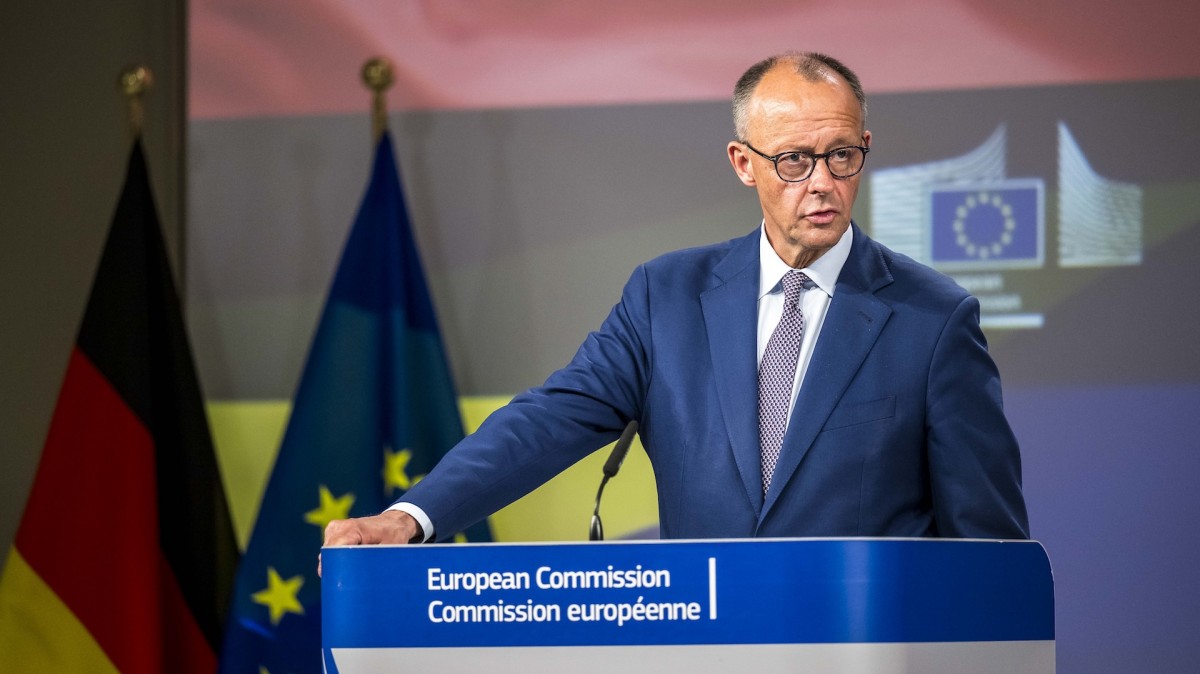
Friedrich Merz speaks at a press conference after his meeting with European Commission President Ursula von der Leyen.Wiktor Dabkowski / Zuma Press / ContactoPhoto
This week, global attention has turned to two secret ballots. The surprise came when the one expected to be more complicated—the conclave—was swiftly and decisively resolved in under twenty-four hours, projecting an image of unity within the Catholic Church after what was the most diverse papal election in history. In stark contrast, Friedrich Merz’s failure in Monday’s first investiture vote in the Bundestag—a vote that was supposed to be a mere formality—has raised some doubts over Germany’s political stability under its new government.
This uncertainty reduces confidence in this new Executive to carry out its mandate to bring stability to Germany and create an economic model that allows a return to economic growth. The Government headed by Merz begins after two years that have produced hardly any economic growth and have shattered the perception of the country as Europe's economic engine. The cherished German economic model has suffered under the weight of multiple geopolitical fronts: a hostile Trump Administration that continues to threaten the European Union with punitive tariffs, China's strategic pivot towards higher links in the value chain, and Russia's weaponisation of energy supplies.
"The German economic model has combined labour market liberalisation, fiscal conservatism and dependence on external demand", observes Jeremy Cliffe, editorial director of the European Council on Foreign Relations, when consulted by this outlet. "Today, however, the country's infrastructure is decrepit, its industries are often outdated, and its prosperity is heavily exposed to a China that is moving up the value chain and a United States that is turning its back on trade". This perfect storm of challenges demands what Cliffe describes as a three-part solution: "invest, reform, and Europeanise", which involves "strong investment to modernise the economy, reforms that promote entrepreneurship and adaptation to new technologies, and completing and deepening the European single market".
All of this has translated electorally: the February elections left Germany with its most fragmented parliament in decades. The combined support for the CDU and SPD fell below 45%, a dramatic decline from the 70% they regularly secured two decades ago and the nearly 90% they commanded before Reunification.
The difficulties of the centre are the result of the hard blows that economic decline and various political challenges have dealt to German identity, which has created great discontent in the German electorate due to the lack of effective responses and which, in turn, has been capitalised on by the AfD. Its rhetoric has become increasingly strident: its leader, Alice Weidel, attacks Muslim immigrants in parliament and refers to the German culture of Holocaust remembrance as a "guilt cult", a stance that even received backing from Elon Musk during a video appearance at the party's pre-election convention. Germany's fragile sense of identity has opened the door to xenophobic tendencies, and the decline in living standards is fuelling a disturbing resurgence of ethnic nationalism.
"The AfD shares a significant trait with Austria's FPÖ", points out Cliffe. "Both are confident in their radicalism and have avoided the path of 'detoxification' followed, for example, by Giorgia Meloni and Marine Le Pen". This ideological purity paradoxically reinforces the AfD's appeal to voters disillusioned with Germany's political class, creating what Thorsten Benner, director of Berlin's Global Public Policy Institute, describes as "enormous pressure on the political system". The consequence, according to Benner, is that "discontented voters will go to the extremes, both far-left and far-right, not to other centrist parties if they become disillusioned with this government".
Even before the investiture, Friedrich Merz was beginning his term with much of his political capital already depleted: his unusual adoption of an expansive fiscal policy required a constitutional change in the outgoing parliament, attracting intense scrutiny to a political figure who once personified fiscal conservatism and discontent within his ranks.
The coalition agreement itself, 146 pages long, reflects this political precariousness. As the only viable coalition partner for Merz, the SPD has obtained significant concessions despite suffering its worst electoral result since 1887. Lars Klingbeil, co-leader of the SPD, will become Finance Minister and Vice-Chancellor and his party will obtain seven ministries, compared to the CDU/CSU's ten. Additionally, he has secured certain key policy victories: a €500 billion infrastructure investment fund, the easing of borrowing rules for unlimited defence spending, tax cuts for lower incomes, pension protection and a provisional commitment to a fifteen-euro minimum wage. This has given many Christian Democrats a sense of having given too much to obtain the compromise.
Despite these internal limitations, Merz seems determined to redefine Germany's international stance, particularly within the European Union. Cliffe points out that "Friedrich Merz is determined to change [Germany's weak role in the EU and transatlantic relations]: with a European reset (visiting Paris and Warsaw on his first day) and unusually blunt language about Europe's need to become independent from Trump's US".
The European dimension is especially relevant for addressing Germany's difficult economic situation. Benner identifies a "dual challenge" stemming from "Trump's trade war and the 'China 2.0 shock'", suggesting that Merz will try to negotiate a trade agreement with the Trump Administration through the European Commission. If this fails, "Europe will have to counterattack Trump's tariffs, which will affect German exporters". Moreover, Benner argues that "Europe needs to protect its market from unfair Chinese competition in key industries, from automobiles to tools and chemicals", which requires a fundamental change in Germany's traditionally open trade stance.
Regarding the internal economic renewal that the new Government must address, it faces not only its national complexities but also how to combine them with European challenges. The Draghi report on European competitiveness, cited by both Cliffe and Benner, identifies substantial barriers to trade within the EU itself, equivalent to tariffs of 40% on products and more than 100% on services. Dismantling these internal German obstacles while simultaneously protecting European markets from unfair external competition represents a delicate balancing act for a country historically committed to free trade.
Can the Merz coalition navigate these turbulent waters? Benner suggests that "it will be difficult for the government to fail to meet expectations because they are so low". Success, however, will require Merz to "surprise his critics with a strong start to Government that makes it clear he will act constructively and decisively against migration, against external security challenges in Germany, against bureaucracy and in favour of Germany's economic resilience". Something that was called into question on Monday, when doubts arose about the coalition Executive's ability to gather parliamentary majorities and push forward its agenda.
Nevertheless, Germany still possesses considerable economic and intellectual resources: a solid manufacturing sector that produces top-tier automobiles, chemicals and medical equipment, along with world-class research institutions and a skilled workforce. With its engineering prowess and creative potential, there remains an opportunity to drive a transition towards the 21st-century economy that will once again put the country at the forefront whilst stimulating the rest of the Union.
But the sine qua non condition that Germany faces is a task it has avoided for much of the past eight decades: adapting to change. The economy is only part of the challenge; in an era of profound change, Merz and his Government must respond to the questions of where the country is heading and how it wants to redefine its role in the world. In a context where the AfD's identity nationalism is beginning to fill the void left by years of unambitious nation-building, the outcome of this coalition—possibly the last chance for real renewal—will mark not only Germany's course, but also the future of the European project.
"Merz's failure in the first vote has cast a shadow of uncertainty over the coalition"The episode was resolved that same evening in a second vote, avoiding a greater crisis. However, it has cast a shadow of uncertainty over the coalition, as the confidentiality afforded to German MPs in the investiture vote makes it difficult to understand the reasons behind the dissent towards Merz—and even whether it came from his own Christian Democrats (CDU) or from their Social Democratic partners (SPD)—.
This uncertainty reduces confidence in this new Executive to carry out its mandate to bring stability to Germany and create an economic model that allows a return to economic growth. The Government headed by Merz begins after two years that have produced hardly any economic growth and have shattered the perception of the country as Europe's economic engine. The cherished German economic model has suffered under the weight of multiple geopolitical fronts: a hostile Trump Administration that continues to threaten the European Union with punitive tariffs, China's strategic pivot towards higher links in the value chain, and Russia's weaponisation of energy supplies.
"The German economic model has combined labour market liberalisation, fiscal conservatism and dependence on external demand", observes Jeremy Cliffe, editorial director of the European Council on Foreign Relations, when consulted by this outlet. "Today, however, the country's infrastructure is decrepit, its industries are often outdated, and its prosperity is heavily exposed to a China that is moving up the value chain and a United States that is turning its back on trade". This perfect storm of challenges demands what Cliffe describes as a three-part solution: "invest, reform, and Europeanise", which involves "strong investment to modernise the economy, reforms that promote entrepreneurship and adaptation to new technologies, and completing and deepening the European single market".
All of this has translated electorally: the February elections left Germany with its most fragmented parliament in decades. The combined support for the CDU and SPD fell below 45%, a dramatic decline from the 70% they regularly secured two decades ago and the nearly 90% they commanded before Reunification.
"Economic stagnation has fuelled the alarming rise of Alternative for Germany"In turn, economic stagnation has fuelled the alarming rise of Alternative for Germany (AfD), which doubled its percentage of votes in February to secure second place nationally. This success comes after last September when the party won its first state elections in eastern Germany, a previously unthinkable achievement for a far-right party in post-war Germany. And, despite being classified as an extremist party, its support in the polls continues to increase, as Professor Alberto Bueno explained in Agenda Pública this week. At the time of publication of this article, its aggregate voting estimate is approaching 25% and would be close to becoming the leading political force in Germany.
The difficulties of the centre are the result of the hard blows that economic decline and various political challenges have dealt to German identity, which has created great discontent in the German electorate due to the lack of effective responses and which, in turn, has been capitalised on by the AfD. Its rhetoric has become increasingly strident: its leader, Alice Weidel, attacks Muslim immigrants in parliament and refers to the German culture of Holocaust remembrance as a "guilt cult", a stance that even received backing from Elon Musk during a video appearance at the party's pre-election convention. Germany's fragile sense of identity has opened the door to xenophobic tendencies, and the decline in living standards is fuelling a disturbing resurgence of ethnic nationalism.
"The AfD shares a significant trait with Austria's FPÖ", points out Cliffe. "Both are confident in their radicalism and have avoided the path of 'detoxification' followed, for example, by Giorgia Meloni and Marine Le Pen". This ideological purity paradoxically reinforces the AfD's appeal to voters disillusioned with Germany's political class, creating what Thorsten Benner, director of Berlin's Global Public Policy Institute, describes as "enormous pressure on the political system". The consequence, according to Benner, is that "discontented voters will go to the extremes, both far-left and far-right, not to other centrist parties if they become disillusioned with this government".
Even before the investiture, Friedrich Merz was beginning his term with much of his political capital already depleted: his unusual adoption of an expansive fiscal policy required a constitutional change in the outgoing parliament, attracting intense scrutiny to a political figure who once personified fiscal conservatism and discontent within his ranks.
The coalition agreement itself, 146 pages long, reflects this political precariousness. As the only viable coalition partner for Merz, the SPD has obtained significant concessions despite suffering its worst electoral result since 1887. Lars Klingbeil, co-leader of the SPD, will become Finance Minister and Vice-Chancellor and his party will obtain seven ministries, compared to the CDU/CSU's ten. Additionally, he has secured certain key policy victories: a €500 billion infrastructure investment fund, the easing of borrowing rules for unlimited defence spending, tax cuts for lower incomes, pension protection and a provisional commitment to a fifteen-euro minimum wage. This has given many Christian Democrats a sense of having given too much to obtain the compromise.
"Friedrich Merz is determined to change [Germany's weak role in the EU and transatlantic relations]: with a European reset and unusually blunt language about Europe's need to become independent from Trump's US"The pact —and, above all, Monday's investiture— demonstrate the central paradox of the Merz Government: although it is born with the ambition to face the country's deep economic and social challenges, it may lack the internal cohesion and political courage needed to drive truly transformative reform. However, Germany cannot afford for this to be just another exercise in grand coalition. It could be the last opportunity to halt the consolidation of the AfD's power.
Despite these internal limitations, Merz seems determined to redefine Germany's international stance, particularly within the European Union. Cliffe points out that "Friedrich Merz is determined to change [Germany's weak role in the EU and transatlantic relations]: with a European reset (visiting Paris and Warsaw on his first day) and unusually blunt language about Europe's need to become independent from Trump's US".
The European dimension is especially relevant for addressing Germany's difficult economic situation. Benner identifies a "dual challenge" stemming from "Trump's trade war and the 'China 2.0 shock'", suggesting that Merz will try to negotiate a trade agreement with the Trump Administration through the European Commission. If this fails, "Europe will have to counterattack Trump's tariffs, which will affect German exporters". Moreover, Benner argues that "Europe needs to protect its market from unfair Chinese competition in key industries, from automobiles to tools and chemicals", which requires a fundamental change in Germany's traditionally open trade stance.
Regarding the internal economic renewal that the new Government must address, it faces not only its national complexities but also how to combine them with European challenges. The Draghi report on European competitiveness, cited by both Cliffe and Benner, identifies substantial barriers to trade within the EU itself, equivalent to tariffs of 40% on products and more than 100% on services. Dismantling these internal German obstacles while simultaneously protecting European markets from unfair external competition represents a delicate balancing act for a country historically committed to free trade.
Can the Merz coalition navigate these turbulent waters? Benner suggests that "it will be difficult for the government to fail to meet expectations because they are so low". Success, however, will require Merz to "surprise his critics with a strong start to Government that makes it clear he will act constructively and decisively against migration, against external security challenges in Germany, against bureaucracy and in favour of Germany's economic resilience". Something that was called into question on Monday, when doubts arose about the coalition Executive's ability to gather parliamentary majorities and push forward its agenda.
"This Government is probably the last stabilisation strike for Germany to prevent the far-right from coming to power"Nevertheless, the Merz coalition perhaps represents the last conventional solution to Germany's multifaceted crisis. Benner characterises it bluntly as "probably the last stabilisation strike for Germany to prevent the far-right from coming to power". If this coalition fails, Germany could find itself following the path of several European neighbours towards political fragmentation and governmental paralysis. The political centre, already in retreat, could become irrelevant, condemning Europe's largest democracy to a series of ineffective governments lacking the unity and vision to address the country's fundamental challenges.
Nevertheless, Germany still possesses considerable economic and intellectual resources: a solid manufacturing sector that produces top-tier automobiles, chemicals and medical equipment, along with world-class research institutions and a skilled workforce. With its engineering prowess and creative potential, there remains an opportunity to drive a transition towards the 21st-century economy that will once again put the country at the forefront whilst stimulating the rest of the Union.
But the sine qua non condition that Germany faces is a task it has avoided for much of the past eight decades: adapting to change. The economy is only part of the challenge; in an era of profound change, Merz and his Government must respond to the questions of where the country is heading and how it wants to redefine its role in the world. In a context where the AfD's identity nationalism is beginning to fill the void left by years of unambitious nation-building, the outcome of this coalition—possibly the last chance for real renewal—will mark not only Germany's course, but also the future of the European project.
Ahora en portada
17 de octubre de 2026
16 de octubre de 2026
Noticias relacionadas
Hace 84 semanas
European strategic autonomy includes creating new social networks
Hace 97 semanas
Merkel is out to defend her legacy, Von der Leyen should be taking notes
Lo más leído