Viernes, 16 de octubre de 2026




GEOPOLITICAL BOARD
Spain as a middle power in the new international disorder
Faced with a global landscape dominated by unilateralism, Spain must urgently embrace its role as a "middle power." Antonio Tintoré, research assistant at the Center for Strategic and International Studies (CSIS) in Washington, D.C., argues that it is necessary to forge a "third way" that escapes rivalry between blocs. To avoid being left at the mercy of a "world of carnivores," Madrid needs to lead European integration, strengthen economic competitiveness, and advance genuine strategic autonomy.
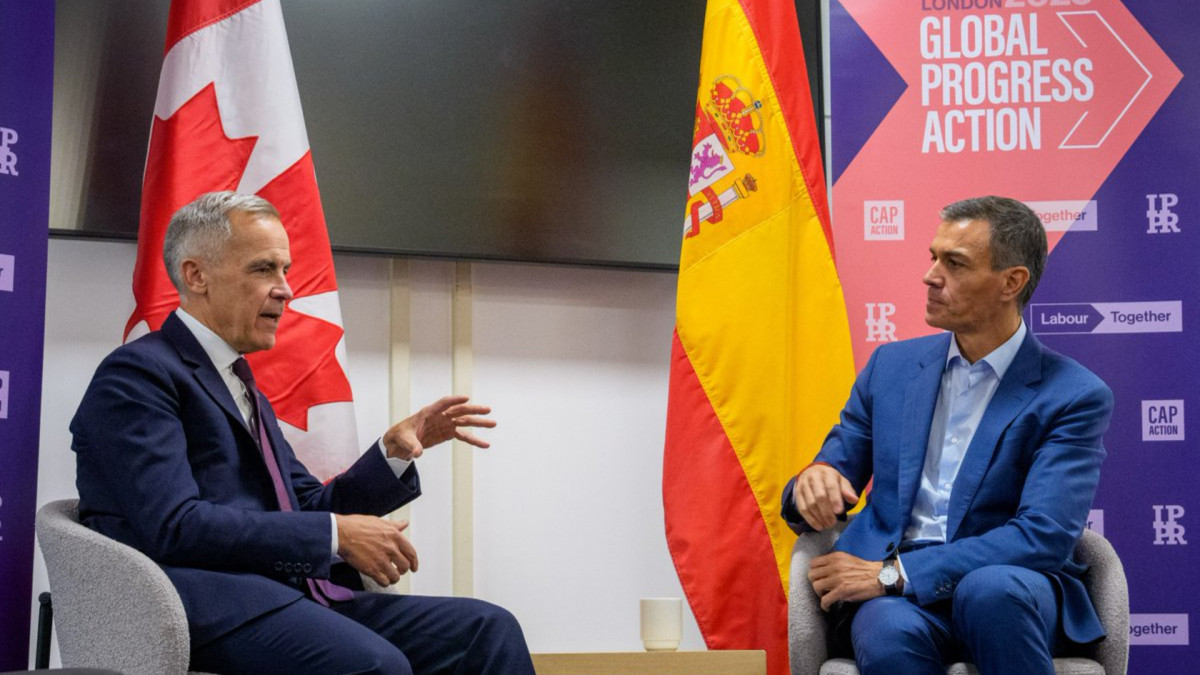
Canadian Prime Minister Mark Carney (left), alongside Spanish Prime Minister Pedro Sánchez.Mark Carney’s social media
Spain is becoming increasingly differentiated on the international stage. The government’s recent actions and statements regarding Iran have placed Madrid in open disagreement not only with Washington but also with the half-hearted support of many of our European partners. And this is no longer an isolated episode. Spain also broke ranks in The Hague by refusing to commit to the 5% defense spending target. It did so again in taking one of the strongest European stances against Israel's actions in Gaza. And, to a lesser extent, by seeking a normalization of relations with China that raised suspicions on both sides of the Atlantic.
This growing differentiation is attracting a level of international attention Spain has not received in years, projecting autonomy and principles, yes, but also making us vulnerable to serious retaliation. Beyond the crisis with Iran, it is therefore worth asking what Spain’s role in the world should be. If we are going to step away from the herd, we must be clear about where we are heading. That requires more than gestures or statements: it requires a coherent and sustained strategy capable of turning differentiation into leadership and real influence.
In this context, it is worth revisiting Mark Carney’s Davos speech. The Canadian presented a vision of the world diametrically opposed to that of Trump. Canada’s prime minister did not advance a nostalgic discourse exalting the longed-for "rules-based international order" or calling for an impossible return to the past. Instead, he began by criticizing the hypocrisies of the old order, devoting most of his remarks to what should come next, to what should be done after this now-famous "rupture."
Indeed, as the world’s fifteenth-largest economy, Spain should position itself as a Carney-style middle power, proactively seeking to construct an alternative to a world defined by hegemonies and fragmentation. To do so, however, our foreign policy must cease to be reactive and episodic and instead become a cross-party national commitment, structured around three complementary pillars.
In trade policy, Spain should champion strategic openness and diversification, encouraging Brussels to conclude more free trade agreements with like-minded partners. The final ratification of agreements with MERCOSUR and India is a clear necessity, as is the signing of the agreement with Australia and a closer relationship with the CPTPP. Amid so much global uncertainty, these agreements—stalled for decades—demonstrate Europe’s renewed attractiveness as a reliable and predictable partner, laying the groundwork for deeper political and diplomatic alignment.
In defense, Spain must increase spending. Given our geographic position, it is understandable that we do not lead allied military spending rankings; nonetheless, we cannot simply break with the European consensus nor settle for an uncomfortable form of followership. For Spain, the rationale for this effort extends well beyond the conflict in Eastern Europe. It is equally necessary to reduce our structural dependence on the United States and given growing instability on our southern flank. In short, if we wish to safeguard our own interests and principles—as the current crisis illustrates—we must do so from a position of strength.
The second pillar of this middle-power strategy concerns the geopolitical articulation of the Ibero-American space. Spain, by history, language, and geography, holds a unique position here. Many countries in Ibero-America share democratic values and increasingly feel threatened by the erosion of the international order. There is therefore a clear window of opportunity to deepen ties. With the expected ratification of the MERCOSUR agreement, the European Union will have trade deals covering 97% of Latin America’s GDP.
And this should be seen as a starting point. With Spain at the forefront, the EU and Ibero-America should strengthen economic cooperation, promoting joint projects in strategic sectors such as infrastructure and critical raw materials. We could also coordinate positions in multilateral forums such as the UN, where together we represent roughly one third of the votes. Finally, Spain should firmly support deeper Ibero-American political integration, helping ensure that a sister region—linked by language, culture, and shared values—grows stronger and more prosperous.
The third pillar of Spain’s middle-power strategy refers to the strategic management of relations with the United States and China, the two most consequential actors of the coming century. The relationship with the United States—putting the current crisis aside—remains important for Spain. Europe’s security architecture revolves around NATO, and a credible alternative remains unthinkable in the short and medium term. Moreover, a total rupture with Washington would almost certainly come to bite in our ever-latent dispute with Morocco.
Stabilizing the transatlantic relationship is therefore essential. That said, Europe cannot compromise its interests and principles every time a potential crisis emerges with Washington. If stability is pursued at the expense of everything else, genuine strategic autonomy will never be achieved. Reaching it requires a degree of assertiveness, as Europe demonstrated in response to the Greenland debacle.
In any case, greater autonomy vis-à-vis the United States is necessary and is an imperative that goes beyond the present Administration. Trump’s rise is symptomatic of a deeper and troubling transformation in America’s political and strategic thinking. In the short and medium term, this calls for a reinforcement of the European pillar of NATO; but in the long term, Europe must preserve its ability to go further. If the United States continues along this increasingly bellicose, unilateral, and reckless road, Europe must be able to pivot.
In conclusion, Mark Carney’s speech offers no easy recipes, but it does provide a compass. In a world increasingly governed by the logic of brute force, middle powers have both the responsibility—and the opportunity—to build alternatives. It is true that Carney himself, by supporting US and Israeli actions in Iran, has put up the sign once again and fallen back into the familiar hypocrisies of the old order. For the moment, many of our European partners have done the same. But that is not the path of the middle powers.
This crisis with the United States should serve as a catalyst. Spain should launch a diplomatic offensive to rally support against this war—first within Europe, but also among the many Gulf and Middle Eastern countries that seek de-escalation. Only in this way, by fully embracing our European, Ibero-American, and global role, can Spain place itself along the "third way" Carney describes—transforming differentiation into leadership, and principles into real power.
This growing differentiation is attracting a level of international attention Spain has not received in years, projecting autonomy and principles, yes, but also making us vulnerable to serious retaliation. Beyond the crisis with Iran, it is therefore worth asking what Spain’s role in the world should be. If we are going to step away from the herd, we must be clear about where we are heading. That requires more than gestures or statements: it requires a coherent and sustained strategy capable of turning differentiation into leadership and real influence.
In this context, it is worth revisiting Mark Carney’s Davos speech. The Canadian presented a vision of the world diametrically opposed to that of Trump. Canada’s prime minister did not advance a nostalgic discourse exalting the longed-for "rules-based international order" or calling for an impossible return to the past. Instead, he began by criticizing the hypocrisies of the old order, devoting most of his remarks to what should come next, to what should be done after this now-famous "rupture."
"As the world’s fifteenth-largest economy, Spain should position itself as a Carney-style middle power"Carney argues that the most effective counterweight to the law of the jungle lies in the action of middle powers. It is precisely the countries caught between the largest states that can forge a more hopeful "third way." Middle powers, according to the Canadian, must move beyond the exclusivism of traditional alliances, embracing "variable geometries" and seeking cooperation beyond rigid alignments wherever common interests exist. Taken as a whole, his speech was a call for realism and responsibility among countries such as Spain.
Indeed, as the world’s fifteenth-largest economy, Spain should position itself as a Carney-style middle power, proactively seeking to construct an alternative to a world defined by hegemonies and fragmentation. To do so, however, our foreign policy must cease to be reactive and episodic and instead become a cross-party national commitment, structured around three complementary pillars.
The three pillars Spain must develop as a middle power
The first—and most important—concerns European integration and the pursuit of genuine strategic autonomy. In the face of mounting threats, the European project represents the most effective lever for the protection of our sovereignty and influence. On its own, Spain could be hopelessly exposed to the pressure of the great powers; but together with our twenty-six European partners we can punch well above our weight on the world stage. Moreover, beyond our immediate national interests, the European Union can genuinely be a positive force in shaping the global order. Multilateralism is embedded in the Union’s political DNA, and so, a stronger EU could project that logic of cooperation and rules into an increasingly anarchic world."In a world of carnivores, economic competitiveness must be our first priority, ensuring that the green agenda complements — rather than undermines — our productive capacity"Economically, Spain should firmly back Europe’s competitiveness agenda: deepening the single market, supporting an ambitious MFF, facilitating the integration of capital markets, implementing at home the Commission’s simplification agenda, and promoting a new issuance of eurobonds to unlock much-needed investment. In a world of carnivores, economic competitiveness must be our first priority, ensuring that the green agenda complements—rather than undermines—our productive capacity.
In trade policy, Spain should champion strategic openness and diversification, encouraging Brussels to conclude more free trade agreements with like-minded partners. The final ratification of agreements with MERCOSUR and India is a clear necessity, as is the signing of the agreement with Australia and a closer relationship with the CPTPP. Amid so much global uncertainty, these agreements—stalled for decades—demonstrate Europe’s renewed attractiveness as a reliable and predictable partner, laying the groundwork for deeper political and diplomatic alignment.
In defense, Spain must increase spending. Given our geographic position, it is understandable that we do not lead allied military spending rankings; nonetheless, we cannot simply break with the European consensus nor settle for an uncomfortable form of followership. For Spain, the rationale for this effort extends well beyond the conflict in Eastern Europe. It is equally necessary to reduce our structural dependence on the United States and given growing instability on our southern flank. In short, if we wish to safeguard our own interests and principles—as the current crisis illustrates—we must do so from a position of strength.
"We should also try to anchor the debate in a rigorous analysis of the operational environment and of Europe’s capability gaps, moving beyond arbitrary political benchmarks"Where Spain can exercise greater leadership is in shifting the European defense debate toward quality over quantity: promoting a common industrial base, developing pan-European capabilities, strengthening interoperability, and seeking ever-increasing economies of scale. We should also try to anchor the debate in a rigorous analysis of the operational environment and of Europe’s capability gaps, moving beyond arbitrary political benchmarks. Even without the United Kingdom, European defense spending is already the second largest in the world and more than double Russia’s. The challenge, therefore, is not only how to spend more, but above all how to spend better.
The second pillar of this middle-power strategy concerns the geopolitical articulation of the Ibero-American space. Spain, by history, language, and geography, holds a unique position here. Many countries in Ibero-America share democratic values and increasingly feel threatened by the erosion of the international order. There is therefore a clear window of opportunity to deepen ties. With the expected ratification of the MERCOSUR agreement, the European Union will have trade deals covering 97% of Latin America’s GDP.
And this should be seen as a starting point. With Spain at the forefront, the EU and Ibero-America should strengthen economic cooperation, promoting joint projects in strategic sectors such as infrastructure and critical raw materials. We could also coordinate positions in multilateral forums such as the UN, where together we represent roughly one third of the votes. Finally, Spain should firmly support deeper Ibero-American political integration, helping ensure that a sister region—linked by language, culture, and shared values—grows stronger and more prosperous.
"While many European countries can reasonably be accused of double standards regarding Ukraine and Israel, Spain is often perceived as a more aligned partner"Beyond that, closer ties with Ibero-America would make Spain a privileged bridge to the Global South, a pivotal force likely to gain weight in the international system. Composed largely of countries that neither desire nor can afford a world of pure anarchy, the Global South offers ample room for convergence. Moreover, Spain’s foreign policy—including its stance on the Palestinian issue—has generated a degree of soft power that should be leveraged. While many European countries can reasonably be accused of double standards regarding Ukraine and Israel, Spain is often perceived as a more aligned partner, one that could serve as a credible intermediary between the Global North and the Global South.
The third pillar of Spain’s middle-power strategy refers to the strategic management of relations with the United States and China, the two most consequential actors of the coming century. The relationship with the United States—putting the current crisis aside—remains important for Spain. Europe’s security architecture revolves around NATO, and a credible alternative remains unthinkable in the short and medium term. Moreover, a total rupture with Washington would almost certainly come to bite in our ever-latent dispute with Morocco.
Stabilizing the transatlantic relationship is therefore essential. That said, Europe cannot compromise its interests and principles every time a potential crisis emerges with Washington. If stability is pursued at the expense of everything else, genuine strategic autonomy will never be achieved. Reaching it requires a degree of assertiveness, as Europe demonstrated in response to the Greenland debacle.
In any case, greater autonomy vis-à-vis the United States is necessary and is an imperative that goes beyond the present Administration. Trump’s rise is symptomatic of a deeper and troubling transformation in America’s political and strategic thinking. In the short and medium term, this calls for a reinforcement of the European pillar of NATO; but in the long term, Europe must preserve its ability to go further. If the United States continues along this increasingly bellicose, unilateral, and reckless road, Europe must be able to pivot.
"Spain is right in maintaining high-level contacts and remaining open to Chinese investment, but it must always prioritize European unity, reciprocity, and mutual benefit"With regard to China, Spain should adopt a more strategic and long-term approach. At a time when the Trump administration is undoubtedly one of the most destabilizing factors in the international order, a normalization of relations with China is understandably appealing on symbolic and political grounds. Even so, caution is warranted. The EU’s characterization of China as partner, competitor, and rival—though sometimes criticized as schizophrenic—is in fact the most realistic lens. China is a country with which diplomacy is both possible and necessary. Spain is right in maintaining high-level contacts and remaining open to Chinese investment, but it must always prioritize European unity, reciprocity, and mutual benefit. China’s economic model, increasingly dependent on the export of overcapacities, poses real challenges for Spain and Europe, as does Beijing’s support for Russia. In this context, Madrid should protect and cultivate areas of cooperation with Beijing while also acknowledging these serious structural concerns.
In conclusion, Mark Carney’s speech offers no easy recipes, but it does provide a compass. In a world increasingly governed by the logic of brute force, middle powers have both the responsibility—and the opportunity—to build alternatives. It is true that Carney himself, by supporting US and Israeli actions in Iran, has put up the sign once again and fallen back into the familiar hypocrisies of the old order. For the moment, many of our European partners have done the same. But that is not the path of the middle powers.
This crisis with the United States should serve as a catalyst. Spain should launch a diplomatic offensive to rally support against this war—first within Europe, but also among the many Gulf and Middle Eastern countries that seek de-escalation. Only in this way, by fully embracing our European, Ibero-American, and global role, can Spain place itself along the "third way" Carney describes—transforming differentiation into leadership, and principles into real power.
.png)
Antonio Tintoré Vicent
Analista internacional en Washington D. C.
Exdelegado joven de la Unión Europea para el G20. Analista internacional en Washington D. C. Estudiante de Asuntos Transatlánticos en el Colegio de Europa y la Fletcher School of Law and Diplomacy. Graduado en Historia y Economía por la Universidad de Edimburgo.
Ahora en portada
16 de octubre de 2026
16 de octubre de 2026
16 de octubre de 2026
Noticias relacionadas
Hace 38 semanas
La doctrina Carney: el liberalismo nacional canadiense como antídoto contra Trump
Hace 38 semanas
El exasesor de Trump que responde a Mark Carney: "Canadá actúa como si las reglas por sí solas fueran a mantenerlos a salvo"
Hace 32 semanas
Trump frente a España, Europa frente a sí misma
Lo más leído