Jueves, 8 de octubre de 2026




FIRMAS TOP
Against Donald Trump, a Europe that abandons its illusions and wields its coercive power
For Jeremy Cliffe, editorial director at the ECFR think tank, the administration’s National Security Strategy confirms that both Europe and Washington misunderstand their relationship. In his analysis, he argues that a "return to hard facts" is the only possible response for a Europe looking out for its own well-being.
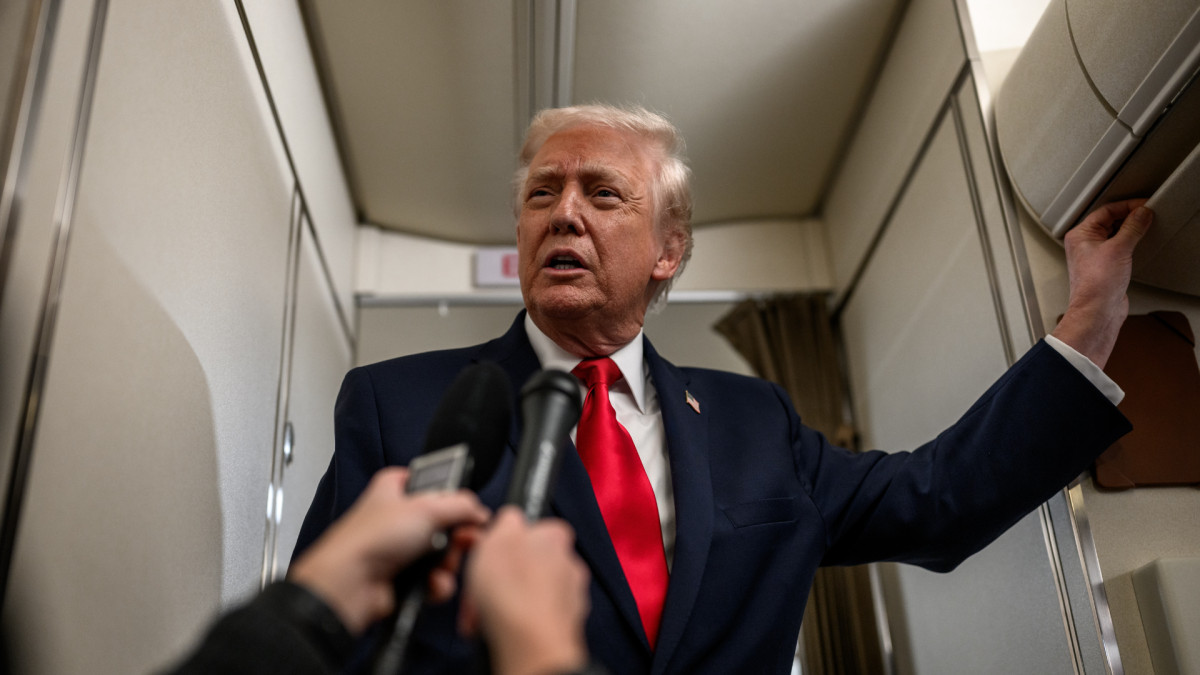
U.S. President Donald Trump aboard Air Force One.The White House / Molly Riley
Does Europe have a strategy to deal with Donald Trump? It seems like a bizarrely simplistic question, but it deserves to be asked. The first anniversary of the inauguration is looming into sight, yet many Europeans have spent the past months lurching erratically between hope and panic about the president’s designs on their continent.
None of which should have come as a surprise. The Heritage Foundation’s Mandate for Leadership 2025, a Trumpian blueprint published in 2023, argued that "US diplomacy must be more attentive to inner-EU developments, while also developing new allies inside the EU". Vice-president JD Vance’s speech at the Munich Security Conference in February warned of "the threat from within, the retreat of Europe from some of its most fundamental values". In May a State Department post on Substack advocated US support for "civilizational allies in Europe" opposed to a "global liberal project" that, it claimed, is "trampling democracy, and Western heritage along with it".
That, despite these warnings, the NSS seemingly startled some Europeans spoke to a broader truth: both sides of the US-Europe partnership seem to be overestimating their mutual familiarity. The line between the domestic and the transatlantic seems to be blurred. A fog has descended over the Atlantic.
On the European side, leaders have misinterpreted the monarchical structure of Trump’s administration. The academics Stacie Goddard and Abraham Newman have described it as "neo-royalist"; less a modern executive with pretensions of empirical rigour than a medieval court where rival cliques contest access to the king’s ear.
European leaders have understood this but drawn the wrong conclusion: that they too can participate in that game. Thus, European governments have devoted vast time and energy to the art of working the clique system in Washington. NATO’s secretary-general has called Trump "daddy". Ministers in capitals like London and Berlin boast about their allegedly privileged friendships with the likes of Vance and Marco Rubio. At the same time, Trump makes it increasingly clear that while he appreciates sycophancy within his court (and sometimes even rewards it) he sees such behaviour from outsiders as contemptible weakness. It is notable that China, which has declined to bow to Trump and been serious about its willingness to retaliate, received surprisingly mild treatment in the NSS – unlike deferential Europe.
European leaders who believe they can play a Washington factional game that is closed to them; a US administration that treats European politics as an extension of its domestic campaign of retribution: such is the essence of today’s transatlantic muddle. The result is that the Europeans are inadvertently signalling their weakness, and that MAGA is interpreting this as a green light to extend its retribution campaign across the Atlantic with new speed and ambition. The NSS is this unfortunate reality carved into tablets of stone.
Enough. Any serious European answer to the Trumpian threat needs to begin by burning off that mid-Atlantic fog. That means giving up clever-clever ideas about gameplaying in DC and disabusing the Trump administration of its hopes for a transformative transatlantic campaign of retribution. And the key to that is a cold, ruthless assessment of the coercive levers available to both sides.
That is the part of the post-NSS panic in Europe that has been most conspicuously missing: how, precisely, does the administration seek to "cultivate resistance in Europe"? Based on the available evidence, there are four main categories of action.
The first is exemptions from US sanctions and tariff policies for allied European leaders. A prominent recent example of this came last month, when Trump granted Viktor Orbán’s Hungary a one-year exemption from its sanctions on Russian oil. The Hungarian prime minister is a close Trump ally and, despite his centralisation of power and strenuous moves against independent civil society and media, faces a challenging general election in April.
But another case, which may prove more significant in the long term, came in October when Trump retweeted a social media post by a White House staffer suggesting that Giorgia Meloni’s right-wing government in Rome was seeking independent tariff reductions from the US. The Italian government, always treading a fine line between European convention and Trumpian alignment, subsequently insisted that it respects the EU’s exclusive role in trade negotiations, but the incident countenanced the possibility of preferential trade terms for favoured European governments.
The second, related lever would involve Trump using America’s security umbrella over Europe to pursue this political agenda. His administration has published its NSS, but drafts of its National Defence Strategy (NDS) are still being discussed. Coming alongside the long-awaited US force posture review, the final text could involve announcements of troop withdrawals from, or redeployments within, Europe. How this might serve the goal of "cultivating resistance" is less clear than changes in sanctions and tariff policies; not least as the voter bases of some illiberal European parties, like the Alternative for Germany (AfD), are sceptical about the US military presence in Europe.
A third way that the US government could seek to advance its agenda within Europe would be to target the officials involved in decisions it dislikes. There is solid documentation of such measures being threatened: including the possibility of sanctions against European officials implementing the Digital Services Act or critical of Elon Musk’s X/Twitter (so much for Trumpian concerns about free speech in Europe) and threats of personal consequences against those advocating green shipping rules.
The biggest unknown is the fourth lever available to Trump: direct efforts to interfere in European party politics. US administrations with vastly more respect for international norms than Trump have used commercial channels, diplomatic pressure and intelligence activity to tilt politics in partner states towards perceived US interests. That his administration should do so is thus almost beyond doubt.
Indeed, there are already plenty of public examples of it. Trump and Vance both rallied behind France’s Marine Le Pen after her embezzlement conviction in April 2025 (the president calling it a "witch hunt", revealingly using the term he applied to his own impeachment in the US). Germany’s AfD has been welcomed in Washington and Musk himself spoke in support of the party at one of its rallies ahead of the German federal election in February. Spain’s Vox boasts of its links with the Trump administration and its participation in American right-wing gatherings like CPAC.
But the menu of options for the Trump administration, and its powerful allies in the American private sector, is much wider. Other tools include loans to individual European parties or politicians; financial support for think-tanks and media outlets; and the use of US-based digital giants (especially social media platforms) to foreground radical-right European parties and other Trump-friendly voices on the video feeds of European voters.
Yet overall, the continent is still acting as if the Trump era were just a passing phase. European language about buying more US arms (gleefully reported by the White House, however vague the actual commitment) sends all the wrong messages. On the two topics most likely to make the difference between European sovereignty and vassalage – joint defence and deeper integration of the single market – progress during Trump’s first year in office has been piecemeal at best.
Meanwhile, the dual transatlantic delusion continues. Europeans continue to devote more attention to gaming Washington politics than to deconstructing their reliance on it. Encouraged by this, Trump and his courtiers increasingly see Europe as a sort of sandbox where they can play out the political revenge fantasies they cannot yet implement in the US. The cycle perpetuates itself.
Again: enough. Not only does Europe need to get wise to the levers that Trump may now pull; it must get comfortable pulling the levers at its own disposal in defence of its democracy, its sovereignty, its pluralism – its very dignity. For Europeans do possess such levers. They too can impose costs on their transatlantic partners. It is just that they have little experience of doing so, and are therefore unfamiliar with the tools of the craft. This is unfortunate, as their tools are numerous and potent.
To recognise this is to overcome that dual transatlantic delusion. The European obsession with wooing Trump, and Trump’s own confidence game in Europe, are both distractions from the underlying balance of coercive power. And that distraction process disadvantages the European side: because its coercive capacity ends up being severely underpriced by all involved.
Conversely, Europe flatters itself in its implicit claims to be above using brute force. It takes pride in being the power that still enshrines rules-based order and positive-sum games. Yet that pride risks tipping into wishful thinking about the state of the world in the late-2020s, and especially of the transatlantic relationship. It may be uncomfortable, but the time has come for a coercive European approach towards America.
"According to reports, a longer version of the U.S. document went so far as to propose an even more radical goal: peeling Austria, Hungary, Italy, and Poland away from the European project"The shocked European response to the Trump administration’s National Security Strategy (NSS) has typified that: emotive, reactive, and strangely ignorant of the writing on the wall. The NSS advocated "cultivating resistance to Europe’s current trajectory within European nations" against the "stark prospect of civilizational erasure" by the likes of the European Union. A longer, unpublished version reportedly envisages the yet more radical goal of peeling Austria, Hungary, Italy and Poland away from the union.
None of which should have come as a surprise. The Heritage Foundation’s Mandate for Leadership 2025, a Trumpian blueprint published in 2023, argued that "US diplomacy must be more attentive to inner-EU developments, while also developing new allies inside the EU". Vice-president JD Vance’s speech at the Munich Security Conference in February warned of "the threat from within, the retreat of Europe from some of its most fundamental values". In May a State Department post on Substack advocated US support for "civilizational allies in Europe" opposed to a "global liberal project" that, it claimed, is "trampling democracy, and Western heritage along with it".
That, despite these warnings, the NSS seemingly startled some Europeans spoke to a broader truth: both sides of the US-Europe partnership seem to be overestimating their mutual familiarity. The line between the domestic and the transatlantic seems to be blurred. A fog has descended over the Atlantic.
On the European side, leaders have misinterpreted the monarchical structure of Trump’s administration. The academics Stacie Goddard and Abraham Newman have described it as "neo-royalist"; less a modern executive with pretensions of empirical rigour than a medieval court where rival cliques contest access to the king’s ear.
European leaders have understood this but drawn the wrong conclusion: that they too can participate in that game. Thus, European governments have devoted vast time and energy to the art of working the clique system in Washington. NATO’s secretary-general has called Trump "daddy". Ministers in capitals like London and Berlin boast about their allegedly privileged friendships with the likes of Vance and Marco Rubio. At the same time, Trump makes it increasingly clear that while he appreciates sycophancy within his court (and sometimes even rewards it) he sees such behaviour from outsiders as contemptible weakness. It is notable that China, which has declined to bow to Trump and been serious about its willingness to retaliate, received surprisingly mild treatment in the NSS – unlike deferential Europe.
"The administration’s targeted attacks against its opponents appear to be crossing U.S. borders and increasingly taking aim at the European Union as well"On the American side, too, the fog in the Atlantic seems to be blurring certain lines. "I am your retribution", Trump told his supporters in 2023. Two years on, Reuters now reports that "at least 470 people, organisations and institutions have been targeted for retribution since Trump took office – an average of more than one a day." For the president and his acolytes, European politics resembles an extension of his American vendetta. The State Department blog referenced above argued of the "trampling" of democracy in Europe that: "Americans are familiar with these tactics. Indeed, a similar strategy of censorship, demonization, and bureaucratic weaponization was utilized against President Trump and his supporters." So it is that the administration’s targeted assaults against its perceived opponents – be they the jurist Letitia James, comedian Jimmy Kimmel, or institutions like Harvard University – seem to be transcending American borders and targeting the European Union too.
European leaders who believe they can play a Washington factional game that is closed to them; a US administration that treats European politics as an extension of its domestic campaign of retribution: such is the essence of today’s transatlantic muddle. The result is that the Europeans are inadvertently signalling their weakness, and that MAGA is interpreting this as a green light to extend its retribution campaign across the Atlantic with new speed and ambition. The NSS is this unfortunate reality carved into tablets of stone.
Enough. Any serious European answer to the Trumpian threat needs to begin by burning off that mid-Atlantic fog. That means giving up clever-clever ideas about gameplaying in DC and disabusing the Trump administration of its hopes for a transformative transatlantic campaign of retribution. And the key to that is a cold, ruthless assessment of the coercive levers available to both sides.
That is the part of the post-NSS panic in Europe that has been most conspicuously missing: how, precisely, does the administration seek to "cultivate resistance in Europe"? Based on the available evidence, there are four main categories of action.
The first is exemptions from US sanctions and tariff policies for allied European leaders. A prominent recent example of this came last month, when Trump granted Viktor Orbán’s Hungary a one-year exemption from its sanctions on Russian oil. The Hungarian prime minister is a close Trump ally and, despite his centralisation of power and strenuous moves against independent civil society and media, faces a challenging general election in April.
But another case, which may prove more significant in the long term, came in October when Trump retweeted a social media post by a White House staffer suggesting that Giorgia Meloni’s right-wing government in Rome was seeking independent tariff reductions from the US. The Italian government, always treading a fine line between European convention and Trumpian alignment, subsequently insisted that it respects the EU’s exclusive role in trade negotiations, but the incident countenanced the possibility of preferential trade terms for favoured European governments.
The second, related lever would involve Trump using America’s security umbrella over Europe to pursue this political agenda. His administration has published its NSS, but drafts of its National Defence Strategy (NDS) are still being discussed. Coming alongside the long-awaited US force posture review, the final text could involve announcements of troop withdrawals from, or redeployments within, Europe. How this might serve the goal of "cultivating resistance" is less clear than changes in sanctions and tariff policies; not least as the voter bases of some illiberal European parties, like the Alternative for Germany (AfD), are sceptical about the US military presence in Europe.
"It is not hard to imagine how this could translate into moving troops away from countries deemed "undemocratic" (the UK, Germany) and toward those considered "democratic" (Poland, Italy)"But the politicisation of deployment decisions was the explicit logic of Vance’s speech in Munich: the vice-president essentially argued that America’s security provision was dependent on his interpretation of "our shared democratic values". In other words, those governments that do not adhere to that interpretation might not deserve the munificence of American defence. It is not hard to imagine that translating into redeployments of US troops, and their enabling and deterrent force, away from "undemocratic" states (say, the UK and Germany, both targets of Vance’s anger) and towards "democratic" ones (say, Poland and Italy).
A third way that the US government could seek to advance its agenda within Europe would be to target the officials involved in decisions it dislikes. There is solid documentation of such measures being threatened: including the possibility of sanctions against European officials implementing the Digital Services Act or critical of Elon Musk’s X/Twitter (so much for Trumpian concerns about free speech in Europe) and threats of personal consequences against those advocating green shipping rules.
The biggest unknown is the fourth lever available to Trump: direct efforts to interfere in European party politics. US administrations with vastly more respect for international norms than Trump have used commercial channels, diplomatic pressure and intelligence activity to tilt politics in partner states towards perceived US interests. That his administration should do so is thus almost beyond doubt.
Indeed, there are already plenty of public examples of it. Trump and Vance both rallied behind France’s Marine Le Pen after her embezzlement conviction in April 2025 (the president calling it a "witch hunt", revealingly using the term he applied to his own impeachment in the US). Germany’s AfD has been welcomed in Washington and Musk himself spoke in support of the party at one of its rallies ahead of the German federal election in February. Spain’s Vox boasts of its links with the Trump administration and its participation in American right-wing gatherings like CPAC.
But the menu of options for the Trump administration, and its powerful allies in the American private sector, is much wider. Other tools include loans to individual European parties or politicians; financial support for think-tanks and media outlets; and the use of US-based digital giants (especially social media platforms) to foreground radical-right European parties and other Trump-friendly voices on the video feeds of European voters.
"Europe’s long-term response barely needs stating: it must rapidly reduce its dependence on the United States"The long-term European answer to these risks barely requires stating: the continent needs a warp-speed effort to reduce its dependence on the US. At points, European leaders have conceded this reality; witness Friedrich Merz on December 13th declaring the era of "Pax Americana" over. Some European governments have matched this observation with action; Spain’s decision to reject American F-35s in favour of European-made models to modernise its fleet of jet fighters is one example.
Yet overall, the continent is still acting as if the Trump era were just a passing phase. European language about buying more US arms (gleefully reported by the White House, however vague the actual commitment) sends all the wrong messages. On the two topics most likely to make the difference between European sovereignty and vassalage – joint defence and deeper integration of the single market – progress during Trump’s first year in office has been piecemeal at best.
Meanwhile, the dual transatlantic delusion continues. Europeans continue to devote more attention to gaming Washington politics than to deconstructing their reliance on it. Encouraged by this, Trump and his courtiers increasingly see Europe as a sort of sandbox where they can play out the political revenge fantasies they cannot yet implement in the US. The cycle perpetuates itself.
Again: enough. Not only does Europe need to get wise to the levers that Trump may now pull; it must get comfortable pulling the levers at its own disposal in defence of its democracy, its sovereignty, its pluralism – its very dignity. For Europeans do possess such levers. They too can impose costs on their transatlantic partners. It is just that they have little experience of doing so, and are therefore unfamiliar with the tools of the craft. This is unfortunate, as their tools are numerous and potent.
"Both Europe’s obsession with wooing Trump and the confidence game he is running in Europe divert attention from the real balance of coercive power"My colleague at the European Council on Foreign Relations, Tobias Gehrke, recently published an inventory of the toolbox. Ranging across EU tariffs on politically sensitive US goods, clampdowns on American digital giants, export control licences, sell-downs of US debt holdings, and even sanctions on individual US officials – as well as an array of other creative measures – the paper was a symphony of European agency. It was an assertion of our continent’s power to stand up for itself, of its right to choose its own course, and of its freedom to regard the American administration’s opinions about its politics with cool equanimity.
To recognise this is to overcome that dual transatlantic delusion. The European obsession with wooing Trump, and Trump’s own confidence game in Europe, are both distractions from the underlying balance of coercive power. And that distraction process disadvantages the European side: because its coercive capacity ends up being severely underpriced by all involved.
Conversely, Europe flatters itself in its implicit claims to be above using brute force. It takes pride in being the power that still enshrines rules-based order and positive-sum games. Yet that pride risks tipping into wishful thinking about the state of the world in the late-2020s, and especially of the transatlantic relationship. It may be uncomfortable, but the time has come for a coercive European approach towards America.

Jeremy Cliffe
Editorial director and senior policy fellow at the European Council on Foreign Relations
He is based in Berlin. Previously he was international editor of the 'New Statesman'. Before that he spent eight years at The Economist, where he served as bureau chief in Brussels and Berlin, and was first the 'Bagehot' (UK) and then 'Charlemagne' (Europe) columnist. He studied at the universities of Oxford and Harvard.
Ahora en portada
7 de octubre de 2026
8 de octubre de 2026
8 de octubre de 2026
Noticias relacionadas
Hace 42 semanas
Frente a Trump, una Europa que abandone sus ilusiones y aprenda a imponer el poder coercitivo
Lo más leído