Sábado, 17 de octubre de 2026




LÓPEZ PLANA'S EUROPEAN COMPASS
Brussels in the dark: Europe’s weakness in counterintelligence puts its institutions at risk
In his weekly column, Marc López Plana — director and editor of 'Agenda Pública' — examines how the EU’s weakness in counterintelligence opens space for foreign actors (from Russia to Morocco to Huawei) to influence its institutions. His central thesis: Europe exercises considerable power but lacks the strategic apparatus required to safeguard it. Without such defenses, the very autonomy of Europe will remain at risk.

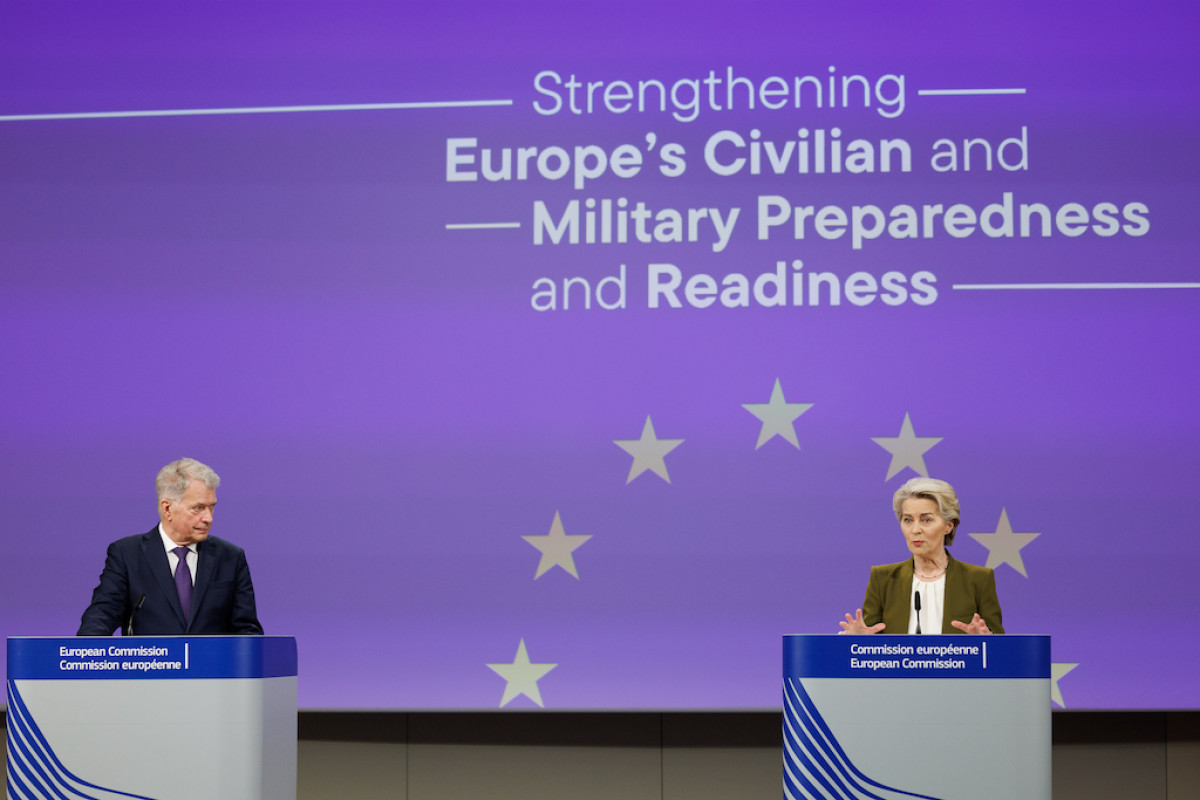
Ursula von der Leyen, President of the European Commission, takes part in a press conference where Sauli Niinistö, her special adviser, presents the report on strengthening Europe’s civil and military preparedness.Audiovisual Service of the European Commission
"Ukraine may be at risk of losing either its dignity or a key ally," said President Zelensky last Friday in response to a 28-point peace proposal floated by the United States (and amenable to Vladimir Putin). Today marks 1,403 days since Russia’s invasion, and yet certain previous events should also be recalled: the Maidan Revolution of 2014, sparked by the refusal of pro-Russian President Yanukovych to sign an agreement with the EU, and the entry of Russian troops into Crimea that same year.
Also in 2014, Nathan Gill, a politician linked to Nigel Farage’s UK Party, took a seat in the European Parliament. Gill has since been sentenced to more than ten years for accepting bribes from Putin’s entourage (specifically from oligarch Oleg Voloshin) to spread pro-Russian propaganda from inside the parliament. These were early signs of what would later become the invasion of Ukraine, and they showed that Putin knew perfectly well where to strike (less visibly, but effectively) in order to weaken the EU.
A few days ago, I had a very interesting conversation with Beatriz Méndez de Vigo, former secretary general of the National Intelligence Center (CNI), and I asked how the secret services regard the relationship between national and European intelligence. Méndez de Vigo praised the strong coordination among national services, but she also repeated the diagnosis of former President of Finland Sauli Niinistö, who articulated concerns heard in the corridors of Brussels: although mechanisms for cooperation are in place, the EU has no genuine culture of counterintelligence and counterespionage capable of protecting its own institutions. Niinistö further warned that the EU continues to act as though its political power were no longer a priority target for foreign actors — and that no community aspiring to global influence can afford so careless an approach. The uncomfortable but crucial message was that Europe must go beyond the coordination of existing services and develop interior capacities that prevent others from affecting its decision-making.
Niinistö’s report indicates that the EU is facing not just economic or regulatory challenges but the growing risk of infiltration and espionage within its own institutions. Although the national services practice cooperation, only an institutional culture of counterintelligence and counterespionage at the EU level can protect internal processes from external actors. Cases more recent than Gill’s such as ‘Marocgate’ and the Huawei affair illustrate this weakness: key decisions are vulnerable to influence by actors taking advantage of the dispersion of responsibilities and the lack of clear procedures. According to the report, the solution is not only to share information but to provide the Commission and other European organisms with the operational capabilities to detect, prevent, and neutralize threats. The EU must develop protocols, early warning systems, and a security culture that treats institutional protection as a strategic component of European power. Without such measures, Brussels will remain an attractive target for those seeking to influence the Union from the shadows, undermining its autonomy as well as the integrity of its political decisions.
In March 2025, several individuals associated with the European Parliament were charged by Belgian prosecutors as part of an investigation into the Chinese corporation Huawei, suspected of trying to influence parliamentary decisions through secret payments and gifts. This incident cast the spotlight on an influence operation by a tech company with strong geopolitical ties — as well as the inability of EU institutions to detect, anticipate, and mitigate such threats.
A year earlier, in an affair known as ‘Marocgate’ (linked to the wider ‘Qatargate’ scandal), Morocco was found to have deployed an influence and corruption network that reached several MEPs, their aides, and the internal structures of the European Parliament. According to the investigation, Moroccan diplomats and intelligence services sought to finance trips, gifts, and activities that would help align legislative decisions with Moroccan interests. Brussels had no mechanisms to unveil this threat, giving rise to assessments of chronic institutional vulnerability.
The report by Sauli Niinistö, requested by the European Commission, addresses this problem directly. Niinistö stresses that the EU has developed policies around defense, cybersecurity, and resilience, but that it lacks a counterintelligence system capable of guarding its institutions, which he describes as a "nerve center without an immune system." Moreover, the problem is cultural as well as structural. Unlike Washington or London, Brussels has not yet internalized the notion that political power means direct exposure to foreign persuasion and espionage. The EU has tended to protect itself as a low-risk technical administration, not as a center of global power.
Highlighting that contradiction are the cases of Huawei and ‘Marocgate’, where EU institutions failed to detect threats and acted naively, even in the midst of carefully planned operations. The bribes, gifts, and lobbying networks employed by Huawei and Morocco were in many cases seen as simple issues of ethics or corruption in administration, without regard for their strategic dimension.
These measures would not replace national services but would enable closure of the security gap that makes Brussels an appealing target for external actors. As long as the Member States retain tight control over their intelligence, whether for historical or political reasons, the European institutions will remain vulnerable.
The paradox is clear: Europe legislates, sanctions, and regulates like a superpower, but its institutions are treated as independent administrations without recourse to collective intelligence. Each time an actor like Huawei or Morocco succeeds in infiltrating, influencing, or co-opting a legislative process, we again confirm that the EU has underestimated the strategic dimension of its own power.
Until Brussels develops a vigorous culture of intelligence and counterintelligence, its vital institutions will remain exposed. Recent scandals aren’t anomalies but dire warnings about what transpires when institutional preparedness and advocacy are overcome by regulation and political power. Europe may be an economic and regulatory giant, but without strategic armor, it’s still an easy target for those who prefer to wield influence from the shadows rather than through open diplomacy.
Also in 2014, Nathan Gill, a politician linked to Nigel Farage’s UK Party, took a seat in the European Parliament. Gill has since been sentenced to more than ten years for accepting bribes from Putin’s entourage (specifically from oligarch Oleg Voloshin) to spread pro-Russian propaganda from inside the parliament. These were early signs of what would later become the invasion of Ukraine, and they showed that Putin knew perfectly well where to strike (less visibly, but effectively) in order to weaken the EU.
"The lack of solid mechanisms in Brussels to detect, prevent, and respond to threats of espionage or strategic infiltration is becoming alarmingly urgent"This scenario demonstrates the extent to which EU institutions can be targeted by foreign influence campaigns, underlining with immediate urgency the lack of robust mechanisms in Brussels to detect, prevent, and respond to threats of espionage or strategic infiltration.
A few days ago, I had a very interesting conversation with Beatriz Méndez de Vigo, former secretary general of the National Intelligence Center (CNI), and I asked how the secret services regard the relationship between national and European intelligence. Méndez de Vigo praised the strong coordination among national services, but she also repeated the diagnosis of former President of Finland Sauli Niinistö, who articulated concerns heard in the corridors of Brussels: although mechanisms for cooperation are in place, the EU has no genuine culture of counterintelligence and counterespionage capable of protecting its own institutions. Niinistö further warned that the EU continues to act as though its political power were no longer a priority target for foreign actors — and that no community aspiring to global influence can afford so careless an approach. The uncomfortable but crucial message was that Europe must go beyond the coordination of existing services and develop interior capacities that prevent others from affecting its decision-making.
Niinistö’s report indicates that the EU is facing not just economic or regulatory challenges but the growing risk of infiltration and espionage within its own institutions. Although the national services practice cooperation, only an institutional culture of counterintelligence and counterespionage at the EU level can protect internal processes from external actors. Cases more recent than Gill’s such as ‘Marocgate’ and the Huawei affair illustrate this weakness: key decisions are vulnerable to influence by actors taking advantage of the dispersion of responsibilities and the lack of clear procedures. According to the report, the solution is not only to share information but to provide the Commission and other European organisms with the operational capabilities to detect, prevent, and neutralize threats. The EU must develop protocols, early warning systems, and a security culture that treats institutional protection as a strategic component of European power. Without such measures, Brussels will remain an attractive target for those seeking to influence the Union from the shadows, undermining its autonomy as well as the integrity of its political decisions.
"From Brussels, decisions are made that affect global markets or negotiate sanctions against nuclear powers, yet, ironically, there is a lack of a real intelligence and counterintelligence culture"Europe is today a regulatory and economic giant: Brussels makes decisions that affect global markets; sanctions are negotiated against nuclear powers; budgets are disbursed that transform the economies of Member States. Nonetheless, the EU institutions are without an intelligence/counterintelligence culture that can adequately safeguard against external actors pursuing their own strategic interests.
In March 2025, several individuals associated with the European Parliament were charged by Belgian prosecutors as part of an investigation into the Chinese corporation Huawei, suspected of trying to influence parliamentary decisions through secret payments and gifts. This incident cast the spotlight on an influence operation by a tech company with strong geopolitical ties — as well as the inability of EU institutions to detect, anticipate, and mitigate such threats.
A year earlier, in an affair known as ‘Marocgate’ (linked to the wider ‘Qatargate’ scandal), Morocco was found to have deployed an influence and corruption network that reached several MEPs, their aides, and the internal structures of the European Parliament. According to the investigation, Moroccan diplomats and intelligence services sought to finance trips, gifts, and activities that would help align legislative decisions with Moroccan interests. Brussels had no mechanisms to unveil this threat, giving rise to assessments of chronic institutional vulnerability.
The report by Sauli Niinistö, requested by the European Commission, addresses this problem directly. Niinistö stresses that the EU has developed policies around defense, cybersecurity, and resilience, but that it lacks a counterintelligence system capable of guarding its institutions, which he describes as a "nerve center without an immune system." Moreover, the problem is cultural as well as structural. Unlike Washington or London, Brussels has not yet internalized the notion that political power means direct exposure to foreign persuasion and espionage. The EU has tended to protect itself as a low-risk technical administration, not as a center of global power.
Highlighting that contradiction are the cases of Huawei and ‘Marocgate’, where EU institutions failed to detect threats and acted naively, even in the midst of carefully planned operations. The bribes, gifts, and lobbying networks employed by Huawei and Morocco were in many cases seen as simple issues of ethics or corruption in administration, without regard for their strategic dimension.
"It is not just about coordinating existing services, but about providing the European institutions with their own capabilities. This would include a European counterintelligence unit"On this point, the Niinistö report and Méndez de Vigo are in agreement: beyond the coordination of existing services, European institutions must be equipped with their own capacities to anticipate risks, protect legislative processes, and respond autonomously and systematically to any attempts at outside influence. Adaptations undertaken to confront the current geopolitical reality should include a Europe-wide counterintelligence unit, mandatory protocols for institutional transparency and integrity, early warning systems, and specific training for MEPs and officials.
These measures would not replace national services but would enable closure of the security gap that makes Brussels an appealing target for external actors. As long as the Member States retain tight control over their intelligence, whether for historical or political reasons, the European institutions will remain vulnerable.
The paradox is clear: Europe legislates, sanctions, and regulates like a superpower, but its institutions are treated as independent administrations without recourse to collective intelligence. Each time an actor like Huawei or Morocco succeeds in infiltrating, influencing, or co-opting a legislative process, we again confirm that the EU has underestimated the strategic dimension of its own power.
Until Brussels develops a vigorous culture of intelligence and counterintelligence, its vital institutions will remain exposed. Recent scandals aren’t anomalies but dire warnings about what transpires when institutional preparedness and advocacy are overcome by regulation and political power. Europe may be an economic and regulatory giant, but without strategic armor, it’s still an easy target for those who prefer to wield influence from the shadows rather than through open diplomacy.
Ahora en portada
17 de octubre de 2026
16 de octubre de 2026
Noticias relacionadas
Hace 46 semanas
Bruselas a ciegas: la falta de cultura de inteligencia que pone en riesgo las instituciones europeas
Lo más leído