Domingo, 18 de octubre de 2026




LÓPEZ PLANA'S EUROPEAN COMPASS
Between Moncloa and Berlaymont: Pedro Sánchez, Europe’s Kingmaker
New weekly feature from 'Agenda Pública': Publication director and editor Marc López Plana takes the pulse of Spain and Europe and examines the relationship between domestic and European politics – not merely two sides of the same coin, but two elements of an increasingly interrelated equation in which Spain, a key country for European stability, can play a decisive role.
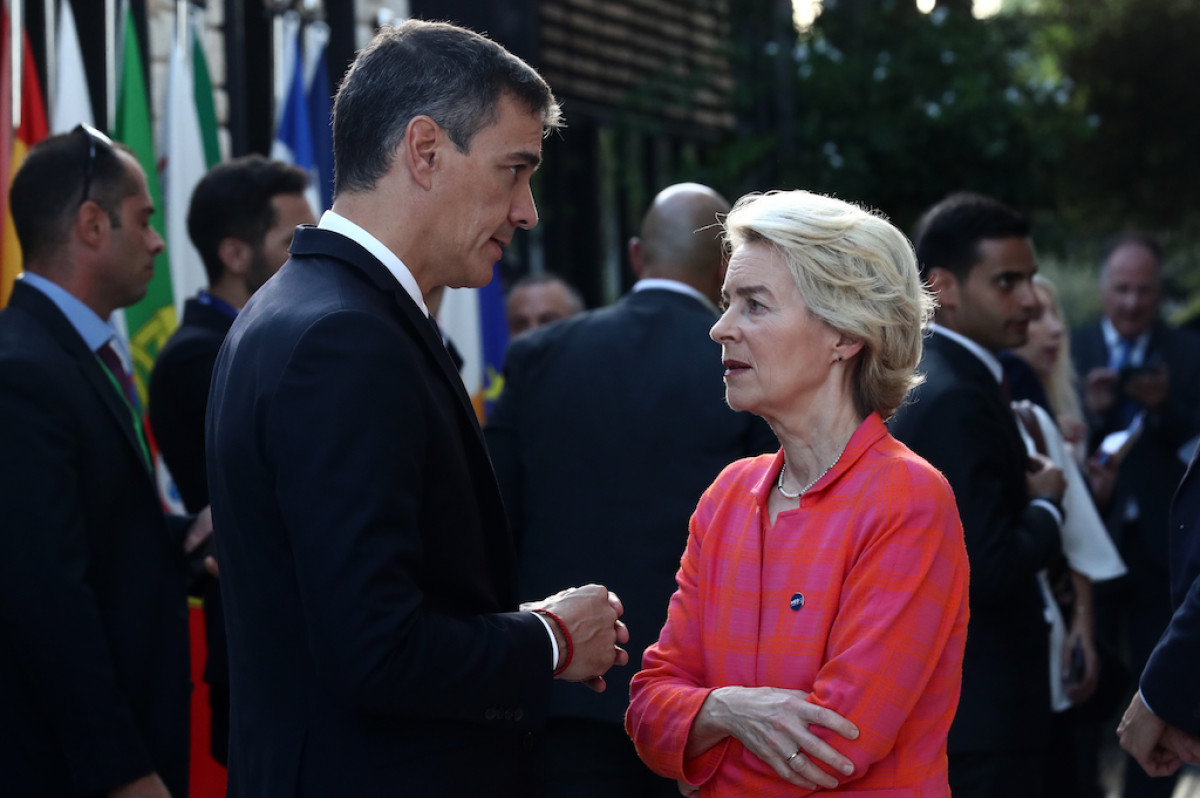
The Prime Minister, Pedro Sánchez, and the President of the European Commission, Ursula Von der Leyen.Pool Moncloa/Fernando Calvo / Europa Press / ContactoPhoto
A question has recently been hovering around the public debate in Spain: Is the President of the Government losing influence in Europe and on the international stage? In its latest edition, The Economist echoed this question and found President Sánchez’s "anti-Trump position" to be worrisome.
At first glance, Sánchez’s situation may seem contradictory. In Madrid, he governs by way of intricate negotiations and delicate balances, while in Brussels he is regarded as a necessity. To a significant extent, Ursula von der Leyen's incumbency at the head of the European Commission depends on him.
Pointing to a member of the Social Democrats, one MEP from the European People’s Party told me, "If those gentlemen wanted, they could bring down the Von der Leyen Commission." An MEP from the Social Democrats replied that "If we lose more governments, we’ll have no incentive to keep on supporting the Commission."
With these calculated words, Weber presented Pedro Sánchez as an example of the political risks that (in his opinion) now threaten Europe; for Weber, there are good socialists and bad socialists.
The message cut two ways – as a reminder to Ursula von der Leyen that her Commission remains standing thanks to the Spanish Socialists, and as a signal to the Parliament that the European People’s Party has no intention of yielding the initiative. Is Weber angling for leadership of an EPP majority that includes the Danish Socialists, Meloni’s partisans, and occasional support from Abascal?
Another paradox is that by making Sánchez a target, Weber is admitting his importance on the EU chessboard. Sánchez becomes the face of a parliamentary bloc without which the EC President would have great difficulty sustaining her position.
Every vote counts, and the votes of the PSOE remain decisive. The conclusion is simple: without disciplined support from Spain’s Socialists, von der Leyen cannot guarantee the continuity of her Commission. Thus Spain’s President of the Government can be said to possess implicit veto power – exercised with the discretion of someone who knows that the threat of even a single withdrawal can alter the balance in Brussels.
As a non-governing party, the PSOE and its MEPs would have less incentive to support von der Leyen. Should Spain’s right and extreme right parties see victory in Madrid and align with EPP factions, von der Leyen’s presidency would cease to be a priority for Spain’s left.
In that scenario, the Commission would find itself between two fires: conservatives pushing to harden the agenda, and Spain’s weakened social democrats withdrawing their tacit support, leaving minimal room for maneuver for von der Leyen.
For those reasons, the "Feijóo factor" isn’t just a matter of internal Spanish politics but a European variable with direct implications for the future of the Commission. I would argue that in the interest of Spanish leadership, it is the responsibility of both the PP and PSOE to act as stabilizers of the European project in the face of extremes. At this crucial time, Spain has a unique opportunity to lead a clearly pro-European project — but understanding must first be forged between the two great Spanish political families.
Both Sánchez and von der Leyen understand this state of affairs – and so does Weber, which is why he underlined the situation while in Strasbourg. The Commission has been pampering him in Brussels, and all three are aware that in this political cycle, Spain wields more influence than would appear logical.
European politics has always been a game of cross-dependencies. This time, the paradox of Spain is embodied by Pedro Sánchez (and also Feijóo): constantly questioned in Madrid, and yet a stabilizing force in Brussels.
BONUS: Nineteen drones described as Russian recently violated Polish air-space; only four were shot down. On Saturday, the presence of similar drones was detected in Romania. To Spaniards who see Poland and Romania as very far away, I recommend reading former NATO Secretary General Fogh Rasmussen: "Spain should look at the war in Ukraine and consider its challenges from the South."
At first glance, Sánchez’s situation may seem contradictory. In Madrid, he governs by way of intricate negotiations and delicate balances, while in Brussels he is regarded as a necessity. To a significant extent, Ursula von der Leyen's incumbency at the head of the European Commission depends on him.
"Without Pedro Sánchez, President von der Leyen would have to choose between resignation or a coalition with the far right"Last week in Strasbourg, I verified this paradox at the State of the European Union debate (SOTEU) and in informal conversations with commissioners and MEPs. One frequently repeated comment was that, without Pedro Sánchez, President von der Leyen would have to choose between resignation or a coalition with the far right – spoken as a warning while offering a glimpse at the new map of European power.
Pointing to a member of the Social Democrats, one MEP from the European People’s Party told me, "If those gentlemen wanted, they could bring down the Von der Leyen Commission." An MEP from the Social Democrats replied that "If we lose more governments, we’ll have no incentive to keep on supporting the Commission."
Weber versus Sánchez and a very fragile majority
A sharp image was presented during the Strasbourg Plenary, when Manfred Weber, leader of the European People’s Party, used his SOTEU speech to again attack Sánchez head-on. "Prime Minister Frederiksen, the Socialist leader, appeared here in July and set out the agenda of the Danish Presidency. He spoke of competitiveness, stopping illegal migration, and security as fundamental pillars. He asked for resolute reduction in bureaucracy in terms of migration. I must say that in today’s Europe, there are two sides to the socialist reality: Sánchez’s socialists and Frederiksen’s socialists. I hope that Spain’s political reality does not spread throughout Europe."With these calculated words, Weber presented Pedro Sánchez as an example of the political risks that (in his opinion) now threaten Europe; for Weber, there are good socialists and bad socialists.
The message cut two ways – as a reminder to Ursula von der Leyen that her Commission remains standing thanks to the Spanish Socialists, and as a signal to the Parliament that the European People’s Party has no intention of yielding the initiative. Is Weber angling for leadership of an EPP majority that includes the Danish Socialists, Meloni’s partisans, and occasional support from Abascal?
Another paradox is that by making Sánchez a target, Weber is admitting his importance on the EU chessboard. Sánchez becomes the face of a parliamentary bloc without which the EC President would have great difficulty sustaining her position.
"Without the disciplined vote of the Spanish Socialists, von der Leyen cannot guarantee the continuity of the Commission. The Spanish president has implicit veto power"The numbers are tough to ignore. Classic majorities involving the PP and Social Democrats joined by liberals and greens have reached their final moment, according to MEPs Adrián Vázquez, Hana Jalloul, and Javi López (in private conversations in Strasbourg following von der Leyen’s speech).
Every vote counts, and the votes of the PSOE remain decisive. The conclusion is simple: without disciplined support from Spain’s Socialists, von der Leyen cannot guarantee the continuity of her Commission. Thus Spain’s President of the Government can be said to possess implicit veto power – exercised with the discretion of someone who knows that the threat of even a single withdrawal can alter the balance in Brussels.
The Spanish contrast
Again, there’s a paradox at play. In Madrid, Pedro Sánchez survives day-by-day in the face of fractious partners, loud opposition, a divided Congress, and judicial sieges. His government always seems to be walking on quicksand. Yet in Brussels, Sánchez is regarded as a guarantor of stability – a President with the power to sustain the institutional architecture of the Union."The 'Feijóo factor' is causing concern in Brussels. If he were to reach La Moncloa with the support of Vox, the European balance would be fundamentally altered"One scenario is worrying Brussels: the "Feijóo factor" – a changing of the guard in Spain. Should PP leader Alberto Núñez Feijóo take charge at La Moncloa with the support of Vox, the prevailing European balance would be fundamentally altered.
As a non-governing party, the PSOE and its MEPs would have less incentive to support von der Leyen. Should Spain’s right and extreme right parties see victory in Madrid and align with EPP factions, von der Leyen’s presidency would cease to be a priority for Spain’s left.
In that scenario, the Commission would find itself between two fires: conservatives pushing to harden the agenda, and Spain’s weakened social democrats withdrawing their tacit support, leaving minimal room for maneuver for von der Leyen.
For those reasons, the "Feijóo factor" isn’t just a matter of internal Spanish politics but a European variable with direct implications for the future of the Commission. I would argue that in the interest of Spanish leadership, it is the responsibility of both the PP and PSOE to act as stabilizers of the European project in the face of extremes. At this crucial time, Spain has a unique opportunity to lead a clearly pro-European project — but understanding must first be forged between the two great Spanish political families.
In the balance between Madrid and Brussels
Ursula von der Leyen is trapped between two forces – if she loses Social Democrat support, she will be pulled to the far right, which would erode her legitimacy and spark an institutional crisis.Both Sánchez and von der Leyen understand this state of affairs – and so does Weber, which is why he underlined the situation while in Strasbourg. The Commission has been pampering him in Brussels, and all three are aware that in this political cycle, Spain wields more influence than would appear logical.
"In the halls in Brussels, specifically in the office of the super chief of staff Bjoern Seibert, the equation is clear"In the halls of Brussels the equation is clear: von der Leyen minus Sánchez equals von der Leyen plus Vox, Meloni, Orbán, and possibly Le Pen. That’s a price that many are unwilling to pay. Pay attention to France: if Lecornu fails to approve a budget in December, Macron could depart, opening potential for Le Pen as Prime Minister and shattering the President’s "domain reserve" in matters of economy and foreign relations.
European politics has always been a game of cross-dependencies. This time, the paradox of Spain is embodied by Pedro Sánchez (and also Feijóo): constantly questioned in Madrid, and yet a stabilizing force in Brussels.
BONUS: Nineteen drones described as Russian recently violated Polish air-space; only four were shot down. On Saturday, the presence of similar drones was detected in Romania. To Spaniards who see Poland and Romania as very far away, I recommend reading former NATO Secretary General Fogh Rasmussen: "Spain should look at the war in Ukraine and consider its challenges from the South."
Ahora en portada
17 de octubre de 2026
16 de octubre de 2026
Lo más leído