Lunes, 19 de octubre de 2026




EUROPEAN POLITICS
Poland's presidential elections will shape Europe's future
Poland goes into a crucial presidential run-off that will measure the strength of Donald Tusk's project to restore democracy and the country's weight in Europe. With a narrow lead for the liberal Rafał Trzaskowski over the PiS candidate, Tusk's ability to overcome presidential obstruction and consolidate change is at stake, with important implications for the EU.

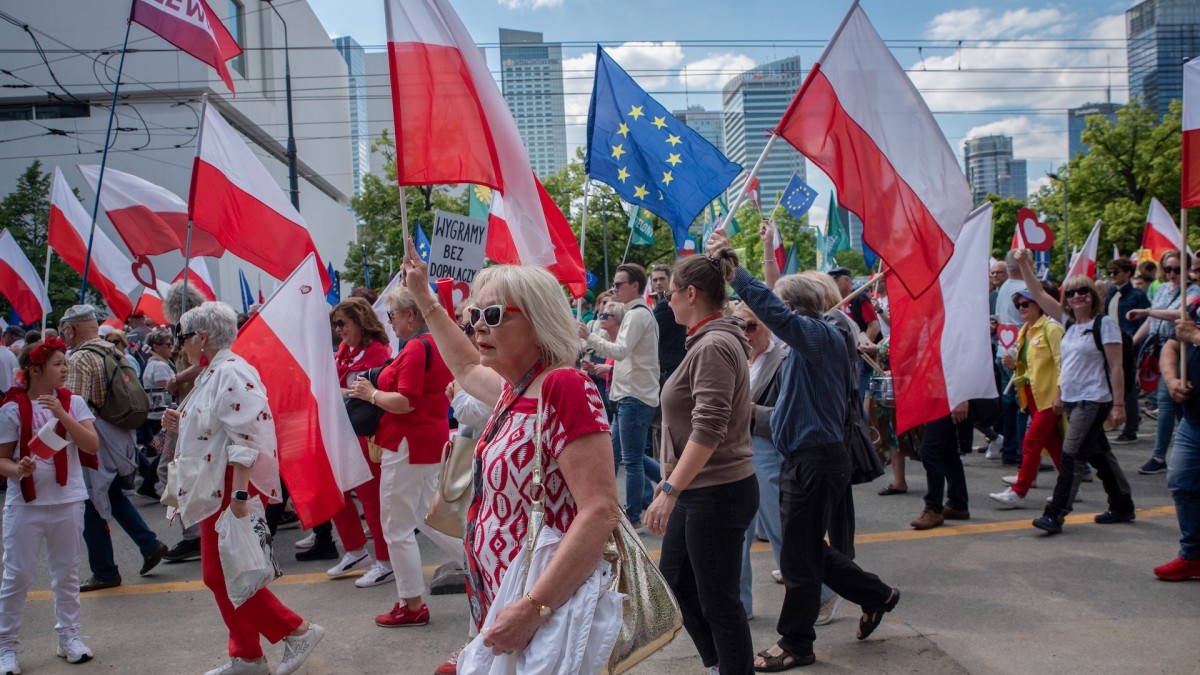
The march of the patriots, promoted by Civic Platform on May 25th.Agnieszka Pazdykiewicz / Zuma Press / ContactoPhoto
Poland heads to the polls this Sunday, 1st June, for the second round of the presidential elections. The narrow advantage obtained in the first round by the liberal candidate, Rafał Trzaskowski, over the candidate backed by PiS (Law and Justice), Mateusz Nawrocki, has sent a clear signal: Prime Minister Donald Tusk's ambitious agenda to restore Poland's democratic position and consolidate its role as a European heavyweight faces a crucial test.
There is much at stake in the decision of the Poles for a Europe grappling with its own challenges, especially in the context of the ongoing war in Ukraine and growing geopolitical isolation.

The initial results, which gave Trzaskowski a slight advantage of 31.4% versus 29.5% for his hard-right opponent, have been received with a mixture of relief and apprehension in pro-European circles. A win is a win; nevertheless, the closeness of the contest, warns Joanna Burnos, Expert at Team Europe Direct in the European Commission Warsaw Representation Office, "should make us pause. A close race in itself isn't alarming, but the fact that a nationalist conservative candidate backed by PiS, after years of democratic erosion, can still command such solid support does raise concerns. It tells us that authoritarian populism has left a lasting imprint". This sentiment underscores a central anxiety: Tusk's government, despite winning parliamentary elections in late 2023 with a mandate for change, risks continued obstruction if the presidency remains in adversarial hands.
In Poland, executive power rests with the Prime Minister and his cabinet. However, the President holds key powers in foreign policy, the army and, crucially, the ability to veto legislation. This has posed an impediment to Civic Platform's reform agenda—Donald Tusk's party.
This potential legislative gridlock is particularly concerning for Tusk's efforts to reverse democratic backsliding and address rule-of-law issues that plagued Poland under the previous PiS administration. Przybylski explains that Tusk had "strategically postponed the most important reforms until the time of the presidential elections", including crucial judicial reforms and a second attempt to liberalise abortion laws, which previously failed due to incoherence within the governing coalition itself.
Dr Piotr Gałązka, expert at Team Europe Direct in the European Commission Warsaw Representation Office, concurs, stating that "many of the projects proposed by the government or by the Civic Platform party did not prosper, either because there was no agreement in the coalition or due to President Duda's vetoes".

However, until Tusk's coalition victory in 2023, the nationalist Law and Justice (PiS) party and its allies had implemented an illiberal agenda without barriers during the previous decade. Przybylski attributes this to deeply rooted historical and cultural factors: "There is a sense of scepticism towards large centralised projects of a supranational character. There's a strong sentiment about protecting sovereignty due to the 250 years of subjugation by other empires in Europe. That sentiment is strong, it's an element of Poland's political culture. It's not going to be eradicated in any way". He clarifies, however, that this doesn't necessarily translate into a desire to leave the EU, but rather a cautiousness that can be "instrumentalised by different political parties".
Whilst Przybylski asserts that "the distribution of wealth, the distribution of success, can be seen in every corner" and that unemployment is amongst the lowest in Europe, he also acknowledges a "relative sense of not gaining what others are gaining through recent economic growth" amongst some. Burnos echoes this, stating: "Ordinary citizens still face rising prices, housing shortages, and inequalities. For liberal reform to succeed, it must be felt in real terms: better public services, fair wages, clean air, and affordable housing". Market confidence, she adds, "doesn't automatically translate into better quality of life".
Dr Gałązka offers a slightly different perspective on economic success, suggesting it occurred "despite the lack of help from the political class" and was driven by "the hard work of all Poles". Sunday's elections could well pave Tusk's path or, conversely, plunge Poland into the circle of scepticism and political disconnection that PiS has provoked.
A strong, democratic, and economically vibrant Poland, firmly anchored in the European Union, is therefore paramount for the bloc's overall strength and security. Tusk's agenda explicitly aims to "strengthen the country in the context of the European Union" and move away from the previous government's oppositional stance. The alternative, as Przybylski warns, is a Poland "that opposes much more strongly a political agenda oriented towards Eurosceptic nationalism".
Conversely, a Nawrocki victory would almost certainly lead to continued, if not intensified, political trench warfare. "Clearly, there's a danger for the government and for Donald Tusk himself" if the PiS candidate wins, admits Przybylski, though he notes that Tusk's team is trying to frame the elections not as a referendum on their management but on the "moral quality" of PiS leadership.
Dr Gałązka, however, is less concerned about the government's immediate collapse, citing constitutional safeguards. The real risk, he believes, is that "the government's effectiveness will be at stake", as a PiS-aligned president "might be interested in slowing down the government's work to gain support for the PiS party in the next elections".
Voter mobilisation will be key. Przybylski suggests that Trzaskowski could gain a decisive advantage "if he manages to mobilise the electorate that stayed at home" in the first round, which was "mainly an electorate of coalition members". He also needs to ensure that supporters of other candidates, particularly left-wing or anti-establishment ones, don't overwhelmingly flock to Nawrocki or simply stay at home. Dr Gałązka underscores this uncertainty, noting that many voters who backed unsuccessful first-round candidates "are so disappointed with the choices they have that they will decide to stay at home".
On Sunday there are European elections in Poland. For the country they are a test of "whether Polish democracy can renew itself after years of institutional capture", as Burnos aptly states. Donald Tusk's ability to implement his vision of a democratic, prosperous, and influential Poland depends significantly on whether he will have a partner or an adversary in the presidential palace. But the impact transcends the national level: Tusk is a key figure for the future of the European project, which is going through one of its most decisive stages in the face of growing challenges in security, defence, and democratic quality. Europe will be watching closely.
There is much at stake in the decision of the Poles for a Europe grappling with its own challenges, especially in the context of the ongoing war in Ukraine and growing geopolitical isolation.
The initial results, which gave Trzaskowski a slight advantage of 31.4% versus 29.5% for his hard-right opponent, have been received with a mixture of relief and apprehension in pro-European circles. A win is a win; nevertheless, the closeness of the contest, warns Joanna Burnos, Expert at Team Europe Direct in the European Commission Warsaw Representation Office, "should make us pause. A close race in itself isn't alarming, but the fact that a nationalist conservative candidate backed by PiS, after years of democratic erosion, can still command such solid support does raise concerns. It tells us that authoritarian populism has left a lasting imprint". This sentiment underscores a central anxiety: Tusk's government, despite winning parliamentary elections in late 2023 with a mandate for change, risks continued obstruction if the presidency remains in adversarial hands.
In Poland, executive power rests with the Prime Minister and his cabinet. However, the President holds key powers in foreign policy, the army and, crucially, the ability to veto legislation. This has posed an impediment to Civic Platform's reform agenda—Donald Tusk's party.
"A close race in itself isn't alarming, but the fact that a nationalist conservative candidate backed by PiS can still command such solid support tells us that authoritarian populism has left a lasting imprint"Wojciech Przybylski, Director of the Res Publica Foundation and editor of Visegrad Insight, notes the existing difficulties. "The government has had to be cautious and, at times, face the reality that Andrzej Duda was going to veto some of Civic Platform's initiatives". He tallied five direct vetoes alongside several "conditional vetoes", where legislation is sent to the Constitutional Tribunal, effectively blocking government policy, as most of these judges were appointed by the PiS government. A president aligned with PiS, as Burnos puts it, "can block or stall almost any meaningful reform, especially on the judiciary, media independence, and women's rights... Tusk's coalition has a mandate for change, but without a cooperative presidency, that mandate is constantly under siege".
This potential legislative gridlock is particularly concerning for Tusk's efforts to reverse democratic backsliding and address rule-of-law issues that plagued Poland under the previous PiS administration. Przybylski explains that Tusk had "strategically postponed the most important reforms until the time of the presidential elections", including crucial judicial reforms and a second attempt to liberalise abortion laws, which previously failed due to incoherence within the governing coalition itself.
Dr Piotr Gałązka, expert at Team Europe Direct in the European Commission Warsaw Representation Office, concurs, stating that "many of the projects proposed by the government or by the Civic Platform party did not prosper, either because there was no agreement in the coalition or due to President Duda's vetoes".
The Polish Paradox
From the outside, the country's politics are perplexing. Poland is the great success story of European integration: its GDP per capita has increased exponentially since the fall of communism and its entry into the European Union, reaching levels comparable to those of Spain. This year, its stock market is the European champion, registering gains that have seen it almost triple in value since 2022. As Dr Gałązka notes, the Polish stock exchange's liquidity is improving and there's hope for further development, partly thanks to EU initiatives.However, until Tusk's coalition victory in 2023, the nationalist Law and Justice (PiS) party and its allies had implemented an illiberal agenda without barriers during the previous decade. Przybylski attributes this to deeply rooted historical and cultural factors: "There is a sense of scepticism towards large centralised projects of a supranational character. There's a strong sentiment about protecting sovereignty due to the 250 years of subjugation by other empires in Europe. That sentiment is strong, it's an element of Poland's political culture. It's not going to be eradicated in any way". He clarifies, however, that this doesn't necessarily translate into a desire to leave the EU, but rather a cautiousness that can be "instrumentalised by different political parties".
"There's a strong sentiment about protecting sovereignty due to the 250 years of subjugation by other empires in Europe. It's an element of Poland's political culture. It's not going to be eradicated in any way"Joanna Burnos attributes PiS's appeal to a potent mix of "cultural anxiety, economic insecurity, and nationalism". She argues that "many voters, particularly in rural areas, feel that European integration has left them behind. They associate Brussels with values and changes they don't always understand or welcome. PiS has exploited these sentiments by offering a narrative of protection and tradition". This underscores a crucial challenge for Tusk's government: ensuring that macroeconomic success reaches all segments of the population.
Whilst Przybylski asserts that "the distribution of wealth, the distribution of success, can be seen in every corner" and that unemployment is amongst the lowest in Europe, he also acknowledges a "relative sense of not gaining what others are gaining through recent economic growth" amongst some. Burnos echoes this, stating: "Ordinary citizens still face rising prices, housing shortages, and inequalities. For liberal reform to succeed, it must be felt in real terms: better public services, fair wages, clean air, and affordable housing". Market confidence, she adds, "doesn't automatically translate into better quality of life".
Dr Gałązka offers a slightly different perspective on economic success, suggesting it occurred "despite the lack of help from the political class" and was driven by "the hard work of all Poles". Sunday's elections could well pave Tusk's path or, conversely, plunge Poland into the circle of scepticism and political disconnection that PiS has provoked.
Tusk's Success is a Key Piece for Europe
Since Russia's illegal invasion of Ukraine, Poland's geopolitical importance has magnified. Its firm stance regarding Moscow before the conflict, strong defence investments, and its role as a crucial logistical hub for the continent's defence have transformed it into one of Europe's undeniable heavyweights. Przybylski notes the high levels of immigration from Ukraine to Poland, even before the 2022 invasion, with Poland topping Eurostat data on first residence permits for five consecutive years.A strong, democratic, and economically vibrant Poland, firmly anchored in the European Union, is therefore paramount for the bloc's overall strength and security. Tusk's agenda explicitly aims to "strengthen the country in the context of the European Union" and move away from the previous government's oppositional stance. The alternative, as Przybylski warns, is a Poland "that opposes much more strongly a political agenda oriented towards Eurosceptic nationalism".
"A strong, democratic, and economically vibrant Poland, firmly anchored in the European Union, is paramount for the bloc's overall strength and security"The presidential elections are thus a crucial juncture. A Trzaskowski victory, aligned with Tusk's government, would likely streamline the legislative process. Dr Gałązka expresses a common hope: "if Trzaskowski is elected president, the legislative processes will be smoother. And there will be no risk of any law passed in parliament being rejected at the presidential level". This would allow Tusk to accelerate his reform agenda, not only on rule-of-law issues but also on broader economic and social policies.
Conversely, a Nawrocki victory would almost certainly lead to continued, if not intensified, political trench warfare. "Clearly, there's a danger for the government and for Donald Tusk himself" if the PiS candidate wins, admits Przybylski, though he notes that Tusk's team is trying to frame the elections not as a referendum on their management but on the "moral quality" of PiS leadership.
Dr Gałązka, however, is less concerned about the government's immediate collapse, citing constitutional safeguards. The real risk, he believes, is that "the government's effectiveness will be at stake", as a PiS-aligned president "might be interested in slowing down the government's work to gain support for the PiS party in the next elections".
"If Trzaskowski is elected president, the legislative processes will be smoother. And there will be no risk of any law passed in parliament being rejected at the presidential level"Joanna Burnos emphasises the need for leadership that transcends partisan divides: "Today Poland urgently needs a true statesman who will be able to unite an extremely polarised society". She argues that Tusk's coalition, despite its internal differences, is united by "the belief in the rule of law, in European cooperation, in restoring democratic institutions. That's not simply being anti-PiS, it's being pro-Poland in a strong and effective Europe".
Voter mobilisation will be key. Przybylski suggests that Trzaskowski could gain a decisive advantage "if he manages to mobilise the electorate that stayed at home" in the first round, which was "mainly an electorate of coalition members". He also needs to ensure that supporters of other candidates, particularly left-wing or anti-establishment ones, don't overwhelmingly flock to Nawrocki or simply stay at home. Dr Gałązka underscores this uncertainty, noting that many voters who backed unsuccessful first-round candidates "are so disappointed with the choices they have that they will decide to stay at home".
On Sunday there are European elections in Poland. For the country they are a test of "whether Polish democracy can renew itself after years of institutional capture", as Burnos aptly states. Donald Tusk's ability to implement his vision of a democratic, prosperous, and influential Poland depends significantly on whether he will have a partner or an adversary in the presidential palace. But the impact transcends the national level: Tusk is a key figure for the future of the European project, which is going through one of its most decisive stages in the face of growing challenges in security, defence, and democratic quality. Europe will be watching closely.
Ahora en portada
19 de octubre de 2026
19 de octubre de 2026
Noticias relacionadas
Hace 73 semanas
The European Commissioner for Defense on Agenda Pública: "Spain has a very strong defense industry"
Hace 73 semanas