Viernes, 16 de octubre de 2026




CONVERSATIONS
Mateo Valero: "Barcelona can lead chip design in Europe"
Marca España. We talk to Mateo Valero, the director of the European supercomputer of reference: the Barcelona Supercomputing Center (BSC). We address some of the main political and economic priorities of the moment: the development of European Artificial Intelligence, the role of the State and of large Spanish companies in contributing to our leadership and the need for diplomatic support to boost our industrial development. "If the market is protected," he warns, "in ten years’ time we can have better chips than anyone else." It's our big opportunity.

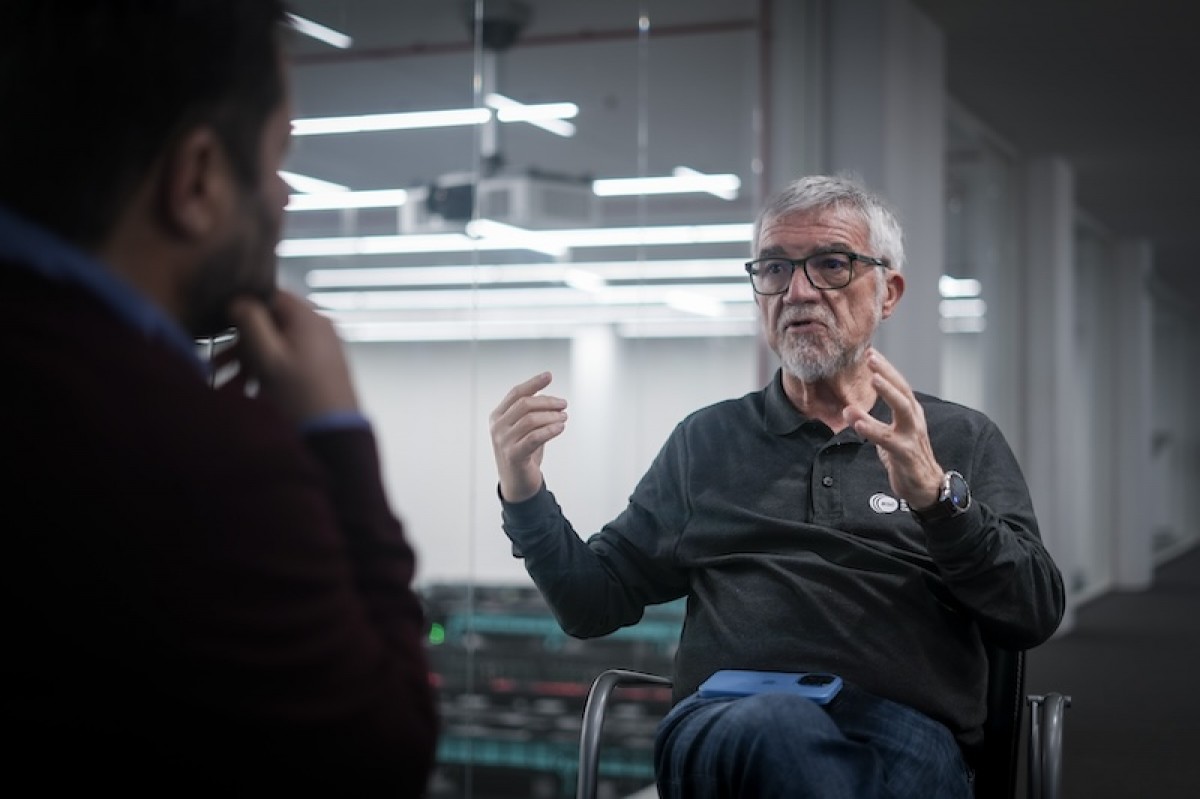
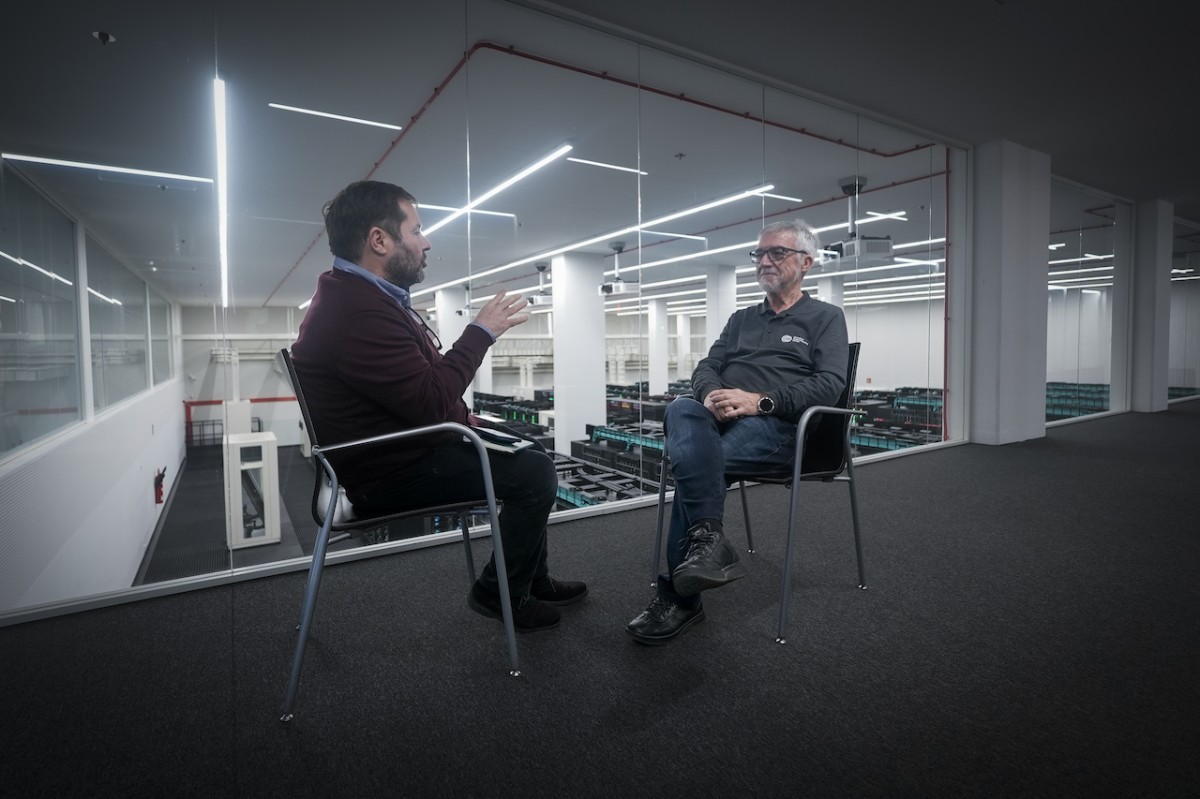
Mateo Valero in the conversation with Marc López Plana.Agenda Pública / Tsun Ho
Mateo Valero talks to Marc López Plana, editor and director of Agenda Pública, about some of the issues that should be occupying more space on our economic and social agenda: how states and companies have the capacity to develop a knowledge industry that will consolidate Europe in the world to come, and that is already here. ‘We have been very timid with state aid. I hope that now with Trump we will not be timid and will protect our companies,’ he says.
Valero, who runs a world-leading supercomputing centre, points out that "there are three types of Artificial Intelligence" and that of ’big companies — which are dominating the world and have made us slaves without declaring war on us. They use internet data, they use our data, they steal all our data to train the networks. And what is the objective? To make money’. For this reason, he proposes implementing a European strategy so that "this data does not leave Europe" and so that "our companies are more productive". It is in our hands.
What do you do at the Barcelona Supercomputing Centre?
The BSC is a research centre that uses supercomputers. A supercomputer is a very fast computer containing many processors, each with its own memory, connected through an interconnection network that allows the exchange of bits with low latency (the time required between when one processor sends a message to another and the first bit arrives) and high bandwidth (the number of bits that two processors can exchange per unit of time).
Supercomputers have such large memory that they can run models and programmes that handle enormous volumes of data. For example, in current language models, such as LLMs (Large Language Models), we work with a trillion parameters. In American notation, a trillion equals 1012. If each number occupies, for example, 8 bytes, the required memory would be 8 terabytes. However, this figure is relatively small compared to other applications.
When complex simulations are performed, such as a digital twin of the Earth, the model divides the planet into multiple layers or meshes, with sample points in each layer where system variables are evaluated. This generates an enormous number of variables. If the complete model doesn't fit in the supercomputer's memory, the programme will have to resort to disks to access the data, which significantly slows down the process due to the slower access speed of disks compared to memory.
In Mare Nostrum 5, for example, there are more than 200 petabytes of disk storage. In addition, these disks are connected to tape storage systems, which are a more economical alternative but with much longer access times. Tapes are used to store data that is not frequently needed, thus optimising the use of storage resources.
The first thing AI did in terms of reaching society was to beat the world champion at chess. The first match of Deep Blue against a champion was organised here, in Barcelona, at the Hilton, in 1995, and it was organised by my team. The player was Miquel Illescas, who was then number seven in the world. And he won. A few years later it was DeepBlue who beat Kasparov. But on a global level, AI really surprised society with ChatGPT.
AI needs a lot of data to train models that, I must tell you, nobody knows how they work, not Google, not anyone. For the first time, we are governed by things we don't know how they work.
Why do you say we don't know how they work?
Neural networks—the largest are an American trillion (1012)—need to be trained. Once trained, they will be able to answer more or less complicated questions. Nobody knows how these values or parameters are calculated. And very few people know what it does. The basic creation of that network is matrix multiplication.
You mentioned supercomputing for research. What do you research here?
There are three types of AI. Always with language models. There's that of large companies—which are dominating the world and have made us slaves without declaring war on us—. They use internet data, they use our data, they steal all our data to train networks. And what is the objective? To make money.
Between the large technology companies and the supercomputing centres are businesses and administrations. Small, medium, or somewhat larger companies have two options. One is to hand over their data to multinationals, which is equivalent to putting wolves in charge of sheep. The other is to bet on a European strategy, which for now is all we have left, and try to ensure that this data does not leave Europe, allowing neural networks to be trained with them so that our companies are more productive.
The European initiative AI Factories has emerged along these lines.
What are AI Factories?
What the AI Factory provides are machines (in our case, it's an update of Mare Nostrum5). We are going to buy another machine in which each chip is thirty times faster than each of the ones the current supercomputer has.
There's Finland with the supercomputer LUMI. It's a consortium of eight countries. Then there's Germany, France, Italy, and us. Not at the scientific level, but at the political level they have more strength. If instead of four there were five, we would surely get it. And even if there are three, we will still fight.
So we are in a battle to get a gigafactory from the European Union?
At the Barcelona Supercomputing Centre there are 4,500 GPUs. We're talking about each gigafactory having 100,000, like Tesla has; like X, which has already released Grok, and like Meta has. Google wants to make one with 1.3 million GPUs. The objective of the gigafactories will be that any activity of any country can try to use AI to improve it.
A digital twin of the human body? So I understand, how to reproduce it?
A twin of your body, with which you can experiment. It's very complicated because we know nothing about your brain. We have parts of the body. We know, more or less, how genes influence health. We can make micro-organs, for example, with which to experiment.
So it's a twin of each of us.
Personalised, with your medical history. We were pioneers in making a digital twin of the heart, in fact not only of the heart, but of the entire circulatory system. In health, Catalonia could be number one in Europe.
In earth simulation, we are number one as well. The project is called Destination Earth.
Note that we are now 1,250 people. We attract talent. 32% are from sixty countries. When it comes to attracting talent, we have a place, which is Barcelona, that is ideal. The culture, the gastronomy.
What do they do? We have a department of Computer Science, which has 400 researchers, everything you want to know to build programmed computers. And then we have three vertical application areas: engineering, earth sciences, life sciences... With all this that we have here, a researcher now has no excuses, they have to dream.
You've talked about public capital. The question is: what is the good formula between public capital and private capital for this supercomputing with AI at the service of research to work?
Let's see. It's a trick question. It's a problem that Spain has, which we are correcting. We only dedicate 1.49% of GDP to R&D. Of that 1.49%, the participation of companies is lower in percentage compared to other industrialised countries. In Spain, companies contribute 55%, but in industrialised countries, they are at more than 70%. We need companies to get more involved.
Is the use of the computer free?
At the BSC we use 20%. The 80% is for any Spanish or European researcher who has to present their projects to evaluation committees in which we are not represented. Moreover, we survive on what we do. Consider that of the 1,250 of us, there are only fourteen civil servants. There is no centre in Spain or in the world that has those percentages. It is practically self-financing: 80% competitive and 20% institutional.
Explain to me, for example, the relationship with Repsol.
They came here in 2005 and explained their problem: they wanted to optimise the location of drillings in hostile environments, such as the Gulf of Mexico. There, they must go through two kilometres of water, then a kilometre of land, and then approximately a kilometre and a half of salt. If there is anything valuable, it's below that layer of salt.
At that time, they were successful in one out of ten drillings. Now, they have improved, but they still hit only one out of seven. Each drilling costs 100 million dollars.
Let's change the subject. What are you doing in the field of chips that contribute so much to strategic autonomy?
When Europe determined in 2017 that supercomputing was a strategic area and that supercomputers were increasingly expensive, it decided to promote a European-level project: EuroHPC.
This programme had two objectives. The first, to provide Europe with powerful supercomputers. The second, given that there was no European technology in this field, to promote the development of chips that could be used in supercomputers, in the training of artificial intelligence models, and in many other applications derived from AI.
By the way, a key aspect: artificial intelligence influences so much of what we do that supercomputing centres should be called AI centres. And those with the fastest supercomputers are the best, because they can develop advances impossible elsewhere.
When you say in-house chip production, what exactly are you referring to?
We really like collaboration between institutions. We say that we are a product of collaboration between ideas, society, and companies. Research not only has to be excellent, it has to be relevant, solving problems that society has.
I hope to be able to say, in three or four years, that Mare Nostrum 6 has some chip manufactured in Barcelona. We would like Barcelona to be the city of chip design in Europe.
Now all the chips from Intel, ARM, NVIDIA, are going to be changed, because there is an initiative called RISC-V, which is open source. Just as in Linux software changed all operating systems, this will also happen with chips. Within ten years, most chips will follow this philosophy. We have a unique opportunity in Barcelona to create 10,000 jobs designing chips with people who earn a lot of money, and this would totally change the city.
So, what about the Taiwan chips that generate the battle between the US and China?
There are two concepts in chips. First, there are many types. The truly strategic ones are those that use the smallest transistors, that is, those that allow more transistors per square centimetre to be included. We are now at 2 nanometres, and we are approaching the point where there will be so few silicon atoms that quantum phenomena will begin to appear, which will prevent further reduction in size. To put it in perspective, in 10 square centimetres we have 100 billion transistors, the same amount as neurons in the human body, 1011.
But in addition, the transistors that are there (he points to the supercomputer), in NVIDIA's chips, switch at 2 billion times per second (2 GHz). And of those we have millions. That's a supercomputer.
So, there are two concepts: designing and manufacturing. Among chips, there are some that are relatively simple, like those used in normal cars, whose transistors are between twelve and twenty-eight nanometres. But the big war is in manufacturing chips with the smallest transistor.
In the world, there are only two companies that design and manufacture chips: Samsung and Intel. But Samsung has a more modern factory than Intel. This has generated panic in the US, which has realised that the chips for their planes are manufactured in Taiwan. That's why they protect Taiwan. I've been saying for five years that if China dared to invade Taiwan, TSMC is mined and would blow up. To avoid this scenario, the US has gotten TSMC to build a factory in Arizona and Samsung to make factories in Austin. The Americans will allow China to invade Taiwan when not a single chip is manufactured there anymore.
Where does Europe stand then?
In Europe, neither is designed nor manufactured. The large companies that design chips, such as NVIDIA and Apple, don't have factories. They are "fabless", that is, they design, but manufacture at TSMC or Samsung. Europe doesn't have factories. That's why it was attempted—and here I give you a very important message—for Europe to have state-of-the-art factories. But then Europe proved that it is not Europe. A manufacturing plant is not a problem for a single country, it's a European problem. However, Germany wanted its own and France its own.
The latest example is the announcement made by Macron of a French plan of 109 billion euros at the AI summit in Paris, with money from the United Arab Emirates and Canada. And two days later, Von der Leyen announced a European plan.
Explain to me the chip that you want.
What I would like is for Mare Nostrum 6 to have chips that, although they won't be able to compete with those from NVIDIA, are a step forward, so that if it goes well in the second step, we can already compete. If the market is protected, I have no doubt that in Europe in ten years we can have chips better than any other.
What does protecting the market mean?
It's public protection. I believe the US has done it all along. Protecting companies. In Europe, we have been very timid with state aid. I hope that now with Trump we won't be timid and will protect our companies.
But the most important thing is that AI is at the service of the productive sector and society. Here we have several spin-offs that I'm very proud of.
The objective of science is not to publish, it is to solve society's problems. It is to make a country more productive, with more jobs and a better world.
Is this what differentiates us from the US?
Yes, it's one of the things that differentiates us.
This is what the gigafactories are for. Bringing AI to any corner where we can take advantage of it. For example, we have decided to make dual technology for national and European security. I believe it's our obligation. We have the best simulator of aircraft in flight, which is a mixture that we make here with AI. Airbus has said it's the best simulator in the world. Well, that can create many jobs. The objective is to create high-quality jobs. To do that, you need to have ideas that believe in companies.
Let's go back, to finish, to Barcelona's desire to get an AI gigafactory.
There's going to be a tremendous battle to place centres that will have more than 100,000 accelerators; they can have more than 200,000. Currently, at the Barcelona Supercomputing Centre, we have 4,500 and, even so, we are in eighth place worldwide. In comparison, Meta has 100,000, Google plans to reach 1.3 million, and Elon Musk already has 200 million. It's a dizzying scenario.
We have already sent the first report, but we lack—and this is not criticism—having high-level Spanish people in decision-making positions in Europe. Especially in science, we don't have anyone.
And, finally, I want to ask you about energy. All of this consumes a lot of energy. How do we make it compatible with the ecological transition?
Each chip consumes a lot of energy. We know that globally, an energy equivalent to 3,000 nuclear power plants of one gigawatt each is needed. Spain consumes thirty gigawatts in total, which is 1% of the energy spent globally. 1% is also what these machines currently spend in the US.
But keep in mind that they spend energy, but their use means that much more energy is produced, so the balance is totally positive for the unit. Cases such as fusion, climate change, or new materials. I'll give you another case, how planes fly, cars, batteries. Without these machines, we wouldn't have, for example, wind turbines for Iberdrola that we make here and are between 15 and 20% more efficient. Our Computer Sciences department researches, for example, how to optimise the energy spent by chips.
Thank you very much, Mateo.
Valero, who runs a world-leading supercomputing centre, points out that "there are three types of Artificial Intelligence" and that of ’big companies — which are dominating the world and have made us slaves without declaring war on us. They use internet data, they use our data, they steal all our data to train the networks. And what is the objective? To make money’. For this reason, he proposes implementing a European strategy so that "this data does not leave Europe" and so that "our companies are more productive". It is in our hands.
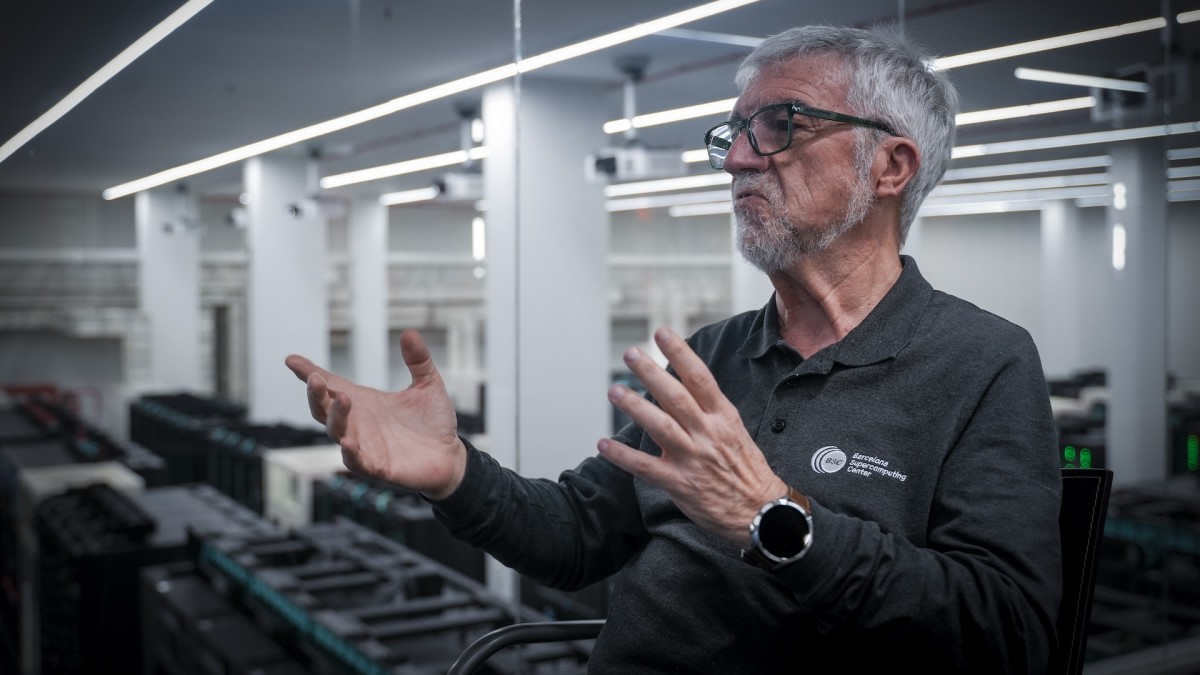
Mateo Valero in front of the BSC supercomputer, which with 4,500 GPUs is the eighth largest in the world. Foto: Agenda Pública / Tsun Ho
What do you do at the Barcelona Supercomputing Centre?
The BSC is a research centre that uses supercomputers. A supercomputer is a very fast computer containing many processors, each with its own memory, connected through an interconnection network that allows the exchange of bits with low latency (the time required between when one processor sends a message to another and the first bit arrives) and high bandwidth (the number of bits that two processors can exchange per unit of time).
"A supercomputer is composed of thousands or even millions of processors, allowing large volumes of information to be processed in parallel"A supercomputer is composed of thousands or even millions of processors, allowing large volumes of information to be processed in parallel. The fundamental idea is that if a programme can be divided into a million independent tasks and we have a million processors, each processor can execute one of these tasks simultaneously. In theory, this would allow calculations to be accelerated up to a million times. To put it in perspective, a million times faster means that a task that would require 125 years on a computer with a single processor could be completed in just one hour.
Supercomputers have such large memory that they can run models and programmes that handle enormous volumes of data. For example, in current language models, such as LLMs (Large Language Models), we work with a trillion parameters. In American notation, a trillion equals 1012. If each number occupies, for example, 8 bytes, the required memory would be 8 terabytes. However, this figure is relatively small compared to other applications.
When complex simulations are performed, such as a digital twin of the Earth, the model divides the planet into multiple layers or meshes, with sample points in each layer where system variables are evaluated. This generates an enormous number of variables. If the complete model doesn't fit in the supercomputer's memory, the programme will have to resort to disks to access the data, which significantly slows down the process due to the slower access speed of disks compared to memory.
In Mare Nostrum 5, for example, there are more than 200 petabytes of disk storage. In addition, these disks are connected to tape storage systems, which are a more economical alternative but with much longer access times. Tapes are used to store data that is not frequently needed, thus optimising the use of storage resources.
"AI needs a lot of data to train models that, I must tell you, nobody knows how they work. For the first time, we are governed by things we don't know how they work"This is what a supercomputer is. Processors, memory, interconnection network, secondary storage which are disks and tapes, programmes and people who make those programmes. What has happened now is that artificial intelligence (AI) has burst onto the scene. Data and supercomputing have taken AI out of the closet. With the concept of AI, which dates back to 1956, people made many speculations. Just as with quantum computing, suddenly something will appear and take over. With AI, this moment has arrived.
The first thing AI did in terms of reaching society was to beat the world champion at chess. The first match of Deep Blue against a champion was organised here, in Barcelona, at the Hilton, in 1995, and it was organised by my team. The player was Miquel Illescas, who was then number seven in the world. And he won. A few years later it was DeepBlue who beat Kasparov. But on a global level, AI really surprised society with ChatGPT.
AI needs a lot of data to train models that, I must tell you, nobody knows how they work, not Google, not anyone. For the first time, we are governed by things we don't know how they work.
Why do you say we don't know how they work?
Neural networks—the largest are an American trillion (1012)—need to be trained. Once trained, they will be able to answer more or less complicated questions. Nobody knows how these values or parameters are calculated. And very few people know what it does. The basic creation of that network is matrix multiplication.
"Europe, use your data to be more competitive!"Now supercomputing centres are changing the way we do research because we have AI. And many things we did by applying formulas from physics, chemistry, and mathematics can now be done simply with AI or with a combination of the methods we were using plus AI. I'll give you an example, the simulation of ITER. Or if you want to simulate the dynamics of an entire aircraft with fluid dynamics techniques, we know the physics, but executing those operations takes centuries. So, with some data calculated from that simulation, you train a neural network and verify that the network gives you that data that would take years to calculate.
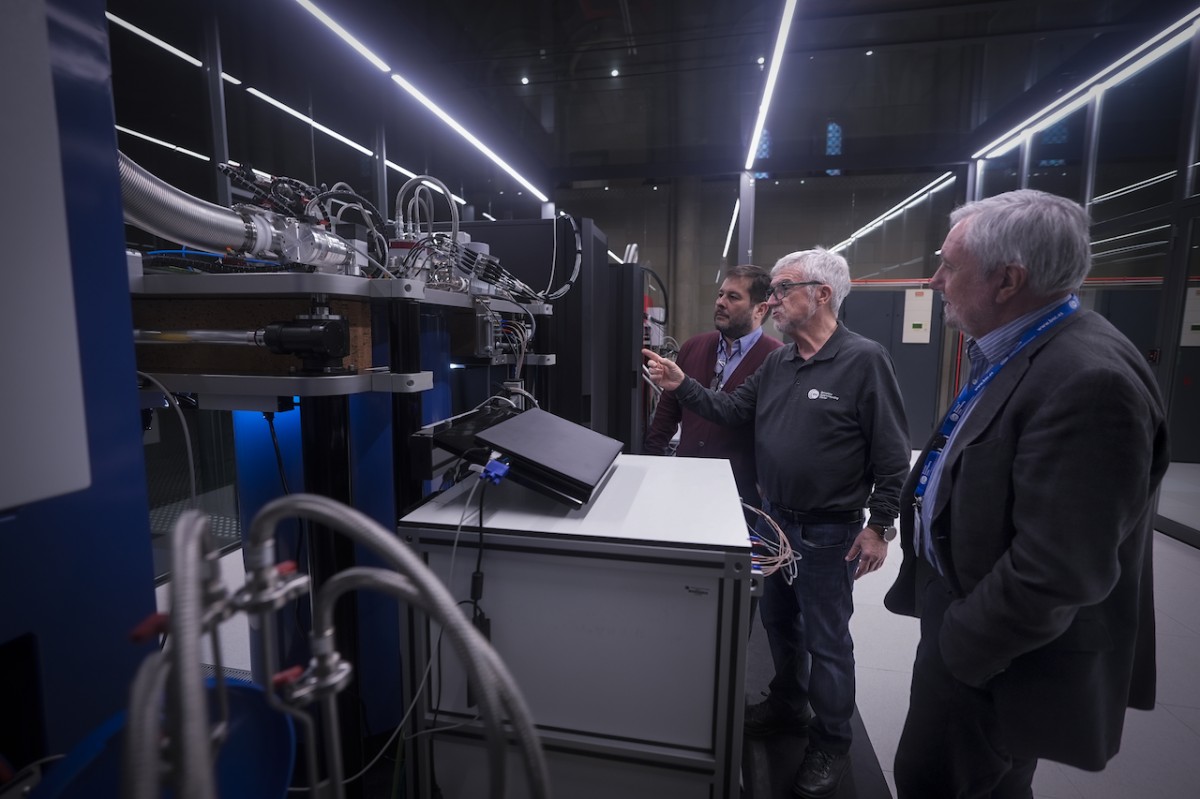
Enric Banda, senior advisor at BSC, visits the facilities with Mateo Valero and Marc López. Foto: Agenda Pública / Tsun Ho
You mentioned supercomputing for research. What do you research here?
There are three types of AI. Always with language models. There's that of large companies—which are dominating the world and have made us slaves without declaring war on us—. They use internet data, they use our data, they steal all our data to train networks. And what is the objective? To make money.
"The companies that are dominating the world have made us slaves without declaring war on us"On the other side are the supercomputing centres. What we do is train networks as complicated as these, but whose objective is to help us do better research, to make the digital twins that we make.
Between the large technology companies and the supercomputing centres are businesses and administrations. Small, medium, or somewhat larger companies have two options. One is to hand over their data to multinationals, which is equivalent to putting wolves in charge of sheep. The other is to bet on a European strategy, which for now is all we have left, and try to ensure that this data does not leave Europe, allowing neural networks to be trained with them so that our companies are more productive.
The European initiative AI Factories has emerged along these lines.
What are AI Factories?
What the AI Factory provides are machines (in our case, it's an update of Mare Nostrum5). We are going to buy another machine in which each chip is thirty times faster than each of the ones the current supercomputer has.
"Von der Leyen has just announced thegigafactories. If at the technical level there is no doubt that the BSC is number one in Europe, at the political level we are not number one"So, what the AI Factory means is: Europe, use your data to be more competitive! Now, due to the battle between Trump and China, the European Commission announced the gigafactories at the Paris AI meeting organised by Macron. Ursula von der Leyen announced 200 billion euros. Of that figure, the European Union will contribute 50 billion euros. The rest will come from private initiatives and Member States. Within that set of 200 billion, the gigafactories are planned, which will be a level above the AI Factories. There it will be 20 billion for four gigafactories. They say there will be four, although I believe there will be five, because, if at the technical level there is no doubt that the BSC is number one in Europe, at the political level we are not number one. We need total support from Spanish diplomacy.
There's Finland with the supercomputer LUMI. It's a consortium of eight countries. Then there's Germany, France, Italy, and us. Not at the scientific level, but at the political level they have more strength. If instead of four there were five, we would surely get it. And even if there are three, we will still fight.
So we are in a battle to get a gigafactory from the European Union?
At the Barcelona Supercomputing Centre there are 4,500 GPUs. We're talking about each gigafactory having 100,000, like Tesla has; like X, which has already released Grok, and like Meta has. Google wants to make one with 1.3 million GPUs. The objective of the gigafactories will be that any activity of any country can try to use AI to improve it.
"In Catalonia we are the best in personalised medicine. The great challenge is to make a digital twin of the human body"We, in Spain, especially in Catalonia, are the best in personalised medicine. The great challenge in research is to make a digital twin of the human body. We have very good people who work with the best researchers.
A digital twin of the human body? So I understand, how to reproduce it?
A twin of your body, with which you can experiment. It's very complicated because we know nothing about your brain. We have parts of the body. We know, more or less, how genes influence health. We can make micro-organs, for example, with which to experiment.
So it's a twin of each of us.
Personalised, with your medical history. We were pioneers in making a digital twin of the heart, in fact not only of the heart, but of the entire circulatory system. In health, Catalonia could be number one in Europe.
In earth simulation, we are number one as well. The project is called Destination Earth.
Note that we are now 1,250 people. We attract talent. 32% are from sixty countries. When it comes to attracting talent, we have a place, which is Barcelona, that is ideal. The culture, the gastronomy.
What do they do? We have a department of Computer Science, which has 400 researchers, everything you want to know to build programmed computers. And then we have three vertical application areas: engineering, earth sciences, life sciences... With all this that we have here, a researcher now has no excuses, they have to dream.
You've talked about public capital. The question is: what is the good formula between public capital and private capital for this supercomputing with AI at the service of research to work?
Let's see. It's a trick question. It's a problem that Spain has, which we are correcting. We only dedicate 1.49% of GDP to R&D. Of that 1.49%, the participation of companies is lower in percentage compared to other industrialised countries. In Spain, companies contribute 55%, but in industrialised countries, they are at more than 70%. We need companies to get more involved.
"We need companies to get more involved in research"This puts us at a great disadvantage. Which leads to you turning to the public sector for help. An example is the BSC. We exist because three institutions agreed in 1985: the Government of Spain, the Government of Catalonia, and the Polytechnic University of Catalonia. In that year, I went to Madrid for the first time, to make a small BSC, which was called CEPBA (European Centre for Parallelism of Barcelona).
Is the use of the computer free?
At the BSC we use 20%. The 80% is for any Spanish or European researcher who has to present their projects to evaluation committees in which we are not represented. Moreover, we survive on what we do. Consider that of the 1,250 of us, there are only fourteen civil servants. There is no centre in Spain or in the world that has those percentages. It is practically self-financing: 80% competitive and 20% institutional.
Explain to me, for example, the relationship with Repsol.
They came here in 2005 and explained their problem: they wanted to optimise the location of drillings in hostile environments, such as the Gulf of Mexico. There, they must go through two kilometres of water, then a kilometre of land, and then approximately a kilometre and a half of salt. If there is anything valuable, it's below that layer of salt.
At that time, they were successful in one out of ten drillings. Now, they have improved, but they still hit only one out of seven. Each drilling costs 100 million dollars.
Valero's vision is unequivocally European. Photo: Agenda Pública / Tsun Ho
Let's change the subject. What are you doing in the field of chips that contribute so much to strategic autonomy?
When Europe determined in 2017 that supercomputing was a strategic area and that supercomputers were increasingly expensive, it decided to promote a European-level project: EuroHPC.
This programme had two objectives. The first, to provide Europe with powerful supercomputers. The second, given that there was no European technology in this field, to promote the development of chips that could be used in supercomputers, in the training of artificial intelligence models, and in many other applications derived from AI.
By the way, a key aspect: artificial intelligence influences so much of what we do that supercomputing centres should be called AI centres. And those with the fastest supercomputers are the best, because they can develop advances impossible elsewhere.
When you say in-house chip production, what exactly are you referring to?
We really like collaboration between institutions. We say that we are a product of collaboration between ideas, society, and companies. Research not only has to be excellent, it has to be relevant, solving problems that society has.
"We would like Barcelona to be the city of chip design in Europe"We have to develop technology and that is very complicated, because we neither design nor manufacture chips. The BSC has been a pioneer; in particular, I have dedicated myself to convincing Europe that we should develop chips on our continent. We started with projects like the European Processing Initiative and yesterday a project led by the BSC of 240 million euros was signed. Three chips will be made in three companies, one of them is Spanish, which is in Barcelona and is called OpenChip, in which the BSC is a founding partner.
I hope to be able to say, in three or four years, that Mare Nostrum 6 has some chip manufactured in Barcelona. We would like Barcelona to be the city of chip design in Europe.
Now all the chips from Intel, ARM, NVIDIA, are going to be changed, because there is an initiative called RISC-V, which is open source. Just as in Linux software changed all operating systems, this will also happen with chips. Within ten years, most chips will follow this philosophy. We have a unique opportunity in Barcelona to create 10,000 jobs designing chips with people who earn a lot of money, and this would totally change the city.
So, what about the Taiwan chips that generate the battle between the US and China?
There are two concepts in chips. First, there are many types. The truly strategic ones are those that use the smallest transistors, that is, those that allow more transistors per square centimetre to be included. We are now at 2 nanometres, and we are approaching the point where there will be so few silicon atoms that quantum phenomena will begin to appear, which will prevent further reduction in size. To put it in perspective, in 10 square centimetres we have 100 billion transistors, the same amount as neurons in the human body, 1011.
But in addition, the transistors that are there (he points to the supercomputer), in NVIDIA's chips, switch at 2 billion times per second (2 GHz). And of those we have millions. That's a supercomputer.
So, there are two concepts: designing and manufacturing. Among chips, there are some that are relatively simple, like those used in normal cars, whose transistors are between twelve and twenty-eight nanometres. But the big war is in manufacturing chips with the smallest transistor.
"The Americans will allow China to invade Taiwan when not a single chip is manufactured there anymore"The leaders in that race are three companies: TSMC from Taiwan, Samsung from South Korea, and Rapidus from Japan, because IBM has taken all its technology there. The US has Intel, but it has fallen behind. And there comes all of Biden's strategy—which actually started with Obama—to restrict China's purchase of Intel chips.
In the world, there are only two companies that design and manufacture chips: Samsung and Intel. But Samsung has a more modern factory than Intel. This has generated panic in the US, which has realised that the chips for their planes are manufactured in Taiwan. That's why they protect Taiwan. I've been saying for five years that if China dared to invade Taiwan, TSMC is mined and would blow up. To avoid this scenario, the US has gotten TSMC to build a factory in Arizona and Samsung to make factories in Austin. The Americans will allow China to invade Taiwan when not a single chip is manufactured there anymore.
Where does Europe stand then?
In Europe, neither is designed nor manufactured. The large companies that design chips, such as NVIDIA and Apple, don't have factories. They are "fabless", that is, they design, but manufacture at TSMC or Samsung. Europe doesn't have factories. That's why it was attempted—and here I give you a very important message—for Europe to have state-of-the-art factories. But then Europe proved that it is not Europe. A manufacturing plant is not a problem for a single country, it's a European problem. However, Germany wanted its own and France its own.
The latest example is the announcement made by Macron of a French plan of 109 billion euros at the AI summit in Paris, with money from the United Arab Emirates and Canada. And two days later, Von der Leyen announced a European plan.
Gigafactories will push the current limits of supercomputing. Foto: Agenda Pública / Tsun Ho
Explain to me the chip that you want.
What I would like is for Mare Nostrum 6 to have chips that, although they won't be able to compete with those from NVIDIA, are a step forward, so that if it goes well in the second step, we can already compete. If the market is protected, I have no doubt that in Europe in ten years we can have chips better than any other.
What does protecting the market mean?
It's public protection. I believe the US has done it all along. Protecting companies. In Europe, we have been very timid with state aid. I hope that now with Trump we won't be timid and will protect our companies.
But the most important thing is that AI is at the service of the productive sector and society. Here we have several spin-offs that I'm very proud of.
"The objective of science is not to publish, it is to solve society's problems. It is to make a country more productive, with more jobs and a better world"An example: from a smartwatch, one can be warned of the probabilities of having a stroke. We now know that a stroke gives warning beforehand. It's about being able to detect that warning from the electrocardiograms that the watch we wear on our wrist regularly does. For this, a neural network has been trained from a lot of data from millions of stroke patients, and AI has detected alterations in the electrocardiogram. If our watch records normal electrocardiograms, it discards them. But if it has alterations detected with AI, the watch sends it to the data centre and acts accordingly. Early detection can save many lives. The data centre also takes into account the genetic part, as it is known that 40% of strokes are inherited. In short, AI can be very beneficial for having a healthier society, and, therefore, better.
The objective of science is not to publish, it is to solve society's problems. It is to make a country more productive, with more jobs and a better world.
Is this what differentiates us from the US?
Yes, it's one of the things that differentiates us.
This is what the gigafactories are for. Bringing AI to any corner where we can take advantage of it. For example, we have decided to make dual technology for national and European security. I believe it's our obligation. We have the best simulator of aircraft in flight, which is a mixture that we make here with AI. Airbus has said it's the best simulator in the world. Well, that can create many jobs. The objective is to create high-quality jobs. To do that, you need to have ideas that believe in companies.
Let's go back, to finish, to Barcelona's desire to get an AI gigafactory.
There's going to be a tremendous battle to place centres that will have more than 100,000 accelerators; they can have more than 200,000. Currently, at the Barcelona Supercomputing Centre, we have 4,500 and, even so, we are in eighth place worldwide. In comparison, Meta has 100,000, Google plans to reach 1.3 million, and Elon Musk already has 200 million. It's a dizzying scenario.
"Barcelona wants to be an AI Gigafactory"In this context, Barcelona aspires to become an AI Gigafactory. Why? In scientific terms, we are at the forefront, but we need financing and a strategic alliance between administrations and companies. We have the full support of Salvador Illa and Pedro Sánchez, but now the challenge is to mobilise resources. We must connect with a thousand SMEs and with all the large companies in the country so that they invest in this project and understand the value that artificial intelligence can bring to them.
We have already sent the first report, but we lack—and this is not criticism—having high-level Spanish people in decision-making positions in Europe. Especially in science, we don't have anyone.
And, finally, I want to ask you about energy. All of this consumes a lot of energy. How do we make it compatible with the ecological transition?
Each chip consumes a lot of energy. We know that globally, an energy equivalent to 3,000 nuclear power plants of one gigawatt each is needed. Spain consumes thirty gigawatts in total, which is 1% of the energy spent globally. 1% is also what these machines currently spend in the US.
But keep in mind that they spend energy, but their use means that much more energy is produced, so the balance is totally positive for the unit. Cases such as fusion, climate change, or new materials. I'll give you another case, how planes fly, cars, batteries. Without these machines, we wouldn't have, for example, wind turbines for Iberdrola that we make here and are between 15 and 20% more efficient. Our Computer Sciences department researches, for example, how to optimise the energy spent by chips.
Thank you very much, Mateo.
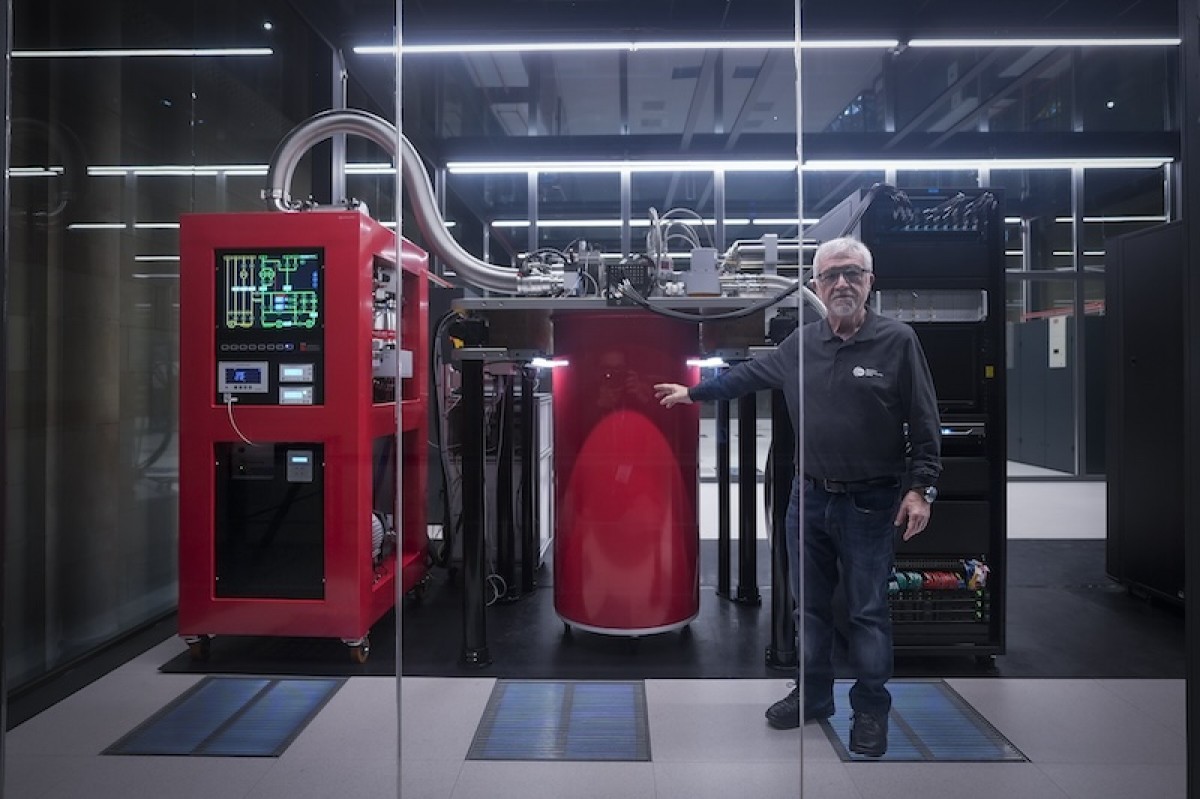
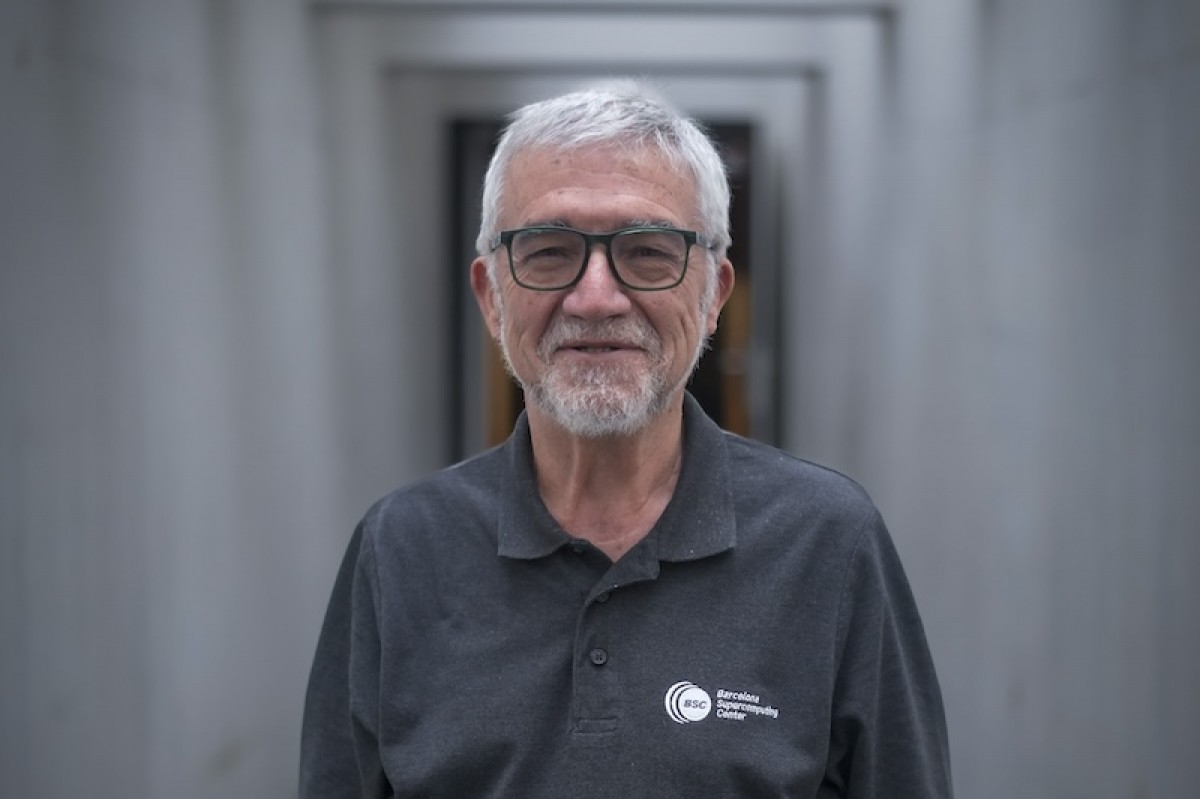
Mateo Valero, director of the Barcelona Supercomputing Center - National Supercomputing Centre. Photo: Agenda Pública / Tsun Ho
Ahora en portada
16 de octubre de 2026
16 de octubre de 2026
16 de octubre de 2026
Noticias relacionadas
Hace 86 semanas
Uljan Sharka: "There are thirty-five trillion euros in European savings accounts, we lack ambition"
Lo más leído