Martes, 20 de octubre de 2026




CONVERSATIONS
Uljan Sharka: "There are thirty-five trillion euros in European savings accounts, we lack ambition"
Agenda Pública travels to Milan to visit Uljan Sharka, the founder of iGenius, one of the main European unicorns of Artificial Intelligence, and to address in depth the future of this technology in its utopian and dystopian aspects. Sharka proposes solutions: the European Union, he says, still has time to lead a model that protects human freedom and improves workers' conditions.

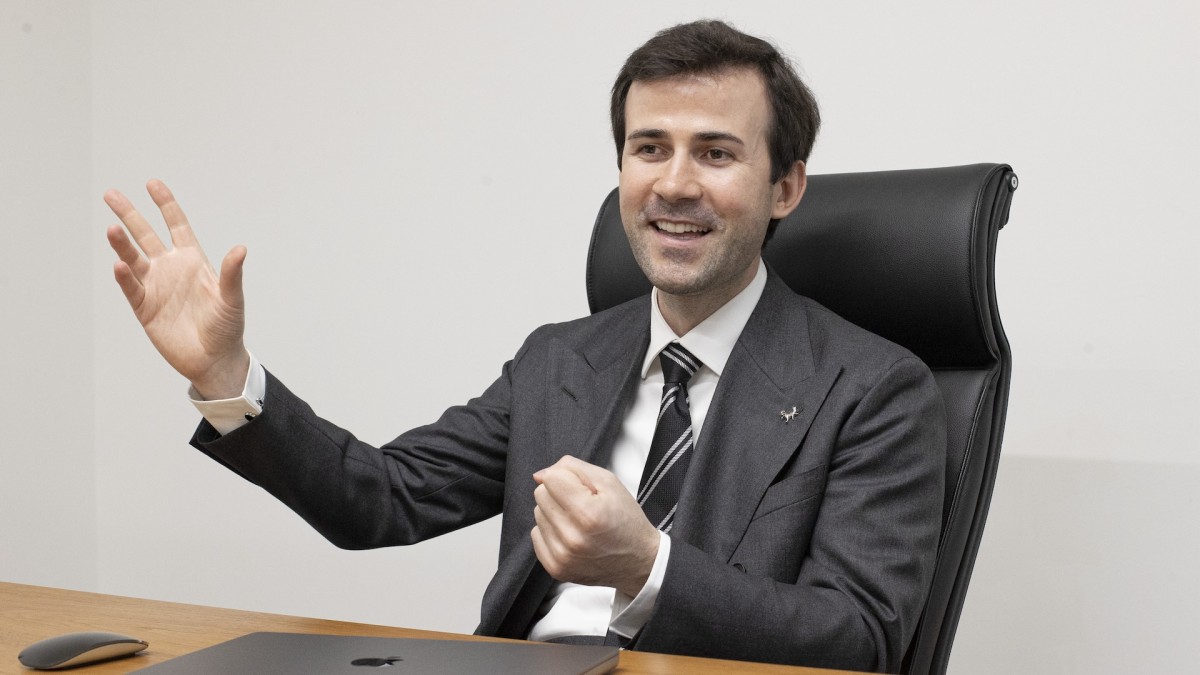
Uljan Sharka is the founder and CEO of iGenius, an AI company that develops and customises linguistic models.Marco Ottico
His name is less well known than that of Elon Musk, but Uljan Sharka leads one of the few European companies that is a world leader in artificial intelligence. And, in addition, he proposes another model through an answer to a key question: how are the scales of innovation managed with human rights?
Sharka, who is also a member of the Advisory Board of the AI Hub for Sustainable Development, co-directed by the Italian G7 Presidency and the United Nations, argues in this conversation that Spain is a key country for the development of this technology and highlights ‘its pragmatic and listening approach’. ‘Spain is going to surprise a lot in the development of AI,’ he concludes. A conversation led by Marc López Plana, editor and director of Agenda Pública.

There is a strong international debate about how far artificial intelligence (AI) can go. Where do we stand?
The AI debate is largely a distortion of reality. We know where AI will take us: towards a more democratic future, with more automated tools, which means prosperity. This is the utopian future most people desire.
But there is also a dystopian future because AI is the first tool that helps us imagine beyond our dreams. It has a non-deterministic ability to scale. It is most akin to chemistry—you can conduct all sorts of lab experiments to create things that do not exist today.
From a philosophical perspective, however, if these capabilities are in the hands of a few players, it means monopoly, it means global dictatorship, it means that we will have a handful of creators while everyone else becomes mere users—potentially enslaved by technology.
So, it is crucial to understand what AI can become but also where it stands today. The goal is to build a path towards a more positive and inclusive vision—one that serves humanity rather than monopoly and the thirst for power of a few individuals.
Then, where is it really at in its development today?
Today, AI is being discussed as if it were equivalent to the flying cars we have imagined and dreamt of for so long—used as a reference in many fields, such as autonomous driving. In reality, AI today is more comparable to electric cars, which have very limited autonomy—more limited than our smartphones.
This is crucial because if we set the rules today and frame an existential political debate around a technology that does not yet exist—while regulation must be forward-thinking and consider long-term risks—we risk enabling monopolies. Why regulate a risk that does not exist and is still far away, thereby excluding equal development opportunities?
But aren't there issues that need to be regulated now, given the current state of AI development?
The European AI Act has done the best possible job of maintaining individual freedom and the intellectual property foundation that underpins modern society. The moment the balance of what copyright and intellectual property rights mean is altered, individual creativity is lost. Even individual freedom becomes restricted, as a new mechanism for transferring that property emerges.
What is needed, however, is to separate AI regulation—which today does not pose a barrier to innovation—from data usage. We must ensure that data can be used freely, as companies' competitive advantage depends on it. If they cannot use data, that advantage disappears—especially when foreign competitors are free to do so.
Another key aspect is the implementation of the AI Act through the European Commission's Code of Good Practices. Yesterday, in Paris, I had the pleasure of discussing this topic, as at iGenius we are actively involved in all avenues of the AI Act's implementation for the development of this code. Today, the real risk does not lie in how the technology functions or what is inside the box, but in who controls the box.
How do the American monopolists affect global geopolitics in relation to Europe and China?
This ambition within the US ecosystem is also what makes it unique in seizing certain opportunities. Every ecosystem is shaped by its own DNA. In reality, the mistake Europe is making now is trying to copy. The American model is not ours. Europe already attempted this in the 2000s, after the internet boom, trying to replicate and instil the Silicon Valley model. We failed because it is not our model.
In the end, an American citizen will decide whether to use OpenAI, iGenius instead of DeepSeek, and vice versa. True freedom comes from creating choices and preserving this beautiful aspect of humanity: the diversity of what we create. The alternative is a black-and-white world, where there is only a European, American, or Chinese solution.
At iGenius, we are strongly advocating for the idea that Europe should not compete. Instead, Europe must focus on its own objectives, which right now are unifying the capital markets and accelerating what we call the digital single market. For the first time, we have a tool called AI—specifically generative intelligence—which both compels action and serves as the best enabler.
Why does Europe need its own AI ecosystem, then?
Europe is one of the most inherently compatible regions for AI fundamentals. Precisely because it is highly fragmented: the twenty-seven member states have different cultures and languages. They have never managed to create a single market because doing so would require abandoning their own values and cultures. We cannot choose a single language. How do you standardise or eliminate regulations? It's impossible. So, the challenge must be transformed into an opportunity. There is a competitive advantage in diversity.
Fragmentation can be monetised through a different AI logic that acts as a translator of complexity. This way, a Spaniard, an Italian, a French person, or a German will be able to carry out the same transaction in their language, with AI translating in real time.
In the US, for instance, fragmentation is absolute. When hiring someone in Texas, California, or New York, different tax rates apply in each state. However, this functions invisibly because software acts as the operating system that manages the issue.
For the capital markets, it is even simpler. We need first movers. In Spain, there is a potential first mover with a strong forward-looking vision. Through my institutional interactions, I have met a person in Spain who, in my view, will be absolutely pivotal to this European renaissance revolution.
Who is it?
I can't say—it wouldn't be right, especially at this moment. But I believe it is essential to have the vision of driving the Capital Markets Union with European values, though not exclusively, and with an international and global approach.
Ultimately, this means recognising that if we want to compete in the capital market, we must adjust the fundamentals. If the variables of a European industrial company are not on par with those of an American or Chinese company, the market becomes entirely unfair, as competition is not on equal terms.
Therefore, if we truly seek a capital markets union, we must not focus solely on the rules. These will always be there, and they are what make the world function—because without law, we would be…
Like animals.
It is crucial to see AI not as a creator of companies like iGenius, but as a tool that leverages companies like iGenius to solve these problems. Once these two challenges are overcome, I envision a highly competitive Europe on the global stage which, thanks to its emphasis on diversity, can achieve a new geopolitical balance based on exchange rather than confrontation.
Do you know what we tell our American clients? If you are looking for the best-performing AI, as you define it, go to Silicon Valley. But if you want AI you can trust, come to Europe.
And China? You have said that plurality and diversity are strengths. Europe has an opportunity—what is China's opportunity? I ask because you also aim to be a global company, with offices in China and India.
China's opportunity lies in exploiting all the negative aspects of its current political and governmental structure. That kind of system also has advantages because the centralisation of fast, top-down decision-making—despite the social unrest it may cause—also yields positive effects.
It's not that we aren't a modern democracy, but we are still a young one. China could become a high-tech democracy—something we aspire to, but they may reach it faster due to their current governance challenges. They are using this policy enforcement mechanism to transform infrastructure at an extreme pace, generate competitive advantages for businesses, and create incentives that accelerate social transition towards a middle and upper class. The advancements in Chinese cities are remarkable.
I was last there in June last year, at the World Economic Forum—also known as the Summer Davos—in Dalian, a city bordering North Korea. The level of technology they have implemented is astonishing: the level of services, the discipline… We are talking about a totalitarian system that clashes with demographic norms. However, I believe that over time, as that system merges with technology, the Chinese people will use it to transform absolute control into efficiency.
At iGenius, we see technology as the means for humanity to achieve true freedom.
But can technology also be used to exert greater control over citizens?
This is why we believe Europe has a unique proposition compared to the rest of the world.
Why do we talk about trust rather than performance? Because if artificial intelligence is the future of intellectual property—and to some extent, it already is—and intellectual property is essential for economies, businesses, and individual freedom, then it cannot be centralised. If it were, a dozen companies would control intellectual property, and with it, the global economy and democracy itself.
Even in the US, they will have to confront these challenges. If Silicon Valley becomes more powerful than the government itself, with a handful of companies controlling the world, it will also be a concern for them.
It's starting to happen.
Europe must champion a decentralised approach to technology, not only for its own benefit but for that of humanity as a whole. This means that anyone can be a creator or a user and choose their side. That is true digital equality. Otherwise, we end up with companies—without naming names—claiming that only they can build AI, or that only they should manage it because it is akin to a nuclear weapon. If AI is a nuclear weapon, then going to university is too. In that case, having doctors and scientists would also be a threat. Should we then eliminate universities, abolish education, and go back 500 years? We like to compare this revolution to Gutenberg's printing press revolution.
I saw the statue of Indro Montanelli in the gardens named after him.
If we had certain industrial revolutions, it was thanks to the printing press revolution. The printing press created individual freedom because it allowed people to develop themselves by following a specific path of their own choosing.
This is incredibly powerful because it creates an unprecedented level of individual freedom and removes the barrier to education that has existed until now. The ability to move up the social ladder or advance professionally will be extraordinary thanks to AI. We are still in the early stages of its application, but in two years, a junior professional will be able to become a senior in just one year with these tools because their capacity to amplify human potential is limitless.
Let's wrap-up China, if you agree. What does DeepSeek really mean for AI performance on a global scale?
There are two truths. The distorted one claims that AI can be built with very few resources. And that is simply not true. There is a story behind DeepSeek. They took an existing model—Meta's LlaMa model. Then, over time, they bought a massive number of GPUs—we don't really know how many chips they used. It may not be true that they only spent six million dollars. Their research paper mentions 139 researchers who, no matter how inexpensive their salaries, are among China's top scientists. Behind them, they have a seven-billion-dollar hedge fund, owned by the same founder of DeepSeek.
From the Chinese state?
We don't know. And even if it were true that they only purchased 2,048 chips—bought, not rented because they own them, as specified in their paper—at market prices, they would have spent over fifty million dollars. That is similar to what we spent on our largest model, and what OpenAI and others have spent. So, while the scale is different, the message it sends to the world is mighty and also benefits Europe.
In other words, it is not necessary to invest 500 billion dollars, as OpenAI and the US claim, to achieve leadership and compete in AI. Substantial resources are needed, but not as many as people think. And this, in my opinion, is the key takeaway: Europe has more than enough resources available to step up and take the lead in this field.
Let's return to Europe. Many say it is very difficult for companies to scale here. What do you think? With your experience running a European unicorn that has an office in New York and is considering others?
Also in Europe—I hope soon in Madrid.
Even in Barcelona?
Why not?
What do you think about Europe's ability to allow startups to scale without having to go to the US?
I believe the simple answer is not venture capital, nor public sector support, but rather private sector leadership. In other words, all it takes is a leader to ignite a spark—a catalyst.
If we think about the US market, without Bill Gates or Satya Nadella believing in the crazy idea that a company could aspire to be worth over a trillion, it would never have happened.
We need a leader with that kind of skill and vision, someone who makes highly disruptive decisions. It could be a major bank, a large industrial company, or an advanced manufacturing firm. Once one European company achieves this, others will follow. The moment that happens, we will see a domino effect that will be remarkable because the number of resources available in Europe is immense.
There are thirty-five trillion euros in European savings accounts. Europe has the resources; we just need to unlock them. But culturally, we are very conservative. So, we have liquidity, solidity, a strong backbone—to use an American term. But to unlock this…
Why hasn't this catalyst emerged yet?
There is a lack of ambition. iGenius is already doing its part. We have built Europe's largest LLM with limited resources. We are building one of the world's largest data centres. This summer, we will launch Colosseum, one of the world's first supercomputers, which will increase Europe's computing power for model training a hundredfold.
Where will the data centre be located?
In southern Italy because there is a surplus of renewable energy. Our next target is Spain.
Our main goal, as I was saying, is to find a strong industrial partner who believes in the ambition of building a trillion-dollar tech company in Europe. That is the only spark needed. Once it is ignited, there will be no limit to what Europe can achieve because the resources will follow. The talent is here, and we have this open approach—we want to plant the seeds so that others can build on them.
What does iGenius offer?
Basically, we offer, freely and openly, in line with our principles and vision, what we call foundational intelligence. Our LLMs and some other tools are free, but with a European specialisation: they come with an enterprise licence, assuring operational continuity and guaranteeing that these tools are designed for businesses. They are not just R&D artefacts like most other open-source tools. And then we sell specialized (intelligent) agents on top, which is the more domain-specific part.
You mentioned defence. Will war change?
Territorial wars will cease to exist once this technology is fully implemented because economic interests will emerge from a new world we are creating.
Moreover, many current conflicts are cultural in nature. Wars sometimes start due to leaders being unable to communicate or a lack of transparency in agreements. Artificial intelligence—especially if decentralized—will create a balance and a ground truth (a shared or fundamental truth) that does not exist today.
That's why I believe the next generation won't even understand the concept of war as we know it today. Of course, competition will still exist, but it will be managed in fields like cybersecurity, information ownership, and the competitive advantage of industrial secrecy.
Will war cease to exist?
The new form of war will be economic confrontation, which will inevitably converge around a few strategic sectors, reducing today's economic diversity and limiting the scope of many industries. If all societies become technology-driven economies, the central question will be which region achieves leadership in this domain.
The real challenge lies in sovereignty—that is, determining the essential pillars each region must secure to maintain geopolitical balance, even if they don't perfectly align with its ideal economic model. The key will be defining those strategic elements, and then deciding in which areas to specialize.
The major transition ahead will depend on how digital sovereignty is structured in each region. Once that sovereignty is secured, the next question will be: how do we specialize to differentiate ourselves and maximize our potential?
Because sovereignty means having a solid foundation in all key sectors, but it also requires each region to choose where to focus to stand out. If all economies compete in the same fields, human capital is wasted on fruitless rivalries instead of driving exponential growth.
You live in the north of Italy, a zone that was very potent in car making. What future does this sector have?
The future means transforming from an industrial company into a technologically advanced one.
Alternatively, technology can be used in service of humanity, increasing dignity in the workplace. Machines can handle heavy labour, while people focus on intellectual tasks. There's a way for human capital to train software and create the brain of an automotive company.
Car manufacturers aren't losing market share to Tesla because of regulations, but because they aren't innovating. On one hand, they can offer the best components—high-quality brakes, leather seats, and greater safety—but on the other, they fail to meet technological expectations.
If Stellantis reorganized its team to develop AI systems that enhance its vehicles, it wouldn't just retain its workforce—it would also create a competitive advantage. Instead of focusing on small cost savings, the key is for these workers to contribute to raising quality and, above all, to creating a new business model based on software.
Will AI help improve public services for citizens?
Yes, definitely. I think this is the missing transformation needed to humanize the public administration interface. Having digitized services rapidly—sometimes even excessively because traditional methods like service windows were eliminated—we've ended up creating a digital divide. I mean that part of the citizenry who does not have the technical skills to use these tools, which then work very poorly because they're difficult to use.
This would also promote social inclusion. Today, a foreigner arriving in a country must deal with complex bureaucratic processes, where, unfortunately, not all languages are covered. Instead, they could interact with an AI that speaks a hundred languages and provides the right answers in seconds—even submitting applications to the relevant offices. This is how AI will help the European market become a true single market—by translating complexity. The same principle applies to interactions between citizens and public administration.
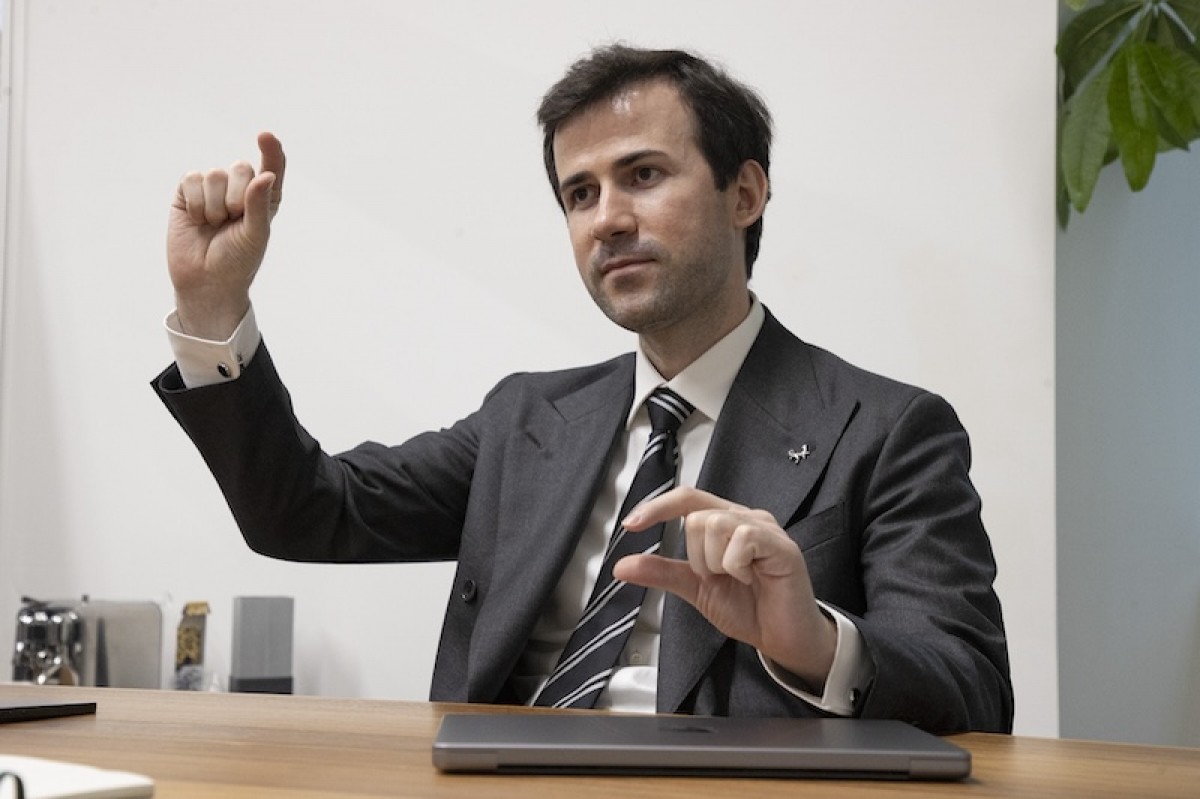 Uljan Sharka believes OpenAI has a negative hunger for power. Photo: Marco Ottico
Would you like to send a message to Spain and our readers? You mentioned that your next step might be in our country. Why? What do you think of Spain right now in terms of AI development?
I believe Spain's approach to AI—putting humans at the centre—is an important philosophy that not all European countries are currently following. I think Italy and Spain are significantly aligned on this matter. Spain is taking the right steps by declaring and supporting investments in data centres. Without data centres, there will be no AI in Europe. Data centres are the raw material of AI. Currently, Spain has been the first to announce major investments with players who are not hyperscalers (companies that provide infrastructure, platform, and private cloud services at a massive scale, with hundreds of thousands or even millions of servers).
When you say that Europe needs a company that understands and invests, what kind of budget are we talking about?
A €10 billion investment this year would be enough to establish a solid foundation for Europe to develop the right technologies. Why not twenty, thirty, or a hundred? Because next year, this technology will take a quantum leap, and long-term investments can quickly become obsolete due to the speed of change. At iGenius, we say that "the future is old": investments must be made wisely, with an efficient hyperscale approach based on two key factors.
In this sense, an annual investment of this scale would keep Europe aligned with the market. Over five years, €50 billion would be a reasonable baseline. But it is not just about that figure—it is about an initial injection to stimulate the market, allowing the private sector to take over from there.
I do not agree with the US approach of allocating €500 billion to a single player while excluding the rest. That model is incompatible with democracy. I would rather see a €10 billion foundation that creates opportunities and fosters an open market, where private players drive growth and innovation.
What will happen to search engines?
It is only a matter of time and adoption. Internet search has been a waste of time within a model built around advertising. In its early days, Google was disruptive, but over time, it stopped innovating—not due to a lack of capability, but to avoid disrupting its business model. Now, the way we search for information online will change dramatically. It is inevitable, and the only question is how quickly the market will adopt conversational systems. In five years—or even two—this market will be entirely different.
This shift will disrupt many economic balances because many businesses today depend on advertising for their success and commercial distribution. But the impact will not be limited to search engines—it will also transform other channels, such as social media, which will be able to offer content in a much smarter way. Not just through algorithms that determine what we see, but through a new form of interaction.
At iGenius, we call this the third revolution of the user interface. The first was the era of command lines and terminals, accessible only to software engineers. Then, Steve Jobs introduced the graphical interface, making technology more accessible. Now, we are taking the next step: humanizing interaction through voice, natural language, and writing.
Can you briefly explain the AI initiatives currently underway?
OpenAI is trying to create a digital god. They want a superintelligence that absorbs the entire world. I believe this is completely misguided, without consideration for its potential applications. The more we, as citizens and businesses, use it, the more destructive the future of humanity will be—because it has a negative hunger for power, and I will leave it at that.
When I come to Europe, I think of Mistral, which is the French player that, besides us, is developing these technologies in Europe. It has managed to develop a position in Europe, but it's not the position I would envision for the future of France, Spain, Italy, and Europe because it's a clone of OpenAI. It's a copy. It's what's called Second Mover Advantage.
The pioneer is the innovator: the one who develops, creates, and invents. Followers usually quickly copy and paste, leveraging government backing or an existing commercial network. To make a historical comparison, I'll share a slide about this.
Olivetti, which made typewriters, created the first personal computer in 1965 with the Programma 101, adopted by 40,000 businesses in the US and the foundation of the first digital cash register. HP, with its follower advantage, surpassed it thanks to its distribution capabilities—without innovating. Then, Steve Jobs revolutionized the concept with the screen, leveraging the third mover advantage.
And in your view, this is Europe's mistake?
Exactly. The attempt to copy. Instead, we want Europe to be the Apple of this technology—to think differently and to have an inventiveness, creativity, and human centrality that is thoroughly different. To achieve this, you can't just develop technology—you must start from user experience, from the problems we need to solve and Europe's challenges, which are the single market and capital markets, and build the technology through reverse engineering.
Europe is losing valuable time trying to build a digital ecosystem and capital markets union from scratch, addressing every part of the value chain simultaneously. This complexity paralyses progress. Instead, Europe needs a single decisive trigger to drive systemic change: one bold, well-executed initiative that can unlock growth and investment.
Thank you very much, Uljan.
Sharka, who is also a member of the Advisory Board of the AI Hub for Sustainable Development, co-directed by the Italian G7 Presidency and the United Nations, argues in this conversation that Spain is a key country for the development of this technology and highlights ‘its pragmatic and listening approach’. ‘Spain is going to surprise a lot in the development of AI,’ he concludes. A conversation led by Marc López Plana, editor and director of Agenda Pública.
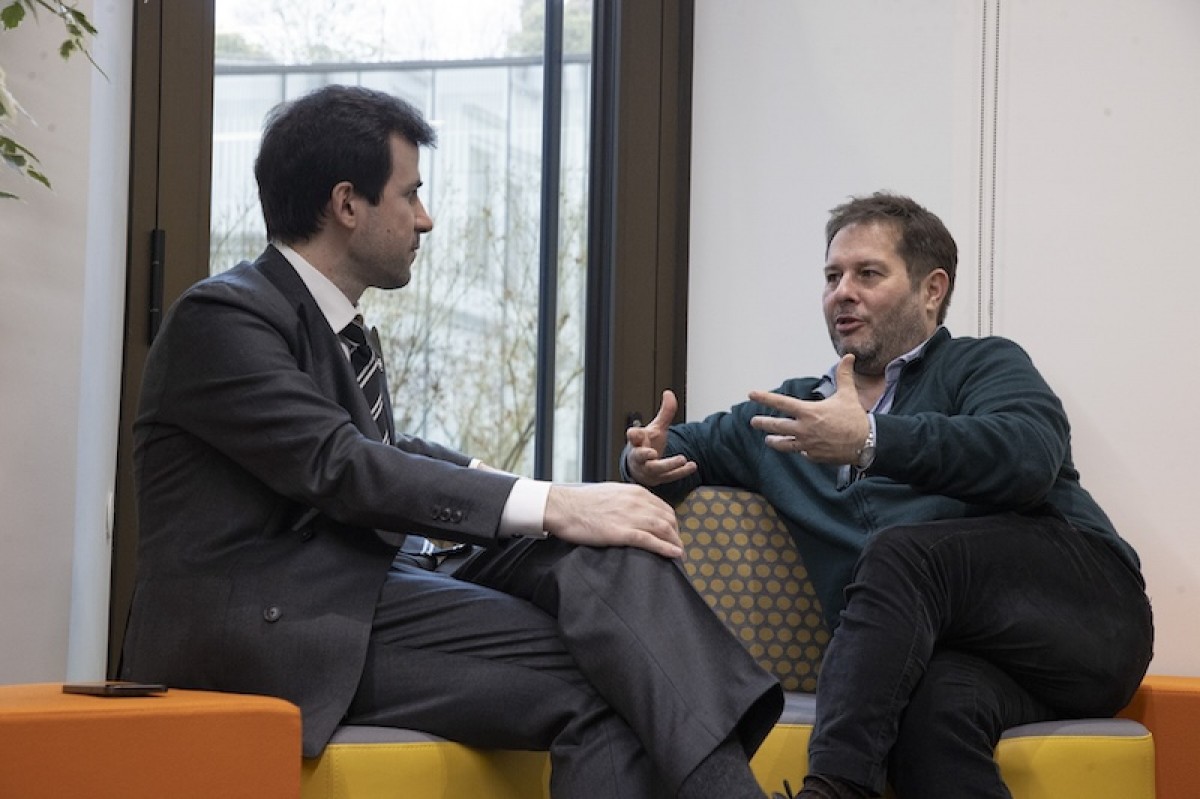
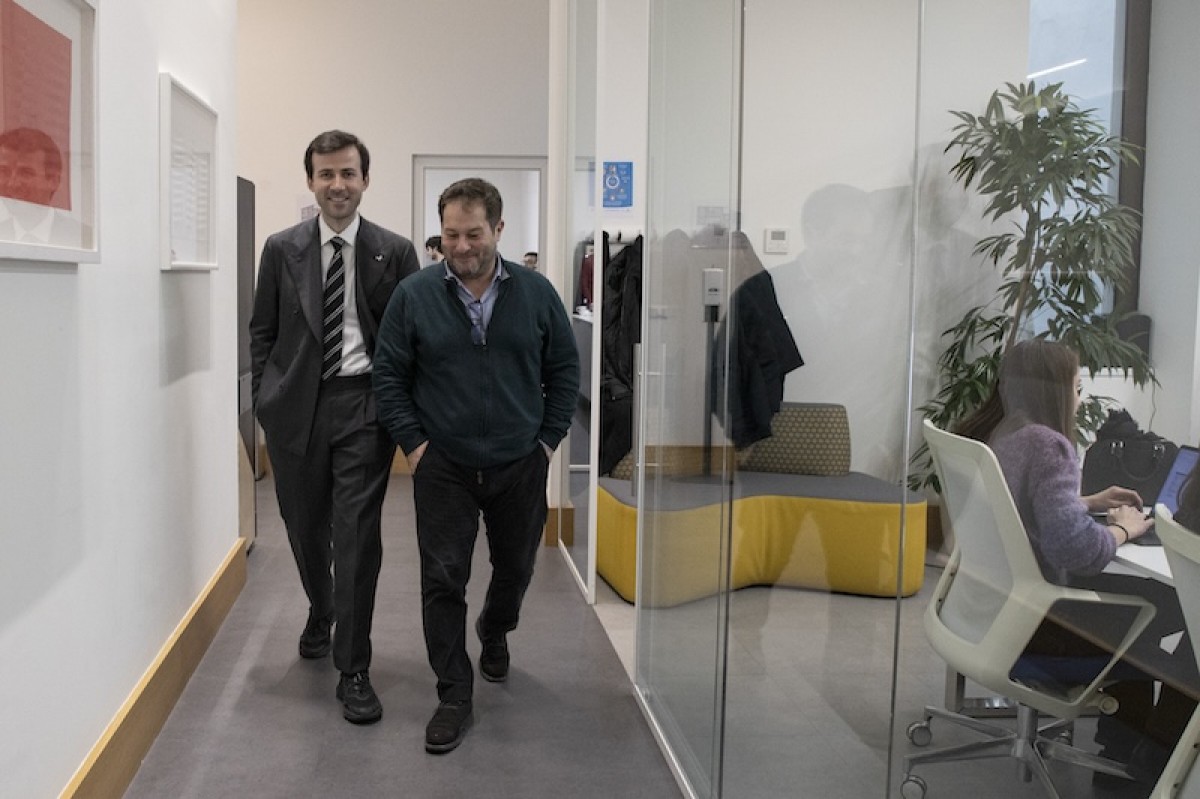
Uljan Sharka welcomed Marc López Plana, director of Agenda Pública, at the iGenius offices in Milan. Photo: Marco Ottico
There is a strong international debate about how far artificial intelligence (AI) can go. Where do we stand?
The AI debate is largely a distortion of reality. We know where AI will take us: towards a more democratic future, with more automated tools, which means prosperity. This is the utopian future most people desire.
But there is also a dystopian future because AI is the first tool that helps us imagine beyond our dreams. It has a non-deterministic ability to scale. It is most akin to chemistry—you can conduct all sorts of lab experiments to create things that do not exist today.
From a philosophical perspective, however, if these capabilities are in the hands of a few players, it means monopoly, it means global dictatorship, it means that we will have a handful of creators while everyone else becomes mere users—potentially enslaved by technology.
So, it is crucial to understand what AI can become but also where it stands today. The goal is to build a path towards a more positive and inclusive vision—one that serves humanity rather than monopoly and the thirst for power of a few individuals.
Then, where is it really at in its development today?
Today, AI is being discussed as if it were equivalent to the flying cars we have imagined and dreamt of for so long—used as a reference in many fields, such as autonomous driving. In reality, AI today is more comparable to electric cars, which have very limited autonomy—more limited than our smartphones.
"AI today is more comparable to electric cars, which have very limited autonomy—more limited than our smartphones"It certainly has great potential as a technology. The fact that we can now humanise the human-machine interface means that, for the first time in twenty years of digital transformation, both technical and non-technical users can exploit technology on equal terms. But we are still far from flying machines.
This is crucial because if we set the rules today and frame an existential political debate around a technology that does not yet exist—while regulation must be forward-thinking and consider long-term risks—we risk enabling monopolies. Why regulate a risk that does not exist and is still far away, thereby excluding equal development opportunities?
But aren't there issues that need to be regulated now, given the current state of AI development?
The European AI Act has done the best possible job of maintaining individual freedom and the intellectual property foundation that underpins modern society. The moment the balance of what copyright and intellectual property rights mean is altered, individual creativity is lost. Even individual freedom becomes restricted, as a new mechanism for transferring that property emerges.
"The European AI Act has done the best possible job of maintaining individual freedom and the intellectual property foundation that underpins modern society"This is the great dilemma, the grand paradox: how do we balance the scales of innovation with human rights? The latter have taken centuries of struggle to be secured. Innovation is positive, but if pushed too far, human rights can be compromised. This is why frameworks like the AI Act are essential: they aim to safeguard human rights, establish a foundation of fundamental principles, prevent the creation of weapons, mitigate systemic risks, and ensure respect for human rights. These are the three core principles set out by the European AI Act. The idea that this regulation stifles innovation in Europe is simply untrue.
What is needed, however, is to separate AI regulation—which today does not pose a barrier to innovation—from data usage. We must ensure that data can be used freely, as companies' competitive advantage depends on it. If they cannot use data, that advantage disappears—especially when foreign competitors are free to do so.
Another key aspect is the implementation of the AI Act through the European Commission's Code of Good Practices. Yesterday, in Paris, I had the pleasure of discussing this topic, as at iGenius we are actively involved in all avenues of the AI Act's implementation for the development of this code. Today, the real risk does not lie in how the technology functions or what is inside the box, but in who controls the box.
How do the American monopolists affect global geopolitics in relation to Europe and China?
This ambition within the US ecosystem is also what makes it unique in seizing certain opportunities. Every ecosystem is shaped by its own DNA. In reality, the mistake Europe is making now is trying to copy. The American model is not ours. Europe already attempted this in the 2000s, after the internet boom, trying to replicate and instil the Silicon Valley model. We failed because it is not our model.
"In reality, the mistake Europe is making now is trying to copy. The American model is not ours"While the US will always have this imposition-driven approach, Europe and China have the opportunity not to compete in a technology that cannot and should not be compared. Each should develop AI based on its own principles and ecosystem and then offer it as a global option—just as happens with food, fashion, cars, or any other consumer product.
In the end, an American citizen will decide whether to use OpenAI, iGenius instead of DeepSeek, and vice versa. True freedom comes from creating choices and preserving this beautiful aspect of humanity: the diversity of what we create. The alternative is a black-and-white world, where there is only a European, American, or Chinese solution.
At iGenius, we are strongly advocating for the idea that Europe should not compete. Instead, Europe must focus on its own objectives, which right now are unifying the capital markets and accelerating what we call the digital single market. For the first time, we have a tool called AI—specifically generative intelligence—which both compels action and serves as the best enabler.
Why does Europe need its own AI ecosystem, then?
Europe is one of the most inherently compatible regions for AI fundamentals. Precisely because it is highly fragmented: the twenty-seven member states have different cultures and languages. They have never managed to create a single market because doing so would require abandoning their own values and cultures. We cannot choose a single language. How do you standardise or eliminate regulations? It's impossible. So, the challenge must be transformed into an opportunity. There is a competitive advantage in diversity.
Fragmentation can be monetised through a different AI logic that acts as a translator of complexity. This way, a Spaniard, an Italian, a French person, or a German will be able to carry out the same transaction in their language, with AI translating in real time.
In the US, for instance, fragmentation is absolute. When hiring someone in Texas, California, or New York, different tax rates apply in each state. However, this functions invisibly because software acts as the operating system that manages the issue.
"Europe and China have the opportunity not to compete in a technology that cannot and should not be compared"In Europe, we lack our own software and an operating system to unify these processes. The moment we recognise this gap, borders will disappear, as software will manage and translate them. This is how we will create the digital single market: by using AI's power to translate complexity.
For the capital markets, it is even simpler. We need first movers. In Spain, there is a potential first mover with a strong forward-looking vision. Through my institutional interactions, I have met a person in Spain who, in my view, will be absolutely pivotal to this European renaissance revolution.
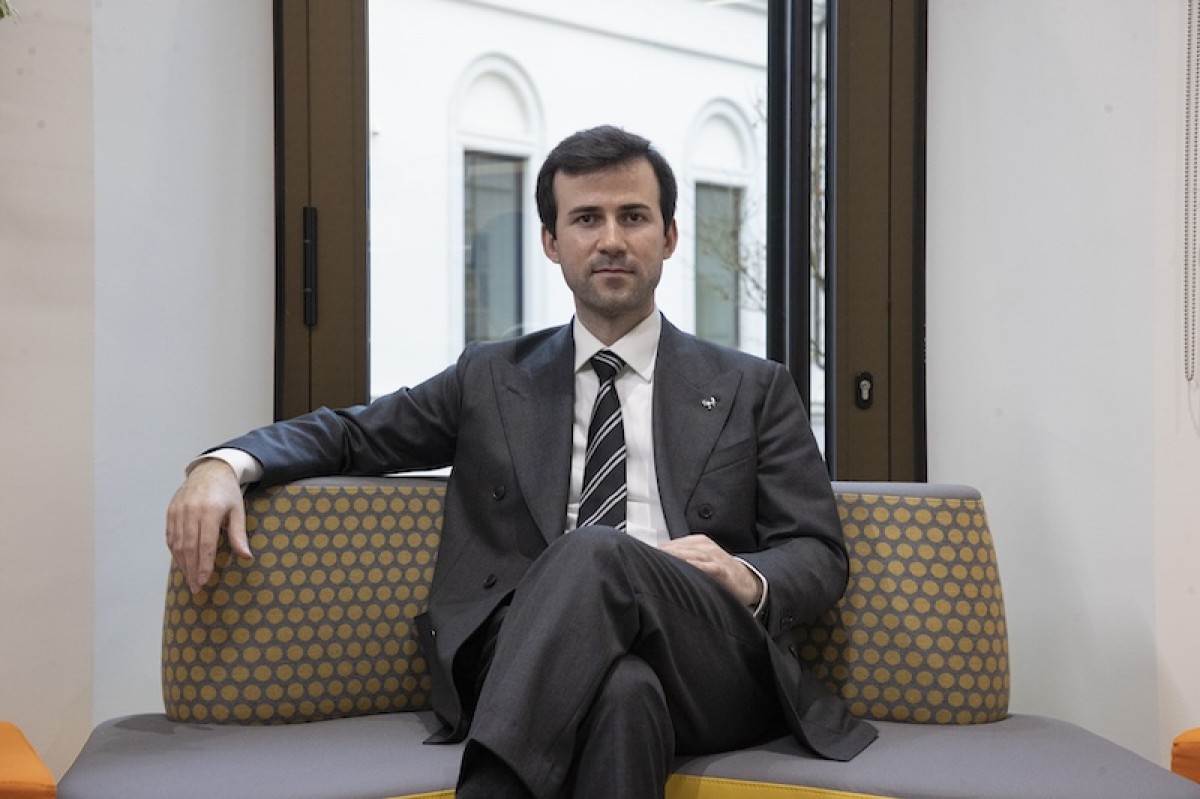
Sharka argues that Europe should create its own artificial intelligence model. Photo: Marco Ottico.
Who is it?
I can't say—it wouldn't be right, especially at this moment. But I believe it is essential to have the vision of driving the Capital Markets Union with European values, though not exclusively, and with an international and global approach.
Ultimately, this means recognising that if we want to compete in the capital market, we must adjust the fundamentals. If the variables of a European industrial company are not on par with those of an American or Chinese company, the market becomes entirely unfair, as competition is not on equal terms.
Therefore, if we truly seek a capital markets union, we must not focus solely on the rules. These will always be there, and they are what make the world function—because without law, we would be…
Like animals.
It is crucial to see AI not as a creator of companies like iGenius, but as a tool that leverages companies like iGenius to solve these problems. Once these two challenges are overcome, I envision a highly competitive Europe on the global stage which, thanks to its emphasis on diversity, can achieve a new geopolitical balance based on exchange rather than confrontation.
Do you know what we tell our American clients? If you are looking for the best-performing AI, as you define it, go to Silicon Valley. But if you want AI you can trust, come to Europe.
And China? You have said that plurality and diversity are strengths. Europe has an opportunity—what is China's opportunity? I ask because you also aim to be a global company, with offices in China and India.
China's opportunity lies in exploiting all the negative aspects of its current political and governmental structure. That kind of system also has advantages because the centralisation of fast, top-down decision-making—despite the social unrest it may cause—also yields positive effects.
"At iGenius, we see technology as the means for humanity to achieve true freedom"This structure can provide China with a foundation and a competitive edge to transition into a modern and democratic society where technology acts as the operating system. This is incredibly powerful because it means China can progress—just as it already is—much faster than the US and Europe, using technology to become a next-generation modern democracy.
It's not that we aren't a modern democracy, but we are still a young one. China could become a high-tech democracy—something we aspire to, but they may reach it faster due to their current governance challenges. They are using this policy enforcement mechanism to transform infrastructure at an extreme pace, generate competitive advantages for businesses, and create incentives that accelerate social transition towards a middle and upper class. The advancements in Chinese cities are remarkable.
I was last there in June last year, at the World Economic Forum—also known as the Summer Davos—in Dalian, a city bordering North Korea. The level of technology they have implemented is astonishing: the level of services, the discipline… We are talking about a totalitarian system that clashes with demographic norms. However, I believe that over time, as that system merges with technology, the Chinese people will use it to transform absolute control into efficiency.
At iGenius, we see technology as the means for humanity to achieve true freedom.
But can technology also be used to exert greater control over citizens?
This is why we believe Europe has a unique proposition compared to the rest of the world.
Why do we talk about trust rather than performance? Because if artificial intelligence is the future of intellectual property—and to some extent, it already is—and intellectual property is essential for economies, businesses, and individual freedom, then it cannot be centralised. If it were, a dozen companies would control intellectual property, and with it, the global economy and democracy itself.
"The real risk is not the technology itself, but absolute control and power concentrated in the hands of a few"This is why AI technology must be decentralised and open source at its core. The real risk is not the technology itself, but absolute control and power concentrated in the hands of a few. To prevent this, we have the European AI Act, as well as other regulations currently being discussed in the US. They, too, are aware of the problem. We often speak of regulation as a European obstacle, but in reality, the US is facing the same complexity. The difference is that it is less visible there due to the weight of capital markets.
Even in the US, they will have to confront these challenges. If Silicon Valley becomes more powerful than the government itself, with a handful of companies controlling the world, it will also be a concern for them.
It's starting to happen.
Europe must champion a decentralised approach to technology, not only for its own benefit but for that of humanity as a whole. This means that anyone can be a creator or a user and choose their side. That is true digital equality. Otherwise, we end up with companies—without naming names—claiming that only they can build AI, or that only they should manage it because it is akin to a nuclear weapon. If AI is a nuclear weapon, then going to university is too. In that case, having doctors and scientists would also be a threat. Should we then eliminate universities, abolish education, and go back 500 years? We like to compare this revolution to Gutenberg's printing press revolution.
I saw the statue of Indro Montanelli in the gardens named after him.
If we had certain industrial revolutions, it was thanks to the printing press revolution. The printing press created individual freedom because it allowed people to develop themselves by following a specific path of their own choosing.
"Europe must champion a decentralised approach to technology, not only for its own benefit but for that of humanity as a whole"Now, with AI, we are multiplying that freedom a thousandfold. Previously, we had an information transport system through books. Now, you can talk to the book, you can talk to the information, and you can consume knowledge while forming your perspective without being influenced by another human.
This is incredibly powerful because it creates an unprecedented level of individual freedom and removes the barrier to education that has existed until now. The ability to move up the social ladder or advance professionally will be extraordinary thanks to AI. We are still in the early stages of its application, but in two years, a junior professional will be able to become a senior in just one year with these tools because their capacity to amplify human potential is limitless.
Let's wrap-up China, if you agree. What does DeepSeek really mean for AI performance on a global scale?
There are two truths. The distorted one claims that AI can be built with very few resources. And that is simply not true. There is a story behind DeepSeek. They took an existing model—Meta's LlaMa model. Then, over time, they bought a massive number of GPUs—we don't really know how many chips they used. It may not be true that they only spent six million dollars. Their research paper mentions 139 researchers who, no matter how inexpensive their salaries, are among China's top scientists. Behind them, they have a seven-billion-dollar hedge fund, owned by the same founder of DeepSeek.
From the Chinese state?
We don't know. And even if it were true that they only purchased 2,048 chips—bought, not rented because they own them, as specified in their paper—at market prices, they would have spent over fifty million dollars. That is similar to what we spent on our largest model, and what OpenAI and others have spent. So, while the scale is different, the message it sends to the world is mighty and also benefits Europe.
"It is not necessary to invest 500 billion dollars, as OpenAI and the US claim, to achieve leadership and compete in AI"
In other words, it is not necessary to invest 500 billion dollars, as OpenAI and the US claim, to achieve leadership and compete in AI. Substantial resources are needed, but not as many as people think. And this, in my opinion, is the key takeaway: Europe has more than enough resources available to step up and take the lead in this field.
Let's return to Europe. Many say it is very difficult for companies to scale here. What do you think? With your experience running a European unicorn that has an office in New York and is considering others?
Also in Europe—I hope soon in Madrid.
Even in Barcelona?
Why not?
One of the keys to unlocking European innovation is getting European savings invested in the European Union itself. Photo: Marco Ottico
What do you think about Europe's ability to allow startups to scale without having to go to the US?
I believe the simple answer is not venture capital, nor public sector support, but rather private sector leadership. In other words, all it takes is a leader to ignite a spark—a catalyst.
If we think about the US market, without Bill Gates or Satya Nadella believing in the crazy idea that a company could aspire to be worth over a trillion, it would never have happened.
We need a leader with that kind of skill and vision, someone who makes highly disruptive decisions. It could be a major bank, a large industrial company, or an advanced manufacturing firm. Once one European company achieves this, others will follow. The moment that happens, we will see a domino effect that will be remarkable because the number of resources available in Europe is immense.
There are thirty-five trillion euros in European savings accounts. Europe has the resources; we just need to unlock them. But culturally, we are very conservative. So, we have liquidity, solidity, a strong backbone—to use an American term. But to unlock this…
Why hasn't this catalyst emerged yet?
There is a lack of ambition. iGenius is already doing its part. We have built Europe's largest LLM with limited resources. We are building one of the world's largest data centres. This summer, we will launch Colosseum, one of the world's first supercomputers, which will increase Europe's computing power for model training a hundredfold.
Where will the data centre be located?
In southern Italy because there is a surplus of renewable energy. Our next target is Spain.
Our main goal, as I was saying, is to find a strong industrial partner who believes in the ambition of building a trillion-dollar tech company in Europe. That is the only spark needed. Once it is ignited, there will be no limit to what Europe can achieve because the resources will follow. The talent is here, and we have this open approach—we want to plant the seeds so that others can build on them.
What does iGenius offer?
Basically, we offer, freely and openly, in line with our principles and vision, what we call foundational intelligence. Our LLMs and some other tools are free, but with a European specialisation: they come with an enterprise licence, assuring operational continuity and guaranteeing that these tools are designed for businesses. They are not just R&D artefacts like most other open-source tools. And then we sell specialized (intelligent) agents on top, which is the more domain-specific part.
"If AI is a nuclear weapon, then going to university is too. In that case, having doctors and scientists would also be a threat"We sell agents for financial advisors, for operators and engineers in advanced manufacturing plants, or for defence and public administration operators. These are virtual colleagues, assigned specific roles, working 24/7 to amplify a company's capabilities.
You mentioned defence. Will war change?
Territorial wars will cease to exist once this technology is fully implemented because economic interests will emerge from a new world we are creating.
"I believe the next generation won't even understand the concept of war as we know it today"For example, think about how raw materials today determine conflicts. Now consider that one of the main uses of artificial intelligence will be accelerating the scientific process. AI speeds up the scientific discovery of new materials and can also be used to replicate existing ones with new compounds that we will discover thanks to AI. A country or region will be able to generate its own raw materials, even if it does not naturally possess them. This entirely changes the logic of ambition and geopolitical expansion, especially in geographical terms.
Moreover, many current conflicts are cultural in nature. Wars sometimes start due to leaders being unable to communicate or a lack of transparency in agreements. Artificial intelligence—especially if decentralized—will create a balance and a ground truth (a shared or fundamental truth) that does not exist today.
That's why I believe the next generation won't even understand the concept of war as we know it today. Of course, competition will still exist, but it will be managed in fields like cybersecurity, information ownership, and the competitive advantage of industrial secrecy.
Will war cease to exist?
The new form of war will be economic confrontation, which will inevitably converge around a few strategic sectors, reducing today's economic diversity and limiting the scope of many industries. If all societies become technology-driven economies, the central question will be which region achieves leadership in this domain.
"The major transition ahead will depend on how digital sovereignty is structured in each region"However, it's a mistake to think of a single global leader. Instead, we should aim for a distributed leadership model, where each region specializes according to its strengths and culture. For example, if Europe excels in food production and advanced manufacturing, it makes sense for it to focus on developing those industries, while other regions will concentrate on their own comparative advantages.
The real challenge lies in sovereignty—that is, determining the essential pillars each region must secure to maintain geopolitical balance, even if they don't perfectly align with its ideal economic model. The key will be defining those strategic elements, and then deciding in which areas to specialize.
The major transition ahead will depend on how digital sovereignty is structured in each region. Once that sovereignty is secured, the next question will be: how do we specialize to differentiate ourselves and maximize our potential?
Because sovereignty means having a solid foundation in all key sectors, but it also requires each region to choose where to focus to stand out. If all economies compete in the same fields, human capital is wasted on fruitless rivalries instead of driving exponential growth.
You live in the north of Italy, a zone that was very potent in car making. What future does this sector have?
The future means transforming from an industrial company into a technologically advanced one.
"Car manufacturers aren't losing market share to Tesla because of regulations, but because they aren't innovating"There are two visions regarding the evolution of the labour market. One is a world where only robots build cars, leaving people at home. It's quite dystopian and not very inclusive. If the world consists only of robots making cars, who will actually use those cars?
Alternatively, technology can be used in service of humanity, increasing dignity in the workplace. Machines can handle heavy labour, while people focus on intellectual tasks. There's a way for human capital to train software and create the brain of an automotive company.
Car manufacturers aren't losing market share to Tesla because of regulations, but because they aren't innovating. On one hand, they can offer the best components—high-quality brakes, leather seats, and greater safety—but on the other, they fail to meet technological expectations.
If Stellantis reorganized its team to develop AI systems that enhance its vehicles, it wouldn't just retain its workforce—it would also create a competitive advantage. Instead of focusing on small cost savings, the key is for these workers to contribute to raising quality and, above all, to creating a new business model based on software.
Will AI help improve public services for citizens?
Yes, definitely. I think this is the missing transformation needed to humanize the public administration interface. Having digitized services rapidly—sometimes even excessively because traditional methods like service windows were eliminated—we've ended up creating a digital divide. I mean that part of the citizenry who does not have the technical skills to use these tools, which then work very poorly because they're difficult to use.
"AI in public administration would promote social inclusion"Now imagine citizens comfortably renewing their passports or filing their taxes from their couch instead of scheduling appointments. In other words, public administration would become a service that is literally next to the citizen—accessible via an app in every language in the world.
This would also promote social inclusion. Today, a foreigner arriving in a country must deal with complex bureaucratic processes, where, unfortunately, not all languages are covered. Instead, they could interact with an AI that speaks a hundred languages and provides the right answers in seconds—even submitting applications to the relevant offices. This is how AI will help the European market become a true single market—by translating complexity. The same principle applies to interactions between citizens and public administration.
Would you like to send a message to Spain and our readers? You mentioned that your next step might be in our country. Why? What do you think of Spain right now in terms of AI development?
I believe Spain's approach to AI—putting humans at the centre—is an important philosophy that not all European countries are currently following. I think Italy and Spain are significantly aligned on this matter. Spain is taking the right steps by declaring and supporting investments in data centres. Without data centres, there will be no AI in Europe. Data centres are the raw material of AI. Currently, Spain has been the first to announce major investments with players who are not hyperscalers (companies that provide infrastructure, platform, and private cloud services at a massive scale, with hundreds of thousands or even millions of servers).
"Spain has been the first to announce major investments with players who are not hyperscalers"I was pleasantly surprised when interacting with Spanish leaders by their pragmatic and listening approach. These are incredibly complex issues, and one of Europe's problems is that there are few leaders who actually listen. I believe Spain is going to surprise many in AI development.
When you say that Europe needs a company that understands and invests, what kind of budget are we talking about?
A €10 billion investment this year would be enough to establish a solid foundation for Europe to develop the right technologies. Why not twenty, thirty, or a hundred? Because next year, this technology will take a quantum leap, and long-term investments can quickly become obsolete due to the speed of change. At iGenius, we say that "the future is old": investments must be made wisely, with an efficient hyperscale approach based on two key factors.
"I was pleasantly surprised when interacting with Spanish leaders by their pragmatic and listening approach. I believe Spain is going to surprise many in AI development"The first is ensuring that the investment is large enough to develop the product. Without the right infrastructure to manufacture it, the project cannot move forward.
In this sense, an annual investment of this scale would keep Europe aligned with the market. Over five years, €50 billion would be a reasonable baseline. But it is not just about that figure—it is about an initial injection to stimulate the market, allowing the private sector to take over from there.
I do not agree with the US approach of allocating €500 billion to a single player while excluding the rest. That model is incompatible with democracy. I would rather see a €10 billion foundation that creates opportunities and fosters an open market, where private players drive growth and innovation.
What will happen to search engines?
It is only a matter of time and adoption. Internet search has been a waste of time within a model built around advertising. In its early days, Google was disruptive, but over time, it stopped innovating—not due to a lack of capability, but to avoid disrupting its business model. Now, the way we search for information online will change dramatically. It is inevitable, and the only question is how quickly the market will adopt conversational systems. In five years—or even two—this market will be entirely different.
This shift will disrupt many economic balances because many businesses today depend on advertising for their success and commercial distribution. But the impact will not be limited to search engines—it will also transform other channels, such as social media, which will be able to offer content in a much smarter way. Not just through algorithms that determine what we see, but through a new form of interaction.
At iGenius, we call this the third revolution of the user interface. The first was the era of command lines and terminals, accessible only to software engineers. Then, Steve Jobs introduced the graphical interface, making technology more accessible. Now, we are taking the next step: humanizing interaction through voice, natural language, and writing.
Can you briefly explain the AI initiatives currently underway?
OpenAI is trying to create a digital god. They want a superintelligence that absorbs the entire world. I believe this is completely misguided, without consideration for its potential applications. The more we, as citizens and businesses, use it, the more destructive the future of humanity will be—because it has a negative hunger for power, and I will leave it at that.
"The more we, as citizens and businesses, use OpenAI, the more destructive the future of humanity will be—because it has a negative hunger for power"We must not confuse the idea that AI will cure cancer with the idea that it will democratize work. Yes, it will happen, but not in that way. That vision is merely an instrumentalization of profit. If, on the other hand, the intention was different, it would not be an instrumentalization—it would be a genuine purpose.
When I come to Europe, I think of Mistral, which is the French player that, besides us, is developing these technologies in Europe. It has managed to develop a position in Europe, but it's not the position I would envision for the future of France, Spain, Italy, and Europe because it's a clone of OpenAI. It's a copy. It's what's called Second Mover Advantage.
The pioneer is the innovator: the one who develops, creates, and invents. Followers usually quickly copy and paste, leveraging government backing or an existing commercial network. To make a historical comparison, I'll share a slide about this.
Olivetti, which made typewriters, created the first personal computer in 1965 with the Programma 101, adopted by 40,000 businesses in the US and the foundation of the first digital cash register. HP, with its follower advantage, surpassed it thanks to its distribution capabilities—without innovating. Then, Steve Jobs revolutionized the concept with the screen, leveraging the third mover advantage.
And in your view, this is Europe's mistake?
Exactly. The attempt to copy. Instead, we want Europe to be the Apple of this technology—to think differently and to have an inventiveness, creativity, and human centrality that is thoroughly different. To achieve this, you can't just develop technology—you must start from user experience, from the problems we need to solve and Europe's challenges, which are the single market and capital markets, and build the technology through reverse engineering.
Europe is losing valuable time trying to build a digital ecosystem and capital markets union from scratch, addressing every part of the value chain simultaneously. This complexity paralyses progress. Instead, Europe needs a single decisive trigger to drive systemic change: one bold, well-executed initiative that can unlock growth and investment.
"A powerful solution would be to bring together fifty of the EU's leading financial and industrial leaders and help them transform into high-tech companies"A powerful solution would be to bring together fifty of the EU's leading financial and industrial leaders and help them transform into high-tech companies. This would create a dynamic ecosystem that accelerates European AI startups while strengthening the capital markets union. The result? The foundation for Europe's first trillion-euro tech companies, securing its position as a global leader in innovation and economic power.
Thank you very much, Uljan.
Uljan Sharka and Marc López talked during the week of the AI Action Summit in Paris. Photo: Marco Ottico
Ahora en portada
19 de octubre de 2026
19 de octubre de 2026
Noticias relacionadas
Hace 97 semanas