Sábado, 17 de octubre de 2026




EUROPEAN POLITICS
Meloni clears the way for Poland's radical right
The fourth party in the European Parliament, the European Conservatives and Reformists Party, has appointed former Polish prime minister Mateusz Morawiecki of the ultra-conservative Law and Justice party as its president, succeeding Giorgia Meloni. Carolina Plaza, professor of political science at the University of Salamanca, warns that this reflects "the acceptance of the extreme right in European politics."
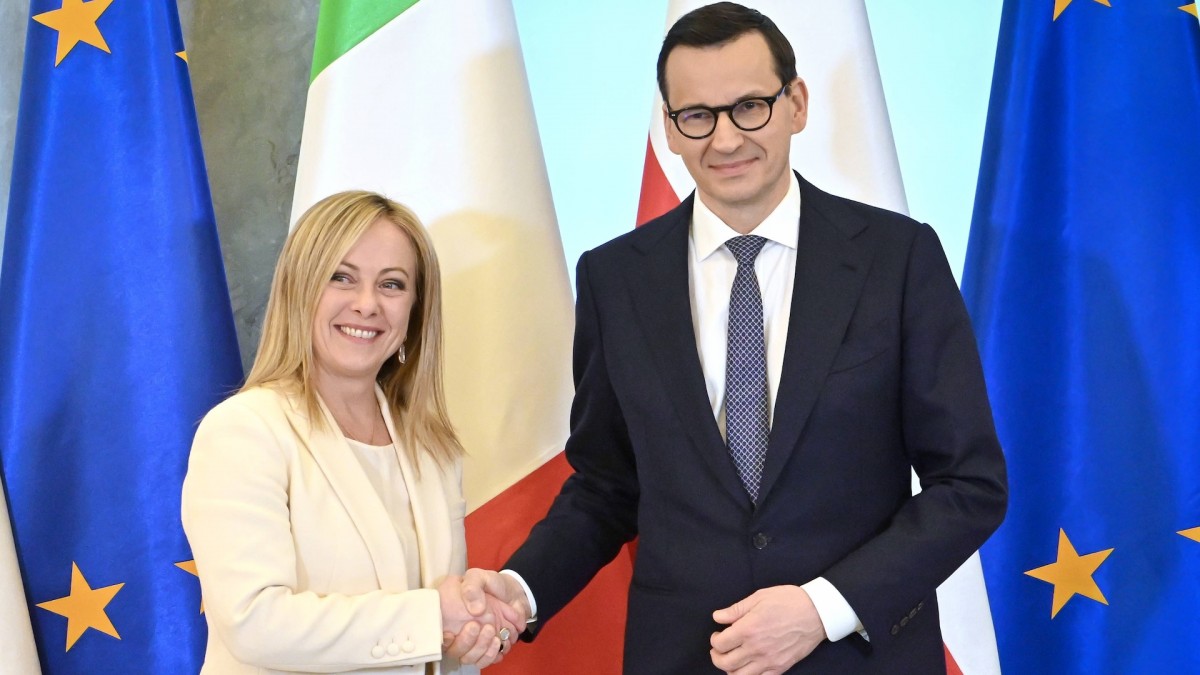
Giorgia Meloni, meets her successor as president of the ECR Group, Mateusz Morawiecki, in 2023.Damian Burzykowski / Zuma Press / ContactoPhoto
The European Conservatives and Reformists (ECR) party has unanimously elected Mateusz Morawiecki, former prime minister of Poland's Law and Justice party, as its leader. Morawiecki will succeed Italy's Prime Minister Giorgia Meloni, who stepped down from leading the party in mid-December. Morawiecki's appointment is highly symbolic, coinciding with the beginning of Poland's presidency of the European Council, a role now held by Law and Justice's nemesis, current centre-right Prime Minister Donald Tusk. With this move, the ECR seeks to bolster Law and Justice's position in Brussels and provide a platform to challenge Tusk's Civic Coalition ahead of the presidential elections in May.
Meloni and Morawiecki also hold fundamentally different views on the European Union. As prime minister, Meloni has thus far worked well with EU institutions, moderating her Eurosceptic stance and offering support to leaders from the European People's Party (EPP). This approach allowed the ECR to gain mainstream traction alongside Christian Democrats, Socialists, and Liberals during the previous European legislature. In contrast, Morawiecki's tenure as Polish prime minister was marked by hostility towards Brussels. As recently as December, Morawiecki stated in the European Parliament that he would "collaborate" with the EPP and the Patriots for Europe group, which includes figures such as Viktor Orbán and Slovakian Prime Minister Robert Fico —leaders who embrace Putin and frequently criticise Ukraine, a key EU ally.
Despite Morawiecki's election, this leadership change seems more nominal than revolutionary. While ideological differences exist, his appointment is unlikely to bring significant changes to the political landscape for the party or to the balance of power within EU institutions. Instead, it reflects the growing acceptance and normalisation of right-wing and populist parties within European politics.
Today, the harshest protest these parties might face is hostile body language or a cold, unsmiling handshake. Even in Germany, where the legacy of Nazism has made cooperation with the far-right politically taboo, there are emerging signs of local collaboration between mainstream parties and Alternative for Germany (AfD). The party is currently polling in second place ahead of a national election on February 23rd.
The new leadership of the ECR signals continuity rather than transformation. Internal ideological differences do not appear poised to significantly alter the group's influence or the dynamics of power within the European Union. The real test of this leadership change will lie in how Morawiecki navigates collaborations and negotiations within a politically diverse continent that is increasingly converging on the acceptance of far-right parties within European politics.
"ECR is now led by Law and Justice, a party deemed far-right and systematically excluded from negotiations and leadership positions"This leadership change within the ECR marks a shift regarding the faction leading the party. The conservative group, which consists of two distinct factions, transitions from being led by Meloni —leader of the faction comprised of national parties considered moderate and acceptable negotiation partners by centrist forces, such as Brothers of Italy and the Civic Democratic Party (ODS) of the Czech Republic— to being led by Law and Justice, a party often regarded as far-right and regularly sidelined in negotiations and leadership roles.
Meloni and Morawiecki also hold fundamentally different views on the European Union. As prime minister, Meloni has thus far worked well with EU institutions, moderating her Eurosceptic stance and offering support to leaders from the European People's Party (EPP). This approach allowed the ECR to gain mainstream traction alongside Christian Democrats, Socialists, and Liberals during the previous European legislature. In contrast, Morawiecki's tenure as Polish prime minister was marked by hostility towards Brussels. As recently as December, Morawiecki stated in the European Parliament that he would "collaborate" with the EPP and the Patriots for Europe group, which includes figures such as Viktor Orbán and Slovakian Prime Minister Robert Fico —leaders who embrace Putin and frequently criticise Ukraine, a key EU ally.
Despite Morawiecki's election, this leadership change seems more nominal than revolutionary. While ideological differences exist, his appointment is unlikely to bring significant changes to the political landscape for the party or to the balance of power within EU institutions. Instead, it reflects the growing acceptance and normalisation of right-wing and populist parties within European politics.
"The line between right-wing populists and conservative leaders in national governments has largely disappeared"Gone are the days when EU leaders, confident in the need to uphold the bloc's centrist values against extremist positions, maintained a strict cordon sanitaire around these parties, keeping right-wing populists out of power for decades across the continent. The line between right-wing populists and conservative leaders in national governments has largely disappeared, with populist parties supporting or forming part of governments in Sweden, Finland, Croatia, France, Italy, the Netherlands, and the Czech Republic.
Today, the harshest protest these parties might face is hostile body language or a cold, unsmiling handshake. Even in Germany, where the legacy of Nazism has made cooperation with the far-right politically taboo, there are emerging signs of local collaboration between mainstream parties and Alternative for Germany (AfD). The party is currently polling in second place ahead of a national election on February 23rd.
The new leadership of the ECR signals continuity rather than transformation. Internal ideological differences do not appear poised to significantly alter the group's influence or the dynamics of power within the European Union. The real test of this leadership change will lie in how Morawiecki navigates collaborations and negotiations within a politically diverse continent that is increasingly converging on the acceptance of far-right parties within European politics.

Carolina Plaza Colodro
Profesora permanente laboral de Ciencia Política en la Universidad de Salamanca
Doctora por la Universidad de Salamanca, especializada en política comparada, opinión pública y participación política, con foco en el sur de Europa. Sus investigaciones abordan populismo, euroescepticismo, género, redistribución y medio ambiente en los sistemas de partidos.
Etiquetas
Agenda Pública in English, Polonia, UE, Italia, Meloni, Parlamento Europeo, extrema derecha, derecha, Consejo Europeo Ahora en portada
16 de octubre de 2026
16 de octubre de 2026
16 de octubre de 2026
Noticias relacionadas
Hace 90 semanas
The next European People's Party congress will be played out in Spain
Hace 90 semanas
Thierry Breton: "If Elon Musk chooses to express himself using X, he must ensure that it complies with European legislation"
Hace 93 semanas
Europe needs a new leading bloc: an E5+1 that includes Spain
Lo más leído