Domingo, 18 de octubre de 2026




CRISIS OF GOVERNMENT IN FRANCE
A budget for France: Sébastien Lecornu’s New Year’s resolution
Despite the urgent need to approve its economic budget, France remains in political deadlock. Miguel Ángel Ortiz-Serrano, PhD in Economic History and Professor of Economics, dissects the "partial victory" of Prime Minister Sébastien Lecornu, whom he sees as "the only figure capable of building bridges to both the left and the right" to prevent further economic declines.
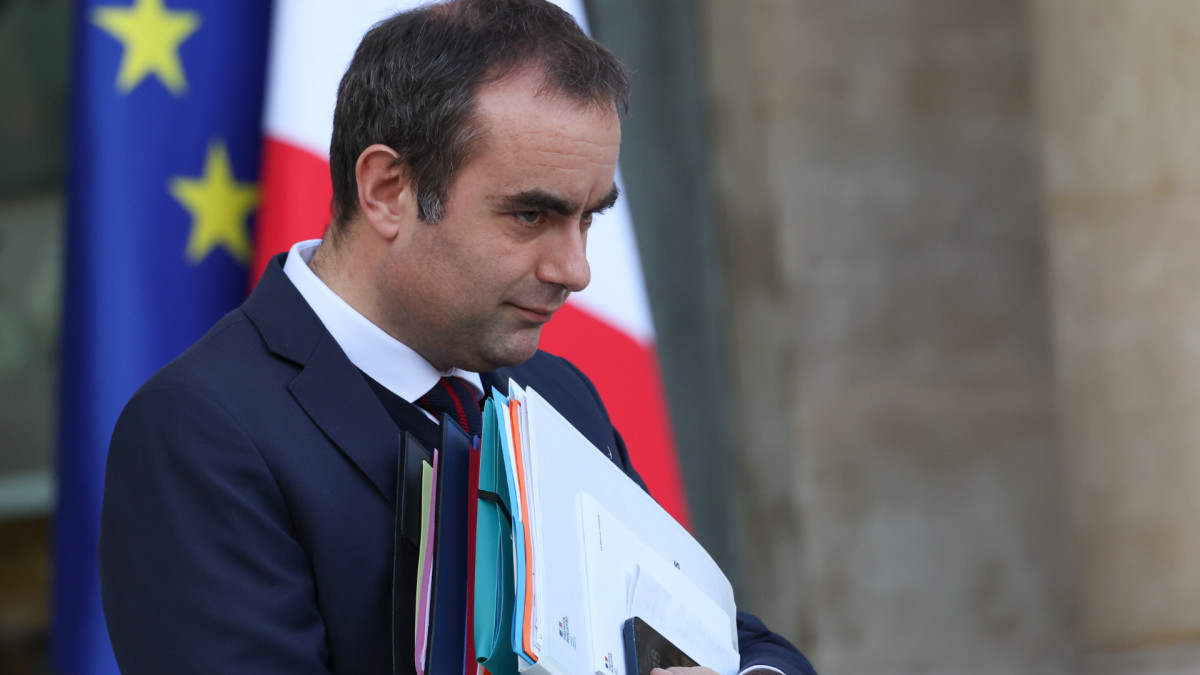
Prime Minister of France Sébastien Lecornu leaving the Elysée Palace after meeting with the Council of Ministers on 17 December.Michael Baucher / Zuma Press / ContactoPhoto
Through the final month of 2025, political life has been hectic, to say the least, for our neighbor to the northeast. Endless meetings among France’s parliamentary groups, constant threats of a motion of no-confidence by those most hostile to the Government, and growing insistence by President Macron to finally provide the country with a budget capable of implementing essential reforms have all conspired to exponentially increase the pressure on the cabinet of Prime Minister Sébastien Lecornu. As the deadline looms, the PM has opted to buy extra time by approving an exceptional rule – the Loi Spéciale – which "extends" the budgets of the current year for a short period, allowing negotiations to continue after the Christmas holidays.
About ten years ago, Philippe was considered Emmanuel Macron’s right-hand man; now, having founded his own political group with the intention of conquering the center-right by 2027, his relationship with the president is one of open confrontation. Meanwhile, Lecornu’s enduring ability to reach agreements on both the left and the right has managed to deactivate Philippe. As such, Lecornu has emerged more respected than his predecessor; his aura conveys responsibility and a sense of State and that could help him confront his greatest challenge: providing France with a complete budget.
Minimal overtime
This special rule is unlike the Spanish model, where the executive can automatically and fully apply the current-year budget for as long as parliamentary support is lacking. In France, the rule permits the State to continue operations for a period as if with no change of fiscal year; but France’s Constitution does not expect that such a situation might become recurrent – as has been the case for four years. Understanding the executive as a guarantor of national stability, the rule’s underlying logic is to push political actors to reach an agreement as soon as possible, to avoid the need to vote on the law again in a matter of weeks."Sébastien Lecornu was able to approve the parliament’s first budgetary law since the last elections, when chances for an absolute majority fell apart"Although, a priori, one might view this as a new failure, triggered by the current difficult parliamentary balance, Lecornu has emerged from the fracas relatively unscathed, in what might be called a partial victory. First, he managed to reach an agreement with the Socialist Party to move forward with the Social Security budget, which is of special importance in times of active debate on the viability of pensions, the retirement age, and social transfers for items such as child-raising, dependency, and so on. With tenacity and tireless will, Lecornu was able to approve the parliament’s first budgetary law since the last elections, when chances for an absolute majority vanished. Moreover, he achieved this in spite of Édouard Philippe, current mayor of Le Havre, former Prime Minister, and Lecornu’s main political rival within the same spectrum.
About ten years ago, Philippe was considered Emmanuel Macron’s right-hand man; now, having founded his own political group with the intention of conquering the center-right by 2027, his relationship with the president is one of open confrontation. Meanwhile, Lecornu’s enduring ability to reach agreements on both the left and the right has managed to deactivate Philippe. As such, Lecornu has emerged more respected than his predecessor; his aura conveys responsibility and a sense of State and that could help him confront his greatest challenge: providing France with a complete budget.
The political deadlock and the debt bill
Nonetheless, the negotiations in January 2026 will not be easy. Lecornu has a major task ahead of him, with the national accounts in deficit and a growing public debt. If this continues, the economic data aren’t very encouraging. With a deficit above 5%, and with debt as a percentage of GDP above 115%, the room for maneuver required to implement reforms is certainly limited. The magnitude of the problem is such that it could directly affect the State’s financing capacity and wipe out projects for industrial and energy development framed in the France 2030 plan – conceived as a great legacy by the Macron administration. In that context, personalities who tend to be cautious before speaking on such matters – such as the governor of the Bank of France – have grown concerned about the executive’s lack of action and unwillingness to address the country’s structural problems. According to the governor, France is paying some €7 billion in interest, so that in ten years’ time, the State will have spent considerably less on research into cutting-edge technologies, energy alternatives, improvements to production, and a renewed security architecture, all at a critical moment for both France and the European Union."Le Pen’s group understands that, if nothing changes, its prospects for the 2027 presidential election could brighten significantly, feeding off the widespread weariness"Along with a context of political fragmentation and polarization, this clearly contributes to exacerbating the pessimism surrounding France’s political class, where each group is entrenched in its positions so as not to undermine its electoral aspirations; and should Lecornu’s efforts end in failure, the legislative elections could be moved forward. The radical right appears comfortable with that situation. Le Pen’s group understands that, if nothing changes, its prospects for the 2027 presidential election could brighten significantly, feeding off widespread weariness over the weakness and fragmentation of traditional groups. With no clear alternative in sight, it seems that Lecornu – the man who once resigned within a month of his appointment to Prime Minister – may be the only figure capable of linking left and right to avoid a worsening economy, then starting France on the long road to recovering its fiscal autonomy. That could pull the country out of depression and restore it to a leadership role at the heart of the EU; and a strong and capable France will be crucial for meeting challenges to come in the next five years. Such a victory won’t be easy, but nothing in politics is easy if you don’t try.

Miguel Ángel Ortiz-Serrano
Profesor de Historia de la Empresa en CUNEF Universidad.
Es doctor en Historia Económica por la Universidad Carlos III de Madrid y fue profesor de Economía en la Universidad de Sussex (Reino Unido). Ha desarrollado el grueso de su actividad investigadora en Sciences Po Paris, donde se ha especializado en el estudio de los mercados financieros en Francia y Europa a finales del siglo XIX.
Ahora en portada
18 de octubre de 2026
18 de octubre de 2026
17 de octubre de 2026
Noticias relacionadas
Hace 53 semanas
Emmanuel Macron, entre la pared política y la espada económica
Hace 56 semanas
La Quinta República bajo presión
Lo más leído