Viernes, 16 de octubre de 2026




IN-DEPTH
If the European Union wants to be sovereign, it must look East
Paolo Gerbaudo, senior researcher in social sciences at the Complutense University of Madrid, warns that in the face of Trump's second-term foreign and trade policy, Europe must adopt a strategy of 'triangulation' as a bloc in the face of 'moral Atlanticism'.

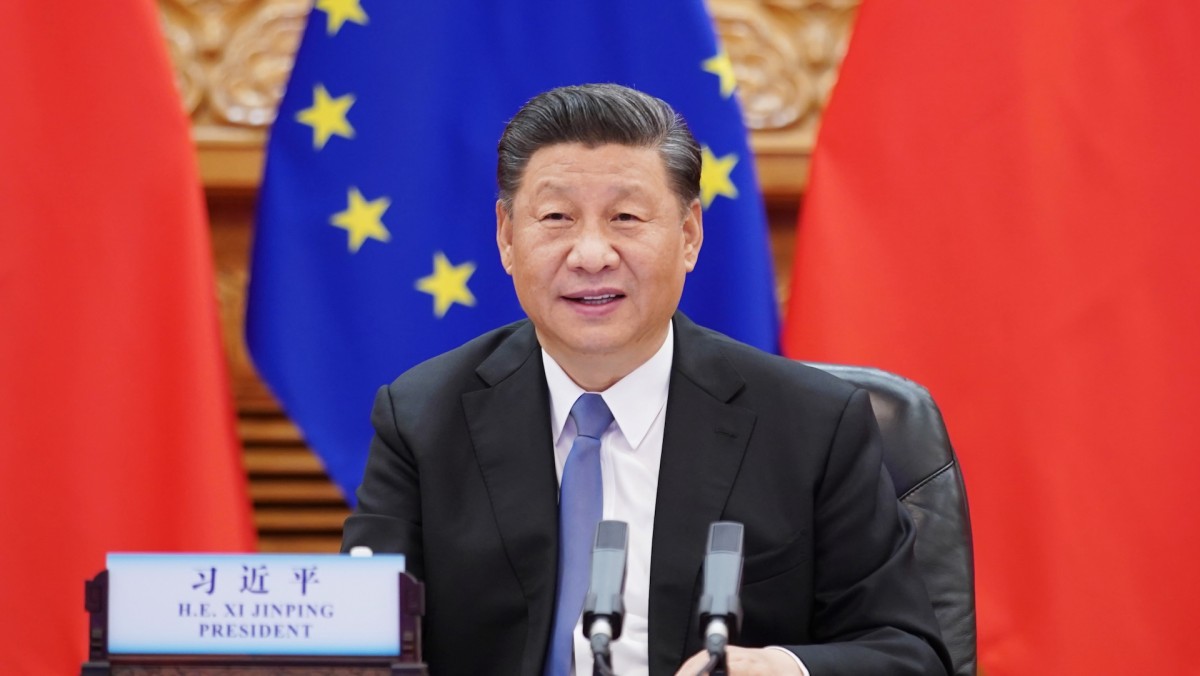
President Xi Jinping at an online meeting with European Commission President Ursula von der Leyen. June 2020.Wang Ye / Zuma Press / ContactoPhoto
There are essentially two paths for how the European Union should respond to Donald Trump's return to the White House and the extreme arrogance with which he has treated European partners: either Europe must fully accept its condition of vassalage under US tutelage that Trump is placing it in and draw the necessary consequences (namely, renouncing any pretence of autonomy, from defence to AI). Or try something new, and start behaving not as a de facto military and economic protectorate or captive market, but as an autonomous bloc, one actually endowed with "strategic autonomy" —to quote a phrase often repeated in Brussels that has thus far mostly remained empty rhetoric.
From Strategic Rival to Critical Partner?
From an economic perspective, it is evident that a stronger relationship with China offers great opportunities for the EU. The Eastern country is already the world's largest economy calculated in purchasing power parity (though not yet in dollar terms). China is a country with which the EU already maintains strong commercial relationships, being its largest trading partner, though only its third export destination after the US and UK.
Developing a stronger relationship with China could have positive impacts on Europe's technological development. Based on the Critical Technology Tracker, developed by the Australian Strategic Policy Institute (ASPI), China is the leader in fifty-seven of the sixty-four assessed technologies. This includes key technologies such as 5G internet, electric batteries, and electric vehicles. In leading technological sectors such as AI and EVs, there are evident opportunities for collaboration between the EU and China.
For example, the rise of DeepSeek as a popular AI alternative to OpenAI's ChatGPT is made all the more interesting by the fact that it uses an open-source model rather than the proprietary one of Silicon Valley companies. This model offers avenues for cooperation with European businesses who are trying to enter an area thus far controlled by enormous US corporate behemoths. Similarly, China and the EU are the largest EV markets and already have significant technological partnerships between their companies.
The EU could draw significant advantages from partnership with Chinese firms in electric vehicles, to acquire Chinese expertise through a sort of "reverse technology transfer", similar to the one Chinese companies enjoyed by developing joint ventures with European companies in past decades. Collaborations in many other sectors, such as 5G and 6G and quantum computing could be very beneficial for the EU. The EU approaches China as a bloc and not each member state by itself, which gives China a far stronger negotiating position, allowing it to profit from the EU's political fragmentation. Some countries such as Hungary are already offering themselves to Chinese EV companies.
What is missing is a European strategy ensuring that the host companies offer in return access to technology and knowledge, thus allowing Europe to recuperate capacity in this area. Thus far, it is China that has gained the best of its dealings with the EU, largely because of European disunity and the reluctance of European policy-makers to adopt a more statist and pro-development approach to technology. However, in the present state of development, with China already well ahead in many sectors, it is Europe that has a clear "technological catch-up" opportunity.
Besides economic interest, there is also evident converging political interest, especially regarding how to deal with global issues such as climate change and energy transition. This has become only more apparent with Trump's arrogant stances in foreign policy, his mindless decision to abandon all environmental goals of emission reduction and the Paris Accord.
Different opinion polls conducted in China have found that the Chinese public views Europe very differently from the US, and that it respects it as an ancient civilization, rather than the barbarous and mischievous capitalism attributed to the US. Lastly, in many respects the contemporary Chinese way of life, with its dense urban centres, mass transit, and high-speed railways. It is surprisingly more similar to the European one than the dominant US way of life of large suburban sprawls and pickup trucks.
While the economic, technological (and diplomatic) interest in developing stronger ties with China is very apparent, pursuing stronger ties with China is going to face enormous hurdles. Although individual European countries often maintain rather friendly relationships with it, China is formally defined in EU policymaking not just as a global partner, but most importantly as "an economic competitor and a systemic rival". This can be clearly seen in the very different ways in which EU policy-makers deal with the US and with China. For example, since the beginning of her first mandate as EU Commission president in December 2019, Ursula von der Leyen coupled strong support for the transatlantic partnership with the US with a mostly guarded if not altogether hostile attitude toward China.
In Von der Leyen's speeches, the US —particularly under the presidency of Joe Biden, bringing welcome relief from the chaos of the first Trump mandate— was presented as a steadfast ally and a partner for the "liberal rules-based international order" and "a pillar of stability, security, and prosperity on both sides of the Atlantic". Conversely, China was often denounced as an authoritarian state, accused of not sharing our values (namely democracy and human rights) and an unfair competitor not playing by the rules. Such as by resorting to state aid and subsidies to technological industries, from solar panels to the electric vehicle market.
Significantly, while under Biden's Buy American economic policy, the US engaged in very similar state aid practices to those practiced by Beijing. This caused considerable dismay in Brussels but was never denounced as grossly unfair, as happened with China, which continues to be frequently represented anachronistically as if it were still the country engaging in cheap manufacturing.
Triangulation versus Moral Atlanticism
The EU's hostility toward China stems largely from its close identification with NATO (something that has become only stronger in recent years) and the consequent view of the need to fall in line with the military ally against what it perceives as its main future military adversary. If anything, this view of the US as an eternal and indisputable ally and of China as a growing threat has only intensified since the outbreak of the conflict in Ukraine in February 2022. During the conflict, Russia's alliance with China became closer under the premise of an "unlimited partnership," which reinforced in Europe the idea of a global confrontation between democracies and authoritarian regimes. This narrative, adopted not only by right-wing politicians but also by sectors of the centre-left, encompasses countries such as China, Russia, and North Korea and associates them with national-populist movements within Europe.
By accepting the narrative of a civilizational war of Western democracies versus Asian despotisms, Europeans are accepting to place themselves in the most dangerous geopolitical place of all: on the front line of future (and present) conflicts. History teaches us that when you are in-between two blocs, you too often end up being the battlefield for their war. Europeans may now start questioning the wisdom of embracing this geopolitical approach. Loyally espousing the framework of a civilizational war between democracies and autocracies has brought only disadvantages and no real advantage. Europeans had to pay an enormous price for the economic consequences of a conflict with Russia, which US aggressive foreign policy and support for NATO expansion contributed to creating. And after doing all this, now they find an autocrat elected to the White House who thinks he can continue offloading all the negative consequences of US geopolitics on Europe while laying his hands on Ukraine's primary resources. Such as rare earth materials, which he sees as "reparation" for the US war effort.
The new US administration seems determined to stop any attempt by the EU to gain some level of technological autonomy in relation to US companies that now completely control its digital sector. The share of European digital companies is ludicrously low. And this did not happen by chance, but because of the servility of European leaders toward US partners. The extraordinary dominance of US firms poses serious threats to European national security, given how strategic digital communication is for basically any industry. Even moderate attempts to push US companies to fall in line with EU regulations are now considered intolerable by the new administration. For example, J.D. Vance has threatened the EU with the end of NATO if it finally attempts to regulate Elon Musk's X. Trump has also argued that the EU is "treating us very badly" —hinting at the fines imposed on US digital companies such as Alphabet and Microsoft because of their monopolistic status—. In many respects, the US now approaches Europe much as imperialist powers of the past approached their colonies and captive markets: as a territory over which they have a fundamental right of economic supremacy and which is compelled to buy their goods. In particular, weapons and gas, to satiate Trump's rage.
Pursuing this strategy will no doubt encounter enormous resistance within the EU: on the right, where many nominally nationalist parties are in fact emissaries of the new US administration and of oligarchs such as Elon Musk; in Eastern Europe, especially in the Baltic States, where many political leaders see an unconditional alliance with the US as the only guarantee for their safety; and in the centre and centre-left where, despite all evidence, cultural suspicion of China persists along with an uncritical adoption of the framework of a civilizational war between democracies and autocracies. However, looking East is the only hope for Europe to regain some pride, eventually stop being a vassal, and begin behaving as a superpower.
"Taking the second path, that of a truly sovereign Europe, necessarily means escaping the geopolitical cage of Atlanticism"Taking the second path, that of a truly sovereign Europe, necessarily means escaping the geopolitical cage of Atlanticism (which has, in fact, translated into comprehensive vassalage of the EU under US tutelage) and finally starting to behave like a bloc that follows its own interests, dealing with other blocs as it sees fit. Specifically, in relation to the current situation, this means looking East, and particularly toward China as a global actor. Europe shares many economic, diplomatic and geopolitical interests with the Asian giant that —especially given the extreme contempt shown by Trump —should now be explored to their full extent; or at least they should be if any self-respect remains among EU policymakers. By engaging in triangulation with China and the United States, Europe can reclaim some of the autonomy it has thus far lost to the US. While regaining the economic and technological ground, it has ceded since the 2008 financial crisis.
From Strategic Rival to Critical Partner?
From an economic perspective, it is evident that a stronger relationship with China offers great opportunities for the EU. The Eastern country is already the world's largest economy calculated in purchasing power parity (though not yet in dollar terms). China is a country with which the EU already maintains strong commercial relationships, being its largest trading partner, though only its third export destination after the US and UK.
"China is far more supportive of the global exchange that the EU has traditionally pursued than the United States"Given the US threat to launch a trade war with the EU to reduce its trade deficit, the EU could try to find new export avenues in China. Especially as its middle class expands along with its desire for foreign goods. Furthermore, surprisingly, China is now far more supportive of the global exchange that the EU has traditionally pursued than the United States. Finally, while ostensibly disagreeing with China on many fronts regarding values, especially in terms of democracy and human rights. Europe has much to share with China regarding global goals, particularly concerning the transition toward renewable energy and the fight against climate change.
Developing a stronger relationship with China could have positive impacts on Europe's technological development. Based on the Critical Technology Tracker, developed by the Australian Strategic Policy Institute (ASPI), China is the leader in fifty-seven of the sixty-four assessed technologies. This includes key technologies such as 5G internet, electric batteries, and electric vehicles. In leading technological sectors such as AI and EVs, there are evident opportunities for collaboration between the EU and China.
For example, the rise of DeepSeek as a popular AI alternative to OpenAI's ChatGPT is made all the more interesting by the fact that it uses an open-source model rather than the proprietary one of Silicon Valley companies. This model offers avenues for cooperation with European businesses who are trying to enter an area thus far controlled by enormous US corporate behemoths. Similarly, China and the EU are the largest EV markets and already have significant technological partnerships between their companies.
The EU could draw significant advantages from partnership with Chinese firms in electric vehicles, to acquire Chinese expertise through a sort of "reverse technology transfer", similar to the one Chinese companies enjoyed by developing joint ventures with European companies in past decades. Collaborations in many other sectors, such as 5G and 6G and quantum computing could be very beneficial for the EU. The EU approaches China as a bloc and not each member state by itself, which gives China a far stronger negotiating position, allowing it to profit from the EU's political fragmentation. Some countries such as Hungary are already offering themselves to Chinese EV companies.
What is missing is a European strategy ensuring that the host companies offer in return access to technology and knowledge, thus allowing Europe to recuperate capacity in this area. Thus far, it is China that has gained the best of its dealings with the EU, largely because of European disunity and the reluctance of European policy-makers to adopt a more statist and pro-development approach to technology. However, in the present state of development, with China already well ahead in many sectors, it is Europe that has a clear "technological catch-up" opportunity.
Besides economic interest, there is also evident converging political interest, especially regarding how to deal with global issues such as climate change and energy transition. This has become only more apparent with Trump's arrogant stances in foreign policy, his mindless decision to abandon all environmental goals of emission reduction and the Paris Accord.
"Collaborations in many other sectors, such as 5G and 6G and quantum computing, could be very beneficial for the EU, provided that the EU approaches China as a bloc and not each member state by itself"Often it is assumed that what sets Europe and China apart is culture, while Europe and the US are deemed to be closely linked as part of the West. Yet, this idea of civilizational cleavage, promoted by authors such as Samuel Huntington, is questionable in certain respects. While there are indeed important cultural divergences and very different political regimes in Europe and the US, Europeans and Chinese share many cultural elements and some sympathy (at least from China toward Europe).
Different opinion polls conducted in China have found that the Chinese public views Europe very differently from the US, and that it respects it as an ancient civilization, rather than the barbarous and mischievous capitalism attributed to the US. Lastly, in many respects the contemporary Chinese way of life, with its dense urban centres, mass transit, and high-speed railways. It is surprisingly more similar to the European one than the dominant US way of life of large suburban sprawls and pickup trucks.
While the economic, technological (and diplomatic) interest in developing stronger ties with China is very apparent, pursuing stronger ties with China is going to face enormous hurdles. Although individual European countries often maintain rather friendly relationships with it, China is formally defined in EU policymaking not just as a global partner, but most importantly as "an economic competitor and a systemic rival". This can be clearly seen in the very different ways in which EU policy-makers deal with the US and with China. For example, since the beginning of her first mandate as EU Commission president in December 2019, Ursula von der Leyen coupled strong support for the transatlantic partnership with the US with a mostly guarded if not altogether hostile attitude toward China.
In Von der Leyen's speeches, the US —particularly under the presidency of Joe Biden, bringing welcome relief from the chaos of the first Trump mandate— was presented as a steadfast ally and a partner for the "liberal rules-based international order" and "a pillar of stability, security, and prosperity on both sides of the Atlantic". Conversely, China was often denounced as an authoritarian state, accused of not sharing our values (namely democracy and human rights) and an unfair competitor not playing by the rules. Such as by resorting to state aid and subsidies to technological industries, from solar panels to the electric vehicle market.
Significantly, while under Biden's Buy American economic policy, the US engaged in very similar state aid practices to those practiced by Beijing. This caused considerable dismay in Brussels but was never denounced as grossly unfair, as happened with China, which continues to be frequently represented anachronistically as if it were still the country engaging in cheap manufacturing.
Triangulation versus Moral Atlanticism
The EU's hostility toward China stems largely from its close identification with NATO (something that has become only stronger in recent years) and the consequent view of the need to fall in line with the military ally against what it perceives as its main future military adversary. If anything, this view of the US as an eternal and indisputable ally and of China as a growing threat has only intensified since the outbreak of the conflict in Ukraine in February 2022. During the conflict, Russia's alliance with China became closer under the premise of an "unlimited partnership," which reinforced in Europe the idea of a global confrontation between democracies and authoritarian regimes. This narrative, adopted not only by right-wing politicians but also by sectors of the centre-left, encompasses countries such as China, Russia, and North Korea and associates them with national-populist movements within Europe.
"The EU's hostility toward China stems largely from its close identification with NATO"It is understandable that European politicians are concerned about shrinking spaces for democracy around the world. But in the aftermath of Trump's return to the White House, it becomes more difficult to sustain the narrative of the West's democratic superiority and the need to fight against Eastern despotism. Under Trump's increasingly authoritarian government, the argument about the opposition between democracies and autocracies —which has been frequently used by European politicians to justify their guarded stance towards China— has far less persuasive force. The democracy versus autocracy discourse now increasingly looks like moral blackmail pushed by US liberal foreign policy think-tanks to geopolitically shackle their European cousins; with disastrous consequences for them.
By accepting the narrative of a civilizational war of Western democracies versus Asian despotisms, Europeans are accepting to place themselves in the most dangerous geopolitical place of all: on the front line of future (and present) conflicts. History teaches us that when you are in-between two blocs, you too often end up being the battlefield for their war. Europeans may now start questioning the wisdom of embracing this geopolitical approach. Loyally espousing the framework of a civilizational war between democracies and autocracies has brought only disadvantages and no real advantage. Europeans had to pay an enormous price for the economic consequences of a conflict with Russia, which US aggressive foreign policy and support for NATO expansion contributed to creating. And after doing all this, now they find an autocrat elected to the White House who thinks he can continue offloading all the negative consequences of US geopolitics on Europe while laying his hands on Ukraine's primary resources. Such as rare earth materials, which he sees as "reparation" for the US war effort.
"Trump has shown utter contempt toward High Representative Kaja Kallas by completely bypassing her and EU leaders in his negotiations with Vladimir Putin to end the war in Ukraine"In less than a month at the helm, Trump has already repeatedly humiliated European leaders, threatening to occupy Greenland (Danish territory) and threatening trade wars. Furthermore, he has shown utter contempt toward High Representative Kaja Kallas by completely bypassing her and EU leaders in his negotiations with Vladimir Putin to end the war in Ukraine. This attitude is all the more insulting given that Europe had to pay a massive price for the war in Ukraine, in terms of its economic consequences, of severing economic ties with Russia, and in terms of growing political discontent. This helps the far-right, such as Alternative für Deutschland (AfD) in Germany, to rise in the polls. This situation is made all the more infuriating by the fact that it was largely the US that pushed for NATO expansion to the East and supported Ukraine's demands for accession, along with many European leaders. In other words, Europe in international relations has been too often "taken for a ride" and grossly humiliated. Unfortunately, this is likely to be even more the dominant picture as we move forward, and the US, while feeling challenged technologically and economically by China, looks at Europe as its own reserved hunting ground.
The new US administration seems determined to stop any attempt by the EU to gain some level of technological autonomy in relation to US companies that now completely control its digital sector. The share of European digital companies is ludicrously low. And this did not happen by chance, but because of the servility of European leaders toward US partners. The extraordinary dominance of US firms poses serious threats to European national security, given how strategic digital communication is for basically any industry. Even moderate attempts to push US companies to fall in line with EU regulations are now considered intolerable by the new administration. For example, J.D. Vance has threatened the EU with the end of NATO if it finally attempts to regulate Elon Musk's X. Trump has also argued that the EU is "treating us very badly" —hinting at the fines imposed on US digital companies such as Alphabet and Microsoft because of their monopolistic status—. In many respects, the US now approaches Europe much as imperialist powers of the past approached their colonies and captive markets: as a territory over which they have a fundamental right of economic supremacy and which is compelled to buy their goods. In particular, weapons and gas, to satiate Trump's rage.
"The new US administration seems determined to stop any attempt by the EU to gain some level of technological autonomy in relation to US companies"The situation is dire, and in the new geopolitical competition between mega-states such as the US and China, the EU runs the risk of becoming even more of a captive partner. Only a triangulation approach, playing a balancing act between the US and China, may still free Europe from the geopolitical cage in which it has shackled itself. Ideally, this should not mean moving from one sphere of influence (the US de facto empire) to another one (China and the BRICS+), but rather claiming for Europe its own autonomous sphere, in relation with other global actors. In this context, engaging in a closer relationship with China would offer Europe a series of trade, economic and technological development opportunities which it has thus far renounced because of its servile loyalty to the US; and on the other hand teach US foreign affairs hawks, now emboldened by Trump's presidency, an important lesson about the consequences of arrogance in international relations.
Pursuing this strategy will no doubt encounter enormous resistance within the EU: on the right, where many nominally nationalist parties are in fact emissaries of the new US administration and of oligarchs such as Elon Musk; in Eastern Europe, especially in the Baltic States, where many political leaders see an unconditional alliance with the US as the only guarantee for their safety; and in the centre and centre-left where, despite all evidence, cultural suspicion of China persists along with an uncritical adoption of the framework of a civilizational war between democracies and autocracies. However, looking East is the only hope for Europe to regain some pride, eventually stop being a vassal, and begin behaving as a superpower.
Ahora en portada
16 de octubre de 2026
16 de octubre de 2026
16 de octubre de 2026
Noticias relacionadas
Hace 88 semanas
What Trump's return means for the war in Ukraine
Hace 88 semanas
Trump's Triple 'D': Deregulation, Deglobalisation, and Disorder
Lo más leído