Viernes, 16 de octubre de 2026




CONVERSATIONS
Josep Borrell: "The US is very keen on Europeans taking on more strategic responsibilities"
Josep Borrell, the European Union's High Representative for Foreign Affairs and Security Policy, addresses the most pressing challenges for European foreign policy at the flagship ‘State of the Union’ conference at the European University Institute in Florence.
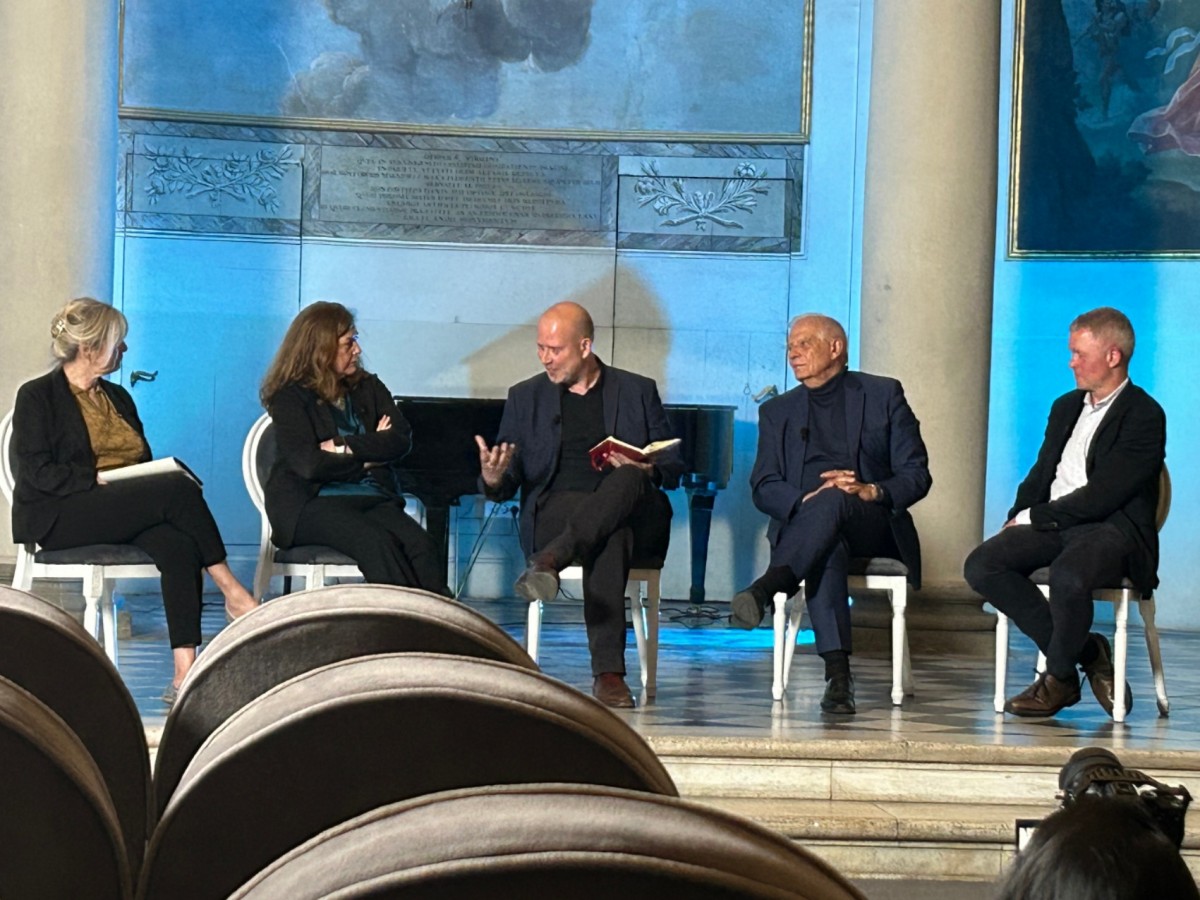
'State of the Union' Conference in the European University Institute in Florence.Agenda Pública
In the emblematic conference on the State of the Union, held at the European University Institute in Florence. Josep Borrell, High Representative of the European Union for Foreign Affairs and Security Policy, addresses the most urgent challenges of European foreign policy.
Accompanied by a distinguished panel of experts and under the moderation of Fabrizio Tassinari, executive director of the School of Transnational Governance, Borrell reflects on the war in Ukraine. The expected Ukrainian counteroffensive, the role of European strategic autonomy and the complex relations with China and the United States.
In this conversation, organized by Agenda Pública, we explore the challenges that define the present and future of Europe in a geopolitical context marked by uncertainty.
Fabrizio Tassinari (F. T.): Good afternoon, everyone. Let's start with what's really on the table right now. The war in Ukraine has entered its fifteenth month, and now we are all waiting for this Ukrainian counteroffensive.
Mr. Borrell, you said today at the State of the Union that you are thinking a lot about ammunition. Recently, we have seen President Zelensky in Europe. We have also seen in the past two weeks an intense debate on China and strategic autonomy, balanced with a transatlantic conversation on economic security. Looking at the balance from your position, how do you see European foreign policy?
Josep Borrell (J.B.): The Kosovo-Serbia dialogue is on my table. Relations with Israel and the Palestinian question are also there. There is the civil war in Sudan and the rescue of European citizens. There is the preparation of the summit with the Latin American countries. The war in Ukraine is not the only thing on the table for me.
But if we have to look for the main structural problem, certainly the Russian invasion of Ukraine and our support for Ukraine continues. In fact, we have to provide ammunition because we provide weapons. Having weapons without ammunition is really useless.
Furthermore, I raise the question of how we reshape our position in the triangle between the United States, China, and the EU.
"The EU has to reach out to the rest of the world with more strength and positivity"[authorquote]Josep Borrell[/autorquote]Finally, our relationship with the rest of the world. Saying the West and the rest is a simplification. However, there is the rest that is not China, nor the US, nor the West in general terms. The EU has to reach out to the rest of the world with more strength and positivity. This requires significant effort.
F. T.: Ben, you have been reporting for the FT on the latest developments in the war in Ukraine, which has become a war of attrition, but now there is probably a counteroffensive underway. How do you see the situation from your perspective?
Ben Hall (B.H.): There is a lot at stake in this counteroffensive for Ukraine, not only in terms of retaking occupied territory, but also in terms of arguing or reaffirming the case to its allies and supporters to maintain support. There has to be some hope for a military breakthrough.
Mr. Borrell, with the American elections in sight next year, but also anticipating the moment when Europeans begin to rethink sanctions on Russia and military support for Ukraine, is this a decisive moment for Ukraine?
J.B.: Frankly, all I know is that the battle continues and will continue. Russia has not been unable to move forward. They have been withdrawing from Ukraine. There are even strong divisions between them. I just heard the command of private military companies complain that the Russian army does not supply ammunition. They threaten to withdraw from the Bakhmut Front without being able to take it.
I heard Putin say that he has military objectives and that as long as he does not get results, the fight will continue. So there is little hope that the invasion can be ended by a Russian withdrawal. Russia is not ready for peace talks.
Meanwhile, we have to continue supporting Ukraine because it fundamentally depends on the support of its Western allies. Although the most important part of military support comes from the United States, our contribution is not negligible, but it is less critical. However, our economic and financial support is crucial. We have to continue supporting Ukraine.
B.H.: Can Russia be brought to a point on the battlefield where it is willing to talk?
J.B.: Nothing in life is guaranteed. While some Member States do not fully support the sanctions, they still vote in favor because the sanctions require unanimity to be adopted. However, these cases are rare. The majority is firmly united in recognizing the need for sanctions.
"The objective of the sanctions is clear: we do not want to finance the Russian war machine"[authorquote]Josep Borrell[/authorquote]But what do we mean by sanctions? Curiously, the term does not appear in the treaties. Instead, we talk about restrictive measures. These measures aim to restrict certain activities, specifically buying and selling. The objective is clear: we do not want to finance the Russian war machine. We avoid purchasing resources such as gas and also refrain from selling them critical materials, such as microchips, that Russia could use to sustain its war efforts.
B. H.: Sanctions are one thing: they tend to be difficult to reverse. Active military support, including long-range weapons on an indefinite basis, is another matter entirely.
I would like to divert the conversation slightly to the topic of strategic autonomy: the idea that Europe should take greater responsibility for its own security and economic future. President Macron recently claimed that he had won the debate on strategic autonomy. In your opinion, where is this debate today?
J.B.: If the term strategic autonomy raises concerns, let's frame it as strategic responsibility. Europe must take greater responsibility for its own defence. Yet, there is no alternative to NATO for the territorial defense of Europe. Let's be clear: no one in Europe suggests creating a European NATO. NATO and transatlantic unity remain the cornerstone of Europe's territorial defence.
"There is no alternative to NATO for the territorial defence of Europe. Let us be clear: no one in Europe suggests creating a European NATO"[authorquote]Josep Borrell[/authorquote]However, beyond NATO, Europe needs to shoulder a greater burden. The United States has been asking for it, and I think it is the country that has the most to gain from a Europe that assumes more responsibilities. A stronger Europe strengthens NATO. It also allows Europeans to address challenges that NATO cannot solve, especially in our immediate neighbourhood and in areas such as the Indo-Pacific and China.
To do this effectively, Europe must develop its capacity to act collectively. This means enhancing the defence capabilities of individual Member States and at the same time coordinating them under a unified vision. Otherwise, we risk inefficiency and wasted resources. Imagine if each state in the United States built its own military without considering the broader needs of the Union: it would be chaotic.
B.H.: However, we see countries like Poland purchasing large quantities of American weapons.
J.B.: I am not opposed to buying American weapons. However, if Europe is serious about strategic responsibility, must also invest in its own industrial capabilities.
F.T.: Alicia, yesterday at the State of the Union you spoke at length about disruptions in value chains. How does that align with the emerging transatlantic consensus (or lack thereof) on China? And how does it relate to the pressing issue of economic security, which is becoming a key agenda for the United States?
Alicia García-Herrero: We already know how the United States approaches this, with different points of view than those of Janet Yellen and Jake Sullivan. But one thing is clear: The idea that trade exists solely in the economic sphere has disappeared, not only in the United States but also in China, where it was never separate to begin with.
In Europe, we have long treated trade as distinct from security, within the framework of multilateralism. However, that framework is no longer effective. Trade and security are now intertwined. Green energy, for example, depends on economies of scale, which create dependencies, particularly on China, whose economic strategy leverages dependence as a tool of influence, especially given its current military limitations.
Europe's growing dependence on China is evident. Even Germany has a trade deficit with China, its largest trading partner on the import side, mainly due to the energy transition. If we fail to address this dependency, it could distance us from our transatlantic alliance, which underpins our security.
So my question is: How can Europe minimize the risk of economic dependence undermining its security alignment with the United States? Do we need a clearly European risk reduction strategy? And if so, what would it be like?
J.B.: This is a complex issue. Europe faces significant dependencies, particularly on critical materials and renewable technologies. These dependencies can become dangerous. Today, we are more dependent on China for some resources than on Russia for gas.
That said, we do not intend to block China's technological and economic development. The challenge is finding the right balance. Reducing risk is easier said than done.
"We must reduce risks without inadvertently fostering new ones or attempting to stifle China's rise as a power"[authorquote]Josep Borrell[/authorquote]China was a pioneer in risk reduction. Its investments in the Indo-Pacific are designed to reduce exposure to potential Western sanctions. We must be cautious, as our attempts to diversify could create secondary dependencies (for example, trading with a neighbor that is heavily dependent on China).
Reducing risk is not just a slogan; requires a nuanced, case-by-case approach. We must reduce risks without inadvertently fostering new ones or attempting to stifle China's rise as a power. The real question is how China will exert its growing influence.
F.T.: Thank you. Let's turn to Catherine, who can offer us insights into the domestic contexts that shape Europe's foreign policy.
Catalina Fieschi (C.F.): Thank you. I realize that I speak after a deep discussion about foreign policy, but I would like to emphasize a crucial point: everything we have discussed depends on the consent of the citizens.
Ben Hall highlighted the importance of 2024, with the US and European elections just around the corner. Today we have heard worrying data about “solidarity fatigue” and changing public priorities. For example, while inflation and rising prices remain major concerns, the war in Ukraine has become less important for many Europeans.
This raises a critical question: much of Europe's mission as a foreign policy actor, especially with regard to strategic autonomy and risk reduction, depends on securing public support for the necessary political, financial and ideological commitments. How confident are you that citizens can be persuaded? What can Europe's foreign policy voices do to foster this support and maintain unity?
J.B.: Trust is limited: democracy is inherently conflictual. Putin himself is betting on this, believing that democratic regimes are fragile due to freedom of expression and public debate. Indeed, many wondered whether Europeans could maintain unity amid rising energy costs and inflation. However, despite the challenges, polls show that a majority still supports Ukraine, albeit with geographical nuances and questions about the timing and purpose of this support.
"Strengthening Putin through inaction risks allowing future aggression. This message must be clearly communicated to the public: nothing comes without a cost, especially peace under these conditions"[authorquote]Josep Borrell[/authorquote]The task of politicians is clear: explain what is at stake and the consequences of inaction. If we stop supporting Ukraine, what then? Will peace come? Strengthening Putin through inaction risks allowing future aggression. This message must be clearly communicated to the public: nothing comes without a cost, especially peace under these conditions.
C.F.: Should the EU itself play a greater role in this public commitment, rather than leaving it solely in the hands of national governments?
J.B.: Absolutely, although it is complex. The EU must act carefully to avoid stoking domestic disputes while focusing on external outreach. Still, all levels of governance must contribute to explaining what is at stake.
F.T.: Indeed, greater public participation is vital. In conclusion, let me thank Agenda Pública, the European University Institute and our panelists for this stimulating debate. Thank you, High Representative Borrell, and to everyone who tuned in: goodbye and good afternoon.
Se puede leer la entrevista en español
Ahora en portada
16 de octubre de 2026
16 de octubre de 2026
16 de octubre de 2026
Noticias relacionadas
Hace 179 semanas
Challenges for the EU and the Transatlantic Relationship in the Face of Industrial Policy and Geopolitics
Hace 182 semanas
The EU's Elusive China Policy
Lo más leído