Martes, 27 de octubre de 2026


LÓPEZ PLANA'S EUROPEAN COMPASS
Europe could lose factories — and the Union itself: regions on the front line of the industrial battle
La Industrial Accelerator Act debe responder a la competencia exterior sin alimentar una disputa interna por la inversión. Las regiones serán decisivas para convertir la reindustrialización en un proyecto europeo. "Una legislación concebida para fortalecer al bloque puede generar conflictos internos si sus beneficios dependen excesivamente del presupuesto y la influencia de cada Estado", escribe el editor y director de 'Agenda Pública', Marc López Plana.

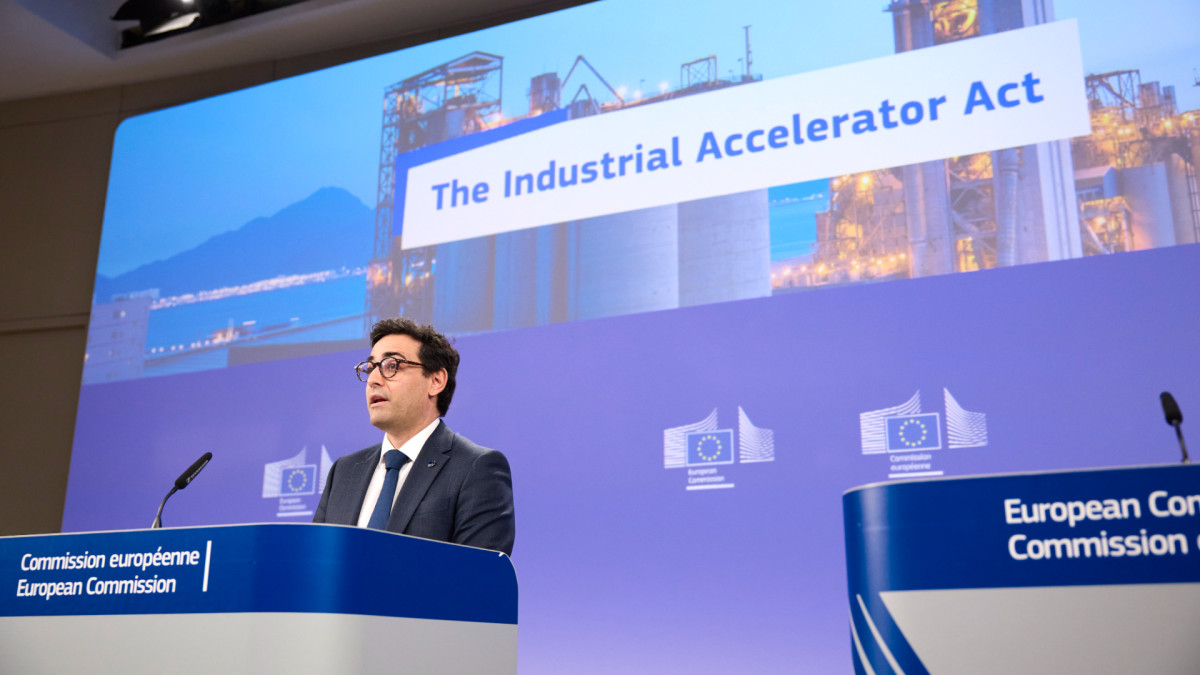
Stéphane Séjourné, European Commission Executive Vice-President for Prosperity and Industrial Strategy, at a press conference on the Industrial Accelerator Act.European Commission / Claudio Centonze
Europe's next political fault line may begin with a business decision as simple as where to build a factory. The region chosen will benefit from the investment, the economic opportunities it brings and the jobs it creates. For those passed over, however, it may be another sign that Europe promises prosperity while the opportunities go elsewhere. The Industrial Accelerator Act, the European Commission's proposal to revive European industry, will be tested on the gap between the collective benefits it promises and how those benefits are distributed across regions. Accelerating industrial development matters. Deciding who benefits from that acceleration will be just as important to the Union's political future.
This is where Spain comes into the picture. As I argued a few months ago in another edition of my 'European Compass' column, renewable energy offers an opportunity to reshape Europe's industrial geography, but differences in fiscal capacity threaten to determine how that shift unfolds. Energy costs may favour one location, while subsidies pull investment towards another. Europe faces a serious risk when competition for investment stops rewarding genuine industrial advantages and turns into a bidding war between national treasuries. The result would be a European response to deindustrialisation that ends up financing a contest between Europeans.
Last week, at Yale's Jackson School of Global Affairs, I heard economics professor Lorenzo Caliendo speak at a seminar to which I had been invited by IE University. His presentation helped me understand why this risk deserves particular attention in today's transatlantic relationship. Caliendo argues that US tariffs and the transatlantic trade agreement have uneven effects across European economies and industries. His estimates place Germany among the countries hardest hit and point to a decline in manufacturing across much of Europe.
What about the political consequences? They extend far beyond a fall in trade volumes. A single agreement negotiated by the Union can impose very different costs on its member states: for some, it may bring greater predictability; for others, it may compound their industrial difficulties. Within each country, too, some regions will be far more exposed than others. This does not mean that negotiating as a bloc is a mistake. It means the common trade policy needs new instruments to manage these distributional effects.
Caliendo offers a warning that applies to both the United States and the European Union: bringing production back does not necessarily revive communities that have lost jobs. A new factory, for example, might be built far from the area left behind, require different skills and employ far fewer people. Industrial policy must distinguish between increasing productive capacity and creating opportunities for particular people. The two goals can reinforce each other, but they will not necessarily coincide without deliberate effort. Confusing them could lead to a situation in which governments celebrate macroeconomic successes while some regions grow ever more frustrated and distrustful of those who promised to restore their economic fortunes.
That is why we wanted to explore the regional dimension at an event organised by Agenda Pública in Brussels. At our Microspace event, Miquel Sàmper, Catalonia's minister for Business and Labour, called for moving beyond diagnosis and getting things done; Jaume Baró, secretary for Business and Competitiveness in the same department, linked Catalonia's industrial strategy to its implementation across the region. Our discussion highlighted a shared concern: regions, which know their own strengths and obstacles, risk being excluded from negotiations conducted solely between national capitals.
That local knowledge should shape funding decisions. Every proposed strategic project should spell out who its suppliers will be and how smaller businesses will be able to benefit. Assessing projects solely by the investment announced could favour eye-catching developments with limited local impact. Looking instead at the capabilities they leave behind would help distinguish between attracting a single facility and building a lasting industrial base. Europe should put particular emphasis on financing what makes the next investment possible, rather than simply celebrating the first.
More than ever, this calls for common European funding governed by transparent criteria. If industrial resilience is a European public good, it cannot be sustained solely by what individual national treasuries can afford. EU funding should take account of cross-border links, the dependencies a project reduces and the costs of adjustment borne by different regions. It should also be tied to verifiable results. Pooling resources does not mean supporting every activity indefinitely; it means ensuring that projects are not selected primarily on the basis of which government can write the biggest cheque.
We should also resist the temptation for every region to demand its own version of every strategic industry. Specialisation requires choices and cooperation, even when these make for a less appealing election announcement than another major factory. European incentives should reward joint projects between regions and discourage unnecessary duplication. If two regions can develop a capability together, subsidising them to compete to replicate it would be a poor use of public money. Cohesion is not about promising identical industries everywhere, but about creating viable opportunities and useful connections.
For Spain, this perspective calls for a strategy that ensures new industrial advantages strengthen Europe's overall capacity and that the rules prevent those advantages from being cancelled out by disproportionate national State aid. Spain also has an interest in ensuring that partners hit hardest can make a viable transition. A Union mired in disputes over the distribution of investment would struggle to sustain common policies. Securing industrial gains while weakening the framework that allows Europeans to trade and invest together would be an incomplete victory.
How can regions be brought into Europe's new industrial policy?
The proposal presented by the Commission in March aims to boost demand for European-made and low-carbon industrial products, speed up permitting and promote industrial acceleration areas. It also proposes conditions on certain foreign investments. These ambitions reflect Europe's vulnerability as it seeks to preserve its industrial capacity in an era of strategic competition. But legislation intended to strengthen the bloc could spark internal disputes if its benefits depend too heavily on each member state's budget and political influence.This is where Spain comes into the picture. As I argued a few months ago in another edition of my 'European Compass' column, renewable energy offers an opportunity to reshape Europe's industrial geography, but differences in fiscal capacity threaten to determine how that shift unfolds. Energy costs may favour one location, while subsidies pull investment towards another. Europe faces a serious risk when competition for investment stops rewarding genuine industrial advantages and turns into a bidding war between national treasuries. The result would be a European response to deindustrialisation that ends up financing a contest between Europeans.
"Legislation intended to strengthen the bloc could spark internal disputes if its benefits depend too heavily on each member state's budget and political influence"Yet it would be a mistake to regard every investment in southern Europe as a loss for the north. The Union needs its industrial capabilities to complement one another. A new factory can increase demand for machinery, services and components produced in other countries. The important questions are how much value an investment adds to the EU as a whole and how widely its benefits spread. If every government judges success solely by the number of factories within its borders, strategic autonomy will end up looking uncomfortably like economic nationalism.
Last week, at Yale's Jackson School of Global Affairs, I heard economics professor Lorenzo Caliendo speak at a seminar to which I had been invited by IE University. His presentation helped me understand why this risk deserves particular attention in today's transatlantic relationship. Caliendo argues that US tariffs and the transatlantic trade agreement have uneven effects across European economies and industries. His estimates place Germany among the countries hardest hit and point to a decline in manufacturing across much of Europe.
What about the political consequences? They extend far beyond a fall in trade volumes. A single agreement negotiated by the Union can impose very different costs on its member states: for some, it may bring greater predictability; for others, it may compound their industrial difficulties. Within each country, too, some regions will be far more exposed than others. This does not mean that negotiating as a bloc is a mistake. It means the common trade policy needs new instruments to manage these distributional effects.
"This does not mean that negotiating as a bloc is a mistake. It means the common trade policy needs new instruments to manage these distributional effects"Otherwise, Europe risks suffering a double blow. First comes an external shock that disproportionately harms particular industries. Then comes a domestic policy response that favours those with the greatest resources to protect themselves. The second can amplify the first, creating a vicious circle. An industrial region hit by tariffs, in a member state with little fiscal room to manoeuvre, would be at a disadvantage not only against the United States but also against other European regions. In that situation, the single market would lose credibility at precisely the moment it most needs to prove its worth.
Caliendo offers a warning that applies to both the United States and the European Union: bringing production back does not necessarily revive communities that have lost jobs. A new factory, for example, might be built far from the area left behind, require different skills and employ far fewer people. Industrial policy must distinguish between increasing productive capacity and creating opportunities for particular people. The two goals can reinforce each other, but they will not necessarily coincide without deliberate effort. Confusing them could lead to a situation in which governments celebrate macroeconomic successes while some regions grow ever more frustrated and distrustful of those who promised to restore their economic fortunes.
That is why we wanted to explore the regional dimension at an event organised by Agenda Pública in Brussels. At our Microspace event, Miquel Sàmper, Catalonia's minister for Business and Labour, called for moving beyond diagnosis and getting things done; Jaume Baró, secretary for Business and Competitiveness in the same department, linked Catalonia's industrial strategy to its implementation across the region. Our discussion highlighted a shared concern: regions, which know their own strengths and obstacles, risk being excluded from negotiations conducted solely between national capitals.
That local knowledge should shape funding decisions. Every proposed strategic project should spell out who its suppliers will be and how smaller businesses will be able to benefit. Assessing projects solely by the investment announced could favour eye-catching developments with limited local impact. Looking instead at the capabilities they leave behind would help distinguish between attracting a single facility and building a lasting industrial base. Europe should put particular emphasis on financing what makes the next investment possible, rather than simply celebrating the first.
More than ever, this calls for common European funding governed by transparent criteria. If industrial resilience is a European public good, it cannot be sustained solely by what individual national treasuries can afford. EU funding should take account of cross-border links, the dependencies a project reduces and the costs of adjustment borne by different regions. It should also be tied to verifiable results. Pooling resources does not mean supporting every activity indefinitely; it means ensuring that projects are not selected primarily on the basis of which government can write the biggest cheque.
"Pooling resources does not mean supporting every activity indefinitely; it means ensuring that projects are not selected primarily on the basis of which government can write the biggest cheque"Regional involvement also requires a clear division of responsibilities. Bringing more levels of government into the process should not mean adding layers of bureaucracy or creating new vetoes. It should mean agreeing from the outset who will tackle each obstacle, with what resources and by what deadline. An industrial acceleration area will achieve little if permits are approved while essential requirements for operating the facility remain unresolved. Institutional commitments must cover every stage of a project and make it clear where delays occur, so that faster implementation becomes something that can actually be measured.
We should also resist the temptation for every region to demand its own version of every strategic industry. Specialisation requires choices and cooperation, even when these make for a less appealing election announcement than another major factory. European incentives should reward joint projects between regions and discourage unnecessary duplication. If two regions can develop a capability together, subsidising them to compete to replicate it would be a poor use of public money. Cohesion is not about promising identical industries everywhere, but about creating viable opportunities and useful connections.
For Spain, this perspective calls for a strategy that ensures new industrial advantages strengthen Europe's overall capacity and that the rules prevent those advantages from being cancelled out by disproportionate national State aid. Spain also has an interest in ensuring that partners hit hardest can make a viable transition. A Union mired in disputes over the distribution of investment would struggle to sustain common policies. Securing industrial gains while weakening the framework that allows Europeans to trade and invest together would be an incomplete victory.
"Securing industrial gains while weakening the framework that allows Europeans to trade and invest together would be an incomplete victory"For all these reasons, the success of the Industrial Accelerator Act should not be measured solely by the number of factories opened. It should also be judged by whether it can prevent each industrial restructuring from becoming a dispute between member states. Tariffs can damage European industry; a poorly designed response can damage European integration itself. Giving regions the resources, responsibilities and a seat at the table would be a concrete way to protect both.
Ahora en portada
27 de octubre de 2026
27 de octubre de 2026
26 de octubre de 2026
Noticias relacionadas
Hace 2 semanas
Ambición europea, especialización regional: la industria se juega en los territorios
Hace 5 días
¿Está Europa preparada para responder a la industria china?
Hace 26 semanas