Lunes, 19 de octubre de 2026




TRUMP's WORLD
The brutalisation of diplomacy is being televised
The international liberal order was buried yesterday in the Oval Office, where Trump's televised outburst at Zelenski marked its demise. Juan Luis Manfredi, Professor of Journalism and International Studies at the University of Castilla-La Mancha, warns: "these are not good times". The consequences are still unpredictable.
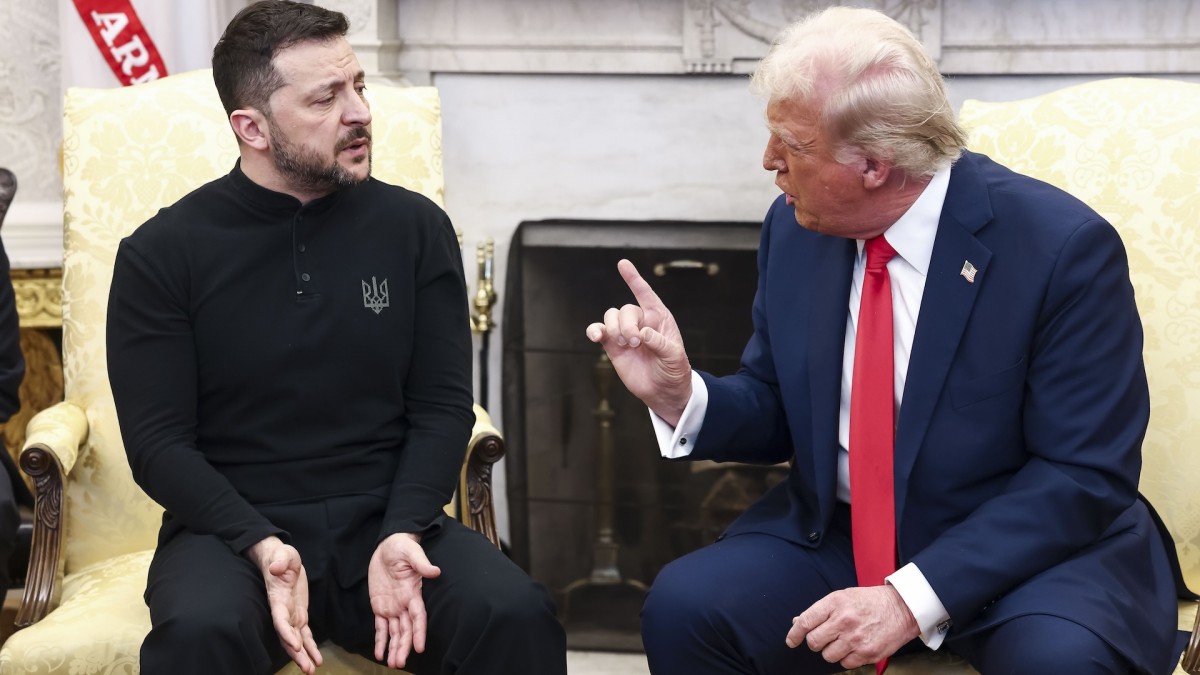
What should have been a public show of unity quickly turned into a heated argument between President Trump and President Zelensky.Jim LoScalzo - Pool via CNP / Zuma Press / ContactoPhoto
The altercation in the Oval Office certifies the end of the international liberal order, based on norms, sovereign states and respect for borders. Neither the Helsinki Act, which will soon be fifty years old, nor the Budapest Memorandum (1994). Everything is Yalta: spheres of influence, excessive sovereignty and strongmen at the head of the executive. Trump, applauded by Putin and Xi Jinping, raises a revisionist agenda of American foreign policy whose effects are unpredictable. It is not about the closure of USAID as the preferred instrument to exert influence in the world or about expansionist tirades (Greenland, Panama, Gaza, Canada, or Mexico), but about brutalising diplomacy. The televised admonishment advances the America First narrative. Endorsing President Zelensky with a "lack of gratitude" seeks the approval of Trump voters. It is a message of withdrawal, of isolationism and, ultimately, a way of seeing the world.
This first geoeconomic onslaught falters in practice, but articulates a narrative of diplomacy by weight. In the televised scene, the silence of Secretary of State Marco Rubio is eloquent. There is no space for his proposals in a show dominated by the Trump-Vance pair. The technobros cheer the leader. They are rich and powerful men, who do not have to respect the rules and, even less so, the European ones. On the contrary, this Silicon Valley philosophy that permeates American diplomacy is based on the ability to break, boast and then, if at all later, check the effects of their decisions. The new technological wolf-warriors laugh at diplomatic channels and values. There is no assertiveness, discretion, mutual trust. The new conversation revolves around security, defence, economic cost and bills. The strategy of the bully is often nothing more than a sign of weakness. Through force alone, the United States will not be able to curb Chinese influence in the Indo-Pacific and Latin America. Russia and China normalise their economic relations and military cooperation. A narrative of victory in Ukraine incentivises other actors to pursue their objectives manu militari. Invasion and conquest of territory is a legitimate path. It remains to be seen how Iran will reinterpret the new unilateralism.
Thirdly, the succession of occurrences drowns the understanding of diplomats, journalists or think-tankers. Literally, we are unable to explain the inconsistencies or the disaster of a peace without guarantees from the aggressor.
What remains to be known is the particular outcome of the challenge. President Zelensky left the White House early and without the necessary military guarantees. The war will be lost from the moment the United States limits its military and financial aid. It is the end of three years of struggle, but the local effort does not seem to be recognised. However, not all is lost. The Ukrainian president has once again legitimised his discourse and international recognition. Ukraine has at least as much right as Russia to sit at the negotiating table. European leaders will support this approach and pay for reconstruction. Transatlantic relations, currently, are broken due to a lack of mutual trust.
The new American Administration is determined to accelerate an unpredictable globalisation. This new administration does not identify with the defence of internationalist values. Let us bid farewell to Wilsonian United States. Let us welcome McKinley's expansionism and Andrew Jackson's populist outlook. Migration policies, the imposition of tariffs or the dissolution of cooperation do not fit into a transatlantic international agenda, but rather into domestic politics. This new unpredictable era is also the era of zero-sum diplomacy. These are not good times.
"The altercation in the Oval Office certifies the end of the international liberal order, based on norms, sovereign states and respect for borders"The intervention of Vice President Vance defines the dynamic that is coming and the dominant ideas in Washington. Diplomacy is a minor instrument of external action because everything passes through the president's ability to push an agenda, negotiate agreements and impose conditions. Transactional diplomacy measures and quantifies the relationship: as many rare earths and minerals as you have, as much peace as you deserve. There is no data to support the economic approach to peace and Bloomberg has limited the validity of the figures circulating on networks.
This first geoeconomic onslaught falters in practice, but articulates a narrative of diplomacy by weight. In the televised scene, the silence of Secretary of State Marco Rubio is eloquent. There is no space for his proposals in a show dominated by the Trump-Vance pair. The technobros cheer the leader. They are rich and powerful men, who do not have to respect the rules and, even less so, the European ones. On the contrary, this Silicon Valley philosophy that permeates American diplomacy is based on the ability to break, boast and then, if at all later, check the effects of their decisions. The new technological wolf-warriors laugh at diplomatic channels and values. There is no assertiveness, discretion, mutual trust. The new conversation revolves around security, defence, economic cost and bills. The strategy of the bully is often nothing more than a sign of weakness. Through force alone, the United States will not be able to curb Chinese influence in the Indo-Pacific and Latin America. Russia and China normalise their economic relations and military cooperation. A narrative of victory in Ukraine incentivises other actors to pursue their objectives manu militari. Invasion and conquest of territory is a legitimate path. It remains to be seen how Iran will reinterpret the new unilateralism.
"A narrative of victory in Ukraine incentivises other actors to pursue their objectives manu militari. Invasion and conquest of territory is a legitimate path"The brutalisation of diplomacy negatively impacts the international board. It hinders strategic planning because decisions are made in front of television cameras or on the social network of the day. There, President Trump offers a winning portrait. There is no space for quiet conversation or document exchange. Secondly, brutalisation benefits a bilateral relationship and dismantles international institutions. If the strongest do not comply with the rules and impose their vision, what can be expected from Egypt, Turkey, Morocco, Argentina, or India? The future of the liberal order today passes through countries with little interest in cosmopolitan societies, the market economy or the quality of democracy.
Thirdly, the succession of occurrences drowns the understanding of diplomats, journalists or think-tankers. Literally, we are unable to explain the inconsistencies or the disaster of a peace without guarantees from the aggressor.
What remains to be known is the particular outcome of the challenge. President Zelensky left the White House early and without the necessary military guarantees. The war will be lost from the moment the United States limits its military and financial aid. It is the end of three years of struggle, but the local effort does not seem to be recognised. However, not all is lost. The Ukrainian president has once again legitimised his discourse and international recognition. Ukraine has at least as much right as Russia to sit at the negotiating table. European leaders will support this approach and pay for reconstruction. Transatlantic relations, currently, are broken due to a lack of mutual trust.
The new American Administration is determined to accelerate an unpredictable globalisation. This new administration does not identify with the defence of internationalist values. Let us bid farewell to Wilsonian United States. Let us welcome McKinley's expansionism and Andrew Jackson's populist outlook. Migration policies, the imposition of tariffs or the dissolution of cooperation do not fit into a transatlantic international agenda, but rather into domestic politics. This new unpredictable era is also the era of zero-sum diplomacy. These are not good times.
Juan Luis Manfredi
Catedrático de Estudios Internacionales en la Universidad de Castilla-La Mancha.
Antiguo catedrático Príncipe de Asturias en Georgetown University. Autor de 'Urban Diplomacy. A Cosmopolitan Outlook' (Brill, 2021) y de 'Diplomacia corporativa: la nueva inteligencia directiva' (UOC Editorial, 2018).
Ahora en portada
19 de octubre de 2026
19 de octubre de 2026
Noticias relacionadas
Hace 88 semanas