Lunes, 19 de octubre de 2026




Europe Caught Between the US and China: Massive aid and new trade war

GETTY IMAGES
In a context marked by the disruption of supply chains, the geopolitical use of trade in strategic goods and the emergence of shortages of crucial health, food or industrial products, the United States has invented the IRA, a policy that aims with a single weapon at three major policy objectives: reindustrialisation, the greening of the economy, and a new trade strategy.
The greening of the US economy has the virtue of nipping in the bud any criticism of protectionism, of hindering China's development or of unilateralism towards the Europeans. Who can seriously criticise the move to green technologies, who can challenge the legitimacy of setting up wind turbine, electric vehicle or electronic component factories on US soil?
For Europe and China this policy is a challenge for which they were unequally prepared.
Certainly, China has long pursued a strategy of increasing the power of these innovative industries (Plan 2025 decided in 2015), and aspires to global leadership, particularly in electronic components, dual technologies par excellence, where it intends to subsidise without ceiling, with the intention of producing and deploying chip manufacturing tools (Financial Times). But this plan will partly run into the US obstacle: access to technologies will be limited, trade flows restricted, and access to public markets very limited.
For Europe, the challenge is threefold. Its DNA is free trade, its internal divisions are evident, and the resources it mobilises on these issues are limited. Europe's awakening is recent and difficult to implement.
Before assessing the possibilities of the European project of reindustrialisation through the greening of the economy, let us return to the IRA, which is one of the models for reference.
The second reason is the colossal international trade deficit of the United States, mainly due to trade in goods (services are in surplus). In 2021, the European Union will have a surplus of $155 billion in trade with the United States, China will have a surplus of almost $1 trillion in 2022. Once again, this protracted situation has come to be seen as problematic, not least because it ends up having serious repercussions on other macroeconomic balances: the balance of payments, which had rebounded after 2007, has started to collapse again.
Se puede leer el artículo en español
Translated from the original version in French published in Telos
The greening of the US economy has the virtue of nipping in the bud any criticism of protectionism, of hindering China's development or of unilateralism towards the Europeans. Who can seriously criticise the move to green technologies, who can challenge the legitimacy of setting up wind turbine, electric vehicle or electronic component factories on US soil?
For Europe and China this policy is a challenge for which they were unequally prepared.
Certainly, China has long pursued a strategy of increasing the power of these innovative industries (Plan 2025 decided in 2015), and aspires to global leadership, particularly in electronic components, dual technologies par excellence, where it intends to subsidise without ceiling, with the intention of producing and deploying chip manufacturing tools (Financial Times). But this plan will partly run into the US obstacle: access to technologies will be limited, trade flows restricted, and access to public markets very limited.
For Europe, the challenge is threefold. Its DNA is free trade, its internal divisions are evident, and the resources it mobilises on these issues are limited. Europe's awakening is recent and difficult to implement.
Before assessing the possibilities of the European project of reindustrialisation through the greening of the economy, let us return to the IRA, which is one of the models for reference.
The New American Industrial PolicyThe Inflation Reduction Act (IRA, summer 2022) provides for some $370 billion of investments in green technologies, renewable energy, transport, and energy saving. The IRA comes in addition to the Chips Act, which aims to relocate semiconductor factories used in all industrial activities to the United States. This law allocated $52.7 billion in subsidies for the production of chips on US soil. How can we explain this industrial sovereignty, with massive aid for companies to produce on US soil, and protectionism?
[Recibe los análisis de más actualidad en tu correo electrónico o en tu teléfono a través de nuestro canal de Telegram]
The first reason for this offensive policy is the rapid deindustrialisation of the United States, which has become a political problem with the electoral swing of traditionally industrial Democratic states towards the pro-Trump camp. Manufacturing contributed 10.8% of US GDP in 2020, a far cry from the share of Germany (more than double) and, above all, China (more than triple). According to the Semiconductor Association of America (SIA), the US now accounts for only 12% of global chip production capacity, three times less than in 1990. Taiwan's dependence on Taiwan for the most advanced chips, in a context where the island's independence is under threat, is becoming a serious strategic problem.The second reason is the colossal international trade deficit of the United States, mainly due to trade in goods (services are in surplus). In 2021, the European Union will have a surplus of $155 billion in trade with the United States, China will have a surplus of almost $1 trillion in 2022. Once again, this protracted situation has come to be seen as problematic, not least because it ends up having serious repercussions on other macroeconomic balances: the balance of payments, which had rebounded after 2007, has started to collapse again.
Over the past twenty years, most EU countries have had a comfortable trade surplus with the United States. This is, of course, the case for Germany, €59 billion in 2021, Italy, €34 billion, and even France, almost €8 billion, a country that nevertheless has a large overall trade deficit. In contrast, between 2011 and 2021, the EU has continuously recorded a trade deficit with China, rising from €129 billion in 2011 to €249 billion in 2021. Chinese products account for around 18% of the EU's extra-European imports, up from 6% in the early 2000s, with a dramatic increase in the quality of Chinese products.
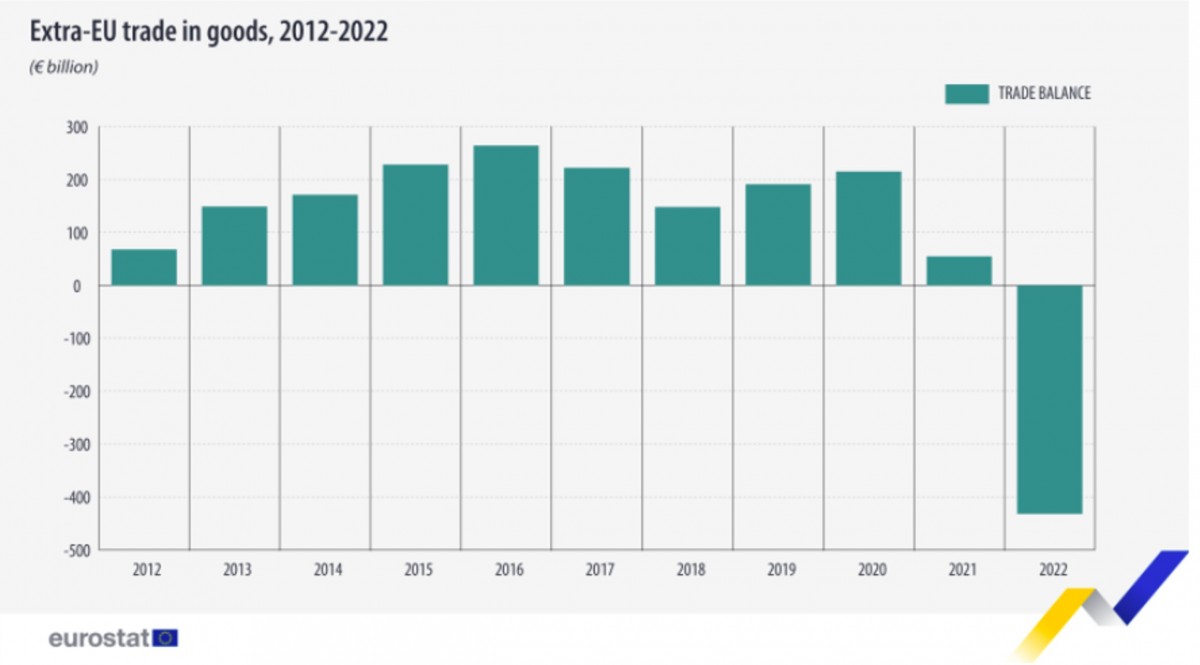
Europe in QuestionUntil 2021, the EU was a net exporter of goods. But the rise in the price of hydrocarbons has pushed it into deficit, with the rising cost of oil and gas imports, coupled with the rapid relocation of some European manufacturers (especially in the chemical sector) to China, and the loss of competitiveness of European products, whose cost price is increased by the rise in energy costs.
Figure 1.- Extra-EU Trade in Goods, 2012, 2022
The shift in US orientation has added a further degree of gravity to this sudden imbalance, as it has become very advantageous for European global manufacturers to set up factories in the US. Finally, trade with China is changing, and the arrival of Chinese automakers sounds like a challenge to one of Europe's specialisations.
The amount of subsidies under the IRA, or semiconductor subsidies, at least has the advantage of being transparent, which is not the case with Chinese subsidies, which are substantial and totally opaque.
It is with regard to American subsidies, and American industrial policy, that the European Union has gone mad. 'I have raised the alarm because I see the impact of this famous IRA put on the table by the Americans, $367 billion of proposed subsidies in gigantic proportions, (...) which creates a real element of distortion of competition,' said Thierry Breton. The EU fears that European companies will set up factories on American soil lured by the IRA's hefty subsidies, such as Volkswagen, which has financed a $2 billion electric vehicle factory in South Carolina. Japanese manufacturers will be able to benefit, like their American and Korean competitors, from the subsidies granted by the Biden administration for electric vehicles assembled in the United States. European brands are hoping for a similar deal.
While European awareness is to be welcomed, and China's qualification as a systemic competitor is to be noted, it does not necessarily follow that the European plans set out in two major texts (the Green Economy programme and the Net Zero Industry law presented on 23 March) are realistic. And in a context marked by the expected explosive growth of the entire green industry sector, Europe is lagging behind.
The first EU commitment is that by 2030 the EU should produce at least 40% of its key clean technologies, such as batteries, wind turbines, electrolysers, biomethane, etc. The second text on raw materials aims to secure the EU's supply of critical minerals such as lithium, cobalt for electric batteries and silicon. The text also proposes an ambitious programme for recycling and diversification of supplies. By 2030, the EU wants to source 10% of its consumption of strategic raw materials from European soil (up from 3% today) and no longer depend on a single third country for more than 65% of its imports of strategic raw materials. The EU currently imports 97% of its lithium and 93% of its magnesium from China.
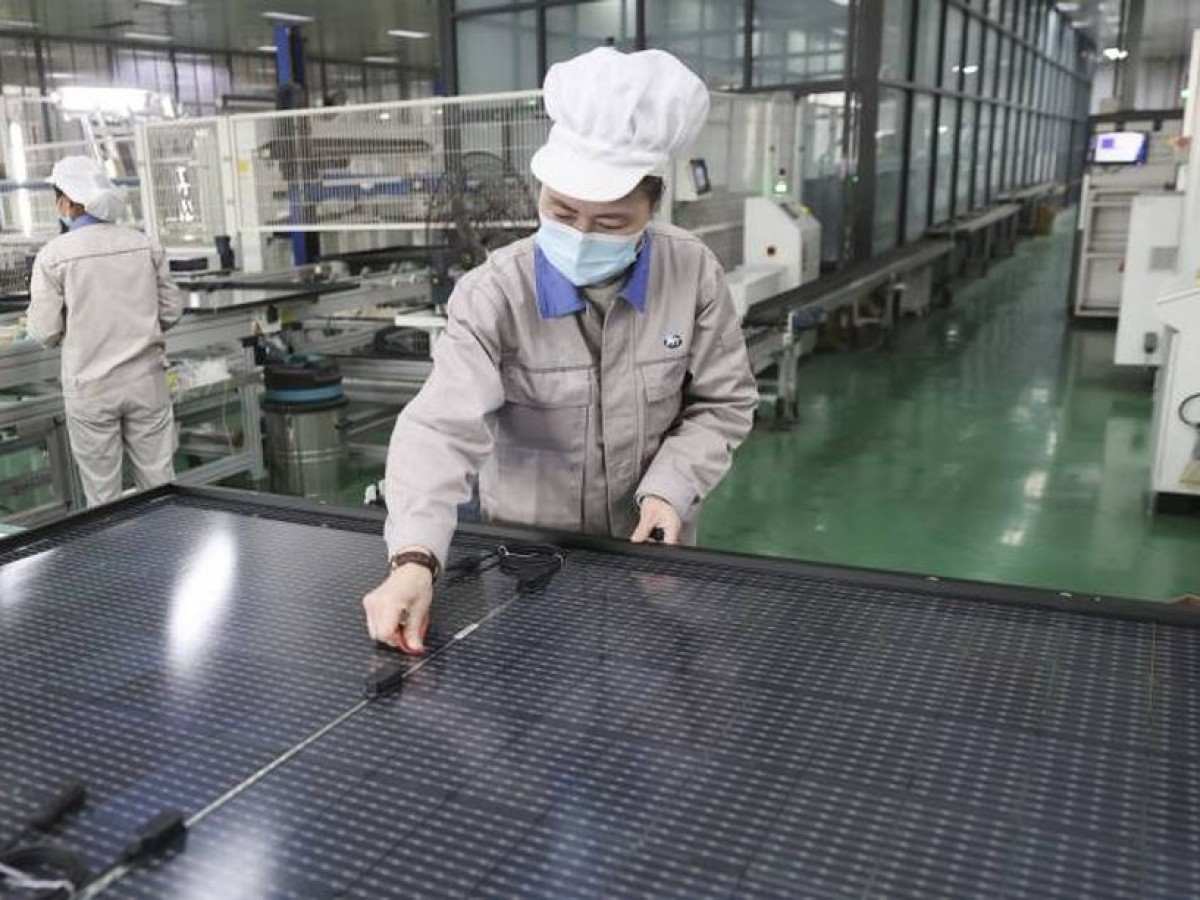
The problem began in the heart of Europe, with an ill-conceived policy of industry support in Germany that resulted in massive consumer subsidies. In 2008, Chinese PV manufacturers increased production of solar panels to such an extent that global supply doubled demand, triggering a price crash that devastated the European industry (and the weaker Chinese manufacturers). It was not until 2012, following a petition from European solar producers, that the European Commission initiated an anti-dumping investigation into Chinese photovoltaics, the largest anti-dumping investigation ever launched. Imports of Chinese solar panels had reached €20 billion in 2011, and in spring 2013 the EU investigation concluded that Chinese solar panels were being sold at dumped prices.
The EU imposed tariffs on them, but China immediately retaliated by launching an investigation into European wines, a measure that directly affects several EU countries. It was too late for European PV. Between 2007 and 2017, the global share of PV produced in Europe fell from 30% to 3%. Many European solar companies went bankrupt or were taken over: Q-Cells, Solon, Conergy, Solarion, SMA Solar, Sunways, Solarwatt and finally SolarWorld, a solar company with almost 3000 employees. Most of the solar companies that remain in this market in Europe are mainly subcontractors, who buy their solar panels in Asia, and above all do not want more anti-dumping measures for Chinese manufacturers. The difficult reconstitution of a European industry is mainly played out in niche markets.
China today is strong, economically and politically. With respect to the European Union and the United States, China is prepared for relations based on a balance of power, and has long since adopted a very offensive industrial policy.
If the European ambition is great, the means are slow to be mobilised. For the time being, no EU funding is planned, but Brussels has relaxed state aid rules, proposes a simplification of procedures until 2025 and a mobilisation of unused EU funds. The proposal for a sovereign wealth fund remains problematic, as the EU-27 have diverging views on its necessity. According to some estimates, the EU should invest 450 billion per year for its 'decarbonisation'. The EU project is underway, but operational measures are slow in coming.
The United States has opted for a new active industrial policy to respond to the triple challenge already mentioned, but also to recover a middle class susceptible to the sirens of populism. This programme is already underway and the first Chips Act cheques have already been signed.
Europe is moving back towards industrial interventionism because of its free trade and multilateralist option. The problem is that, although it has been successful overall (the French exception is due to local factors and, in particular, the choice of a long-standing demand policy), it is now proving insufficient. It is true that the state aid regime has been made more flexible and that in a number of sectors (hydrogen, quantum, batteries) articulated policies combining R&D subsidies and support for industrialisation have started to be put in place. But the scale remains modest.
Despite this, Europe has set specific voluntary targets. While these may seem unattainable for the time being, they provide a promising basis. Geopolitical developments and the China-US conflict will force Europe, if it does not want to fall into line, to define its own line. What is at stake for Europe today is the preservation of its industrial bases, which are being put to the test by Chinese and American strategies. The EU must promote its own interests and denounce the lack of reciprocal access. Should we go further? Should we envisage a Buy European Act? For the moment, the step to be taken is too high.
The amount of subsidies under the IRA, or semiconductor subsidies, at least has the advantage of being transparent, which is not the case with Chinese subsidies, which are substantial and totally opaque.
It is with regard to American subsidies, and American industrial policy, that the European Union has gone mad. 'I have raised the alarm because I see the impact of this famous IRA put on the table by the Americans, $367 billion of proposed subsidies in gigantic proportions, (...) which creates a real element of distortion of competition,' said Thierry Breton. The EU fears that European companies will set up factories on American soil lured by the IRA's hefty subsidies, such as Volkswagen, which has financed a $2 billion electric vehicle factory in South Carolina. Japanese manufacturers will be able to benefit, like their American and Korean competitors, from the subsidies granted by the Biden administration for electric vehicles assembled in the United States. European brands are hoping for a similar deal.
While European awareness is to be welcomed, and China's qualification as a systemic competitor is to be noted, it does not necessarily follow that the European plans set out in two major texts (the Green Economy programme and the Net Zero Industry law presented on 23 March) are realistic. And in a context marked by the expected explosive growth of the entire green industry sector, Europe is lagging behind.
The first EU commitment is that by 2030 the EU should produce at least 40% of its key clean technologies, such as batteries, wind turbines, electrolysers, biomethane, etc. The second text on raw materials aims to secure the EU's supply of critical minerals such as lithium, cobalt for electric batteries and silicon. The text also proposes an ambitious programme for recycling and diversification of supplies. By 2030, the EU wants to source 10% of its consumption of strategic raw materials from European soil (up from 3% today) and no longer depend on a single third country for more than 65% of its imports of strategic raw materials. The EU currently imports 97% of its lithium and 93% of its magnesium from China.
Unresolved QuestionsThe example of the demise of the solar panel industry leaves doubts about Europe's ability to accelerate its transformation: Europe has not been able to resist the Chinese tsunami, its solar industry has been swept away and its regulators have not been able to stem the tide: the failure is political, industrial and regulatory.
The problem began in the heart of Europe, with an ill-conceived policy of industry support in Germany that resulted in massive consumer subsidies. In 2008, Chinese PV manufacturers increased production of solar panels to such an extent that global supply doubled demand, triggering a price crash that devastated the European industry (and the weaker Chinese manufacturers). It was not until 2012, following a petition from European solar producers, that the European Commission initiated an anti-dumping investigation into Chinese photovoltaics, the largest anti-dumping investigation ever launched. Imports of Chinese solar panels had reached €20 billion in 2011, and in spring 2013 the EU investigation concluded that Chinese solar panels were being sold at dumped prices.
The EU imposed tariffs on them, but China immediately retaliated by launching an investigation into European wines, a measure that directly affects several EU countries. It was too late for European PV. Between 2007 and 2017, the global share of PV produced in Europe fell from 30% to 3%. Many European solar companies went bankrupt or were taken over: Q-Cells, Solon, Conergy, Solarion, SMA Solar, Sunways, Solarwatt and finally SolarWorld, a solar company with almost 3000 employees. Most of the solar companies that remain in this market in Europe are mainly subcontractors, who buy their solar panels in Asia, and above all do not want more anti-dumping measures for Chinese manufacturers. The difficult reconstitution of a European industry is mainly played out in niche markets.
China today is strong, economically and politically. With respect to the European Union and the United States, China is prepared for relations based on a balance of power, and has long since adopted a very offensive industrial policy.
If the European ambition is great, the means are slow to be mobilised. For the time being, no EU funding is planned, but Brussels has relaxed state aid rules, proposes a simplification of procedures until 2025 and a mobilisation of unused EU funds. The proposal for a sovereign wealth fund remains problematic, as the EU-27 have diverging views on its necessity. According to some estimates, the EU should invest 450 billion per year for its 'decarbonisation'. The EU project is underway, but operational measures are slow in coming.
The United States has opted for a new active industrial policy to respond to the triple challenge already mentioned, but also to recover a middle class susceptible to the sirens of populism. This programme is already underway and the first Chips Act cheques have already been signed.
Europe is moving back towards industrial interventionism because of its free trade and multilateralist option. The problem is that, although it has been successful overall (the French exception is due to local factors and, in particular, the choice of a long-standing demand policy), it is now proving insufficient. It is true that the state aid regime has been made more flexible and that in a number of sectors (hydrogen, quantum, batteries) articulated policies combining R&D subsidies and support for industrialisation have started to be put in place. But the scale remains modest.
Despite this, Europe has set specific voluntary targets. While these may seem unattainable for the time being, they provide a promising basis. Geopolitical developments and the China-US conflict will force Europe, if it does not want to fall into line, to define its own line. What is at stake for Europe today is the preservation of its industrial bases, which are being put to the test by Chinese and American strategies. The EU must promote its own interests and denounce the lack of reciprocal access. Should we go further? Should we envisage a Buy European Act? For the moment, the step to be taken is too high.
Se puede leer el artículo en español
Translated from the original version in French published in Telos
ARTÍCULOS RELACIONADOS

NOEL CELIS (POOL / REUTERS)


Pierre-André Buigues
Profesor de la Toulouse Business School (Université de Toulouse, Francia)
Fue jefe de la Unidad de Antimonopolio y asesor económico de la Comisión Europea. Experto asociado al Centro Europeo de Derecho Económico de Essec (Francia), y onsultor en materia de competencia y regulación.
Ahora en portada
19 de octubre de 2026
19 de octubre de 2026
Noticias relacionadas
Hace 195 semanas
China: Will the EU make the same mistakes as with Russia?
Hace 186 semanas