Miércoles, 14 de octubre de 2026




ANÁLISIS
"Putinomics": truth and myths
Agenda Pública and United Ukraine Think Tank present Focus Ukraine, a weekly article series analysing how the military conflict in Ukraine and the political and economic situation in the country will evolve. Spain should look at the war in Ukraine with its southern challenges in mind.



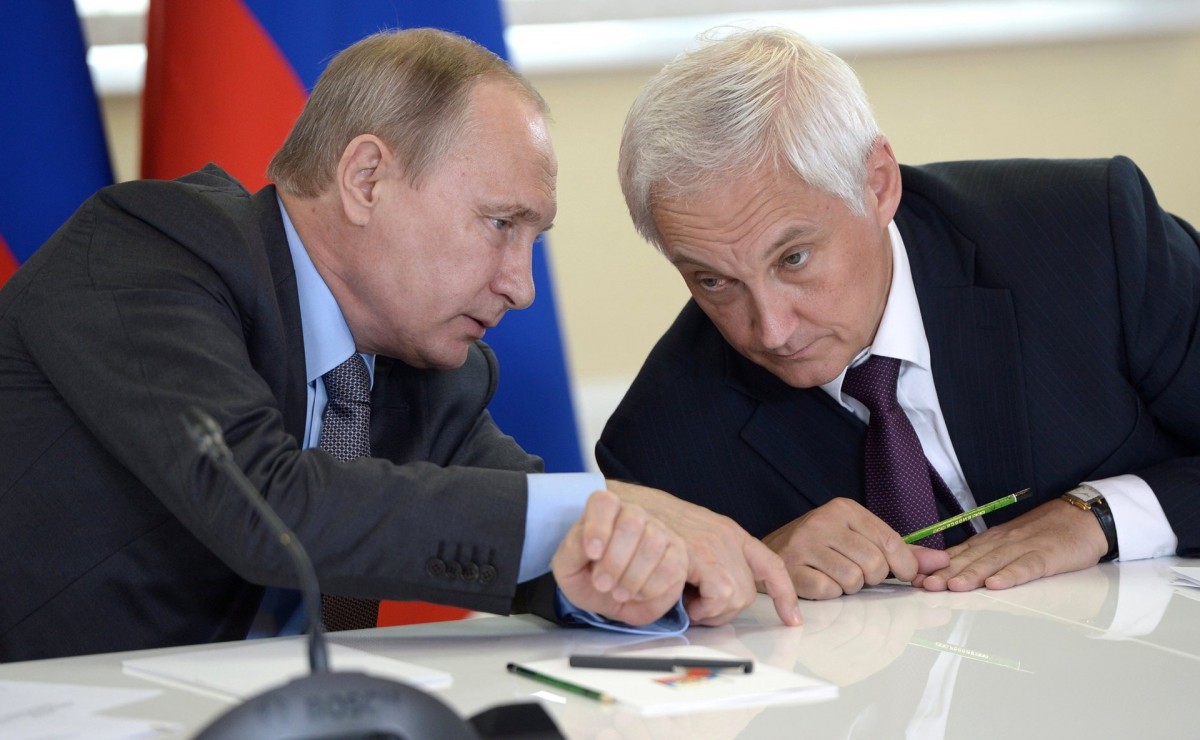
Russian President Vladimir Putin speaks with Andrei BelousovAleksey Nikolskyi / Zuma Press / ContactoPhoto
At the beginning of Russia's full-scale war against Ukraine, a powerful package of sanctions was imposed on Russia. There have already been 13 sanctions rounds (packages). The "hellish sanctions" threatened to tear the Russian economy apart. Russia's GDP was expected to fall by at least 10% in 2022. What happened in reality? In 2022, Russia's GDP declined by only 2%, and in 2023 it grew by 3.6%, fully compensating for the economic losses of the first year of the war. At the beginning of 2024, the growth rate of the Russian economy accelerated to more than 5% (seasonally adjusted at 4.3%). Moreover, there is an industrial boom, with business activity indices at peaks commensurate with growth in the early noughties. Even the most problematic indicator, real disposable income, has reached the level of pre-crisis 2012.
Empire 3.0.
A number of analysts drew attention to the music played at the inauguration of Russian President Putin. Among other things, a part from Mikhail Glinka's opera "Ivan Susanin" (before the 1917 revolution it was called "Life for the Tsar") was played. In this part there are words: "Glory, glory, our Russian Tsar". In fact, this was Putin's first enthronement as the supreme ruler of the Russian Federation, not the inauguration of a politician. Another prediction by Vladimir Zhirinovsky, who spoke of the title of Supreme Ruler of Russia, came true. And the Patriarchate of the Russian Orthodox Church, speaking of a "holy war" and Putin's lifelong rule, in fact, consecrated a new ideological role for him - the role of the Catechist, who "keeps the world from Evil." This is one of the key concepts in Byzantine Orthodoxy, when the emperor was declared to be a person who counteracts the "eschatological horror." All of this was very reminiscent of the Hundred and Thousandth Council of Ivan the Terrible, when it was announced that "the outside world has collapsed," and Moscow is the only center of opposition to sin. This means that, according to the ideologues of the Stoglav, there is no need to get closer to the West, but rather to isolate ourselves from it, since the image of the West has no features that Russia should borrow. Today, this is the first step in forming a new ideology as the basis for economic autarky. A kind of "Iranization" of the political and economic model, but only on the basis of Orthodoxy. Taking into account the new Constitution, we are witnessing the construction of the "Third Russian Empire": after the Romanov Empire and the USSR. Empire 3.0. In France, the process of state formation ended with the adoption of a new Constitution and the format of the Fifth Republic. Napoleon's empire and the temporary restoration of the Bourbons were an aberration, a deviation on this path. In Russia, on the contrary, the Yeltsin period, the quasi-democracy of the 1990s, became such an aberration. Now everything has returned to the Russian historical imperial trend. This is the reality that must be taken into account in geopolitical formulas for the next 10 years.
The architect of "Putinomics"
Andrey Removich Belousov (born March 17, 1959, Moscow), a scientist, economist, First Deputy Prime Minister of the Russian Federation (since January 21, 2020), became the architect of Putinomics and the main methodology for cushioning the sanctions pressure and transition to the growth phase of the Russian economy in 2022-2024. Prior to that, he served as Minister of Economic Development of the Russian Federation (2012-2013) and Assistant to the President of the Russian Federation for Economic Affairs (2013-2020). For almost a month in 2020, he even served as acting Prime Minister of the Russian Federation when Mishustin fell ill with covid. His father, Soviet economist Rem Belousov, was a member of the Kosygin Group. Kosygin was a Soviet reformer of the 1970s: during his tenure in the period 1965-1980, the USSR achieved record industrial production growth of 50% and national income of 45% (this time is now remembered by the older generation as the peak of the USSR's development). Belousov has now been appointed Minister of Defense, the third position in the Russian political hierarchy.
In his report "Long-Term Trends in the Russian Economy: Scenarios for Russia's Economic Development to 2020" (published in 2005), Belousov predicted the global crisis of 2008, the inevitable recession of the Russian economy in 2011-2012, and the potential failure of the Russian government system in 2015-2017. By the way, in 2013, when he was appointed as an aide to the Russian president, he replaced Nabiullina, who was then appointed as the head of the Central Bank of the Russian Federation.
For Putin, Belousov's merit is in launching a self-renewing, multiplier, circular model of the economy. Why is this model important? The fact is that war is a blocker of the natural development of internal productive forces and external investment resources. In the case of Russia, the main reason for these processes is external sanctions, which result in Russia not receiving foreign investment. The economy is in a state of financial hypoxia.
In terms of meaning, the situation is good for the Russian Federation, because at the decision-making level, there is a person who has been accumulating knowledge for this historical moment. Back in 2006, in his dissertation, Belousov considered four basic options for modernizing the reproduction system of the Russian economy:
- Supra-industrial modernization is the realization of the comparative advantages of the Russian economy. The difference is that this direction, according to Belousov, should be manifested in the modernization of the economy by creating a broad internal market (including Russia, Belarus, Ukraine and Kazakhstan).
- Leap into globalization - realization of the comparative advantages of the Russian economy by "cutting off the excess" as part of Russia's integration into global value chains.
- Economic isolationism - refusal to participate in global processes in exchange for the modernization of processing industries based on import substitution (shifting emphasis from oil and gas to non-oil and gas sectors of the economy).
- Energy autism - preservation of the export-raw material model of development with its further narrowing due to the slowdown in oil/gas exports and opening of the domestic market to imported goods.
According to Belousov, the implementation of the first option could ensure GDP growth rates of 6-7% per year with the simultaneous formation of a broad middle class. This model was incorporated into the concept of the Customs Union and the EAEU.
In any other case, the economy will not achieve the necessary parameters of dynamics and efficiency. According to Belousov, the key drivers of growth should be housing construction (an "explosive" growth rate of mortgages in 2023 and housing construction at the level of 100 million square meters) and government investment in the social sector.
Between 2000 and 2008, the Russian Federation developed within the framework of the "energy autism" model.
In 2009, an attempt was made to follow the path of supra-industrial modernization. Some Russian elites still hoped for a "rush into globalization."
Currently, the basic model of the Russian Federation is economic isolationism with the prospect of transition to superindustrialization when the geopolitical preconditions for this are in place (at least in Russia). It is worth remembering that, according to Belousov: "In any other case (except for super-industrialization, i.e., a new development of productive forces), the economy will not reach the necessary parameters of dynamics and efficiency." This means that the Russian Federation will return to the idea of structural "development" of the post-Soviet space again and again. This is the only way, according to its leaders, it will retain its chances of achieving the necessary pace of development.
How are sanctions changing the Russian economy?
In 2023, Russia significantly changed the structure of its international trade. The total foreign trade turnover amounted to $710 billion, which is 39% of GDP. In 2013, before sanctions were imposed, Russia's foreign trade was $841 billion. But in relative terms (the ratio of trade turnover to GDP), the figures have not changed: they remained at 37%, due to a decline in nominal GDP in dollar terms. In fact, the 37% figure suggests that Russia's dependence on foreign markets is significant, but not critical, as many people think. Thus, over the ten years of sanctions, Russia has lost $131 billion in foreign trade, or 15.6% year-on-year. But it cannot yet be called a closed economy. A closed economy is an economy that does not use national absolute and relative trade advantages of international trade. Such an economy does not participate in global technological value chains and focuses on internal, cyclical circulation of capital denominated in the national currency. In the twenty-first century, countries with an international trade turnover of 27% or less were considered to be conditionally closed economies. This means that Russia needs to reduce this figure by 10 percentage points to achieve this status. Judging by the change in the structure of external trading partners, Russia is not yet on the path of autarky, like Iran, but is only radically changing the vector of trade interaction.
Russia's top five trading partners now look like this (trade turnover in 2023 in billions of dollars): China - 240. India - 65 (an increase of 1.8 times). Turkey - 57. Belarus - 55. Kazakhstan - 26. These five countries account for 443 billion dollars of the total 710 billion, or 62%. In terms of the structure of trade, Russia, instead of the EU, focuses on Asia and its growing economies that need energy resources. The top ten countries also include South Korea, Germany, the UAE, Brazil, and the Netherlands. Trade with Germany amounted to $12 billion. In the overall structure, 51% of Russia's trade was with Asia, 23% with Europe, 11% with the Middle East, 8% with the CIS, 4% with the Americas, and 3% with Africa. In fact, what has happened now is only what would have happened anyway by 2050, when the EU planned to move to carbon neutral status by reducing, for example, natural gas imports to 40 billion cubic meters per year. That is, even without the war, Russia would have lost the European market for its energy exports (coal, oil, gas). Reorientation to Asia will give it another 20-30 years plus to generate revenue from carbon exports: Asia is 20-30 years behind the EU in achieving carbon neutrality. Extrapolating from the previous 10 years of sanctions, we can estimate this geopolitical maneuver by Russia at about $2.5 trillion, which is more than its annual GDP. This means a loss of about 5% of GDP per year. But then why is the Russian economy growing (+4.2% seasonally adjusted in the first quarter of 2024)?
This phenomenon is explained by the growth of the oil and gas sector and the emergence of new growth drivers in the form of a number of segments of the domestic economy, such as mortgages. The non-resource sector accounts for about 8% of GDP in the structural transformation of gross income. As a result, taking into account the decline in the raw materials sector, the Russian economy is experiencing a balance (growth of the non-resource sector minus the decline in the resource sector) of about +2-3% compared to the traditional growth rate of 2-2.5%.
The question is how long-lasting is this drive?
In fact, this is a factor-based, opportunistic growth due to import substitution, the military-industrial complex, and mortgages, which are based on a boom in demand, investment, and government orders. In terms of international trade, Russia can currently be classified as a large and relatively open economy. So far, the Russian Federation has not entered the stage of autarky, as this could negatively affect its growth rates: as long as it is possible to sell gas, coal, oil, grain, uranium, diamonds and metals, the Russian Federation will do so. It is trying to develop its non-resource sector of the economy as much as possible during this period. Sanctions, strange as it may seem, contribute to this. Until 2050, Russia will try to maintain its global integration into the world economy, reorienting it from the west to the south and east. Using, among other things, the Revolution of the Global South. And from 2050, and maybe even earlier, the world will face the era of "Warring Clusters", the fragmentation of the world economy into competing geopolitical clusters and protoclusters with the transition to the stage of defragmentation: optimization of the world economic system with the discarding of unnecessary file-countries. However, the date of 2050 does not mean that these processes are switched on discretely, by the "switch" method. Of course, the date 2050 is conditional, it could be 2040 or another date in the period 2024-2050. The historical passage of time has accelerated. The main task for small states for this period is not to find themselves at the junction of clusters - geopolitical "tectonic plates" that will begin to "friction" with each other. For large countries, the main thing is to become a leader in their cluster. This explains the competition between Russia and China against the backdrop of the formation of "cluster unity" in confrontation with the Western global clusters - the EU and the US. From the outside, this looks like "tossing and turning", "trying to sit on two chairs", etc. However, it is neither the former nor the latter.
So, among the key factors of "amortization" of the impact of sanctions on Russia are the following:
- Monetary stimulus from the Central Bank by reducing the key policy rate from 20% to 7.5% and keeping the rate at this level for a year.
- A budgetary incentive from the government - investments in the military-industrial complex and infrastructure.
- Increased social investments - growth of payments to the population, maternity capital, etc.
- The factor of Russian companies replacing the economic space vacated by foreign companies (the effect of convergence and expansion of national capital).
- Sanctions hermetic blocking of the Russian economy from the outside, when the outflow of capital abroad was completely blocked and the inflow of consumer imports was significantly limited. This created a "steam boiler" effect: the currency from oil and gas exports remained inside the country and "transferred" its energy to domestic economic processes (like a steam boiler to the wheels of a locomotive).
- Rapid reorientation of the Russian Federation to settlements and reserves in yuan.
- Reorientation of raw material exports to Asia.
All of these factors obviously could not have been foreseen when the sanctions were imposed, although the sanctions policy has fulfilled its function of slowing down the dynamics of Russian aggression. But the sanctions certainly could not destroy the Russian economy or completely stop the Russian army.
In the coming years, the sanctions policy should be significantly revised. The quantitative extension of sanctions to a certain number of Russian legal entities and individuals in each sanctions package no longer has the desired effect. Sanctions must reach a new qualitative and systemic level.
Empire 3.0.
A number of analysts drew attention to the music played at the inauguration of Russian President Putin. Among other things, a part from Mikhail Glinka's opera "Ivan Susanin" (before the 1917 revolution it was called "Life for the Tsar") was played. In this part there are words: "Glory, glory, our Russian Tsar". In fact, this was Putin's first enthronement as the supreme ruler of the Russian Federation, not the inauguration of a politician. Another prediction by Vladimir Zhirinovsky, who spoke of the title of Supreme Ruler of Russia, came true. And the Patriarchate of the Russian Orthodox Church, speaking of a "holy war" and Putin's lifelong rule, in fact, consecrated a new ideological role for him - the role of the Catechist, who "keeps the world from Evil." This is one of the key concepts in Byzantine Orthodoxy, when the emperor was declared to be a person who counteracts the "eschatological horror." All of this was very reminiscent of the Hundred and Thousandth Council of Ivan the Terrible, when it was announced that "the outside world has collapsed," and Moscow is the only center of opposition to sin. This means that, according to the ideologues of the Stoglav, there is no need to get closer to the West, but rather to isolate ourselves from it, since the image of the West has no features that Russia should borrow. Today, this is the first step in forming a new ideology as the basis for economic autarky. A kind of "Iranization" of the political and economic model, but only on the basis of Orthodoxy. Taking into account the new Constitution, we are witnessing the construction of the "Third Russian Empire": after the Romanov Empire and the USSR. Empire 3.0. In France, the process of state formation ended with the adoption of a new Constitution and the format of the Fifth Republic. Napoleon's empire and the temporary restoration of the Bourbons were an aberration, a deviation on this path. In Russia, on the contrary, the Yeltsin period, the quasi-democracy of the 1990s, became such an aberration. Now everything has returned to the Russian historical imperial trend. This is the reality that must be taken into account in geopolitical formulas for the next 10 years.
The architect of "Putinomics"
Andrey Removich Belousov (born March 17, 1959, Moscow), a scientist, economist, First Deputy Prime Minister of the Russian Federation (since January 21, 2020), became the architect of Putinomics and the main methodology for cushioning the sanctions pressure and transition to the growth phase of the Russian economy in 2022-2024. Prior to that, he served as Minister of Economic Development of the Russian Federation (2012-2013) and Assistant to the President of the Russian Federation for Economic Affairs (2013-2020). For almost a month in 2020, he even served as acting Prime Minister of the Russian Federation when Mishustin fell ill with covid. His father, Soviet economist Rem Belousov, was a member of the Kosygin Group. Kosygin was a Soviet reformer of the 1970s: during his tenure in the period 1965-1980, the USSR achieved record industrial production growth of 50% and national income of 45% (this time is now remembered by the older generation as the peak of the USSR's development). Belousov has now been appointed Minister of Defense, the third position in the Russian political hierarchy.
"Belousov predicted the global crisis of 2008, the inevitable recession of the Russian economy in 2011-2012."
In his report "Long-Term Trends in the Russian Economy: Scenarios for Russia's Economic Development to 2020" (published in 2005), Belousov predicted the global crisis of 2008, the inevitable recession of the Russian economy in 2011-2012, and the potential failure of the Russian government system in 2015-2017. By the way, in 2013, when he was appointed as an aide to the Russian president, he replaced Nabiullina, who was then appointed as the head of the Central Bank of the Russian Federation.
For Putin, Belousov's merit is in launching a self-renewing, multiplier, circular model of the economy. Why is this model important? The fact is that war is a blocker of the natural development of internal productive forces and external investment resources. In the case of Russia, the main reason for these processes is external sanctions, which result in Russia not receiving foreign investment. The economy is in a state of financial hypoxia.
In terms of meaning, the situation is good for the Russian Federation, because at the decision-making level, there is a person who has been accumulating knowledge for this historical moment. Back in 2006, in his dissertation, Belousov considered four basic options for modernizing the reproduction system of the Russian economy:
- Supra-industrial modernization is the realization of the comparative advantages of the Russian economy. The difference is that this direction, according to Belousov, should be manifested in the modernization of the economy by creating a broad internal market (including Russia, Belarus, Ukraine and Kazakhstan).
- Leap into globalization - realization of the comparative advantages of the Russian economy by "cutting off the excess" as part of Russia's integration into global value chains.
- Economic isolationism - refusal to participate in global processes in exchange for the modernization of processing industries based on import substitution (shifting emphasis from oil and gas to non-oil and gas sectors of the economy).
- Energy autism - preservation of the export-raw material model of development with its further narrowing due to the slowdown in oil/gas exports and opening of the domestic market to imported goods.
According to Belousov, the implementation of the first option could ensure GDP growth rates of 6-7% per year with the simultaneous formation of a broad middle class. This model was incorporated into the concept of the Customs Union and the EAEU.
In any other case, the economy will not achieve the necessary parameters of dynamics and efficiency. According to Belousov, the key drivers of growth should be housing construction (an "explosive" growth rate of mortgages in 2023 and housing construction at the level of 100 million square meters) and government investment in the social sector.
Between 2000 and 2008, the Russian Federation developed within the framework of the "energy autism" model.
In 2009, an attempt was made to follow the path of supra-industrial modernization. Some Russian elites still hoped for a "rush into globalization."
Currently, the basic model of the Russian Federation is economic isolationism with the prospect of transition to superindustrialization when the geopolitical preconditions for this are in place (at least in Russia). It is worth remembering that, according to Belousov: "In any other case (except for super-industrialization, i.e., a new development of productive forces), the economy will not reach the necessary parameters of dynamics and efficiency." This means that the Russian Federation will return to the idea of structural "development" of the post-Soviet space again and again. This is the only way, according to its leaders, it will retain its chances of achieving the necessary pace of development.
How are sanctions changing the Russian economy?
In 2023, Russia significantly changed the structure of its international trade. The total foreign trade turnover amounted to $710 billion, which is 39% of GDP. In 2013, before sanctions were imposed, Russia's foreign trade was $841 billion. But in relative terms (the ratio of trade turnover to GDP), the figures have not changed: they remained at 37%, due to a decline in nominal GDP in dollar terms. In fact, the 37% figure suggests that Russia's dependence on foreign markets is significant, but not critical, as many people think. Thus, over the ten years of sanctions, Russia has lost $131 billion in foreign trade, or 15.6% year-on-year. But it cannot yet be called a closed economy. A closed economy is an economy that does not use national absolute and relative trade advantages of international trade. Such an economy does not participate in global technological value chains and focuses on internal, cyclical circulation of capital denominated in the national currency. In the twenty-first century, countries with an international trade turnover of 27% or less were considered to be conditionally closed economies. This means that Russia needs to reduce this figure by 10 percentage points to achieve this status. Judging by the change in the structure of external trading partners, Russia is not yet on the path of autarky, like Iran, but is only radically changing the vector of trade interaction.
"In terms of the structure of trade, Russia, instead of the EU, focuses on Asia and its growing economies that need energy resources. The top ten countries also include South Korea, Germany, the UAE, Brazil, and the Netherlands."
Russia's top five trading partners now look like this (trade turnover in 2023 in billions of dollars): China - 240. India - 65 (an increase of 1.8 times). Turkey - 57. Belarus - 55. Kazakhstan - 26. These five countries account for 443 billion dollars of the total 710 billion, or 62%. In terms of the structure of trade, Russia, instead of the EU, focuses on Asia and its growing economies that need energy resources. The top ten countries also include South Korea, Germany, the UAE, Brazil, and the Netherlands. Trade with Germany amounted to $12 billion. In the overall structure, 51% of Russia's trade was with Asia, 23% with Europe, 11% with the Middle East, 8% with the CIS, 4% with the Americas, and 3% with Africa. In fact, what has happened now is only what would have happened anyway by 2050, when the EU planned to move to carbon neutral status by reducing, for example, natural gas imports to 40 billion cubic meters per year. That is, even without the war, Russia would have lost the European market for its energy exports (coal, oil, gas). Reorientation to Asia will give it another 20-30 years plus to generate revenue from carbon exports: Asia is 20-30 years behind the EU in achieving carbon neutrality. Extrapolating from the previous 10 years of sanctions, we can estimate this geopolitical maneuver by Russia at about $2.5 trillion, which is more than its annual GDP. This means a loss of about 5% of GDP per year. But then why is the Russian economy growing (+4.2% seasonally adjusted in the first quarter of 2024)?
This phenomenon is explained by the growth of the oil and gas sector and the emergence of new growth drivers in the form of a number of segments of the domestic economy, such as mortgages. The non-resource sector accounts for about 8% of GDP in the structural transformation of gross income. As a result, taking into account the decline in the raw materials sector, the Russian economy is experiencing a balance (growth of the non-resource sector minus the decline in the resource sector) of about +2-3% compared to the traditional growth rate of 2-2.5%.
"The Russian Federation has not entered the stage of autarky, as this could negatively affect its growth rates: as long as it is possible to sell gas, coal, oil, grain, uranium, diamonds and metals, the Russian Federation will do so."
The question is how long-lasting is this drive?
In fact, this is a factor-based, opportunistic growth due to import substitution, the military-industrial complex, and mortgages, which are based on a boom in demand, investment, and government orders. In terms of international trade, Russia can currently be classified as a large and relatively open economy. So far, the Russian Federation has not entered the stage of autarky, as this could negatively affect its growth rates: as long as it is possible to sell gas, coal, oil, grain, uranium, diamonds and metals, the Russian Federation will do so. It is trying to develop its non-resource sector of the economy as much as possible during this period. Sanctions, strange as it may seem, contribute to this. Until 2050, Russia will try to maintain its global integration into the world economy, reorienting it from the west to the south and east. Using, among other things, the Revolution of the Global South. And from 2050, and maybe even earlier, the world will face the era of "Warring Clusters", the fragmentation of the world economy into competing geopolitical clusters and protoclusters with the transition to the stage of defragmentation: optimization of the world economic system with the discarding of unnecessary file-countries. However, the date of 2050 does not mean that these processes are switched on discretely, by the "switch" method. Of course, the date 2050 is conditional, it could be 2040 or another date in the period 2024-2050. The historical passage of time has accelerated. The main task for small states for this period is not to find themselves at the junction of clusters - geopolitical "tectonic plates" that will begin to "friction" with each other. For large countries, the main thing is to become a leader in their cluster. This explains the competition between Russia and China against the backdrop of the formation of "cluster unity" in confrontation with the Western global clusters - the EU and the US. From the outside, this looks like "tossing and turning", "trying to sit on two chairs", etc. However, it is neither the former nor the latter.
So, among the key factors of "amortization" of the impact of sanctions on Russia are the following:
- Monetary stimulus from the Central Bank by reducing the key policy rate from 20% to 7.5% and keeping the rate at this level for a year.
- A budgetary incentive from the government - investments in the military-industrial complex and infrastructure.
- Increased social investments - growth of payments to the population, maternity capital, etc.
- The factor of Russian companies replacing the economic space vacated by foreign companies (the effect of convergence and expansion of national capital).
- Sanctions hermetic blocking of the Russian economy from the outside, when the outflow of capital abroad was completely blocked and the inflow of consumer imports was significantly limited. This created a "steam boiler" effect: the currency from oil and gas exports remained inside the country and "transferred" its energy to domestic economic processes (like a steam boiler to the wheels of a locomotive).
- Rapid reorientation of the Russian Federation to settlements and reserves in yuan.
- Reorientation of raw material exports to Asia.
All of these factors obviously could not have been foreseen when the sanctions were imposed, although the sanctions policy has fulfilled its function of slowing down the dynamics of Russian aggression. But the sanctions certainly could not destroy the Russian economy or completely stop the Russian army.
In the coming years, the sanctions policy should be significantly revised. The quantitative extension of sanctions to a certain number of Russian legal entities and individuals in each sanctions package no longer has the desired effect. Sanctions must reach a new qualitative and systemic level.
Ahora en portada
13 de octubre de 2026
14 de octubre de 2026
Lo más leído